Living
Which is the better overall choice?
The Pug for small-space, lower-exercise households; the Lab for active owners who want a dog that can keep up outdoors.

Quick answer
Which is the better overall choice?
The Pug for small-space, lower-exercise households; the Lab for active owners who want a dog that can keep up outdoors.
Labrador Retriever or Pug? On paper they differ most on exercise need, and on the scales Labrador Retriever is the heavier at 55–80 lbs. Here is how the two compare on everything that shapes an ordinary week.
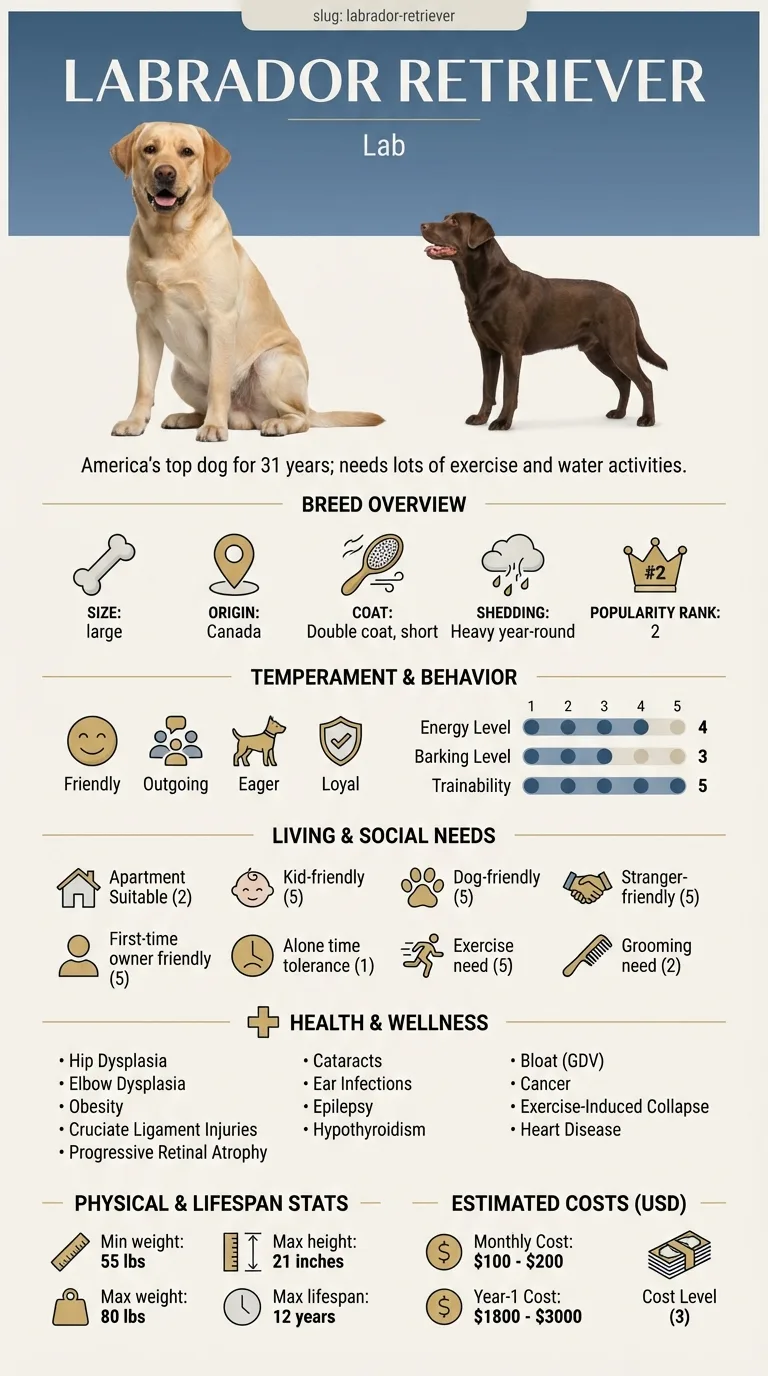
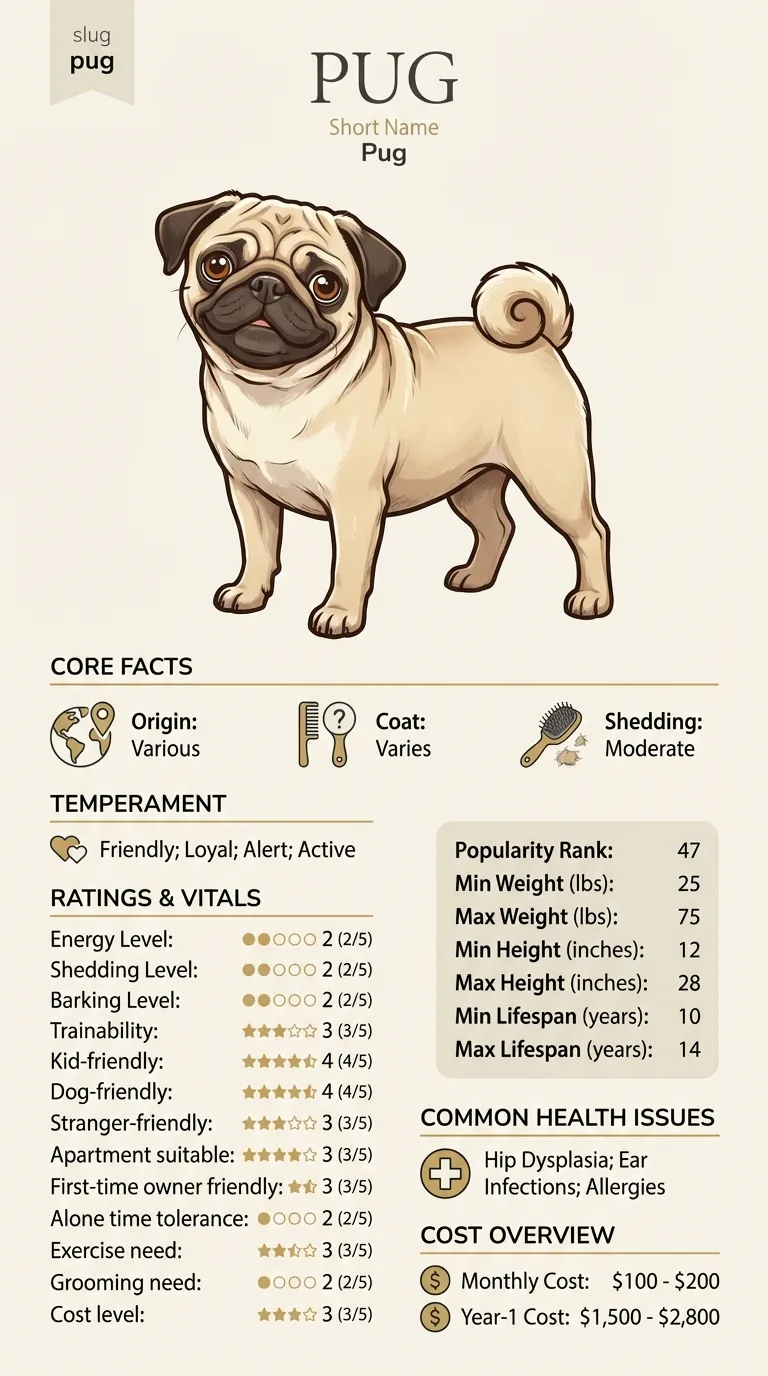
This is for someone already down to Labrador Retriever and Pug and deciding between them. For this pair the decision usually turns on exercise need and apartment suitability, so those are covered first and in most detail. Anyone choosing from a flat has a clear answer here: Pug rates 5/5 against 2/5. The focus throughout is on daily consequences rather than breed background.
Between Labrador Retriever and Pug, exercise need is what separates them, and Pug is the lower-effort dog of the two to keep.
Choose Labrador Retriever if you already have another dog, you want a dog that picks up training quickly and you want a dog that can keep up with an active routine.
Choose Pug if you are in a flat or a smaller home, your walking routine is modest and a smaller dog suits your car, your home or your back.
| Feature | labrador retriever | pug | Winner |
|---|---|---|---|
| Size class | large | small | Equal |
| Weight | 55–80 lbs | 14–18 lbs | Equal |
| Height | 21–24 in | 10–13 in | Equal |
| Lifespan | 10–12 years | 13–15 years | pug |
| Exercise need | Very high (5/5) | Low (2/5) | pug |
| Grooming need | Low (2/5) | Low (2/5) | Equal |
| Shedding | High (4/5) | High (4/5) | Equal |
| Energy level | High (4/5) | Low (2/5) | Equal |
| Barking | Moderate (3/5) | Low (2/5) | pug |
| Apartment suitability | Low (2/5) | Very high (5/5) | pug |
| Good for first-time owners | Very high (5/5) | Very high (5/5) | Equal |
| Tolerates being alone | Very low (1/5) | Low (2/5) | pug |
| Trainability | Very high (5/5) | Moderate (3/5) | labrador retriever |
| Good with kids | Very high (5/5) | Very high (5/5) | Equal |
| Good with other dogs | Very high (5/5) | High (4/5) | labrador retriever |
| Friendly to strangers | Very high (5/5) | Very high (5/5) | Equal |
| Cost level | Moderate (3/5) | Moderate (3/5) | Equal |
| Coat | Double coat, short | Short, smooth double coat | Equal |
| Origin | Canada | Various | Equal |
| Typical monthly cost | $100–$200 | $80–$150 | Equal |
| Typical first-year cost | $1,800–$3,000 | $1,100–$2,300 | Equal |
The Pug is a small breed through and through, 14-18 lbs and 10-13 inches, against the Lab's 55-80 lbs and 21-24 inches. You're looking at roughly a quarter of the weight and half the height. Anyone picturing small dog, big dog as their deciding factor has an easy read here.
This is where the two breeds really part ways. The Lab rates a maximum 5/5 for exercise need; the Pug sits at a low 2/5, and energy level tells the same story, 4/5 versus 2/5. A short, flat-faced breed like the Pug simply isn't built for the kind of activity a Lab expects, and pushing it too hard isn't advisable given its build.
Grooming ties at a low 2/5 for both, easy coats to maintain either way. Shedding also ties, both at a heavy 4/5, which surprises some people expecting the short-haired Pug to shed less. It doesn't; short coats can shed just as much as longer ones, just in finer, harder-to-see hairs.
The Pug rates a maximum 5/5 for apartment suitability against the Lab's low 2/5, and it barks less too, 2/5 versus 3/5. Between the low exercise need and the quiet, small footprint, the Pug reads as the far easier small-space dog on paper, provided you can manage its brachycephalic breathing in warm weather.
Both breeds suit first-time owners equally, tied at a full 5/5, though the Lab trains somewhat more readily, 5/5 versus the Pug's moderate 3/5. Pugs are food-motivated and generally easygoing, which makes up for some stubbornness, but don't expect the same crisp obedience-class performance a Lab tends to deliver.
Kids and strangers both tie at a perfect 5/5, a strong showing for the Pug given its size. The Lab edges ahead slightly with other dogs, 5/5 versus 4/5, but this is one of the more evenly matched categories across this whole comparison.
This is the Pug's real trade-off. It outlives the Lab, 13-15 years against 10-12, but its five listed conditions, brachycephalic airway syndrome, pug dog encephalitis, corneal ulcers, hemivertebrae, obesity, are almost entirely tied to its flat-faced build and share no overlap with the Lab's list. Breathing and eye issues need active management throughout its life.
Cost level ties at moderate (3/5), and the Pug actually runs cheaper on paper, $80-$150 monthly and $1,100-$2,300 first-year, against the Lab's $100-$200 and $1,800-$3,000. Worth noting: brachycephalic breeds like the Pug can carry higher vet costs than the sticker price implies, since airway and eye issues often mean specialist visits.
Labrador Retriever weighs 55–80 lbs and lives 10–12 years; Pug weighs 14–18 lbs and lives 13–15 years. The two diverge most on exercise need, apartment suitability and energy level and 1 other rated axes. They are level on cost level, good for first-time owners and grooming need, so those cannot decide it. The table below marks a winner only where one breed is genuinely easier for a typical owner; size and origin are facts rather than merits and stay level. Ratings come from one source applied to both breeds, so they are meaningful against each other rather than as absolute scores.

Considerably, 14-18 lbs versus 55-80 lbs, roughly a quarter of the weight.
The Pug, clearly, rated 2/5 against the Lab's maximum 5/5. Its flat-faced build also means you shouldn't push it hard in heat.
They're actually tied, both rated 4/5. The Pug's short coat sheds just as much as the Lab's, in finer hairs.
Yes, tied with the Lab at 5/5 for first-time-owner suitability.
The Pug, clearly, 5/5 versus the Lab's 2/5, and it barks less too.
No, not on the data given. The Pug's conditions are almost entirely tied to its brachycephalic build, airway syndrome, eye issues, spinal problems, none of which appear on the Lab's list.
The Pug, typically 13-15 years against the Lab's 10-12.
The Pug for small-space, lower-exercise households; the Lab for active owners who want a dog that can keep up outdoors.
Pug averages $80-$150; Lab averages $100-$200, though brachycephalic vet visits can push the Pug's real costs higher than the sticker range.
Lab rates a maximum 5/5; Pug rates a low 2/5, a genuinely different daily commitment.
The Pug, typically 13-15 years against the Lab's 10-12.
See every pug comparison.
Secure checkout on Stripe. We never see your card.
7-day money-back guarantee. Instant access.
Health information here is general and is not veterinary advice. If your dog shows pain, sudden behaviour change, or worsening symptoms, consult a licensed veterinarian.
Some links on this site are affiliate links. We may earn a commission at no extra cost to you, and we only suggest products we believe are helpful for dog owners.
We research and check what we publish, but we do not warrant that any figure, date, price, or statement is accurate, complete, or current, and we accept no liability for any loss, cost, injury, or other harm arising from the use of this site. Use it as one reference among several. You remain responsible for your own decisions and for your dog's care - confirm anything that matters with a licensed veterinarian or another qualified professional before you act on it. Full disclaimer.
Match your lifestyle to the right dog.
Take quizNot sure which breed is right for you? Take our 2-minute quiz to find out.
Take the quiz