Health
What's a classic sign of OCD in a Lab puppy?
Sudden lameness on one leg, often the front, appearing without an obvious injury during the rapid growth period of four to eight months old.

Quick answer
What's a classic sign of OCD in a Lab puppy?
Sudden lameness on one leg, often the front, appearing without an obvious injury during the rapid growth period of four to eight months old.
A Lab puppy that suddenly starts limping on one front leg after a normal play session, with no obvious injury, is describing a classic OCD presentation — cartilage that's failed to convert to bone properly during a growth spurt, not a sprain that will simply heal with a few days of rest.
Owners of large-breed puppies between four and twelve months old who notice sudden lameness that doesn't fit an obvious injury story, and owners managing a growing dog's exercise trying to balance activity against joint development.
This guide is not medical advice. If your dog shows pain, sudden behavior change, or worsening symptoms, consult a licensed veterinarian.
Some links may be affiliate links. We may earn a commission at no extra cost to you. We only suggest products we believe are helpful for dog owners.
Osteochondritis dissecans is a developmental joint condition in growing large-breed puppies, including Labrador Retrievers, where cartilage fails to convert to bone properly during a growth spurt, sometimes forming a flap that detaches and causes pain, instability, and sudden lameness. It typically appears between four and eight months old, most commonly in the shoulder, and treatment ranges from rest to arthroscopic surgery depending on severity.
OCD is a well-recognized condition in large, fast-growing breeds generally, including Labradors, common enough that vets routinely consider it when a young large-breed puppy presents with sudden, unexplained lameness.
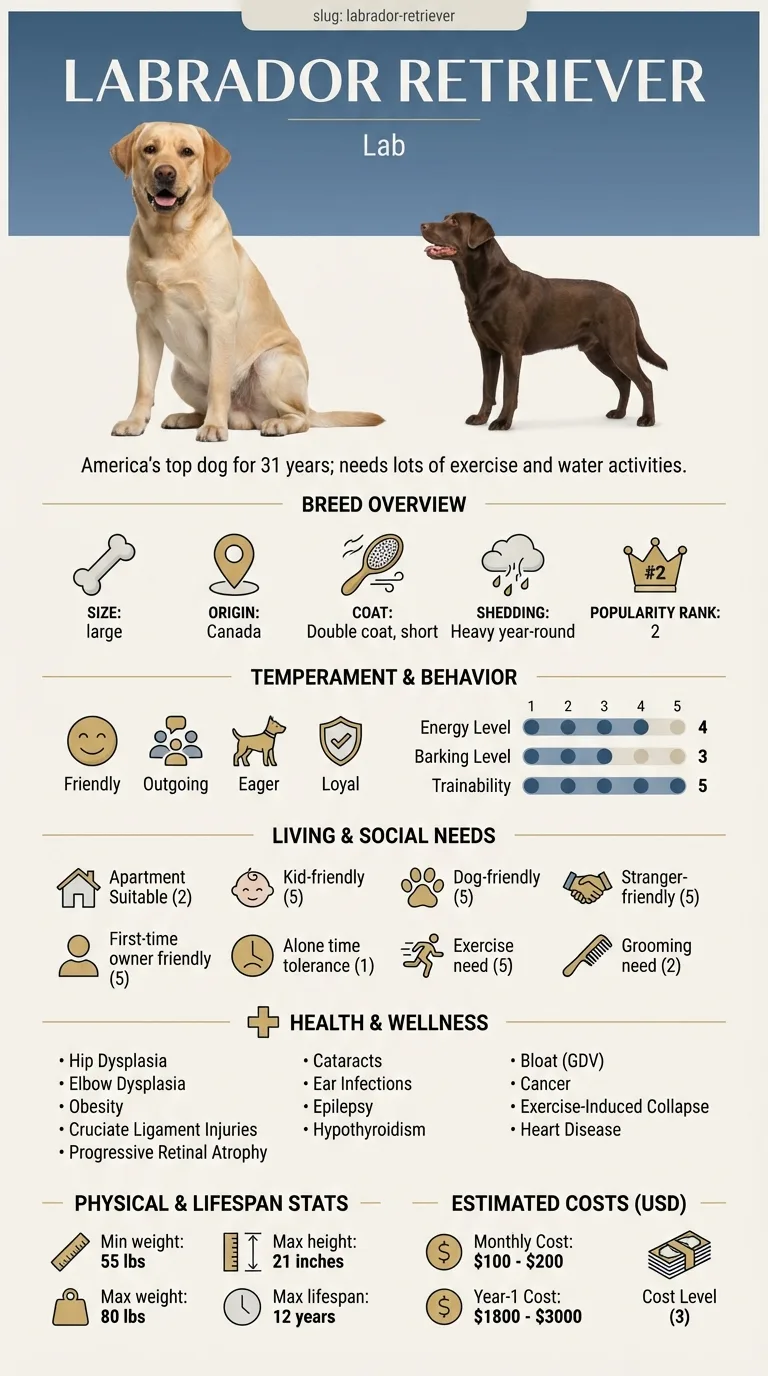
As a large breed reaching 55 to 80 pounds with an exercise need rated near the top of the scale, Labrador puppies grow quickly and put real mechanical stress on developing joints during that growth period, which creates the conditions where a cartilage conversion abnormality is more likely to become clinically apparent. Genetic predisposition toward the underlying cartilage development issue is also documented in the breed.
Overly rich, calorie-dense diets that accelerate growth rate beyond what's optimal for joint development are a significant environmental contributor, as is high-impact exercise like repeated jumping during the vulnerable growth window before joints are fully mature.
See a vet promptly for any sudden lameness in a young, large-breed puppy, especially one that doesn't resolve within a day or two of rest — OCD generally isn't a wait-and-see condition, since early diagnosis and treatment improve long-term joint outcomes.
See all Labrador Retriever health problems, which breeds are prone to osteochondritis dissecans ocd, or the full Labrador Retriever breed guide for temperament, exercise needs and ownership costs.
Diagnosis typically involves an X-ray appointment, sometimes followed by a specialist referral for more advanced imaging or arthroscopy. Non-surgical rest trials run six to eight weeks; surgical recovery typically involves several weeks of restricted activity followed by gradual rehabilitation.
Success means resolved lameness and a stable, functional joint going forward, though some dogs may develop mild arthritis in the affected joint later in life, particularly with more severe or delayed-diagnosis cases — a realistic, not overly optimistic, long-term picture.
During normal growth, cartilage at the ends of long bones gradually converts to bone as a puppy matures. In OCD, a section of this cartilage fails to convert properly and instead develops abnormally, sometimes forming a flap that can partially or fully detach from the underlying bone. This creates joint instability, inflammation, and pain, and if a cartilage fragment breaks loose entirely, it can float within the joint as what's sometimes called a 'joint mouse,' causing intermittent catching and worsening discomfort.
The shoulder is the most commonly affected joint in Labradors, though OCD can also occur in the elbow, hock, or knee. It typically develops during the rapid growth period of four to eight months old, and rapid growth itself — fueled by rich, high-calorie puppy food or genetics predisposing toward fast growth — is a documented contributing factor, alongside the underlying genetic predisposition toward the cartilage abnormality itself.
Diagnosis usually involves X-rays, sometimes supplemented with CT or arthroscopy for a clearer view of cartilage flaps that plain X-rays can miss, particularly in early or subtle cases. This matters because treatment decisions — rest versus surgical removal of the cartilage flap — depend heavily on how clearly the lesion can actually be visualized and characterized.

The right path depends on lesion size, joint involved, and whether the cartilage has already detached — here's the general decision pattern vets use.
Six-month-old Lab puppy Scout suddenly wouldn't put weight on his front-right leg one morning, with no obvious injury the night before. His owner, Marcus, initially assumed a sprain from rough play with the neighbor's dog, but the limp hadn't improved after two days of rest. X-rays showed a classic OCD lesion in the shoulder. Given the flap appeared partially detached, Scout's vet recommended arthroscopic surgery rather than a longer rest trial. Six weeks of structured rehabilitation followed, and by eight months old Scout was back to normal activity with no lingering lameness, though his vet noted mild early joint changes that will be worth monitoring as he ages.
Key takeaway: Sudden puppy lameness with no clear injury story, especially in a large breed during the rapid growth months, deserves an X-ray rather than a wait-and-see rest period — OCD responds better to earlier treatment.
It's a condition where cartilage at the end of a growing bone fails to convert to normal bone properly, sometimes forming a flap that partially or fully detaches, causing joint pain, instability, and lameness, typically in young, fast-growing large-breed dogs.
Most cases appear during the rapid growth period between four and eight months old, though it can occasionally be diagnosed slightly outside this range depending on individual growth patterns.
The shoulder is the most commonly affected joint in this breed, though OCD can also occur in the elbow, hock, or knee.
Not entirely, since genetics play a role, but feeding a controlled-growth large-breed puppy formula rather than a calorie-dense adult or generic puppy food, and avoiding excessive high-impact exercise during the rapid growth period, can reduce severity risk.
Not always — some mild cases in very young puppies are managed with strict rest first, but moderate to severe cases, especially with a detached cartilage fragment, generally respond more reliably to arthroscopic surgical removal.
Arthroscopic surgery to remove a cartilage flap typically runs $2,500–$4,500 depending on the joint involved and regional specialist pricing.
Some degree of arthritis in the affected joint is a realistic long-term possibility, particularly if there was a delay in diagnosis and treatment, which is part of why prompt attention to sudden puppy lameness matters.
Sudden lameness on one leg, often the front, appearing without an obvious injury during the rapid growth period of four to eight months old.
The shoulder is the most commonly affected joint in this breed.
Typically $2,500–$4,500 depending on the joint involved and specialist pricing.
Yes — overly rich, calorie-dense diets that cause rapid growth are a documented contributing factor alongside genetics.
Not always — some mild, early cases in very young puppies are managed with strict rest first, though many moderate to severe cases respond better to surgery.
A one-page prep sheet for this condition: the signs, the questions to ask, what to get priced. Unlocks here.
You get: Vet visit prep sheet
No spam. One-click unsubscribe. See our privacy policy.
Preview page 1 before you decide.