Health
What age does OCD typically appear?
Most commonly between four and eight months old, during the fastest part of the growth spurt.

Quick answer
What age does OCD typically appear?
Most commonly between four and eight months old, during the fastest part of the growth spurt.
A young Akita that's suddenly lame in a front leg after a growth spurt, with no obvious injury to point to, may be dealing with a cartilage flap that's come loose inside the joint.
Owners of Akita puppies between four and eight months, especially larger, faster-growing males, are the ones who typically encounter this first.
This guide is not medical advice. If your dog shows pain, sudden behavior change, or worsening symptoms, consult a licensed veterinarian.
Some links may be affiliate links. We may earn a commission at no extra cost to you. We only suggest products we believe are helpful for dog owners.
We research and check what we publish, but we do not warrant that any figure, date, price, or statement is accurate, complete, or current, and we accept no liability for any loss, cost, injury, or other harm arising from the use of this site. Use it as one reference among several. You remain responsible for your own decisions and for your dog's care - confirm anything that matters with a licensed veterinarian or another qualified professional before you act on it. Full disclaimer.
Check this first
A puppy that suddenly refuses to use a front leg at all, or that shows obvious pain when the shoulder is manipulated, should be seen promptly. While OCD itself develops gradually, the point at which a cartilage flap detaches can cause a sudden, noticeable increase in pain and lameness.
More commonly, OCD shows up as a persistent, gradually worsening lameness in one front leg during the growth spurt — not usually a dramatic sudden event, but also not something that resolves with a few days of rest the way simple overexertion soreness would.
The key signal for scheduling an exam rather than waiting is duration: lameness in a growing puppy that persists more than a few days, or that worsens with continued activity, warrants X-rays to check for OCD or another developmental joint condition.
If any of these apply, call your vet or an emergency clinic now. The rest of this page is for the cases that are not an emergency.
Osteochondritis dissecans is a developmental cartilage condition where a piece of joint cartilage fails to properly attach to the underlying bone and can eventually separate, most often in the shoulder of large, fast-growing breeds. It typically shows up as unexplained lameness in a puppy during its fastest growth period.
OCD is well recognized in large and giant breeds as a consequence of rapid growth, and while individual prevalence varies by bloodline, it's common enough in fast-growing large breeds that vets routinely consider it when a young, large-breed dog develops unexplained front-leg lameness.
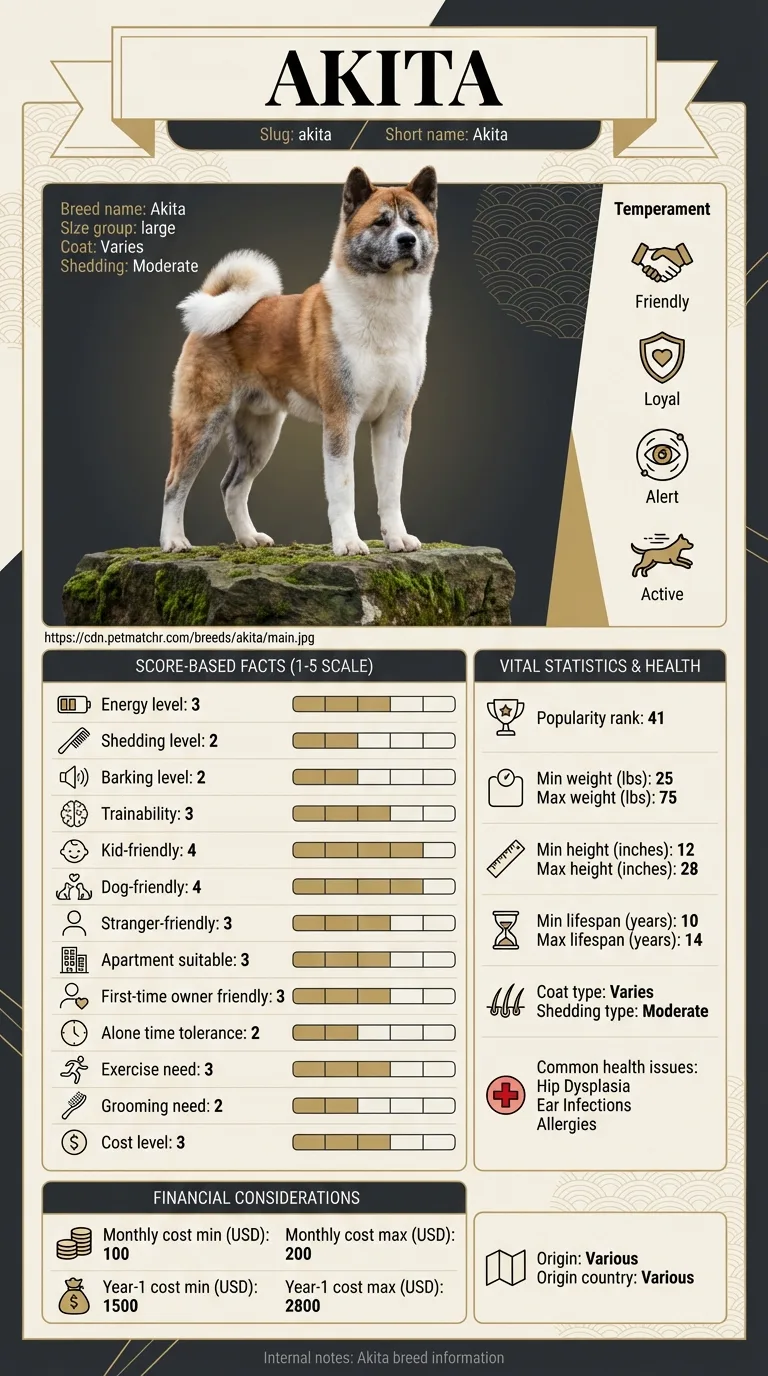
The Akita's rapid growth rate, reaching much of its adult size of 70 to 130 pounds within the first year, puts real developmental stress on cartilage that needs time to properly convert to bone. This speed is precisely the mechanism believed to underlie OCD in large breeds generally, and the Akita's growth curve places it among the breeds where this risk is meaningfully elevated.
Overfeeding, excess calcium, and high-impact exercise during the growth window all add mechanical or nutritional stress that can worsen cartilage development problems already in progress. A controlled-growth large-breed diet and appropriately paced exercise reduce how much additional stress compounds an underlying developmental vulnerability.
Schedule an exam for any front-leg lameness in a growing puppy that lasts more than a few days or worsens with activity. Seek same-day care if the puppy suddenly won't use the leg at all or shows sharp pain when the shoulder is handled.
A few common choices during the growth window make this cartilage condition more likely or more severe. Avoid these.
See all Akita health problems, which breeds are prone to osteochondritis dissecans ocd, or the full Akita breed guide for temperament, exercise needs and ownership costs.
Small lesions managed with rest alone often improve within 6 to 8 weeks of strict activity restriction. Surgically treated cases typically show good use of the limb within a similar timeframe, with full recovery and return to normal activity over two to three months.
Success is a dog that grows into an adult with a comfortable, even gait and full use of the affected limb, even if some long-term joint monitoring remains part of routine care.
Cho's Akita puppy Titan was a big, fast-growing five-month-old in Raleigh when he suddenly started limping on his right front leg after a normal play session, with no fall or obvious injury Cho could point to. The limp didn't improve over three days of rest. X-rays at the vet revealed a cartilage lesion in Titan's shoulder consistent with OCD. Given the size of the lesion, the vet recommended arthroscopic surgery to remove the loose cartilage flap. Titan recovered well over about ten weeks of restricted activity and has had no recurring lameness since, now back to full off-leash exercise.
Key takeaway: Unexplained lameness in a fast-growing puppy is worth prompt imaging — catching OCD before a cartilage flap fully detaches generally means a smoother, more predictable recovery.
The shoulder is the most commonly affected joint in large-breed dogs, though OCD can also occur in the elbow, hock, or knee.
X-rays often show the characteristic flattened or irregular joint surface, though some cases require a CT scan or arthroscopy to fully characterize the size and location of the cartilage flap.
Not necessarily — some small, early lesions improve with strict rest and activity restriction alone, but larger or detached cartilage flaps generally have better outcomes with arthroscopic surgical removal.
Arthroscopic surgery for shoulder OCD commonly runs from roughly $2,500 to $5,000 depending on the joint involved, the surgeon, and the region.
Many dogs return to full, comfortable function after appropriate treatment, though some develop mild secondary arthritis in the affected joint over the long term.
It can't be entirely prevented since it has a genetic and developmental component, but a controlled-growth diet and avoiding excessive high-impact exercise during puppyhood reduce the mechanical stress that contributes to it.
Panosteitis is inflammation within the long bones that causes shifting-leg lameness and resolves on its own, while OCD is a specific cartilage defect within a joint that often needs targeted treatment rather than simply resolving with time.
Most commonly between four and eight months old, during the fastest part of the growth spurt.
The shoulder is the most common site in large breeds, though other joints can be affected.
Diagnostic imaging runs a few hundred dollars; arthroscopic surgery typically costs $2,500 to $5,000.
Yes — limit to short leash walks and avoid jumping or running until your vet has evaluated the joint.
Yes — calm, low-impact obedience work is fine and helps keep an active puppy engaged during activity restriction.
A one-page prep sheet for this condition: the signs, the questions to ask, what to get priced. Unlocks here.
You get: Vet visit prep sheet
No spam. One-click unsubscribe. See our privacy policy.
Preview page 1 before you decide.