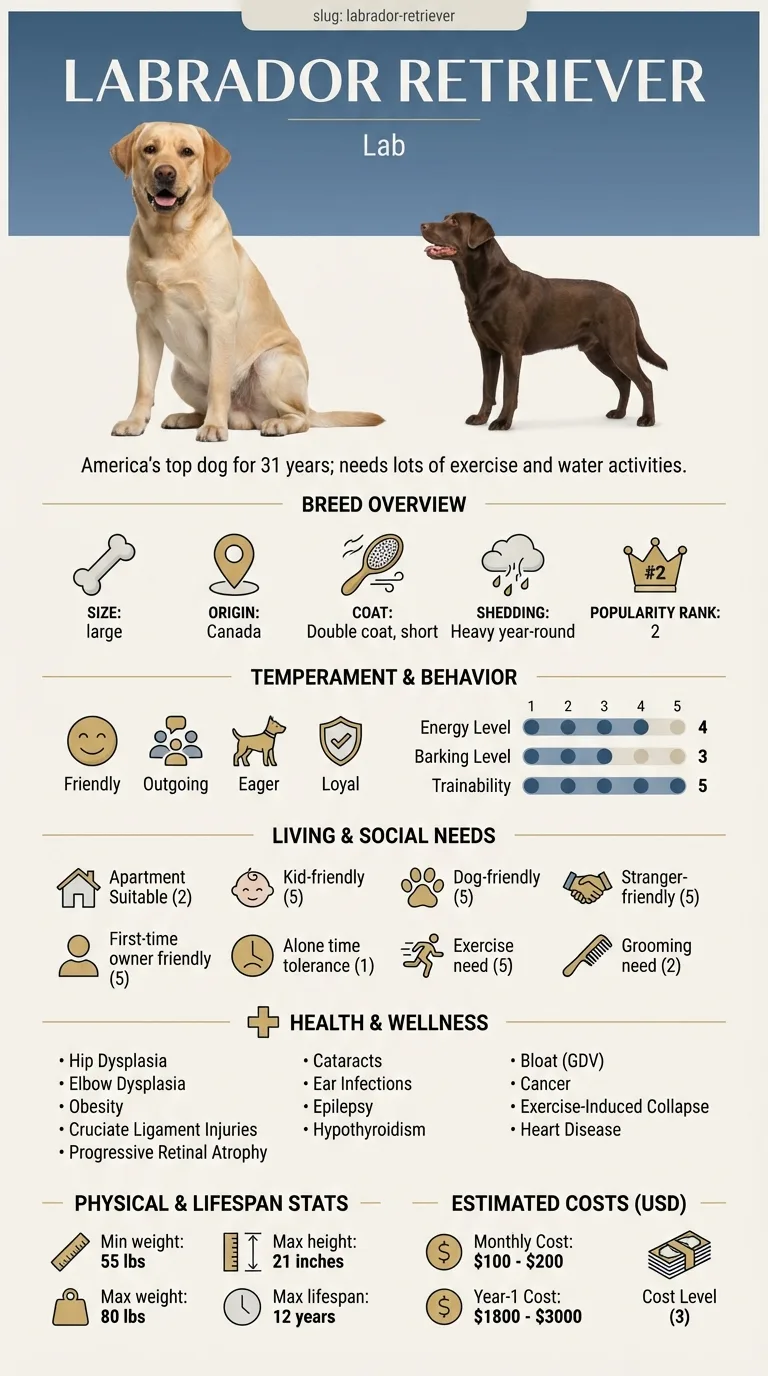
Is my Lab's constant hunger just bad behavior?
Not necessarily; a documented gene mutation present in about a quarter of Labradors genuinely disrupts normal fullness signaling, making it a real physiological factor rather than simple misbehavior.
Quick answer
Is my Lab's constant hunger just bad behavior?
Not necessarily; a documented gene mutation present in about a quarter of Labradors genuinely disrupts normal fullness signaling, making it a real physiological factor rather than simple misbehavior.
Roughly one in four Labradors carries a mutation that makes them feel measurably hungrier after eating than dogs without it, which reframes "just needs more willpower" into a real physiological difference worth managing directly.

Every Labrador owner benefits from understanding this, but it matters most for owners of dogs that seem insatiably food-driven, beg constantly, or have struggled with weight despite what seems like reasonable portion control.
This guide is not medical advice. If your dog shows pain, sudden behavior change, or worsening symptoms, consult a licensed veterinarian.
Some links may be affiliate links. We may earn a commission at no extra cost to you. We only suggest products we believe are helpful for dog owners.
We research and check what we publish, but we do not warrant that any figure, date, price, or statement is accurate, complete, or current, and we accept no liability for any loss, cost, injury, or other harm arising from the use of this site. Use it as one reference among several. You remain responsible for your own decisions and for your dog's care - confirm anything that matters with a licensed veterinarian or another qualified professional before you act on it. Full disclaimer.
A documented mutation in the POMC gene, present in roughly a quarter of Labrador Retrievers, disrupts normal signaling that tells the brain a dog has eaten enough, making affected dogs genuinely hungrier rather than simply more food-motivated by temperament. This directly explains why obesity is separately documented as one of this breed's most common health concerns, and why weight management connects to nearly every other major condition covered in this breed's health profile.
Directly documented and specifically researched in this breed, with the POMC mutation present in an estimated one in four Labradors in studied populations, making genetically driven food motivation a real, common, and identifiable factor rather than a vague breed stereotype.
Obesity is directly documented as one of Labrador Retrievers' most common health concerns, and the POMC gene mutation, specifically researched and documented in this breed, provides a genuine physiological explanation: affected dogs' brains don't receive normal fullness signals, making them measurably hungrier than dogs without the mutation regardless of how much they've actually eaten.
Free-feeding, imprecise portions, frequent treats and table scraps, and insufficient exercise all compound a genetic hunger predisposition into actual excess weight. A household that responds to a POMC-positive dog's persistent begging with extra food, rather than recognizing it as a physiological signal to manage rather than satisfy, drives the most significant real-world weight gain.
Talk to your vet about a structured weight-management plan if your dog is above ideal body condition, or about genetic testing if you want to understand your dog's specific food-motivation baseline. Regular weigh-ins at routine vet visits help catch gradual weight creep before it becomes significant.
See all Labrador Retriever health problems, which breeds are prone to genetic predisposition to obesity, or the full Labrador Retriever breed guide for temperament, exercise needs and ownership costs.
Weight loss in an overweight dog typically proceeds safely at about one to two percent of body weight per week under veterinary guidance, meaning a meaningful weight-loss plan can take two to four months depending on how much needs to come off.
Success looks like a dog maintained at a healthy weight through deliberate, consistent portion control, understanding that a POMC-positive dog will likely always feel hungrier than average and will need this management as a permanent, not temporary, part of its care.
Research published by Cambridge University geneticists identified a mutation in the POMC gene present in a substantial minority of Labrador Retrievers, estimated at around one in four dogs in some study populations. This gene is involved in producing the signals that tell the brain a dog has eaten enough. Dogs carrying the mutation have a disrupted version of this signaling, meaning they genuinely feel hungrier and are more strongly motivated by food than dogs without the mutation, even after eating a normal, appropriate meal. This isn't a training or willpower issue for the dog, and importantly, it isn't an owner's failure either, it's a real, documented physiological difference that directly explains why this breed's already well-known food drive tips into genuine obesity risk for so many individual dogs.
Obesity is separately and directly documented as one of Labrador Retrievers' most common health concerns, and understanding the POMC connection explains why: for a meaningful share of this breed, food drive isn't primarily behavioral, it's genetic. That matters practically because excess weight in this breed connects directly to several other documented conditions covered throughout this breed's health profile, arthritis, cruciate ligament injuries, diabetes risk, and increased cardiac workload all become measurably more likely with sustained excess weight. Recognizing that a POMC-positive dog needs deliberate portion control precisely because its hunger signals are unreliable, not because it lacks discipline, is the honest, useful starting point for managing this breed's single most consequential controllable health factor.

Pepper's owner had always joked that her Labrador had a bottomless stomach, since Pepper begged relentlessly even minutes after finishing a full meal, and had steadily gained weight despite what seemed like reasonable portions. A genetic panel run out of curiosity confirmed Pepper carried two copies of the POMC mutation, explaining her seemingly endless hunger as a real physiological trait rather than simple greediness or a training failure. With that understanding, Pepper's owner switched to a strict, scale-measured feeding routine split across three meals, using a portion for training rewards, and stopped responding to begging with extra food. Pepper lost the twelve pounds she'd gained over eighteen months of consistent management, and her owner no longer takes the constant begging personally.
Key takeaway: A Labrador's intense food drive can be a genuine, documented genetic trait rather than a behavioral shortcoming, and understanding that reframes weight management as deliberate physiological accommodation rather than a battle of willpower.

A documented genetic mutation, identified through Cambridge University research, present in roughly a quarter of Labrador Retrievers, that disrupts the normal signaling telling the brain a dog has eaten enough, making affected dogs genuinely hungrier than dogs without the mutation.
Yes, a DNA test for this specific mutation is commercially available and often included in comprehensive breed health panels, giving useful information for tailoring feeding and weight management.
It's possible, though not certain without testing. Strong, persistent food motivation despite regular meals is a pattern consistent with the mutation, but only a genetic test confirms it definitively.
Yes, it's directly and separately documented as one of this breed's most common health issues, and the POMC mutation is a major, well-researched explanation for why this breed struggles with weight more than many others.
Strict, measured portion control based on ideal body weight rather than appetite cues, using a kitchen scale rather than eyeballing, splitting the daily allowance into multiple small meals, and using a portion of that allowance for training treats rather than adding extras.
Indirectly, yes. Sustained excess weight connects to several other documented conditions in this breed, including arthritis, cruciate ligament injuries, and increased diabetes and cardiac risk, making weight management a meaningfully protective factor across multiple systems.
Yes, with deliberate, consistent portion control and exercise, POMC-positive dogs can absolutely maintain a healthy weight, it typically just requires more intentional management than it might for a dog without the mutation.
Not necessarily; a documented gene mutation present in about a quarter of Labradors genuinely disrupts normal fullness signaling, making it a real physiological factor rather than simple misbehavior.
Yes, a DNA test for the POMC mutation is commercially available and often included in comprehensive breed health panels.
Yes, directly to arthritis, cruciate injuries, diabetes risk, and cardiac workload, all of which are worsened by sustained excess weight.
Measure portions precisely with a kitchen scale based on ideal weight, split meals throughout the day, and use part of the daily allowance for training treats rather than adding extras.
Yes, given how many other documented health conditions in this breed are directly worsened by excess weight, it's arguably the single most impactful controllable health factor an owner manages.
A one-page prep sheet for this condition: the signs, the questions to ask, what to get priced. Unlocks here.
You get: Vet visit prep sheet
No spam. One-click unsubscribe. See our privacy policy.
Preview page 1 before you decide.