Health
Is the POMC gene mutation a real Bichon Frise trait?
No, it was characterized in Labrador and Flat-Coated Retrievers. It is not documented as a Bichon Frise finding, even though commercial panels may still test for it.

Quick answer
Is the POMC gene mutation a real Bichon Frise trait?
No, it was characterized in Labrador and Flat-Coated Retrievers. It is not documented as a Bichon Frise finding, even though commercial panels may still test for it.
A panel result naming a specific appetite-gene mutation sounds definitive. For this breed, the honest answer is more complicated than the test result implies.
This affects owners who have run a commercial genetic panel on their Bichon Frise and received a result mentioning the POMC gene, and are trying to work out whether it explains their dog's weight or appetite.
This guide is not medical advice. If your dog shows pain, sudden behavior change, or worsening symptoms, consult a licensed veterinarian.
Some links may be affiliate links. We may earn a commission at no extra cost to you. We only suggest products we believe are helpful for dog owners.
We research and check what we publish, but we do not warrant that any figure, date, price, or statement is accurate, complete, or current, and we accept no liability for any loss, cost, injury, or other harm arising from the use of this site. Use it as one reference among several. You remain responsible for your own decisions and for your dog's care - confirm anything that matters with a licensed veterinarian or another qualified professional before you act on it. Full disclaimer.
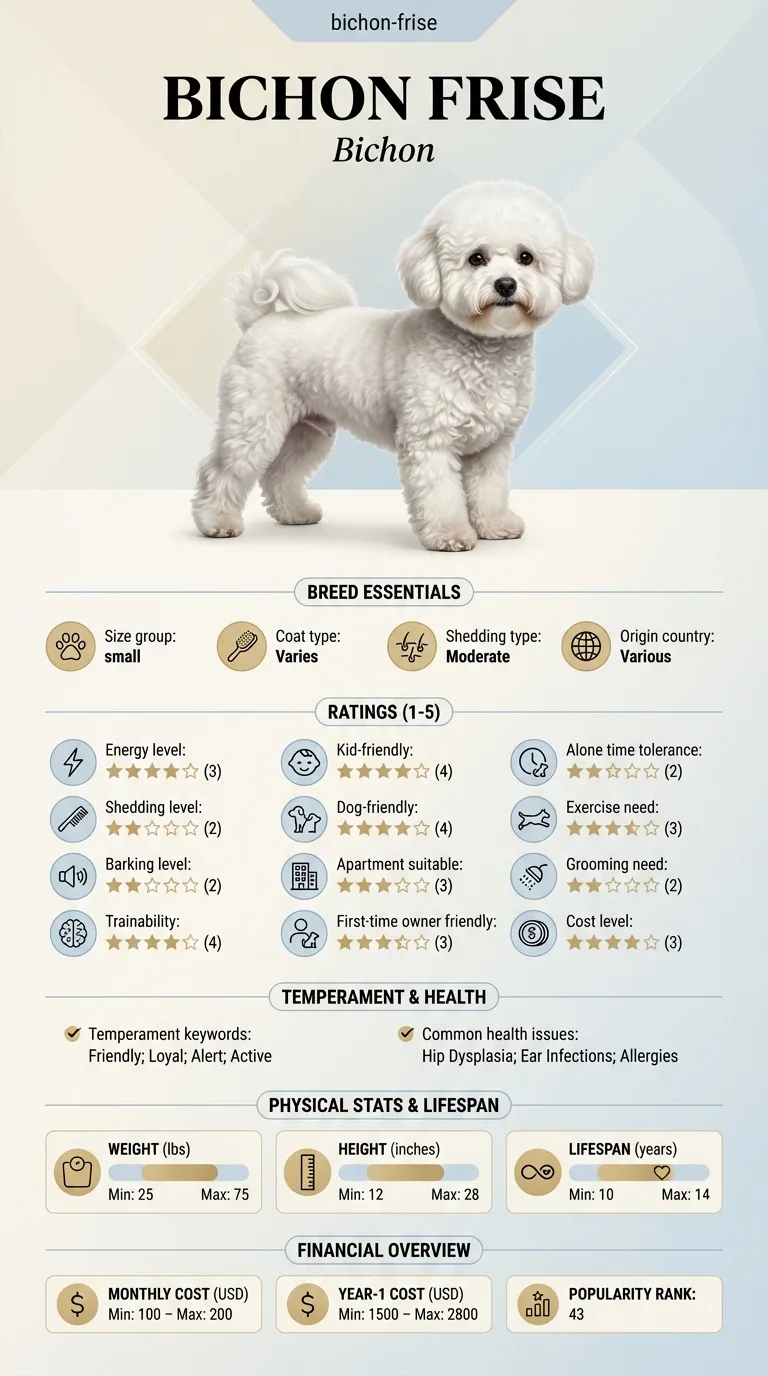
The POMC gene mutation linked to increased appetite and obesity risk was characterized in Labrador Retrievers and Flat-Coated Retrievers, not the Bichon Frise. A commercial genetic panel can still flag this breed for the marker, but that flag reflects broad screening rather than a confirmed breed finding. The breed's genuine weight risk is straightforward: a modest exercise need combined with a small body size.
Weight gain itself is a common, practical risk in this breed given its size and exercise profile. The specific POMC gene variant, however, is not documented as occurring meaningfully in the Bichon Frise population, regardless of how often panels flag it.
No obesity-related gene variant is documented for the Bichon Frise. The POMC mutation appearing on some panel results was validated in a different breed's population entirely. The breed's genuine, documented weight risk comes from its modest exercise need and small mature size, which together mean small excess calories have an outsized proportional effect.
Households that free-feed, offer frequent treats, or do not measure portions consistently make it easy for a small dog with a modest activity requirement to gain weight steadily without anyone noticing day to day.
Talk to your vet if your dog seems persistently hungry beyond what portion adjustments address, or if weight climbs despite consistent measured feeding, since these patterns deserve a proper workup rather than assumption based on an unconfirmed genetic marker.
See all Bichon Frise health problems, which breeds are prone to genetic predisposition to obesity, or the full Bichon Frise breed guide for temperament, exercise needs and ownership costs.
Consistent portion control and activity typically produce measurable weight change within four to eight weeks, tracked through monthly weigh-ins.
Success looks like a stable, appropriate weight maintained through measured feeding, not a genetic explanation confirmed or ruled out, since no such confirmed explanation currently exists for this breed.
The POMC gene mutation linked to increased appetite and obesity risk was identified and validated in Labrador Retrievers and the closely related Flat-Coated Retriever, where a specific deletion disrupts the production of appetite-regulating hormones, leaving affected dogs persistently hungrier than littermates without the variant. That research is well established for those two breeds specifically.
The Bichon Frise is not a breed in which this variant has been characterized, and no documented obesity-gene predisposition of any kind appears on this breed's health record. A panel flagging a Bichon Frise for this marker is testing for a mutation validated in a different breed's population, and a result should be read with that context rather than treated as a confirmed, breed-relevant finding.
Broad genetic panels typically screen every submitted sample against the same library of known variants, regardless of whether that variant has been established in the submitting dog's specific breed. This is useful for catching genuinely relevant findings in mixed-breed dogs or in breeds with limited individual research, but it also means a purebred Bichon Frise can receive a flag for a marker that has simply never been shown to behave the same way, or occur at meaningful frequency, in this breed's population at all.

Setting the POMC question aside, this breed does carry a genuine, documented profile that makes weight gain easy regardless of any single gene: a modest exercise requirement rated toward the low end, and a small mature body size of just 12 to 18 pounds. At that scale, a handful of extra calories a day, an extra treat here and there, produces a proportionally large weight gain compared to the same habit in a much larger dog. This is a straightforward calorie-and-activity mechanism, not a hormonal appetite disorder, and it applies whether or not a genetic panel ever mentions POMC at all.
If you think your Bichon has genetic predisposition to obesity, the plan is three steps: write down what you have seen and when it started, book a veterinary appointment rather than waiting for the next flare, and take video of the behaviour or symptom before you go — the thing you are worried about rarely happens in the consulting room. Screening in the parents covers skin allergies, patellar luxation, bladder stones.
What the vet visit should produce is a diagnosis and a written plan, not just reassurance: what is being ruled out, what the monitoring interval is, and which signs mean you come back sooner. Ask what the treatment costs across a year rather than per visit, because that is the number that decides whether you are managing this condition or reacting to it.
Between appointments, keep a short log — dates, what you saw, what changed. It is the single most useful thing an owner brings to a follow-up, and for genetic predisposition to obesity it is often what separates a clear pattern from a guess.
When Otis's owner ran a comprehensive genetic panel out of general curiosity, the result flagged the POMC appetite gene, and a quick search online turned up alarming information about obesity risk in dogs carrying it. Otis had always been food-motivated, and his owner assumed the mystery was solved. At his next checkup, the vet explained that the variant had been established in Labrador Retrievers specifically, and that no research supported it behaving the same way, or occurring at any meaningful rate, in Bichon Frises. Otis's actual weight history was reviewed instead: steady portions, but treats that had crept up over the past year without anyone tracking them. Cutting treats back to a measured daily allowance brought Otis back to a healthy weight over two months, with the genetic flag turning out to be a red herring rather than the explanation.
Key takeaway: A specific gene name on a panel result can feel like a complete answer, but for this breed the POMC flag reflects a variant characterized elsewhere, and the dog's actual weight gain usually has a simpler, calorie-based explanation.
No. It was identified and validated in Labrador Retrievers and Flat-Coated Retrievers. The Bichon Frise is not a breed in which this variant has been characterized, and no obesity-gene predisposition is documented for this breed.
Commercial panels typically screen every sample against the same variant library regardless of the dog's breed. A flag means the marker was tested for, not that it has been shown to behave meaningfully in this breed's population.
Discuss it with your vet rather than ignoring or over-relying on it. It is reasonable context to be aware of, but it should not be treated as a confirmed explanation for your dog's weight or appetite the way it would be in a Labrador.
The breed's documented modest exercise need combined with its small size, 12 to 18 pounds, means small excess calories translate into proportionally large weight gain, a straightforward calorie-and-activity effect rather than a hormonal appetite disorder.
They test for known variants broadly rather than filtering by confirmed breed relevance, so a flag can appear for a marker validated in an entirely different breed. Interpreting results in the context of the dog's actual breed is important.
Yes. Portion control matched to the breed's modest exercise need, consistent measured feeding, and regular weight checks manage weight effectively regardless of whether any specific gene is involved.
No, it was characterized in Labrador and Flat-Coated Retrievers. It is not documented as a Bichon Frise finding, even though commercial panels may still test for it.
Panels typically screen against the same broad variant library for every sample, regardless of whether that specific variant has been validated in the submitting dog's breed.
A modest documented exercise need combined with a small 12 to 18 pound body size means small excess calories cause proportionally large weight gain, independent of any specific gene.
Discuss it with your vet for context rather than treating it as confirmed, since the variant has not been shown to behave meaningfully in this breed's population.
Measured portions matched to the breed's modest exercise need, consistent feeding routines, and regular weight checks are effective regardless of any genetic test result.
A one-page prep sheet for this condition: the signs, the questions to ask, what to get priced. Unlocks here.
You get: Vet visit prep sheet
No spam. One-click unsubscribe. See our privacy policy.
Preview page 1 before you decide.