Health
Does my Labrador have a shortened muzzle?
No, Labradors have a normal, proportionate muzzle length and don't have the structural setup that causes elongated soft palate in flat-faced breeds.

Quick answer
Does my Labrador have a shortened muzzle?
No, Labradors have a normal, proportionate muzzle length and don't have the structural setup that causes elongated soft palate in flat-faced breeds.
If you've read about elongated soft palate in connection with your Lab's breathing, the honest first fact to know is that this is a flat-faced-breed defect this breed's anatomy doesn't produce.
Owners who've noticed snoring, snorting, or noisy breathing in their Labrador and searched for a structural explanation are the ones most likely to encounter this term, and deserve the accurate redirect toward what actually applies to this breed.
This guide is not medical advice. If your dog shows pain, sudden behavior change, or worsening symptoms, consult a licensed veterinarian.
Some links may be affiliate links. We may earn a commission at no extra cost to you. We only suggest products we believe are helpful for dog owners.
We research and check what we publish, but we do not warrant that any figure, date, price, or statement is accurate, complete, or current, and we accept no liability for any loss, cost, injury, or other harm arising from the use of this site. Use it as one reference among several. You remain responsible for your own decisions and for your dog's care - confirm anything that matters with a licensed veterinarian or another qualified professional before you act on it. Full disclaimer.
An elongated soft palate is a structural birth defect specific to flat-faced, brachycephalic breeds, where excess soft tissue at the back of the mouth partially blocks the airway due to a shortened muzzle. Labrador Retrievers have a normal, proportionate muzzle and don't develop this defect. Noisy breathing or snoring in this breed is far more often explained by excess weight, sleeping position, or in older dogs, a distinct age-related nerve condition affecting the voice box.
Not applicable to Labrador Retrievers as a documented condition; this defect requires brachycephalic conformation that this breed's anatomy doesn't have, making a true elongated soft palate essentially a non-issue for this breed.
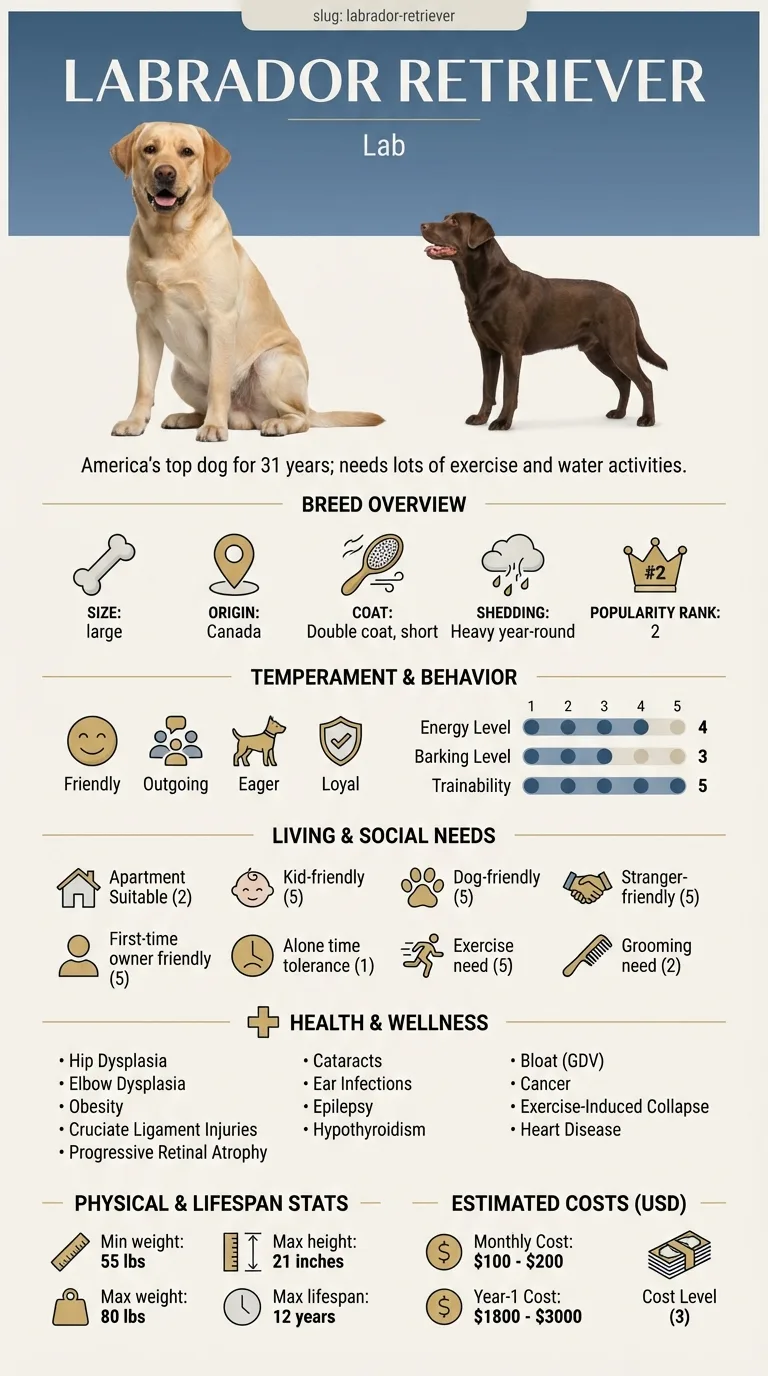
Labrador Retrievers have a normal, mesocephalic skull and a proportionate muzzle length, so they don't develop the muzzle-to-soft-tissue mismatch that causes an elongated soft palate in brachycephalic breeds. This breed's real, documented airway-adjacent risk is unrelated: obesity adding throat soft tissue, and in older dogs, geriatric laryngeal paralysis, a distinct nerve condition.
Weight gain from overfeeding or reduced activity adds soft tissue around the throat regardless of muzzle length, which is the more relevant environmental factor behind any breathing noise in this breed. Heat and humidity can make any existing breathing effort, from whatever cause, feel more pronounced.
Talk to your vet about persistent or worsening noisy breathing, especially if it's new, occurs while your dog is awake and active, or comes with a changed bark. This is worth investigating using causes relevant to this breed rather than assuming a structural palate defect that doesn't apply here.
See all Labrador Retriever health problems, which breeds are prone to elongated soft palate, or the full Labrador Retriever breed guide for temperament, exercise needs and ownership costs.
Since this specific defect doesn't apply to the breed, there's no diagnosis or treatment timeline to speak of for it directly. Any actual airway noise investigation follows the timeline of whatever real cause, weight, allergies, or age-related change, is ultimately identified.
Success is understanding that this specific term doesn't describe your Labrador's anatomy, and redirecting any real concern about breathing noise toward the causes that genuinely apply to this breed.
An elongated soft palate develops specifically because breeding for a shortened, flattened muzzle doesn't proportionally shorten the soft tissue structures inside the mouth and throat, leaving excess tissue that partially blocks the airway. This defect is essentially a direct consequence of brachycephalic conformation. Labrador Retrievers have a normal, moderately long, proportionate muzzle, so there's no mismatch between muzzle length and soft tissue length to create this problem in the first place. A vet examining a Lab for noisy breathing isn't going to find this specific structural defect, because the anatomical setup for it doesn't exist in this breed.
In a Labrador, noisy breathing or snoring typically traces back to one of these causes instead:

If you think your Lab has elongated soft palate, the plan is three steps: write down what you have seen and when it started, book a veterinary appointment rather than waiting for the next flare, and take video of the behaviour or symptom before you go — the thing you are worried about rarely happens in the consulting room. Screening in the parents covers hip dysplasia, elbow dysplasia, obesity.
What the vet visit should produce is a diagnosis and a written plan, not just reassurance: what is being ruled out, what the monitoring interval is, and which signs mean you come back sooner. Ask what the treatment costs across a year rather than per visit, because that is the number that decides whether you are managing this condition or reacting to it.
Between appointments, keep a short log — dates, what you saw, what changed. It is the single most useful thing an owner brings to a follow-up, and for elongated soft palate it is often what separates a clear pattern from a guess.
Tank's owner heard her seven-year-old Labrador snoring louder than usual one night and, after some online searching, found elongated soft palate listed as a cause of dog snoring and grew worried her dog might need surgery. At her next vet visit, the vet explained plainly that this defect is specific to flat-faced breeds and simply doesn't apply to Tank's normal muzzle, and instead pointed to Tank's recent ten-pound weight gain as the far more likely explanation. Tank's owner adjusted his portions and increased his daily walks, and within two months his snoring had noticeably quieted, confirming weight, not any structural defect, had been the real cause all along.
Key takeaway: Snoring in a Labrador almost never points to a brachycephalic-style structural defect, and starting with the causes that actually apply to this breed, like weight, leads to a faster, more useful answer.
No, this defect specifically results from brachycephalic breeding for a shortened muzzle, which Labradors don't have. Their normal, proportionate muzzle means this specific structural mismatch doesn't occur in this breed.
Snoring in a Labrador is more likely related to excess weight adding soft tissue around the throat, sleeping position, or in older dogs, geriatric laryngeal paralysis, rather than any structural palate defect.
Yes, often. Reducing excess soft tissue around the neck and throat through weight loss can meaningfully decrease snoring in a dog where weight, rather than a structural defect, is the driving factor.
Occasional snoring usually isn't concerning, but a gradual increase in noisy breathing, especially with a changed bark, in a dog over eight or nine years old is worth mentioning to your vet as a possible early sign of laryngeal paralysis.
It would be highly unusual, since this breed doesn't have the underlying structural defect that soft palate surgery is designed to correct in brachycephalic breeds.
Not necessarily; simple snoring from sleeping position or minor soft tissue bulk doesn't usually indicate a functional airway problem, unlike labored breathing while awake or during activity.
You can, but it's more useful to describe the actual symptom, snoring, noisy breathing, or exercise-related noise, and let your vet investigate the causes that genuinely apply to this breed rather than starting from a brachycephalic-specific term.
No, Labradors have a normal, proportionate muzzle length and don't have the structural setup that causes elongated soft palate in flat-faced breeds.
Most often excess weight, sleeping position, or in older dogs, age-related laryngeal paralysis, rather than any structural palate defect.
Weight management is the most effective home strategy if excess weight is contributing; persistent or worsening noise should still be checked by a vet.
Essentially never, since the breed doesn't have the underlying anatomical defect that this specific surgery addresses.
Occasional puppy snoring is usually harmless and unrelated to any structural concern in this breed; persistent, loud, or worsening noise still deserves a vet check.
A one-page prep sheet for this condition: the signs, the questions to ask, what to get priced. Unlocks here.
You get: Vet visit prep sheet
No spam. One-click unsubscribe. See our privacy policy.
Preview page 1 before you decide.