Health
Is this a Bichon Frise condition?
No. An overlong palate is a consequence of a heavily shortened skull, and this breed has a proportionate, functional muzzle.

Quick answer
Is this a Bichon Frise condition?
No. An overlong palate is a consequence of a heavily shortened skull, and this breed has a proportionate, functional muzzle.
The problem arises when a breed's jaw has been shortened without the palate shortening to match, and that mismatch is a defining feature of flat-faced breeds rather than of moderately proportioned ones.
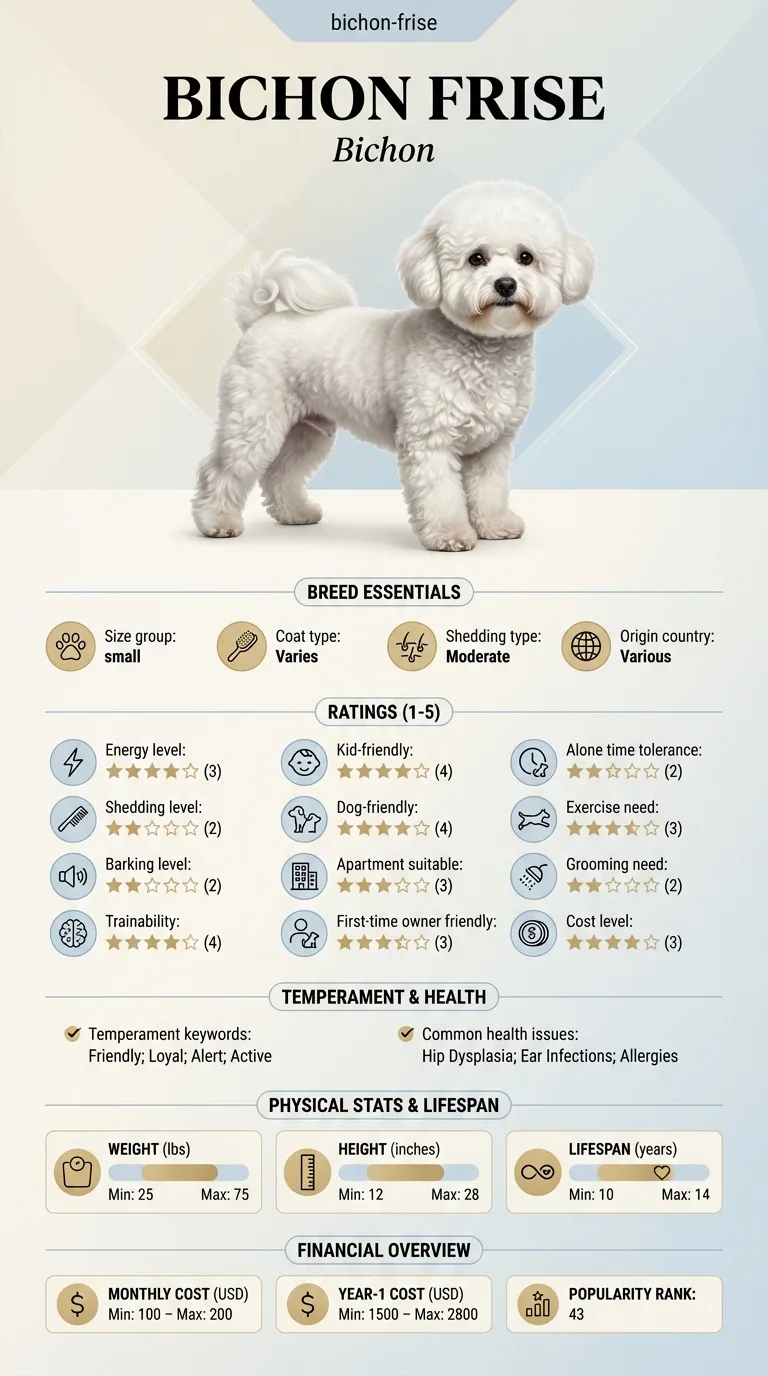
Owners whose Bichon gags, retches after eating or drinking, or makes an alarming snorting noise, and who have found a diagnosis that belongs to a different kind of dog. Also anyone comparing breeds and wanting to understand this specific anatomical trade-off.
This guide is not medical advice. If your dog shows pain, sudden behavior change, or worsening symptoms, consult a licensed veterinarian.
Some links may be affiliate links. We may earn a commission at no extra cost to you. We only suggest products we believe are helpful for dog owners.
We research and check what we publish, but we do not warrant that any figure, date, price, or statement is accurate, complete, or current, and we accept no liability for any loss, cost, injury, or other harm arising from the use of this site. Use it as one reference among several. You remain responsible for your own decisions and for your dog's care - confirm anything that matters with a licensed veterinarian or another qualified professional before you act on it. Full disclaimer.
An elongated soft palate is a flap at the back of the mouth that is too long for the jaw containing it, so its free edge overhangs the entrance to the windpipe and is drawn into the airway with each breath. It causes noisy, laboured breathing, poor heat tolerance, gagging and progressive secondary damage to the larynx. It is a feature of flat-faced breeds and is not documented in the Bichon Frise.
Very common in the flat-faced breeds, where corrective surgery is a routine part of veterinary practice and where breed clubs and veterinary bodies run assessment schemes. Absent as a breed problem in the Bichon Frise. Owners of this breed who arrive here are almost always trying to explain gagging or snorting, and those have more likely explanations that this page sets out.
The palate itself is not abnormal in affected dogs; it is a normal length structure inside an abnormally short skull. That mismatch is created by selective breeding for a flat face and it cannot be bred out without lengthening the muzzle again. The Bichon Frise has a moderately short muzzle within functional proportions, an open nose and a jaw of adequate length, so no mismatch exists. What its proportions do produce is dental crowding, which is why dental disease and not airway disease appears on this breed's documented health list. It is the same conformational pressure stopping at a very different point.
For breeds that do have the condition, heat, humidity, excitement and weight determine whether a chronic difficulty becomes an emergency. For a Bichon Frise, the environmental factors behind gagging and snorting are quite different: how fast the dog eats, whether a collar presses on the throat during walks, how much aerosol and fragrance is used indoors, whether the mouth is painful, and how much the dog weighs. Each of those is adjustable, which is a more useful place to spend attention than a structural problem the breed does not have.
Book an appointment for gagging or retching that happens regularly, for a breathing noise that is new or worsening, for a change in the sound of the bark, or for coughing during or after meals. Go to an emergency clinic immediately for breathing with visible effort, an extended neck with open-mouthed breathing at rest, gums that look pale, grey or blue, choking that does not stop within seconds, or collapse. Persistent pawing at the mouth with heavy drooling suggests something lodged and needs same-day attention. Overheating with heavy panting, unsteadiness and bright red gums is an emergency in any breed and cooling should begin immediately.
See all Bichon Frise health problems, which breeds are prone to elongated soft palate, or the full Bichon Frise breed guide for temperament, exercise needs and ownership costs.
Gagging caused by eating too quickly usually improves within a week of changing how food is presented. Reverse sneezing driven by indoor irritants tends to reduce within a month of removing them. Retching from dental disease resolves after appropriate dental treatment, typically with obvious improvement inside a fortnight. Where an investigation under sedation is needed, it is usually a single appointment that settles the question rather than a prolonged process.
Success is knowing exactly what your dog's noise is and why, and having eliminated the causes that were fixable. A healthy Bichon Frise should eat without gagging, breathe silently at rest, tolerate an ordinary summer walk taken at a sensible hour, and recover from exercise within a few minutes. Occasional reverse sneezing that ends in twenty seconds and leaves a bright dog sits comfortably inside normal.
When the palate is longer than the jaw it sits in, its free edge extends back over the opening of the windpipe. Every inward breath draws it downward into the airway.
The result is a flap that vibrates and partially blocks the passage with each breath. That produces the characteristic snoring and snorting of affected breeds, and it produces real work: the dog has to generate more negative pressure to move the same air.
That extra suction is what causes the syndrome to worsen over time. Increased negative pressure pulls other soft tissues inward, small pouches near the voice box get sucked into the airway, and the larynx itself can eventually weaken and collapse. A dog that started with one anatomical problem accumulates several.
Affected dogs also struggle with heat, because panting is how a dog cools itself and panting requires moving a large volume of air quickly. An obstructed airway makes the cooling system inefficient at exactly the moment it is needed most.
Surgical shortening of the palate, usually combined with widening the nostrils, is the treatment, and outcomes are best when it is done before the secondary changes have developed.

Gagging and retching are what usually bring owners to this topic. In a breed with a proportionate palate, the cause is generally somewhere else entirely, and several of the alternatives are treatable.
Saffron gagged after almost every evening meal. Her owner, Tomas, had timed it: she finished a full bowl in nineteen seconds, then stood with her neck extended making a wet retching sound for the next minute. He had read about soft palate problems and arrived at the clinic prepared for a discussion about surgery. His vet examined her mouth, found a normal muzzle and clean throat, listened to her chest and asked one question: how fast does she eat. The recommendation was unremarkable. Spread the evening meal across a maze bowl, and split the daily ration into two meals rather than one. Saffron's meal now takes just over four minutes. The gagging stopped within three days and has not returned in two years. Tomas describes it as the cheapest veterinary advice he has ever received, and notes that he had genuinely been prepared to pay for an operation instead.
Key takeaway: Before investigating the anatomy of the throat, time how long your dog takes to empty its bowl, because nineteen seconds explains a great deal.
Not as a breed characteristic. The condition arises where a skull has been shortened dramatically without the soft tissue shortening to match, and the Bichon Frise has a moderately short but functional muzzle rather than a flat face. No airway condition appears on the breed's documented health list.
Almost certainly not. Gagging after drinking most often relates to drinking too fast, to irritation in the throat, or to a windpipe issue. If it happens regularly, film an episode and book an appointment, because the pattern and the sound tell a vet far more than the description does.
By examining the back of the throat under sedation or light anaesthesia, since a conscious dog will not permit a proper look. In affected breeds this examination is often combined with assessment of the nostrils and the larynx, so the full picture is obtained in one session rather than piecemeal.
There is no reason to operate on an airway that is not obstructed. If a vet has specifically identified a structural problem in your individual dog, that is a different conversation and is worth pursuing with a surgeon. Surgery offered on the basis of breed assumption rather than examination should prompt a question about what exactly has been found.
Yes, but as an ordinary dog rather than as an airway-compromised one. A dense curly double coat is a good insulator, so shade, early and late walks, water and never leaving your dog in a parked car are the standard sensible measures for this breed.
Occasional coughing or sneezing after a hurried mouthful happens in many dogs. Persistent nasal discharge after eating, food coming down the nose, or repeated coughing during meals is different and warrants investigation, since it can indicate a defect in the palate or a problem with swallowing.
No. An overlong palate is a consequence of a heavily shortened skull, and this breed has a proportionate, functional muzzle.
It seals off the nasal passage during swallowing. When too long for the jaw, it overhangs the windpipe and obstructs breathing.
Most often eating too fast, dental disease, reverse sneezing, or a windpipe problem. Each has a different fix.
Slow the meal with a maze bowl or by scattering the food, which usually resolves mealtime gagging within a few days.
No. For this breed the predictable veterinary spending is dental work and skin care, not airway procedures.
A one-page prep sheet for this condition: the signs, the questions to ask, what to get priced. Unlocks here.
You get: Vet visit prep sheet
No spam. One-click unsubscribe. See our privacy policy.
Preview page 1 before you decide.