Golden Retriever or Labrador Retriever: Which Fits Your Home?
Quick answer
Golden Retriever vs Labrador: which should I choose?
Take the Labrador if you want the same temperament with a third of the grooming and a lower cancer risk. Take the Golden if you want the gentler dog and will genuinely brush it weekly for twelve years. On temperament the two are nearly identical; on coat care they are not close.
Most people choosing between these two are really choosing between two coats. On temperament, energy and trainability the Golden Retriever and the Labrador Retriever are as close as any pair of breeds gets. On grooming, shedding and long-term health risk they are not close at all.
This is for someone who has already decided they want a large, friendly, family-suited retriever and is stuck on which one. The honest answer depends on three things almost nobody weighs before the puppy arrives: how much brushing you will actually do, how you feel about hair on everything you own, and whether you want to know the uncomfortable statistic about Golden Retriever cancer before you commit rather than after.
Quick verdict
Take the Labrador if you want the same dog with a third of the grooming and a meaningfully lower lifetime cancer risk; take the Golden if you want a softer, slightly more sensitive dog and you are genuinely willing to brush it every week for twelve years.
Choose golden retriever if...
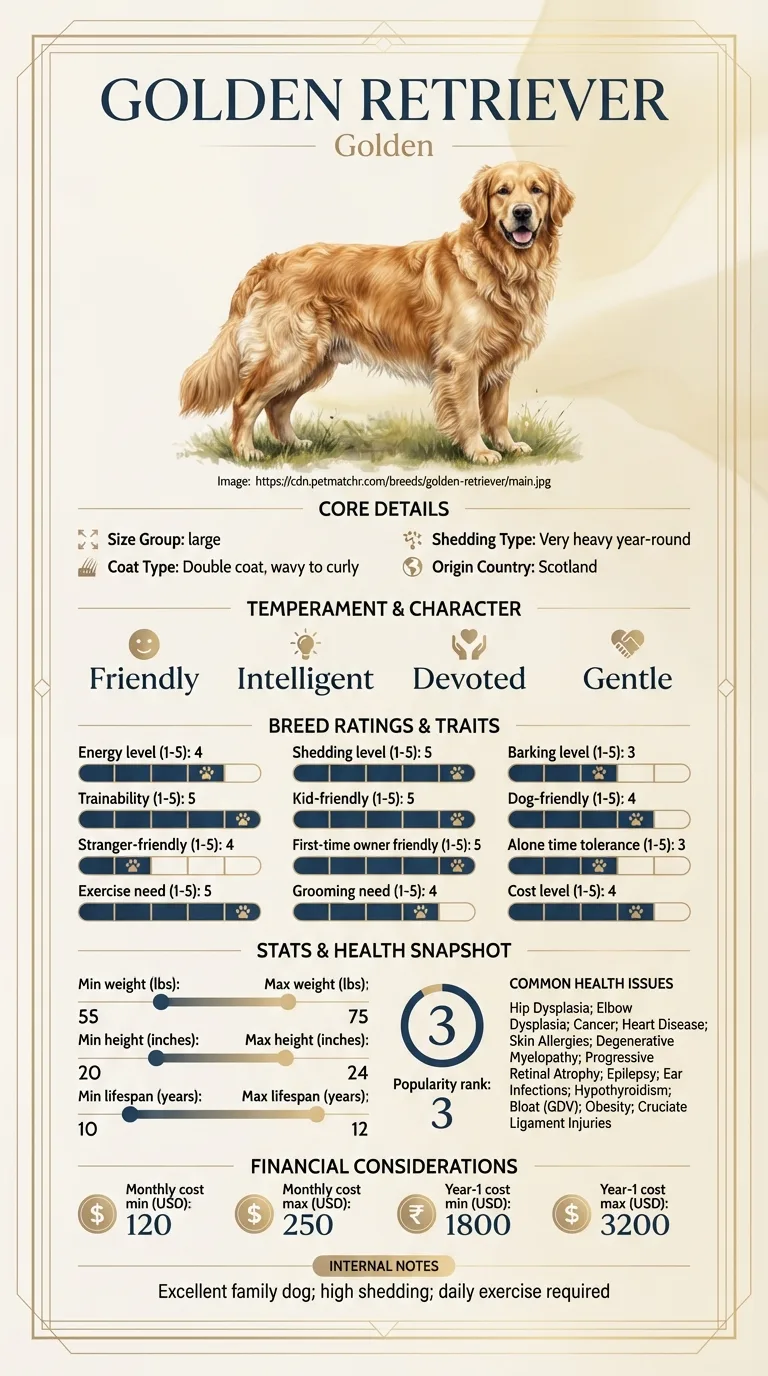
Choose the Golden Retriever if you want the gentler of the two temperaments, you can live with a coat that mats behind the ears and collects every burr on the walk, and you will commit to weekly line-brushing plus a professional tidy every couple of months. Goldens also cope better with a working day alone than Labradors do, rating 3/5 against the Labrador's 1/5.
Choose labrador retriever if...
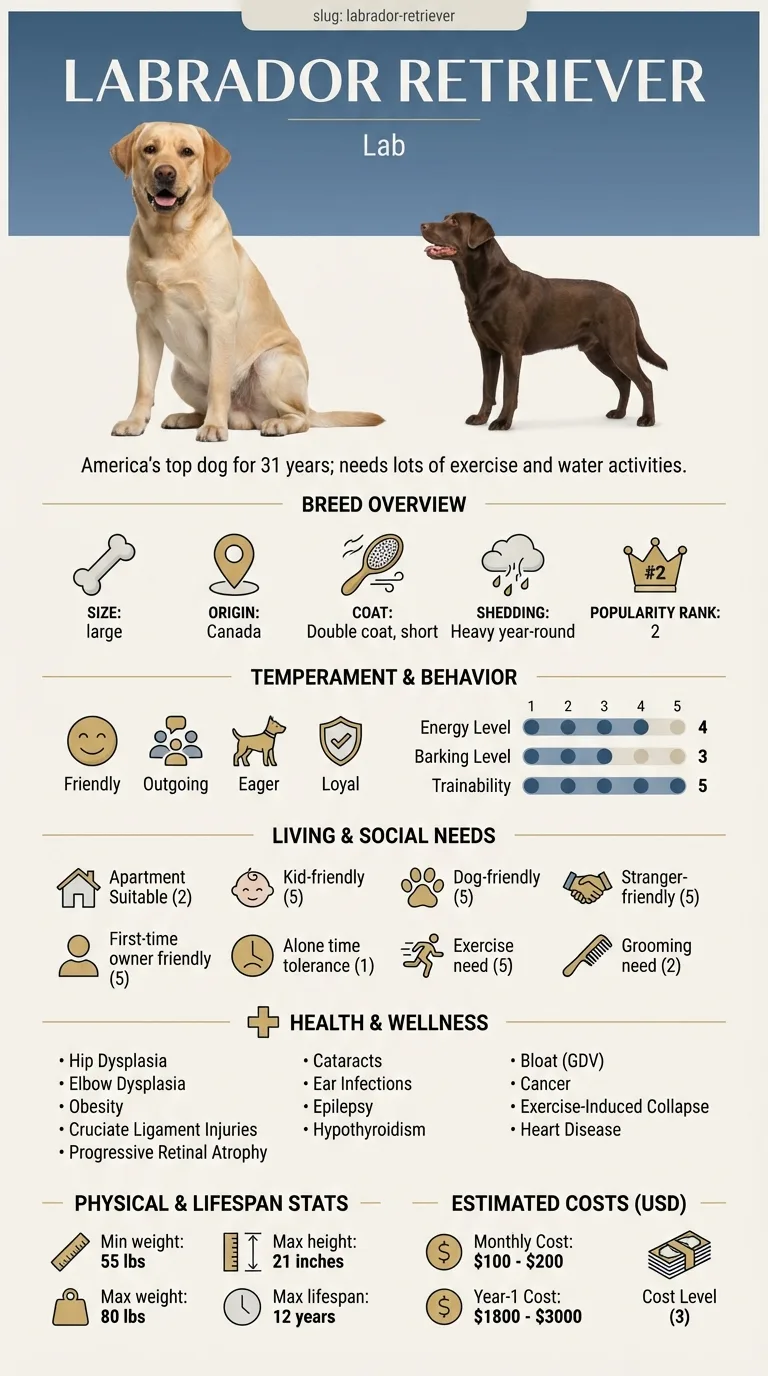
Choose the Labrador Retriever if you want a wash-and-wear coat, a dog that dries in ten minutes after a swim, lower running costs, and the best temperament on this site for a house with other dogs and constant visitors — it rates 5/5 on both. Be honest about the food obsession first: this is the breed most likely to eat something it should not.
Head-to-head comparison
Feature
golden retriever
labrador retriever
Winner
Weight
55–75 lbs
55–80 lbs
Equal
Height
20–24 in
21–24 in
Equal
Lifespan
10–12 years
10–12 years
Equal
Coat
Double coat, wavy with feathering
Double coat, short
Equal
Grooming need
High (4/5)
Low (2/5)
labrador retriever
Shedding
Very high (5/5)
High (4/5)
labrador retriever
Energy level
High (4/5)
High (4/5)
Equal
Exercise need
Very high (5/5)
Very high (5/5)
Equal
Trainability
Very high (5/5)
Very high (5/5)
Equal
Good with kids
Very high (5/5)
Very high (5/5)
Equal
Good with other dogs
High (4/5)
Very high (5/5)
labrador retriever
Friendly to strangers
High (4/5)
Very high (5/5)
labrador retriever
Tolerates being alone
Moderate (3/5)
Very low (1/5)
golden retriever
Barking
Moderate (3/5)
Moderate (3/5)
Equal
Apartment suitability
Low (2/5)
Low (2/5)
Equal
Good for first-time owners
Very high (5/5)
Very high (5/5)
Equal
Typical monthly cost
$120–$250
$100–$200
Equal
Typical first-year cost
$1,800–$3,200
$1,800–$3,000
Equal
Deep dive
The coat is the real decision
A Labrador has a short, dense, slightly oily double coat that was designed to shed cold water. Practically, that means a Labrador that swims in a muddy river is a clean dry dog again within about fifteen minutes, and a Labrador that is never brushed still looks like a Labrador. Grooming rates 2/5 and that is not an understatement — a rubber curry mitt once a week during moult is close to the whole job.
A Golden has a longer wavy outer coat with feathering on the tail, the backs of the legs, the chest and behind the ears. Every one of those places mats, and the spot behind the ears mats fastest because it is the bit people forget. Feathering also collects burrs, grass seed and mud, and holds water long after a Labrador has dried off. Grooming rates 4/5, and honestly earned: expect line-brushing through to the skin once a week with a slicker and a comb, plus a professional tidy every six to ten weeks if you want the trousers and tail to look like the photographs that made you want a Golden in the first place.
One warning that applies to the Golden and not the Labrador, because the Labrador has no feathering to ruin: never shave a Golden down in summer. The double coat insulates against heat as well as cold, and shaving it can permanently wreck the regrowth.
Both shed heavily, but not in the same way
Neither of these is a low-shedding dog and anyone telling you otherwise is selling something. The Golden rates 5/5 and the Labrador 4/5, and both shed year-round with two heavier moults.
The difference is the nature of the hair rather than the quantity. Labrador hair is short, straight and stiff, and it weaves itself into upholstery and car seats like a needle — it survives vacuuming and you end up picking it out of fabric by hand. Golden hair is longer and softer, so it forms visible drifts on hard floors and tumbleweeds under furniture, but it lifts off fabric more easily.
Which is worse depends entirely on your house. Hard floors and a lint roller favour the Golden. Carpet and dark upholstery favour the Labrador, marginally. What neither favours is an owner who was hoping for a clean house.
The uncomfortable part: cancer risk is not equal
Both breeds share the large-retriever problems — hip and elbow dysplasia, cruciate ligament injuries, ear infections in floppy wet ears, hypothyroidism, progressive retinal atrophy, and bloat.
But the Golden Retriever carries a genuinely elevated cancer burden compared with almost any other breed, hemangiosarcoma and lymphoma in particular. It is the reason the Morris Animal Foundation runs a decades-long Golden Retriever Lifetime Study following thousands of dogs specifically to understand it. Labradors get cancer too, and it is on their listed conditions here, but not at the same rate. This is the single most important asymmetry between these two dogs and it is the one most comparison articles leave out because it is unpleasant to write.
That is not a reason to refuse a Golden. It is a reason to ask a breeder directly what the cancer history in their lines looks like, to budget for insurance in year one rather than year five, and to know what hemangiosarcoma looks like — sudden collapse and pale gums in a middle-aged dog is an emergency, not a wait-and-see.
The Labrador has its own genetic asymmetry, and it is specific: a deletion in the POMC gene, common in the breed and especially in working lines, is associated with increased food motivation and obesity risk. It is why obesity appears in the Labrador's condition list and not in most other breeds'. A fat Labrador is not a jolly Labrador; it is a Labrador with a shorter life and worse joints.
Adolescence: same intelligence, different failure mode
Both rate 5/5 for trainability, which is true and also slightly misleading. Trainable does not mean easy — it means the dog learns fast, including things you did not intend to teach.
Labrador adolescence, roughly eight to eighteen months, is physical. It is mouthing, counter-surfing, pulling on the lead and an apparently sincere belief that everything on the floor is food. Nothing about it is malicious and most of it is over by two years, but it is a lot of dog moving fast through a house.
Golden adolescence is softer and emotionally slower. Goldens tend to be more sensitive to harsh handling — a raised voice lands harder than it would on a Labrador, and heavy-handed correction produces a shut-down dog rather than a corrected one. They often stay mentally puppyish into their third year.
If you have never trained a dog before, either is forgiving. The Labrador will test your patience through your furniture; the Golden will test it through repetition.
Time alone is where they genuinely diverge
This is the one behavioural rating with a real gap: the Golden rates 3/5 for tolerating an empty house, the Labrador 1/5.
Both are companion breeds that want to be where you are, but the Labrador combines that with the food obsession described above, and a bored Labrador with access to a kitchen is a genuinely expensive animal. Foreign body surgery for something swallowed is one of the more common emergency bills in the breed.
If the dog will be alone across a full working day without a dog walker, neither is an ideal fit, but the Golden handles it better. Plan crate training and midday company for either, and treat the Labrador's rating as the warning it is.
Cost: close, with the gap in grooming
Running costs are $120–$250 a month for the Golden against $100–$200 for the Labrador, and first-year totals land at $1,800–$3,200 and $1,800–$3,000 respectively. The gap is small on paper and almost entirely explained by grooming: a Golden tidied professionally every eight weeks adds a recurring line that the Labrador simply does not have.
Both are large dogs, so food, preventives and boarding are priced accordingly, and both have joint and cruciate risk that makes insurance worth pricing early rather than after the first limp. For the Golden specifically, take the cancer risk into account when choosing a policy limit — a lifetime cap that looked generous for a small dog will not go far against oncology.
Kids, other dogs and visitors
Both rate 5/5 with children and are genuinely good at it — soft-mouthed, tolerant, and not startle-prone. The usual caveat applies more to size than temperament: an eighty-pound adolescent retriever knocks over a toddler without any intent to.
With other dogs the Labrador edges it at 5/5 against the Golden's 4/5, and with strangers the same, 5/5 against 4/5. In practice both are sociable, but the Labrador is the more indiscriminately friendly of the two. If you already have a dog, or your house has a constant stream of visitors, the Labrador is the marginally safer bet.
Neither is a protection dog and neither should be asked to be one.
Golden Retriever vs Labrador Retriever: an unusual comparison
Most breed comparisons on this site turn on temperament. This one does not, because these two have nearly the same temperament. Both rate 5/5 for trainability, 5/5 with children, 4/5 or better with other dogs, and 5/5 for first-time owners. Both were built for the same job — marking a fallen bird, swimming out, and bringing it back undamaged — and that job selected for the same qualities in both: soft mouth, biddable nature, tolerance of noise and chaos, and no suspicion of strangers whatsoever. If you want a watchdog, neither of these is it. A Labrador will show a burglar where the silverware is kept; a Golden will help carry it. What actually separates them is the coat, the cancer statistics, and one specific gene.
Golden Retriever or Labrador Retriever: Which Fits Your Home? - Golden Retriever vs Labrador Retriever: an unusual comparison
Frequently asked questions
Which sheds more, a Golden Retriever or a Labrador?
The Golden, rated 5/5 against the Labrador's 4/5, and both shed year-round with heavier seasonal moults. The more useful difference is the type of hair: short stiff Labrador hair weaves into upholstery and car seats and resists vacuuming, while longer Golden hair gathers in visible drifts on hard floors but lifts off fabric more easily. Neither breed is hypoallergenic.
Is a Golden Retriever harder to groom than a Labrador?
Considerably. The Labrador rates 2/5 and needs little more than a weekly rubber curry mitt during moult; its short coat does not mat and dries within minutes of a swim. The Golden rates 4/5 because of the feathering on tail, legs, chest and behind the ears, all of which mats. Expect weekly line-brushing to the skin plus a professional tidy every six to ten weeks.
Do Golden Retrievers really get more cancer than Labradors?
Yes, and it is the most important difference between the two. Golden Retrievers carry an unusually high lifetime cancer burden, hemangiosarcoma and lymphoma especially, which is why the Morris Animal Foundation runs a long-term study following thousands of Goldens specifically to understand it. Labradors are not cancer-free but the rate is meaningfully lower. Ask any Golden breeder directly about cancer in their lines, and price insurance accordingly.
Which is better for a first-time dog owner?
Both rate 5/5, so neither is a mistake. The Labrador is more forgiving of clumsy handling and inconsistent early training; the Golden is more sensitive and responds badly to harsh correction but is gentler through adolescence. Choose on grooming commitment rather than experience — that is the axis a first-time owner most often underestimates.
Can either breed be left alone during a working day?
The Golden copes better, rating 3/5 against the Labrador's 1/5, but neither is a breed that thrives on solitude. The Labrador's low rating combines separation intolerance with strong food motivation, and a bored Labrador with kitchen access is a genuine risk of swallowing something that requires surgery. Arrange a midday walker or company for either.
Which costs more to keep?
The Golden, at $120–$250 a month against the Labrador's $100–$200, with first-year totals of $1,800–$3,200 and $1,800–$3,000. Almost the entire difference is professional grooming, which the Labrador does not need. Both are large dogs with joint and cruciate risk, so insurance is worth pricing in year one for either.
Are Labradors more prone to obesity?
Yes, and it has a known genetic component. A deletion in the POMC gene is common in the breed, particularly in working lines, and is associated with heightened food motivation and obesity risk. It is why obesity appears on the Labrador's condition list. Measure food rather than eyeballing it, and keep treats inside the daily ration.
Golden Retriever vs Labrador: which should I choose?
Take the Labrador if you want the same temperament with a third of the grooming and a lower cancer risk. Take the Golden if you want the gentler dog and will genuinely brush it weekly for twelve years. On temperament the two are nearly identical; on coat care they are not close.
Costs
How much does each cost per month?
The Golden Retriever runs $120–$250 a month and the Labrador $100–$200, with the gap explained almost entirely by professional grooming.
Health
Which has more health problems?
Both share hip and elbow dysplasia, cruciate injuries and ear infections. The Golden carries a notably higher lifetime cancer risk; the Labrador carries a genetic predisposition to obesity through the POMC gene.
Training
Which is easier to train?
Both rate 5/5 and learn fast. The Labrador tolerates blunt handling better; the Golden is more sensitive and shuts down under harsh correction.
Related DogBreedCompass guides
Golden Retriever breed guide – Anyone weighing the Golden needs the full breed profile, particularly the health section.
German Shepherd vs Labrador Retriever – The German Shepherd is the breed people most often add to this shortlist when they want more guarding instinct than either retriever offers.
Golden Retriever vs Poodle – Poodles come up constantly for people who love the Golden temperament but cannot live with the shedding.
Labrador Retriever genetic disorders – The genetic-disorder page sets out what a Labrador breeder should have screened for.
Adopting a Golden Retriever – Adoption changes the health conversation, because you inherit a dog whose lines you cannot ask about.
Health information here is general and is not veterinary advice. If your dog shows pain, sudden behaviour change, or worsening symptoms, consult a licensed veterinarian.
Some links on this site are affiliate links. We may earn a commission at no extra cost to you, and we only suggest products we believe are helpful for dog owners.
We research and check what we publish, but we do not warrant that any figure, date, price, or statement is accurate, complete, or current, and we accept no liability for any loss, cost, injury, or other harm arising from the use of this site. Use it as one reference among several. You remain responsible for your own decisions and for your dog's care - confirm anything that matters with a licensed veterinarian or another qualified professional before you act on it. Full disclaimer.