Health
Is elbow dysplasia as common as hip dysplasia in Labs?
Both are directly documented health concerns for this breed, and elbow dysplasia sometimes presents more subtly, which can make it easier to overlook without proper screening.

Quick answer
Is elbow dysplasia as common as hip dysplasia in Labs?
Both are directly documented health concerns for this breed, and elbow dysplasia sometimes presents more subtly, which can make it easier to overlook without proper screening.
A young Lab that's slightly "off" on a front leg, more of a subtle head-bob when trotting than an obvious limp, is worth taking seriously, since elbow dysplasia often shows up more quietly than hip problems do.
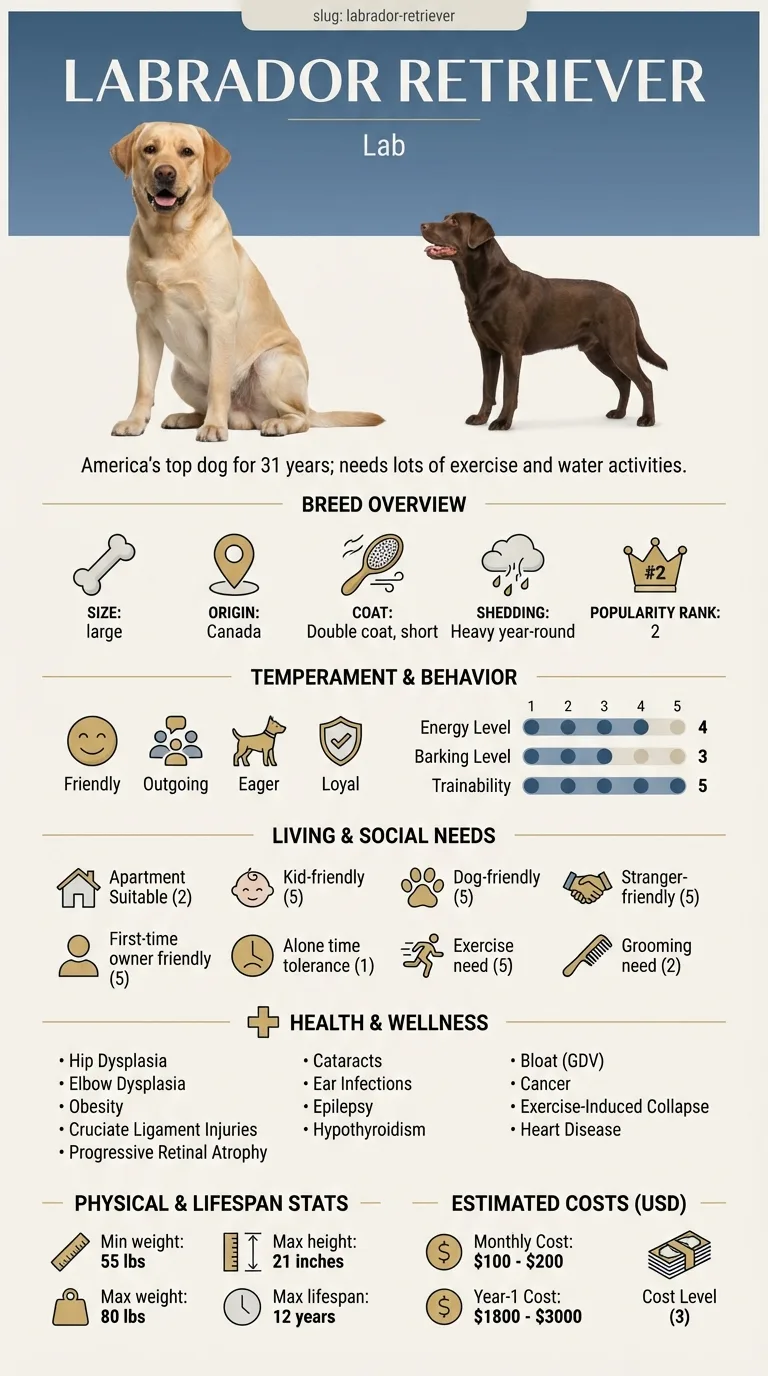
Owners of Labrador puppies and young adults, particularly from breeding lines without documented elbow screening, are the ones most likely to encounter this condition, since it's fundamentally developmental and usually shows its first signs before full skeletal maturity.
This guide is not medical advice. If your dog shows pain, sudden behavior change, or worsening symptoms, consult a licensed veterinarian.
Some links may be affiliate links. We may earn a commission at no extra cost to you. We only suggest products we believe are helpful for dog owners.
We research and check what we publish, but we do not warrant that any figure, date, price, or statement is accurate, complete, or current, and we accept no liability for any loss, cost, injury, or other harm arising from the use of this site. Use it as one reference among several. You remain responsible for your own decisions and for your dog's care - confirm anything that matters with a licensed veterinarian or another qualified professional before you act on it. Full disclaimer.
Elbow dysplasia is a documented developmental joint condition in Labrador Retrievers, covering several abnormalities in how the elbow's bones grow and fit together during puppyhood. It often presents more subtly than hip dysplasia, sometimes just a slight head-bob when trotting, and predictably leads to early arthritis if the underlying joint incongruity isn't identified and managed.
Directly documented as a common health concern for this breed, making it a realistic developmental risk for essentially every Labrador puppy, with formal screening the only reliable way to catch subtle or asymptomatic cases early.
Elbow dysplasia is specifically listed among Labrador Retrievers' documented health concerns, reflecting a genuine, well-established genetic predisposition to abnormal elbow joint development during the breed's rapid puppy growth phase.
Overfeeding, inappropriate growth-phase nutrition, and high-impact exercise before joints have fully matured can all worsen how severely an underlying genetic predisposition ultimately expresses itself. Excess body weight at any age adds ongoing mechanical strain to an already compromised joint.
Talk to your vet about any subtle front-leg lameness, reluctance to play as usual, or a slight head-bob when trotting, especially in a puppy or young adult. These deserve an orthopedic evaluation rather than being dismissed as normal puppy clumsiness.
See all Labrador Retriever health problems, which breeds are prone to elbow dysplasia, or the full Labrador Retriever breed guide for temperament, exercise needs and ownership costs.
Diagnosis typically follows a vet exam and X-rays within a couple of weeks of noticing symptoms, or as part of formal screening around two years old. Management, whether medical or surgical, is generally a lifelong commitment given the joint changes involved.
Success looks like a dog that remains comfortable and active through consistent weight management, appropriate exercise, and medical or surgical treatment as needed, not a full reversal of the underlying joint changes, which don't resolve completely once present.
Elbow dysplasia isn't one single defect but an umbrella term covering several developmental abnormalities in how the three bones of the elbow joint fit together and grow, including fragmented processes within the joint and abnormal cartilage development. Because these bones need to grow in careful coordination during puppyhood, any mismatch in that growth creates joint incongruity, extra friction, and cartilage damage that predictably leads to early arthritis in the affected elbow. It's a genuinely documented, common concern for this breed, not a rare or edge-case finding.
Elbow dysplasia is typically screened for with X-rays taken once a dog is skeletally mature, usually around two years old, submitted to an organization like OFA (Orthopedic Foundation for Animals) for grading. Results range from normal to grades I through III based on the severity of visible joint changes, primarily early arthritis, seen on the X-ray. A grade doesn't necessarily predict exactly how a dog will feel day to day, some dogs with a mild grade show real symptoms while others with a similar grade show none, but it does provide meaningful, standardized information for breeding decisions and helps a vet contextualize any symptoms your dog does show.

Otis's owner almost missed it entirely, a barely-there head-bob when her ten-month-old Labrador trotted across the yard, easy to write off as nothing. A vet visit prompted by her gut feeling led to X-rays that confirmed mild elbow dysplasia in one joint. Because it was caught early, before significant arthritis had developed, Otis's vet recommended a conservative approach: strict weight management, a joint supplement, and moderated exercise rather than surgery. Now three years old and kept lean, Otis shows no lameness at all during normal activity, and his owner credits catching that subtle early sign with avoiding a more serious outcome.
Key takeaway: Elbow dysplasia in a Labrador often presents more subtly than expected, and taking a slight gait change seriously enough to get it checked can make a real difference in long-term joint health.
Yes, it's directly documented as one of this breed's common health concerns, a developmental joint condition affecting how the bones of the elbow grow and fit together.
A subtle front-leg lameness, often worse after exercise or rest, a slight head-bob when trotting, or reluctance to fully extend the affected leg. Signs can be quite subtle compared to hip dysplasia.
X-rays, typically taken once a dog is skeletally mature around two years old, are the standard diagnostic tool, sometimes supplemented with a CT scan for more detailed evaluation in complex cases.
Grades range from normal to I, II, or III based on the severity of joint changes visible on X-ray, primarily early arthritis. It's a standardized way to assess and communicate severity, though it doesn't always perfectly predict day-to-day symptoms.
It depends on severity and the specific abnormality involved. Some cases are managed medically with weight control, joint supplements, and exercise modification, while more significant structural problems may benefit from surgical correction, especially if caught early.
Not entirely, since genetics play a real role, but appropriate growth-phase nutrition and moderate exercise during puppyhood can influence how severely an underlying predisposition ultimately develops.
Yes, it's one of the primary documented pathways to arthritis in this breed, since the joint incongruity and cartilage damage involved predictably progress to secondary osteoarthritis over time.
Both are directly documented health concerns for this breed, and elbow dysplasia sometimes presents more subtly, which can make it easier to overlook without proper screening.
Formal OFA screening is typically done around two years old once skeletal growth is complete, though a vet can evaluate a symptomatic younger dog sooner if needed.
Yes, excess weight adds mechanical load to an already compromised joint, so keeping a dog lean is one of the most effective ways to reduce symptom severity.
It varies significantly by the specific procedure needed, ranging from a moderate cost for minimally invasive arthroscopic treatment to a larger expense for more extensive joint surgery.
Many dogs, with appropriate management including weight control and joint support, live active, comfortable lives despite an elbow dysplasia diagnosis, especially when caught and managed early.
A one-page prep sheet for this condition: the signs, the questions to ask, what to get priced. Unlocks here.
You get: Vet visit prep sheet
No spam. One-click unsubscribe. See our privacy policy.
See a sample page before you decide.
Early access list
The free prep sheet covers the same-day warning signs, a symptom log and the questions to ask. We are considering a fuller kit that adds a cost worksheet for the usual tests and treatments (US price ranges with their sources) and a plain-English guide to ways of covering the bill. It is not built yet; this list tells us whether it is worth building.
One email, no spam, unsubscribe anytime. Information only, not veterinary advice.