Health
What's an early sign of elbow dysplasia?
A puppy favoring a front leg after exercise or holding an elbow turned outward while standing are common early signs.

Quick answer
What's an early sign of elbow dysplasia?
A puppy favoring a front leg after exercise or holding an elbow turned outward while standing are common early signs.
A young Aussie that favors a front leg after exercise, or holds an elbow slightly turned out while standing, may be showing early signs of a joint that never quite lined up correctly.
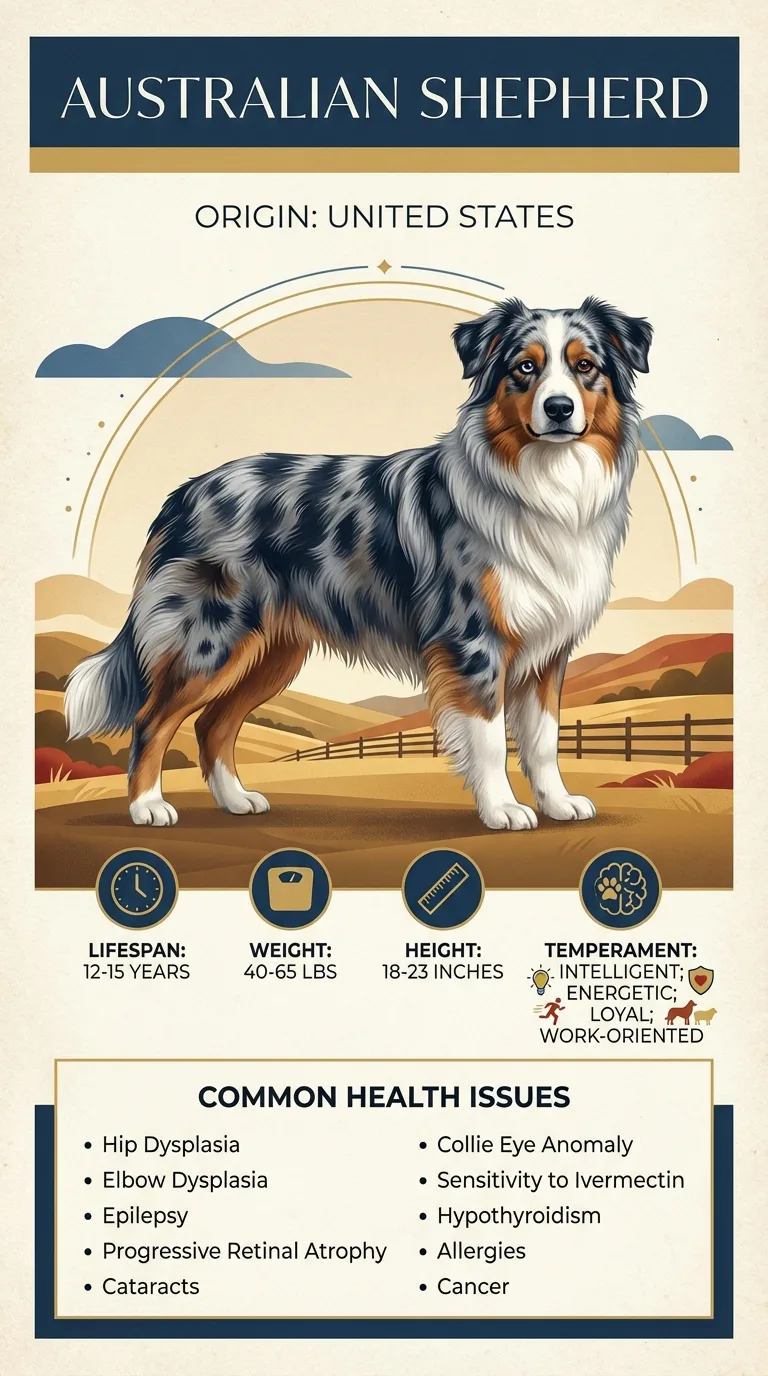
Owners of larger, more heavily built individuals within the breed tend to see this most, and it's often first noticed during a puppy's rapid growth phase rather than later in adulthood.
This guide is not medical advice. If your dog shows pain, sudden behavior change, or worsening symptoms, consult a licensed veterinarian.
Some links may be affiliate links. We may earn a commission at no extra cost to you. We only suggest products we believe are helpful for dog owners.
We research and check what we publish, but we do not warrant that any figure, date, price, or statement is accurate, complete, or current, and we accept no liability for any loss, cost, injury, or other harm arising from the use of this site. Use it as one reference among several. You remain responsible for your own decisions and for your dog's care - confirm anything that matters with a licensed veterinarian or another qualified professional before you act on it. Full disclaimer.
Elbow dysplasia is a documented joint condition in Australian Shepherds where the three bones forming the elbow don't fit together properly, most often becoming apparent during a puppy's rapid growth phase. Severity ranges widely, from mild cases managed with weight control to more significant misalignment requiring surgical correction, and most cases carry some long-term arthritis risk.
Elbow dysplasia is specifically documented as a health concern for this breed, making it one of the more established orthopedic issues vets watch for in Australian Shepherd puppies, particularly larger or faster-growing individuals.
This breed's documented predisposition to elbow dysplasia means the joint's three-bone alignment is more prone to developing incongruity during growth than in breeds without this genetic tendency. High energy levels driving early, enthusiastic activity can compound this during the vulnerable growth window.
Overfeeding, excess calcium supplementation, and high-impact exercise before growth plates close all add mechanical stress to a joint already prone to misalignment, potentially worsening the severity of an underlying genetic predisposition.
Talk to your vet if a puppy shows persistent front-leg lameness, an outward-turned elbow stance, or reluctance to fully extend a front leg. Sudden severe lameness or a leg that won't bear weight at all needs prompt evaluation.
Elbow dysplasia itself is a structural issue present from a young age, but how it's managed in the following months has a real effect on how much arthritis develops later.
See all Australian Shepherd health problems, which breeds are prone to elbow dysplasia, or the full Australian Shepherd breed guide for temperament, exercise needs and ownership costs.
Diagnosis typically happens within the first year of life through imaging. Management, whether surgical or conservative, is generally an ongoing, lifelong consideration given the joint's structural nature.
Success means a functional, comfortable joint managed through appropriate weight control and activity level, even if some arthritis develops over time. Full resolution without any long-term joint change is uncommon in more significant cases.
Diagnosis typically involves X-rays, sometimes supplemented with a CT scan for a clearer view of the joint's three-bone alignment. Vets grade severity on a scale, since a mild case with subtle misalignment behaves very differently from a severe one with significant joint incongruity.
Mild cases are often managed with weight control and exercise modification alone, while more severe cases may benefit from a surgical procedure to address the specific type of misalignment present. Because there are several distinct forms of elbow dysplasia, the right treatment path depends heavily on which specific pattern imaging reveals.

At six months old, Zeke's owner, Priya, noticed he stood with his left elbow turned slightly outward and favored that leg after playtime. X-rays confirmed mild elbow dysplasia, and Zeke's vet recommended weight management and limiting jumping rather than surgery given the mild grade. Priya kept Zeke lean throughout his growth and swapped hard fetch sessions for structured leash walks until he was over a year old. Now three years old, Zeke shows no lameness and remains active, with his vet noting only minimal joint changes on a recent recheck X-ray.
Key takeaway: Catching a mild case early and adjusting exercise accordingly can meaningfully change the joint's long-term trajectory, even without surgery.
It's a general term for several conditions where the three bones forming the elbow joint don't fit together properly, leading to abnormal wear, pain, and eventually arthritis if untreated.
Signs most often show up between four and twelve months old, during a puppy's most active growth period, though milder cases can go unnoticed until later.
X-rays are the standard first step, sometimes followed by a CT scan for a more detailed view, allowing a vet to grade the severity and identify the specific type present.
No, mild cases are often managed with weight control and modified exercise, while more severe cases may benefit from a surgical procedure specific to the type of misalignment found.
Most dogs with meaningful elbow dysplasia do develop some degree of arthritis over time, since the underlying joint incongruity causes ongoing uneven wear regardless of treatment.
It can't be fully prevented since it's a developmental condition, but controlling growth rate through appropriate feeding and limiting high-impact exercise in puppyhood can reduce how severely it progresses.
A puppy favoring a front leg after exercise or holding an elbow turned outward while standing are common early signs.
X-rays, and sometimes a CT scan, allow a vet to grade severity and identify the specific type of joint misalignment.
No, mild cases are often managed with weight control and modified exercise rather than surgery.
Costs range from a modest ongoing management plan for mild cases to a significant surgical expense for more severe ones.
Most dogs with meaningful elbow dysplasia develop some arthritis over time due to ongoing uneven joint wear.
A one-page prep sheet for this condition: the signs, the questions to ask, what to get priced. Unlocks here.
You get: Vet visit prep sheet
No spam. One-click unsubscribe. See our privacy policy.
Preview page 1 before you decide.