Behavior
Which should you actually get?
If you want an athletic dog for daily exercise and don't mind separation anxiety, the Lab. If you want a calmer giant that tolerates alone time better but costs more to keep, the Newfoundland.

Quick answer
Which should you actually get?
If you want an athletic dog for daily exercise and don't mind separation anxiety, the Lab. If you want a calmer giant that tolerates alone time better but costs more to keep, the Newfoundland.
Labrador Retriever or Newfoundland? On paper they differ most on exercise need, and on the scales Newfoundland is the heavier at 100–150 lbs. Here is how the two compare on everything that shapes an ordinary week.
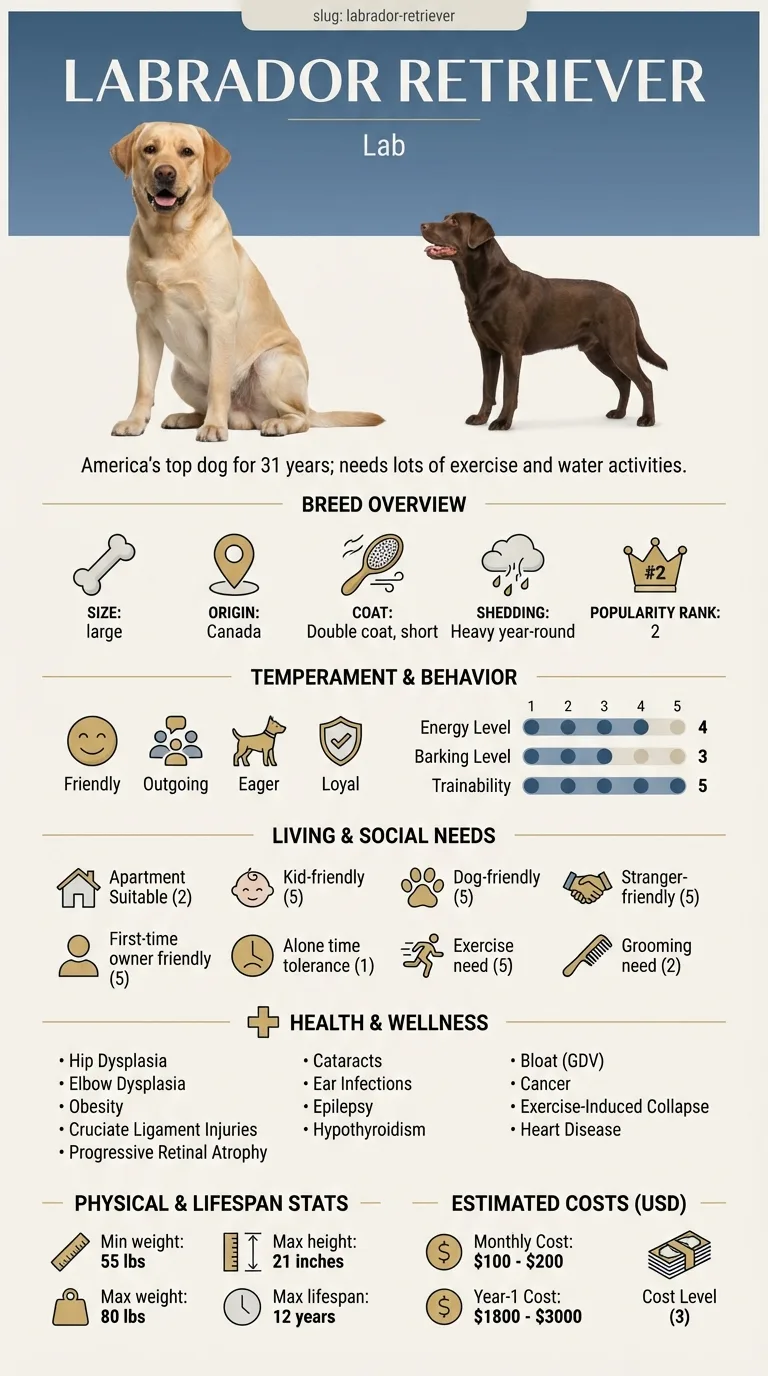
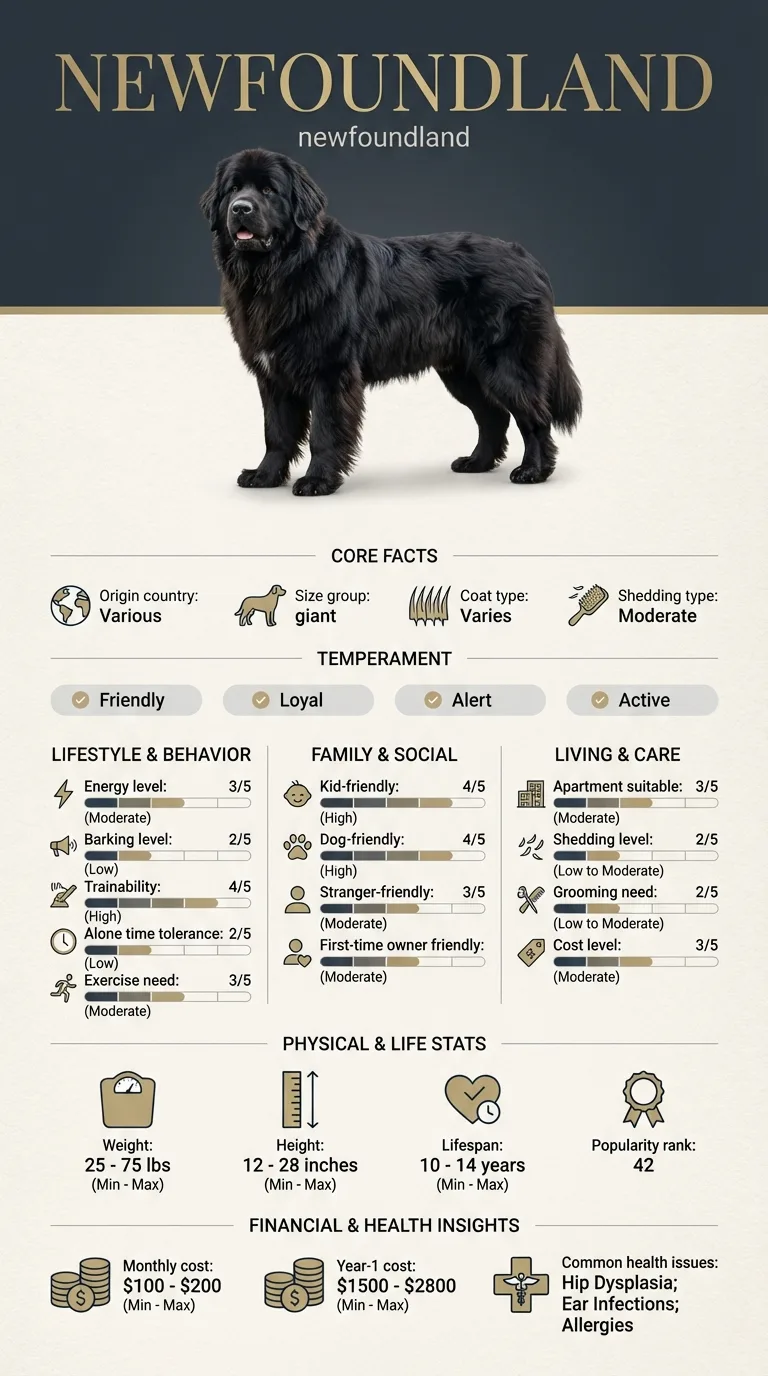
This is for someone already down to Labrador Retriever and Newfoundland and deciding between them. For this pair the decision usually turns on exercise need and grooming need, so those are covered first and in most detail. Anyone choosing from a flat has a clear answer here: Labrador Retriever rates 2/5 against 1/5. Breed history is left out; what follows is what you will actually live with.
Between Labrador Retriever and Newfoundland, exercise need is what separates them, and Labrador Retriever is the lower-effort dog of the two to keep.
Choose Labrador Retriever if this is your first dog, you do not want a standing grooming appointment and shedding is a problem in your house.
Choose Newfoundland if your walking routine is modest, the dog will be alone during the working day and you want a dog that is more watchful with visitors.
| Feature | labrador retriever | newfoundland | Winner |
|---|---|---|---|
| Size class | large | giant | Equal |
| Weight | 55–80 lbs | 100–150 lbs | Equal |
| Height | 21–24 in | 26–28 in | Equal |
| Lifespan | 10–12 years | 9–10 years | labrador retriever |
| Exercise need | Very high (5/5) | Moderate (3/5) | newfoundland |
| Grooming need | Low (2/5) | High (4/5) | labrador retriever |
| Shedding | High (4/5) | Very high (5/5) | labrador retriever |
| Energy level | High (4/5) | Low (2/5) | Equal |
| Barking | Moderate (3/5) | Low (2/5) | newfoundland |
| Apartment suitability | Low (2/5) | Very low (1/5) | labrador retriever |
| Good for first-time owners | Very high (5/5) | Moderate (3/5) | labrador retriever |
| Tolerates being alone | Very low (1/5) | Moderate (3/5) | newfoundland |
| Trainability | Very high (5/5) | High (4/5) | labrador retriever |
| Good with kids | Very high (5/5) | Very high (5/5) | Equal |
| Good with other dogs | Very high (5/5) | High (4/5) | labrador retriever |
| Friendly to strangers | Very high (5/5) | High (4/5) | labrador retriever |
| Cost level | Moderate (3/5) | Very high (5/5) | labrador retriever |
| Coat | Double coat, short | Heavy water-resistant double coat | Equal |
| Origin | Canada | Various | Equal |
| Typical monthly cost | $100–$200 | $150–$310 | Equal |
| Typical first-year cost | $1,800–$3,000 | $2,200–$4,200 | Equal |
The Lab tops out around 80 lbs and 24 inches; the Newfoundland can reach 150 lbs and 28 inches, putting it in the giant-breed category. That's nearly double the mass at the largest end. If you need a dog you can physically lift into a car or a bathtub in an emergency, that's a real practical difference, not just a preference.
The Lab rates a full 5/5 on exercise need, it wants running, retrieving, real daily work. The Newfoundland sits at a moderate 3/5; despite the bulk, it's content with a couple of solid walks and some water time. Bigger doesn't mean busier here, the Newf's calm engine is the whole appeal for people who don't want a dog demanding fetch at sunrise.
Grooming is where the Newf earns its keep, 4/5 versus the Lab's easy 2/5, and its shedding edges even higher, 5/5 against the Lab's already-heavy 4/5. That water-resistant double coat needs regular brushing to avoid mats, and you'll find hair everywhere regardless. Neither is a low-shedding pick, but the Newfoundland asks for more of your time at the brush.
Both breeds score low on apartment suitability, 2/5 for the Lab, just 1/5 for the Newfoundland, whose size makes small spaces genuinely impractical. The Newf is quieter (2/5 barking versus 3/5) and handles alone time better (3/5 versus the Lab's rock-bottom 1/5), but neither is built for a studio walk-up.
Both train well, the Lab at a perfect 5/5, the Newfoundland close behind at 4/5, but the Lab rates 5/5 for first-time owners while the Newfoundland sits at a more moderate 3/5. That gap comes down to size management: a giant-breed puppy that hasn't learned manners is a different problem than a Lab puppy with the same issue.
Both breeds score a perfect 5/5 with kids. The Lab edges ahead with other dogs and strangers, 5/5 on both versus the Newf's 4/5, though the difference is modest. This is one area where either dog fits a busy, social household without much compromise.
The Lab's health list runs long, thirteen conditions on record including bloat, cancer, and heart disease, but it also lives longer, 10-12 years against the Newfoundland's 9-10. The Newf's five listed conditions include serious cardiac issues, subaortic stenosis and dilated cardiomyopathy, alongside bloat, a real concern for a deep-chested giant breed.
The Lab runs a moderate 3/5 on cost, $100-$200 a month; the Newfoundland climbs to 5/5, $150-$310 monthly and $2,200-$4,200 in year one against the Lab's $1,800-$3,000. Food alone for 150 lbs of dog adds up fast, and vet bills tend to scale with body weight too.
Labrador Retriever weighs 55–80 lbs and lives 10–12 years; Newfoundland weighs 100–150 lbs and lives 9–10 years. The two diverge most on exercise need, grooming need and energy level and 3 other rated axes. Almost every rated axis separates them at least slightly. The comparison marks an easier option only where one exists. Facts like weight and country of origin are not scored. Both dogs are rated from the same dataset, which is what makes the numbers comparable with each other even though any individual dog sits somewhere inside its breed's range.

The Newfoundland, by a wide margin, it can weigh up to 150 lbs and stand 28 inches tall, versus the Lab's 80 lbs and 24 inches. The Newf sits in the giant-breed category; the Lab is simply large.
Neither sheds lightly, but the Lab sheds slightly less, 4/5 versus the Newfoundland's 5/5. Expect regular vacuuming with either dog.
It's workable at 3/5 for first-time owners, but the Lab's 5/5 makes it the easier on-ramp. A giant breed adds size-management challenges a beginner may not expect.
Neither is a strong fit, Lab at 2/5, Newfoundland at 1/5. If you're in a small space, look elsewhere; the Newfoundland especially needs room to just exist.
Plan on $100-$200 for a Lab and $150-$310 for a Newfoundland, reflecting the cost-level gap, 3/5 versus 5/5, between them.
Yes, on two fronts: both carry hip dysplasia risk and both are prone to bloat (GDV), which matters for a deep-chested giant breed like the Newf especially.
The Newfoundland, at 3/5 versus the Lab's very low 1/5. Labs are notoriously clingy; if you're out of the house a lot, that's worth weighing.
If you want an athletic dog for daily exercise and don't mind separation anxiety, the Lab. If you want a calmer giant that tolerates alone time better but costs more to keep, the Newfoundland.
Lab runs $100-$200; Newfoundland runs $150-$310, the Newf's size pushes food and vet costs higher.
The Lab rates 5/5, essentially daily hard exercise; the Newfoundland rates a moderate 3/5, happy with walks and swimming.
The Labrador, 10-12 years versus the Newfoundland's 9-10, typical for the size gap between a large and a giant breed.
Secure checkout on Stripe. We never see your card.
7-day money-back guarantee. Instant access.
Health information here is general and is not veterinary advice. If your dog shows pain, sudden behaviour change, or worsening symptoms, consult a licensed veterinarian.
Some links on this site are affiliate links. We may earn a commission at no extra cost to you, and we only suggest products we believe are helpful for dog owners.
We research and check what we publish, but we do not warrant that any figure, date, price, or statement is accurate, complete, or current, and we accept no liability for any loss, cost, injury, or other harm arising from the use of this site. Use it as one reference among several. You remain responsible for your own decisions and for your dog's care - confirm anything that matters with a licensed veterinarian or another qualified professional before you act on it. Full disclaimer.
Match your lifestyle to the right dog.
Take quizNot sure which breed is right for you? Take our 2-minute quiz to find out.
Take the quiz