Health
Is my Lab's back problem the sudden or slow kind?
Without a documented chondrodystrophic trait, a Labrador's spine issues are typically the slow, degenerative Type II pattern rather than a sudden early-life rupture.

Quick answer
Is my Lab's back problem the sudden or slow kind?
Without a documented chondrodystrophic trait, a Labrador's spine issues are typically the slow, degenerative Type II pattern rather than a sudden early-life rupture.
If your older Lab has gone from occasionally stiff to consistently hesitant about stairs over the past year, you're likely watching a slow degenerative spine process, not a sudden emergency, though it still deserves real attention.
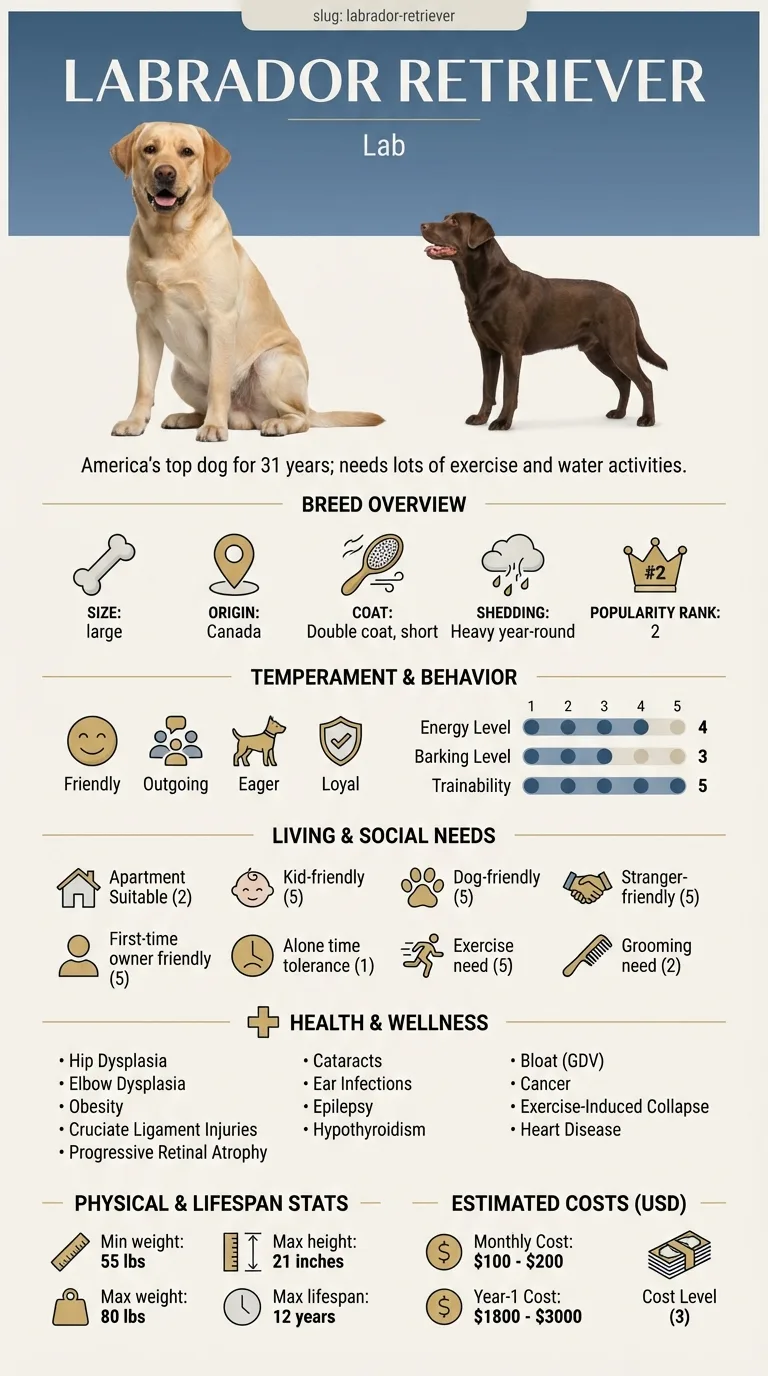
Owners of Labradors past middle age, especially those carrying extra weight or with a history of reduced core fitness, are the ones most likely to see this gradual pattern develop, since it's tied closely to age and body condition rather than any inherited spinal defect.
This guide is not medical advice. If your dog shows pain, sudden behavior change, or worsening symptoms, consult a licensed veterinarian.
Some links may be affiliate links. We may earn a commission at no extra cost to you. We only suggest products we believe are helpful for dog owners.
We research and check what we publish, but we do not warrant that any figure, date, price, or statement is accurate, complete, or current, and we accept no liability for any loss, cost, injury, or other harm arising from the use of this site. Use it as one reference among several. You remain responsible for your own decisions and for your dog's care - confirm anything that matters with a licensed veterinarian or another qualified professional before you act on it. Full disclaimer.
Check this first
A gradual pattern doesn't mean it can't turn serious. If a chronically weakening spine reaches the point of significant nerve compression, a Labrador can develop sudden hind-limb weakness, dragging of the back feet, or loss of bladder control, even after months of only mild symptoms. That kind of sudden neurological change, on top of a slow-building history, is a genuine emergency requiring immediate veterinary attention, since delayed treatment for significant nerve compression can mean permanent loss of function.
If any of these apply, call your vet or an emergency clinic now. The rest of this page is for the cases that are not an emergency.
Back and spine issues in a Labrador Retriever typically take the form of slow, degenerative Type II intervertebral disc disease, discs gradually losing cushioning capacity over years, rather than the sudden early-life ruptures seen in short-legged, chondrodystrophic breeds. It builds gradually enough that owners often have real warning before symptoms become severe, though a sudden neurological decline on top of that slow history is a genuine emergency.
Not listed as a hallmark Labrador condition, but degenerative disc changes are a realistic concern for this breed's senior years, particularly in dogs carrying extra weight or with a long history of high-impact activity.
Labradors have no documented chondrodystrophic trait, so they don't develop the early, sudden disc ruptures seen in Dachshunds or Corgis. When spine problems occur in this breed, they follow the slower, age-related Type II pattern common to larger, normally-proportioned breeds, discs gradually bulging and losing cushioning over years rather than rupturing suddenly.
Long-term excess weight and years of high-impact activity without adequate core conditioning both accelerate gradual disc degeneration. A sedentary lifestyle that lets back-supporting muscles weaken over time can also make an aging spine more vulnerable to strain.
See your vet for any gradual but consistent change in mobility, posture, or stair use lasting more than a couple of weeks. Treat sudden hind-limb weakness, dragging of the back feet, or loss of bladder or bowel control as an immediate emergency requiring same-day care.
See all Labrador Retriever health problems, which breeds are prone to backspine issues, or the full Labrador Retriever breed guide for temperament, exercise needs and ownership costs.
Mild, early degenerative changes can be managed for months to years with weight control and low-impact exercise before symptoms progress meaningfully. If significant nerve compression develops, treatment decisions and recovery unfold over weeks rather than the gradual timeline of the underlying condition.
Success is a dog that maintains comfortable, functional mobility for as long as possible through weight control and activity modification, with early intervention if the condition ever escalates suddenly, not a permanent reversal of the underlying degeneration.
Veterinary medicine generally splits intervertebral disc disease into two patterns. Type I is sudden and explosive, common in chondrodystrophic breeds whose discs are structurally predisposed to rupture early in life. Type II is slow and degenerative, discs gradually bulging and losing cushioning capacity over years, typically in larger, older, non-chondrodystrophic breeds. Labrador Retrievers, with no documented chondrodystrophic trait, fit the Type II pattern when spine problems occur. That means a Lab's disc-related back trouble tends to build gradually, giving owners a longer window to notice something is changing before it becomes severe.
If you think your Lab has back/spine issues, the plan is three steps: write down what you have seen and when it started, book a veterinary appointment rather than waiting for the next flare, and take video of the behaviour or symptom before you go — the thing you are worried about rarely happens in the consulting room. Screening in the parents covers hip dysplasia, elbow dysplasia, obesity.
What the vet visit should produce is a diagnosis and a written plan, not just reassurance: what is being ruled out, what the monitoring interval is, and which signs mean you come back sooner. Ask what the treatment costs across a year rather than per visit, because that is the number that decides whether you are managing this condition or reacting to it.
Between appointments, keep a short log — dates, what you saw, what changed. It is the single most useful thing an owner brings to a follow-up, and for back/spine issues it is often what separates a clear pattern from a guess.
Hazel, a nine-year-old Labrador carrying about ten extra pounds, had been slightly stiffer each season for about a year, something her owner had chalked up to normal aging. When Hazel suddenly seemed unsteady on her back legs one morning and dragged a paw slightly while walking, her owner rushed her to the vet. An exam and imaging showed moderate Type II disc degeneration that had progressed to mild nerve involvement. Caught before it worsened further, Hazel responded well to strict rest, anti-inflammatory medication, and a structured weight-loss plan, avoiding the need for surgery. A year later, at a healthier weight and on a consistent low-impact exercise routine, Hazel's mobility has remained stable, with her owner now watching closely for any sudden changes rather than assuming stiffness is just old age.
Key takeaway: Slow-building spine changes in an aging Labrador deserve attention before they progress, and a sudden shift in symptoms on top of a gradual history is the clearest sign it's time for immediate veterinary care.
It occurs, particularly in older or overweight dogs, but as a slow, degenerative Type II process rather than the sudden early-onset ruptures seen in short-legged breeds. It isn't listed as a hallmark condition for this breed the way joint problems are.
Type I is a sudden disc rupture, typically in chondrodystrophic breeds, causing rapid-onset pain or paralysis. Type II is a slow, gradual bulging and degeneration over years, more typical of larger, older, non-chondrodystrophic breeds like Labradors.
Gradual hesitation before jumping, subtle stiffness that's worse in the morning, a slightly hunched posture, and reduced enthusiasm for stairs or getting into the car, developing over weeks to months rather than overnight.
Sudden hind-limb weakness, dragging of the back feet, loss of coordination, or loss of bladder or bowel control are all signs of significant nerve compression and require immediate emergency veterinary care.
Yes. Less mechanical load on the spine reduces strain on already-degenerating discs and surrounding tissue, and it's one of the few genuinely controllable factors in a slow-building spine condition.
Weight management, anti-inflammatory medication, controlled low-impact exercise, and in advanced or acute cases, surgical decompression, depending on severity and how much nerve function is affected.
Often yes, with weight management, low-impact exercise, and monitoring, many dogs live comfortably for years with mild to moderate disc changes as long as sudden neurological decline doesn't develop.
Without a documented chondrodystrophic trait, a Labrador's spine issues are typically the slow, degenerative Type II pattern rather than a sudden early-life rupture.
Sudden hind-limb weakness, dragging back feet, or loss of bladder control after a history of slow-building symptoms means immediate emergency care, not a wait-and-see approach.
Yes, reducing excess weight lowers mechanical load on the spine and is one of the most controllable factors in slowing degenerative disc changes.
Decompression surgery for significant nerve compression is a major expense, often several thousand dollars, which is part of why catching gradual symptoms early matters.
Reducing repeated stair use and providing ramps where possible eases strain on a degenerating spine without eliminating normal daily movement.
A one-page prep sheet for this condition: the signs, the questions to ask, what to get priced. Unlocks here.
You get: Vet visit prep sheet
No spam. One-click unsubscribe. See our privacy policy.
Preview page 1 before you decide.