Behavior
Which needs more exercise?
The Labrador Retriever, rated Very High (5/5) versus the Boston's Low (2/5).

Quick answer
Which needs more exercise?
The Labrador Retriever, rated Very High (5/5) versus the Boston's Low (2/5).
Boston Terrier or Labrador Retriever? On paper they differ most on exercise need, and on the scales Labrador Retriever is the heavier at 55–80 lbs. Here is how the two compare on everything that shapes an ordinary week.
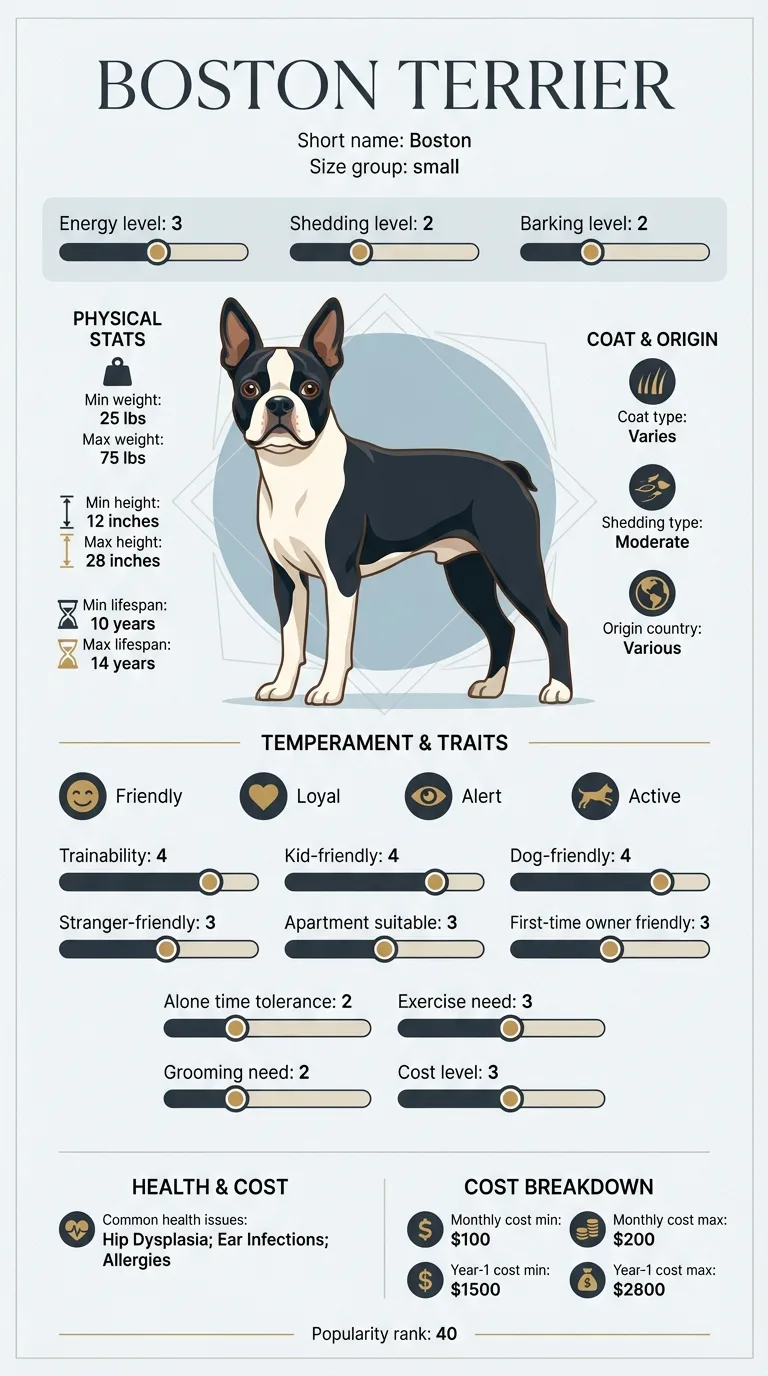
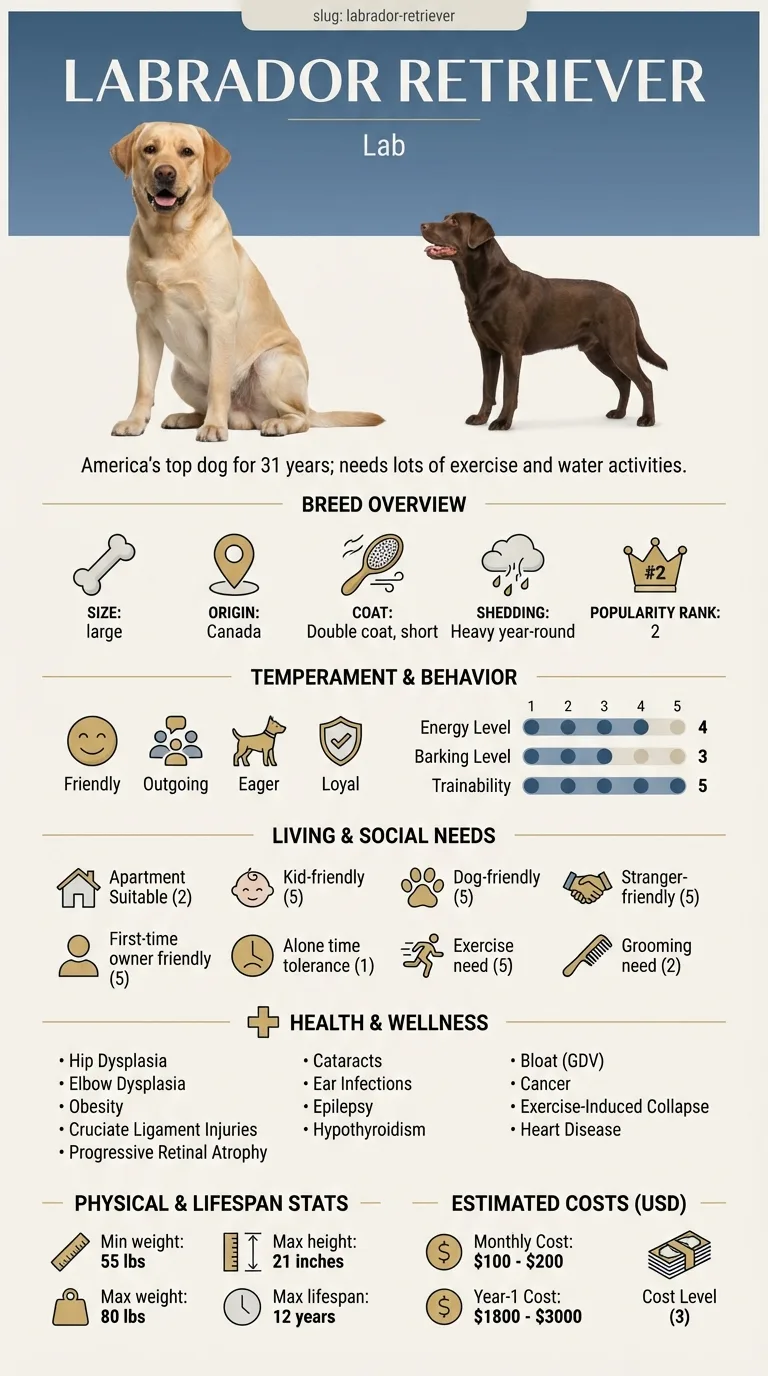
This is for someone already down to Boston Terrier and Labrador Retriever and deciding between them. For this pair the decision usually turns on exercise need and apartment suitability, so those are covered first and in most detail. Anyone choosing from a flat has a clear answer here: Boston Terrier rates 5/5 against 2/5. It is written for the decision rather than the breed history.
Between Boston Terrier and Labrador Retriever, exercise need is what separates them, and Boston Terrier is the lower-effort dog of the two to keep.
Choose Boston Terrier if you are in a flat or a smaller home, you do not want a standing grooming appointment and shedding is a problem in your house.
Choose Labrador Retriever if you already have another dog, you want a dog that picks up training quickly and you want a dog that can keep up with an active routine.
| Feature | boston terrier | labrador retriever | Winner |
|---|---|---|---|
| Size class | small | large | Equal |
| Weight | 12–25 lbs | 55–80 lbs | Equal |
| Height | 15–17 in | 21–24 in | Equal |
| Lifespan | 11–13 years | 10–12 years | boston terrier |
| Exercise need | Low (2/5) | Very high (5/5) | boston terrier |
| Grooming need | Very low (1/5) | Low (2/5) | boston terrier |
| Shedding | Low (2/5) | High (4/5) | boston terrier |
| Energy level | Moderate (3/5) | High (4/5) | Equal |
| Barking | Low (2/5) | Moderate (3/5) | boston terrier |
| Apartment suitability | Very high (5/5) | Low (2/5) | boston terrier |
| Good for first-time owners | Very high (5/5) | Very high (5/5) | Equal |
| Tolerates being alone | Moderate (3/5) | Very low (1/5) | boston terrier |
| Trainability | High (4/5) | Very high (5/5) | labrador retriever |
| Good with kids | Very high (5/5) | Very high (5/5) | Equal |
| Good with other dogs | High (4/5) | Very high (5/5) | labrador retriever |
| Friendly to strangers | High (4/5) | Very high (5/5) | labrador retriever |
| Cost level | Moderate (3/5) | Moderate (3/5) | Equal |
| Coat | Short and smooth | Double coat, short | Equal |
| Origin | Various | Canada | Equal |
| Typical monthly cost | $80–$150 | $100–$200 | Equal |
| Typical first-year cost | $1,100–$2,300 | $1,800–$3,000 | Equal |
Fifty-five to 80 pounds of Labrador Retriever against 12 to 25 pounds of Boston Terrier is not a subtle contrast -- the Lab stands 21 to 24 inches at the shoulder, nearly a foot taller than the Boston's 15-to-17-inch frame. Both are sturdy, well-built dogs for their size class, but the size classes themselves are worlds apart: small versus large. That difference cascades into everything from crate size to how much space a dog takes up on the couch to how much force is behind an enthusiastic greeting at the door. A Lab's double coat over a larger frame also means more physical presence in a home generally, something families should picture concretely before choosing based on temperament alone.
The Labrador Retriever's exercise need rates Very High (5/5) against the Boston Terrier's Low (2/5) -- one of the largest gaps in this comparison. Energy level is closer, High (4/5) for the Lab against Moderate (3/5) for the Boston, but the practical difference shows up in daily routine: a Lab bred for retrieving wants sustained physical activity, swimming, or fetch most days, while a Boston is content with shorter outings. An under-exercised Labrador is a well-known recipe for chewing and weight gain, the latter compounded by the breed's famous appetite. A Boston left on a lighter schedule doesn't carry the same risk. Anyone without an hour or more of daily activity to offer should think hard before choosing the Lab.
The Boston Terrier's Very Low (1/5) grooming need and Low (2/5) shedding beat the Labrador's Low (2/5) grooming and High (4/5) shedding on both counts, and the shedding gap is the one owners feel most. A Lab's double coat blows out seasonally and drops hair steadily the rest of the year, enough that regular brushing becomes a genuine chore rather than an occasional one. The Boston's short, smooth coat sheds lightly and cleans up with minimal effort. Neither breed needs professional grooming or trims, so the cost difference is modest, but the day-to-day difference in vacuuming and lint-rolling is real and consistent, especially for households with dark furniture or allergy sensitivities.
Apartment suitability favors the Boston decisively, Very High (5/5) against the Labrador's Low (2/5), a gap driven almost entirely by the size and exercise difference rather than noise -- barking actually favors the Boston too but by less, Low (2/5) versus Moderate (3/5). The real problem with a Lab in a small unit isn't volume, it's a large, high-energy dog with nowhere to move. Tolerating time alone is where the split widens further: Moderate (3/5) for the Boston against Very Low (1/5) for the Labrador, a breed known for attachment to its people and a harder time with long solo stretches. A Lab in an apartment generally needs a yard-equivalent substitute -- frequent long walks, a dog park, or a very active owner.
Both breeds are considered good bets for a first-time owner, tying at Very High (5/5), but trainability tips to the Labrador at Very High (5/5) against the Boston's High (4/5) -- the Lab's Eager and Outgoing temperament makes it one of the most food- and praise-motivated breeds to train. The catch is that the Lab's training success depends heavily on channeling its Very High energy first; an untrained but under-exercised Lab is harder to work with than its trainability score alone suggests. The Boston, needing less physical output before it settles enough to focus, can be easier for a first-time owner whose daily schedule is tighter than an ideal Lab owner's would be.
Both breeds tie Very High (5/5) with kids, but the Labrador pulls ahead with other dogs, Very High (5/5) against the Boston's High (4/5), and with strangers, Very High (5/5) against High (4/5) -- consistent with a temperament list built around Friendly, Outgoing, and Eager. The Boston's own list of Friendly, Comical, and Adaptable still describes a genuinely sociable dog, just with slightly less exuberance than the famously gregarious Lab. In practice, both breeds suit busy households with kids and visiting friends well. The main household consideration isn't sociability but physical scale: a Lab's size and energy around small children calls for more active supervision than a Boston's smaller, calmer presence typically requires.
The Boston Terrier actually outlives the Labrador here, 11 to 13 years against 10 to 12, despite the Lab's reputation as a robust breed. The Lab's health list is the longest in this comparison at 13 conditions, including Hip Dysplasia, Cruciate Ligament Injuries, Bloat (GDV), Cancer, and Heart Disease -- a reflection of decades of popularity-driven breeding across a large working body. The Boston's five conditions, led by Brachycephalic Airway Syndrome and eye issues like Cataracts and Corneal Ulcers, are fewer in number but tied tightly to its flat-faced structure. Obesity also appears specifically on the Lab's list, a real risk for a food-driven breed that needs its Very High exercise need actually met to stay lean.
Monthly costs run close, $80 to $150 for the Boston against $100 to $200 for the Labrador, but the first-year gap is wider: $1,100 to $2,300 versus $1,800 to $3,000, even though both breeds tie at Moderate (3/5) overall cost level. The Lab's higher first-year number reflects its size -- larger crates, more food, bigger-dose medications and vaccinations, and higher-capacity gear all cost more than the small-dog equivalents a Boston owner buys. Long-term, the Lab's extensive health list, including cancer and joint conditions common in large working breeds, can mean higher lifetime veterinary spending even when monthly basics look similar. A Boston's smaller body keeps most ongoing costs proportionally lower.
Boston Terrier weighs 12–25 lbs and lives 11–13 years; Labrador Retriever weighs 55–80 lbs and lives 10–12 years. The two diverge most on exercise need, apartment suitability and shedding and 1 other rated axes. They are level on cost level, good for first-time owners and good with kids, so those cannot decide it. In the table, a "winner" means easier for an ordinary household — not better. Size, coat and origin are recorded without a verdict. Because both breeds are scored the same way, the gaps are reliable even where the absolute numbers are rough.

The Labrador, by a wide margin -- 55 to 80 pounds and 21 to 24 inches tall against the Boston's 12 to 25 pounds and 15 to 17 inches.
Not as good as a Boston Terrier -- the Lab rates Low (2/5) for apartment suitability against the Boston's Very High (5/5), mainly due to its Very High exercise needs and size.
The Labrador Retriever, rated High (4/5) against the Boston Terrier's Low (2/5), thanks to its double coat.
The Labrador Retriever rates Very High (5/5) trainability against the Boston's High (4/5), though it needs its high energy exercised out first to focus well.
The Labrador's list is longer, 13 conditions including Hip Dysplasia, Bloat, and Cancer, against the Boston's 5 conditions centered on its flat face and eyes -- though longer doesn't necessarily mean worse for any individual dog.
Not especially well -- they rate Very Low (1/5) for tolerating being alone, the lowest score in this whole comparison, against the Boston's Moderate (3/5).
The Boston Terrier, at $1,100-$2,300 against the Labrador's $1,800-$3,000.
The Labrador Retriever, rated Very High (5/5) versus the Boston's Low (2/5).
The Boston Terrier, rated Very High (5/5) for apartment suitability.
The Boston Terrier, 11-13 years versus the Labrador's 10-12.
The Boston Terrier, Low (2/5) versus the Labrador's High (4/5).
Secure checkout on Stripe. We never see your card.
7-day money-back guarantee. Instant access.
Health information here is general and is not veterinary advice. If your dog shows pain, sudden behaviour change, or worsening symptoms, consult a licensed veterinarian.
Some links on this site are affiliate links. We may earn a commission at no extra cost to you, and we only suggest products we believe are helpful for dog owners.
We research and check what we publish, but we do not warrant that any figure, date, price, or statement is accurate, complete, or current, and we accept no liability for any loss, cost, injury, or other harm arising from the use of this site. Use it as one reference among several. You remain responsible for your own decisions and for your dog's care - confirm anything that matters with a licensed veterinarian or another qualified professional before you act on it. Full disclaimer.
Match your lifestyle to the right dog.
Take quizNot sure which breed is right for you? Take our 2-minute quiz to find out.
Take the quiz