Health
Does this breed have facial skin folds?
No, it has a clean, tight-skinned head with no wrinkling, unlike breeds where fold pyoderma is a real concern.

Quick answer
Does this breed have facial skin folds?
No, it has a clean, tight-skinned head with no wrinkling, unlike breeds where fold pyoderma is a real concern.
A GSP owner searching for 'facial skin infection' will find plenty written about a problem that belongs to a different set of breeds entirely, with a different anatomy driving it.
Owners who have found a sore, infected-looking spot on their dog's face or muzzle and are trying to work out whether it fits anything they've read about fold infections.
This guide is not medical advice. If your dog shows pain, sudden behavior change, or worsening symptoms, consult a licensed veterinarian.
Some links may be affiliate links. We may earn a commission at no extra cost to you. We only suggest products we believe are helpful for dog owners.
We research and check what we publish, but we do not warrant that any figure, date, price, or statement is accurate, complete, or current, and we accept no liability for any loss, cost, injury, or other harm arising from the use of this site. Use it as one reference among several. You remain responsible for your own decisions and for your dog's care - confirm anything that matters with a licensed veterinarian or another qualified professional before you act on it. Full disclaimer.
Facial fold pyoderma requires a deep skin fold to trap moisture and debris, and the German Shorthaired Pointer's clean, tight-skinned, mesocephalic head has no such fold. A localised facial skin infection in this breed is far more likely to be an infected field injury than anything resembling a fold-related problem.
True fold pyoderma is not applicable to this breed's anatomy at all. Minor facial injuries from fieldwork are common and expected for a dog worked through dense cover, and occasional secondary infection of an unnoticed scratch is the realistic version of this concern for a GSP owner.
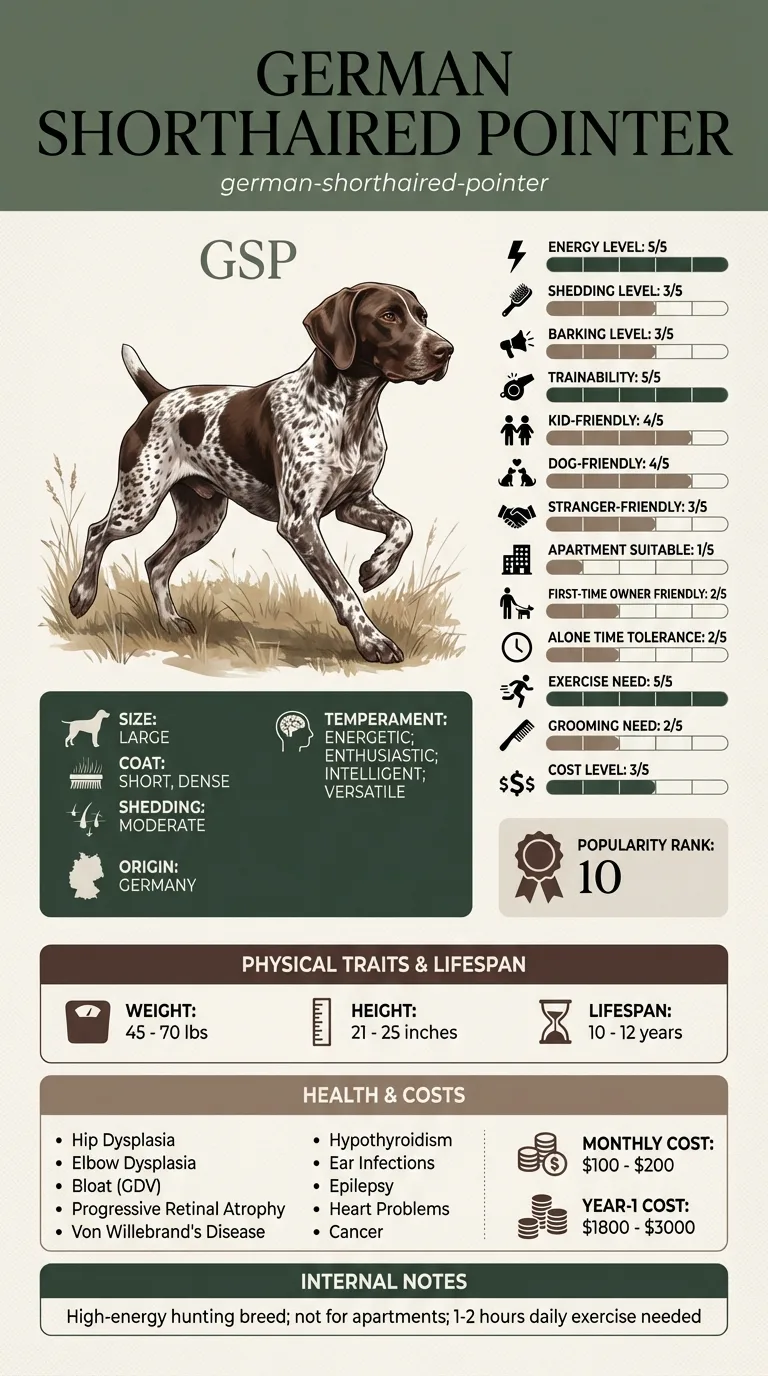
The German Shorthaired Pointer's clean-cut, long muzzle and tight facial skin, the same features that make it unsuited to brachycephalic conditions and cherry eye, leave it without the deep, moisture-trapping folds that drive true fold pyoderma in wrinkled breeds. Its high-volume fieldwork, worked one to two hours daily through cover, is what actually exposes the face to the trauma that leads to localised infection here.
Dense brush, thorny cover and contact with other animals during active fieldwork are the direct environmental drivers of facial injury. A household that does not routinely check the muzzle and face after outings is the main factor that lets a minor scratch progress to a visible infection before being noticed.
See a vet if a facial scratch or scrape shows spreading redness, swelling, thick or smelly discharge, or does not show improvement within three to five days of basic cleaning. Seek attention sooner if the dog seems painful, reluctant to eat, or if a wound is deep enough that you can see beneath the surface of the skin.
See all German Shorthaired Pointer health problems, which breeds are prone to skin infections, or the full German Shorthaired Pointer breed guide for temperament, exercise needs and ownership costs.
A minor infected scratch typically resolves within one to two weeks with basic cleaning and, if needed, a short course of prescribed treatment. This is a one-off, situational issue rather than an ongoing condition, unlike true fold pyoderma in the breeds it actually affects.
A fully healed wound with no recurrence, and a routine of post-outing face checks that catches the next scratch early enough to prevent it becoming an infection in the first place.
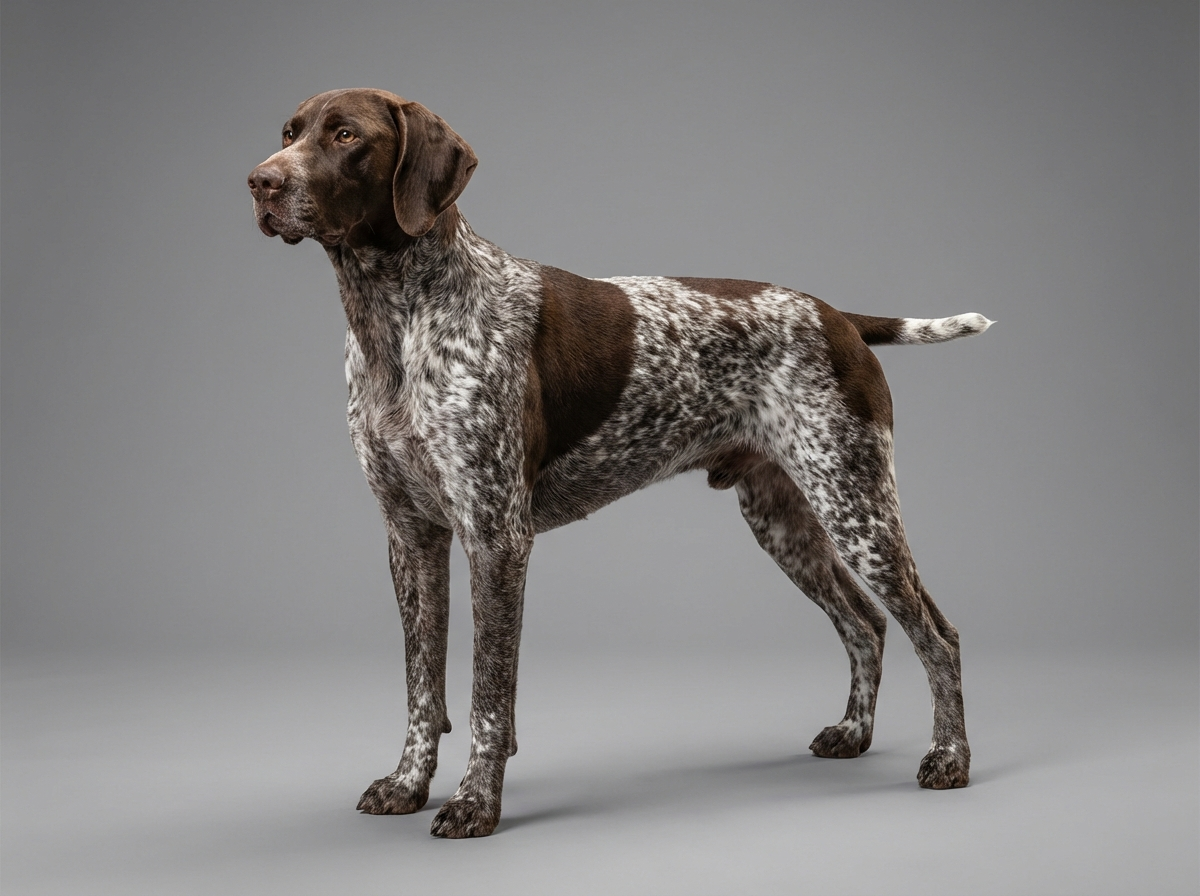
The German Shorthaired Pointer has a long, clean-lined, mesocephalic skull with tight-fitting skin and no deep facial wrinkles anywhere on the muzzle, lips or brow. This is the same tight, close-fitting facial structure already established as the reason this breed is not predisposed to cherry eye or brachycephalic breathing problems, and it works against fold pyoderma for exactly the same anatomical reason: there is no fold for moisture and debris to collect in.
What this breed's face does encounter is different: direct trauma. A dog that quarters cover with its head down, at a run, through brambles, stubble and thorny brush, collects small scratches, punctures and abrasions on the muzzle and around the mouth on a regular basis. Any of these, left unnoticed under a short coat, can become locally infected, producing a sore, sometimes weeping spot that superficially resembles what a fold infection looks like in another breed, without any fold being involved at all.
These fit the breed's actual anatomy and lifestyle far better than a fold-related diagnosis.

Greta found a small, weeping sore at the corner of Moss's mouth after a weekend of hard hunting through blackberry brush and, having read about facial fold infections in other breeds, wondered if Moss had something similar. Her vet explained plainly that Moss's face had no folds to speak of, clean and tight-skinned exactly as the breed is built, and the sore was consistent with a small puncture wound, likely a thorn, that had gone unnoticed and become locally infected. A short course of topical treatment and daily cleaning cleared it within ten days. Greta added a face check to her post-hunt routine going forward, alongside the eye check she was already doing.
Key takeaway: The diagnosis that seemed to fit from the name turned out to be anatomically impossible for this breed. The real cause was ordinary and treatable once someone looked at the actual anatomy rather than the label.
No. This breed's standard describes a clean-cut head with tight-fitting skin and no wrinkling, which is part of what distinguishes it from wrinkled breeds where fold pyoderma is a recognised problem.
In a GSP, a localised facial sore is far more likely to be an infected scratch, puncture or minor bite picked up during fieldwork than a fold-related infection, since there is no fold present to drive that specific mechanism.
Clean the area gently, watch for spreading redness or discharge, and see a vet if it worsens or does not begin improving within a few days. Many will need a short course of an appropriate topical or oral treatment prescribed by a vet.
It can contribute to localised irritation at the corners of the mouth in some individual dogs by keeping that area damp, though it is a minor and avoidable factor rather than a breed-wide predisposition.
Not directly, but infections near the base of the ear can sometimes be confused with a facial skin problem. The breed's documented tendency is specifically toward ear canal infections, a distinct issue from facial skin.
When it spreads, produces thick or smelly discharge, does not begin healing within a few days, or the dog seems painful or reluctant to eat, all of which suggest a true infection needing treatment beyond basic cleaning.
No, it has a clean, tight-skinned head with no wrinkling, unlike breeds where fold pyoderma is a real concern.
Usually infected scratches, punctures or minor bites picked up while working through brush and cover.
Gently rinse with clean water or saline and monitor for spreading redness, swelling or discharge over the following days.
It can help reduce moisture at the mouth corners for a dog prone to irritation there, though it isn't necessary for most dogs.
A routine vet visit and a short course of topical or oral treatment is a modest, one-off cost compared to most items on this breed's health list.
A one-page prep sheet for this condition: the signs, the questions to ask, what to get priced. Unlocks here.
You get: Vet visit prep sheet
No spam. One-click unsubscribe. See our privacy policy.
Preview page 1 before you decide.
Early access list
The free prep sheet covers the same-day warning signs, a symptom log and the questions to ask. We are considering a fuller kit that adds a cost worksheet for the usual tests and treatments (US price ranges with their sources) and a plain-English guide to ways of covering the bill. It is not built yet; this list tells us whether it is worth building.
One email, no spam, unsubscribe anytime. Information only, not veterinary advice.