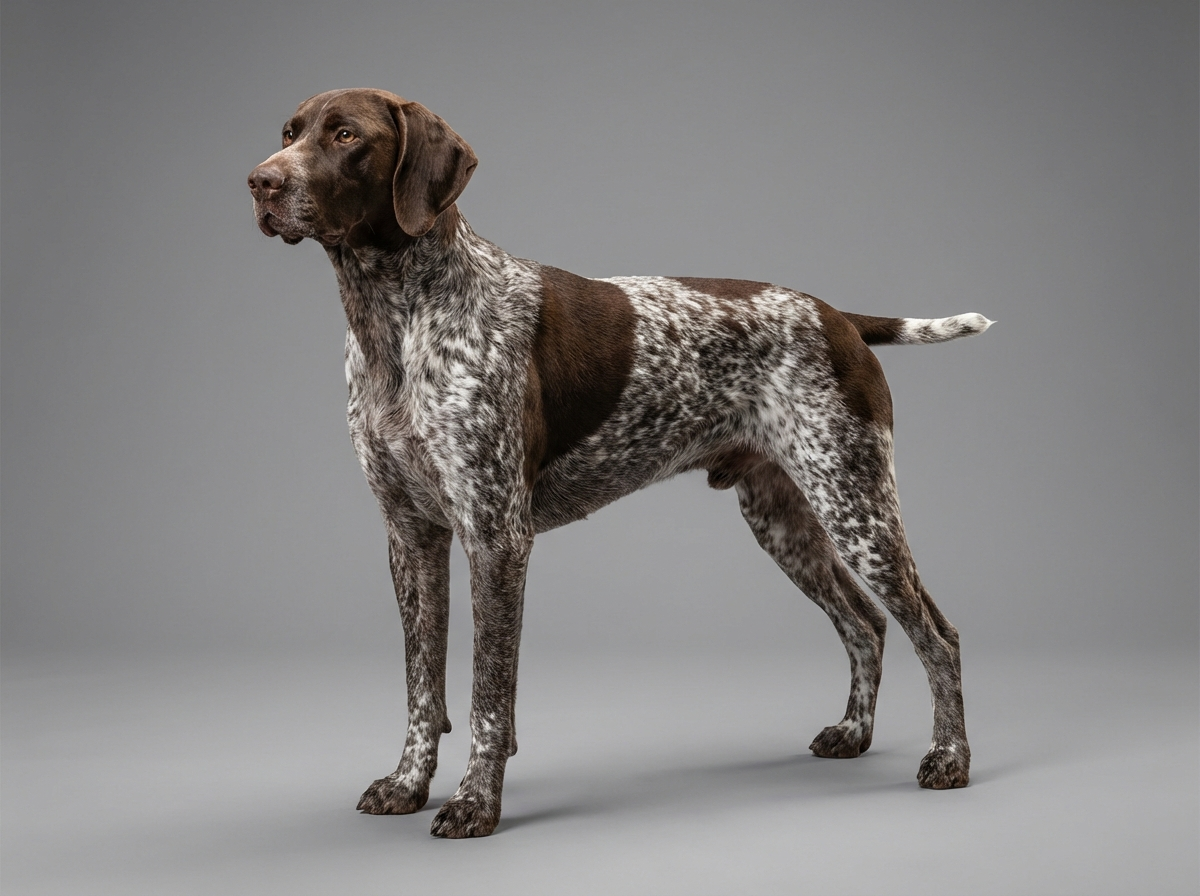
Health
Are IBD and reflux documented health issues in this breed?
No, none of these four named GI conditions appears on the German Shorthaired Pointer's recognised health list.

Quick answer
Are IBD and reflux documented health issues in this breed?
No, none of these four named GI conditions appears on the German Shorthaired Pointer's recognised health list.
The recurring vomiting or loose stools that bring most GSP owners to the vet usually turn out to be about what the dog found in the field, not an inherited bowel disease.
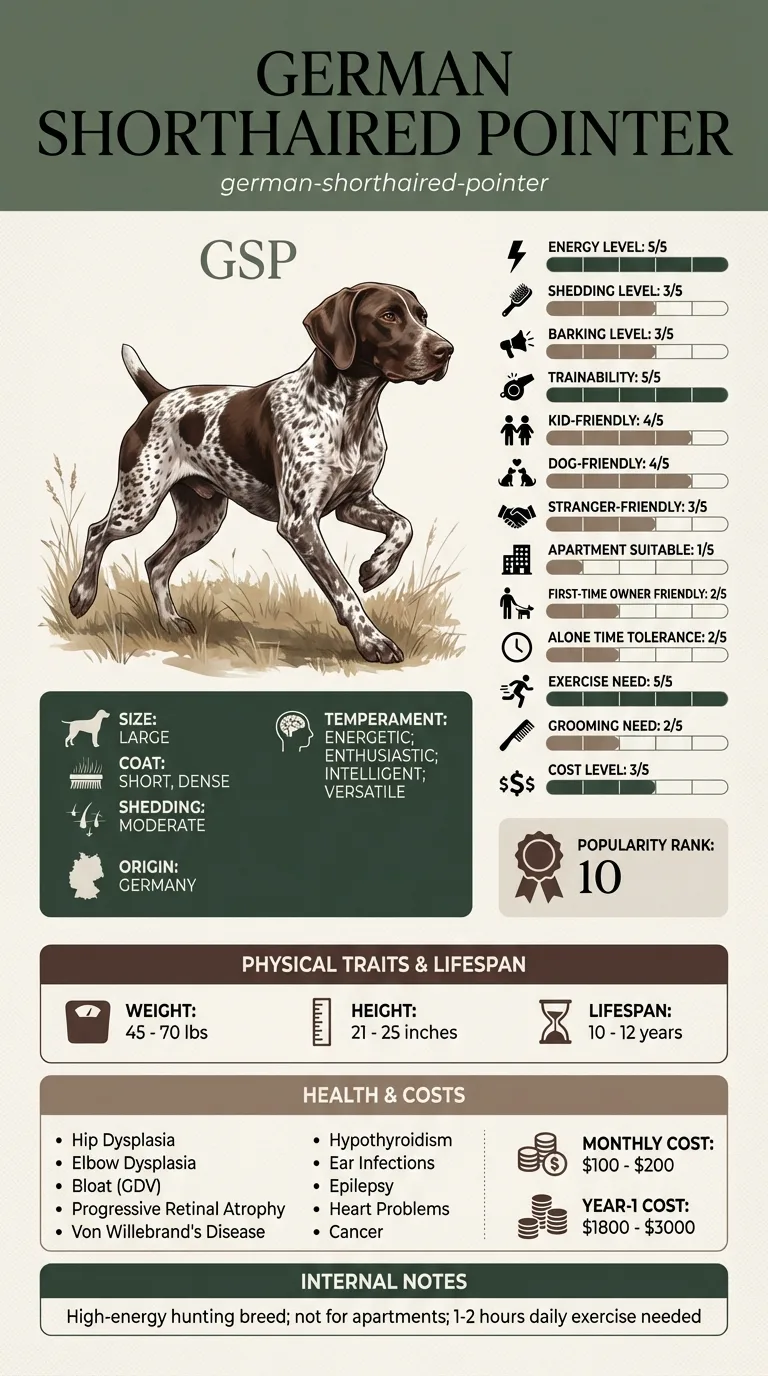
Owners of a hunting or field-trial dog with recurring digestive upsets that never quite add up to a clear pattern from week to week.
This guide is not medical advice. If your dog shows pain, sudden behavior change, or worsening symptoms, consult a licensed veterinarian.
Some links may be affiliate links. We may earn a commission at no extra cost to you. We only suggest products we believe are helpful for dog owners.
Inflammatory bowel disease, pyloric stenosis, hiatal hernia and reflux are recognised canine conditions but none is documented for the German Shorthaired Pointer specifically. The gastrointestinal symptoms this breed's owners actually see far more often trace back to dietary indiscretion from field scavenging and stress-linked upset around travel and competition.
None of these four named conditions is on the German Shorthaired Pointer's documented health list. Ordinary dietary indiscretion and short, self-resolving stress-related upset are common in any hard-working scent breed and account for the great majority of digestive complaints owners actually raise.
The German Shorthaired Pointer's job is to put its nose to the ground and follow scent through cover for hours, which means routine, largely unsupervised access to whatever a field or hedgerow contains. Its trainability rating of five out of five means most of these dogs are heavily engaged in structured work and competition, both of which carry their own travel and environment-change stress that a companion dog's routine rarely includes.
Access to carrion and droppings in working terrain, sudden food or water changes on a trial weekend, unfamiliar boarding kennels, and long vehicle travel are the main environmental contributors. None of these require any inherited predisposition to explain the pattern of symptoms owners see.
Book an appointment for vomiting or loose stool that persists beyond a few days of bland feeding, or that recurs across multiple weeks. Go the same day for blood in vomit or stool, vomiting consistently several hours after every meal, weight loss alongside digestive symptoms, or any sign of abdominal pain and distension, since the last of those overlaps with the breed's genuine bloat risk and should never be assumed to be routine.
See all German Shorthaired Pointer health problems, which breeds are prone to gastrointestinal disorders, or the full German Shorthaired Pointer breed guide for temperament, exercise needs and ownership costs.
A single dietary indiscretion episode typically resolves within two to four days of bland feeding. Stress-related colitis around travel usually clears within a similar window once the dog is back in a familiar routine. Anything that persists past two weeks or recurs across several separate incidents warrants diagnostic workup rather than continued at-home management.
Occasional, brief, self-resolving episodes tied to an identifiable trigger, rather than an ongoing pattern with no clear cause. A dog whose weight and appetite stay stable between episodes is generally not dealing with the chronic named conditions this page opens with.
Inflammatory bowel disease is chronic inflammation of the gut lining that causes ongoing vomiting, diarrhoea or weight loss over weeks to months. Pyloric stenosis is a narrowing at the stomach's outlet that causes vomiting of food some hours after eating, usually diagnosed in young dogs. A hiatal hernia lets part of the stomach slide up through the diaphragm, and acid reflux is the resulting backflow of stomach contents into the oesophagus. None of these four appears on the German Shorthaired Pointer's documented health list, and none is a condition this breed is known to carry more of than any other.
What is genuinely common in this breed, and gets mistaken for one of the above, is dietary indiscretion: eating carrion, other animals' droppings, or prey remains found while working cover, all of which a scent-driven hunting dog encounters routinely and a companion breed rarely does. A weekend of competition or unfamiliar kennel boarding can also trigger stress-related loose stools that resolve on their own within days. Both produce symptoms that look, on the surface, like the start of something chronic, and both are far more likely explanations for a GSP than any of the four named conditions above.
Most single episodes resolve without becoming anything. These patterns are the exception.

If you think your GSP has gastrointestinal disorders, the plan is three steps: write down what you have seen and when it started, book a veterinary appointment rather than waiting for the next flare, and take video of the behaviour or symptom before you go — the thing you are worried about rarely happens in the consulting room. Screening in the parents covers hip dysplasia, elbow dysplasia, bloat (gdv).
What the vet visit should produce is a diagnosis and a written plan, not just reassurance: what is being ruled out, what the monitoring interval is, and which signs mean you come back sooner. Ask what the treatment costs across a year rather than per visit, because that is the number that decides whether you are managing this condition or reacting to it.
Between appointments, keep a short log — dates, what you saw, what changed. It is the single most useful thing an owner brings to a follow-up, and for gastrointestinal disorders it is often what separates a clear pattern from a guess.
Marsh threw up two or three times every trial weekend for most of a season, and his owner, Devon, worried something chronic was developing. Bloodwork and an ultrasound found no structural abnormality, no pyloric narrowing and no sign of inflammatory disease. What emerged from a detailed history was the actual pattern: Marsh scavenged constantly during off-lead searches in unfamiliar terrain, and the change in food, water and kennel environment on travel weekends compounded it. At home, working familiar ground with his usual routine, he never had an episode. Devon tightened up Marsh's 'leave it' response for search work and started bringing his own food and water on every trip. The vomiting all but stopped.
Key takeaway: A symptom that looks chronic because it keeps recurring can still have an entirely situational cause. The pattern of when it happens told the real story here, not a diagnosis.
Not documented. None of inflammatory bowel disease, pyloric stenosis, hiatal hernia or reflux appears on this breed's recognised health list, and there is no known elevated risk for any of them in German Shorthaired Pointers specifically.
Dietary indiscretion is the leading explanation for a scent-driven working dog. A nose-down search through cover finds things a dog was never fed, and an occasional bout of vomiting or loose stool afterward is a common, usually self-limiting, consequence.
The pattern is the tell: vomiting occurring reliably some hours after eating, of partly digested food, rather than immediately or randomly. It typically shows up in puppies or young dogs and needs imaging to confirm.
Yes. Competition, travel and unfamiliar boarding are recognised triggers for a short bout of stress-related diarrhoea in dogs generally, and a breed that trials or hunts regularly is exposed to these triggers more often than a companion dog.
Once it has recurred across several weeks, or come with weight loss, blood, or a consistent multi-hour delay after eating, it has moved past what a bland diet and a wait-and-see approach should be expected to fix.
No, these are separate mechanisms. Bloat is a structural, acute, life-threatening rotation of the stomach and is covered on its own. These are chronic or intermittent digestive issues without the rotation, and the two should not be confused when deciding how urgently to act.
No, none of these four named GI conditions appears on the German Shorthaired Pointer's recognised health list.
Dietary indiscretion from field scavenging, followed by stress-related upset around travel or competition.
A few days at most with a bland diet. Symptoms recurring across several weeks warrant a proper workup.
Bloodwork and imaging to rule out structural causes is a meaningful but not extreme cost; it is far less than emergency bloat surgery.
Not entirely, but a solid 'leave it' cue and close handler awareness during searches reduce how much a dog manages to eat unsupervised.
A one-page prep sheet for this condition: the signs, the questions to ask, what to get priced. Unlocks here.
You get: Vet visit prep sheet
No spam. One-click unsubscribe. See our privacy policy.
Preview page 1 before you decide.