Health
Are German Shorthaired Pointers prone to hip dysplasia?
It is listed first among the breed's documented health issues. That means it occurs meaningfully often, not that most GSPs are affected.

Quick answer
Are German Shorthaired Pointers prone to hip dysplasia?
It is listed first among the breed's documented health issues. That means it occurs meaningfully often, not that most GSPs are affected.
The hip does not wear out and become loose. It is loose first, and the wearing out is the consequence.
Owners of a limping young adult who assumed a strain, people choosing between two puppies with different hip paperwork, and anyone raising a large sporting puppy who has been told conflicting things about how much exercise is safe.
This guide is not medical advice. If your dog shows pain, sudden behavior change, or worsening symptoms, consult a licensed veterinarian.
Some links may be affiliate links. We may earn a commission at no extra cost to you. We only suggest products we believe are helpful for dog owners.
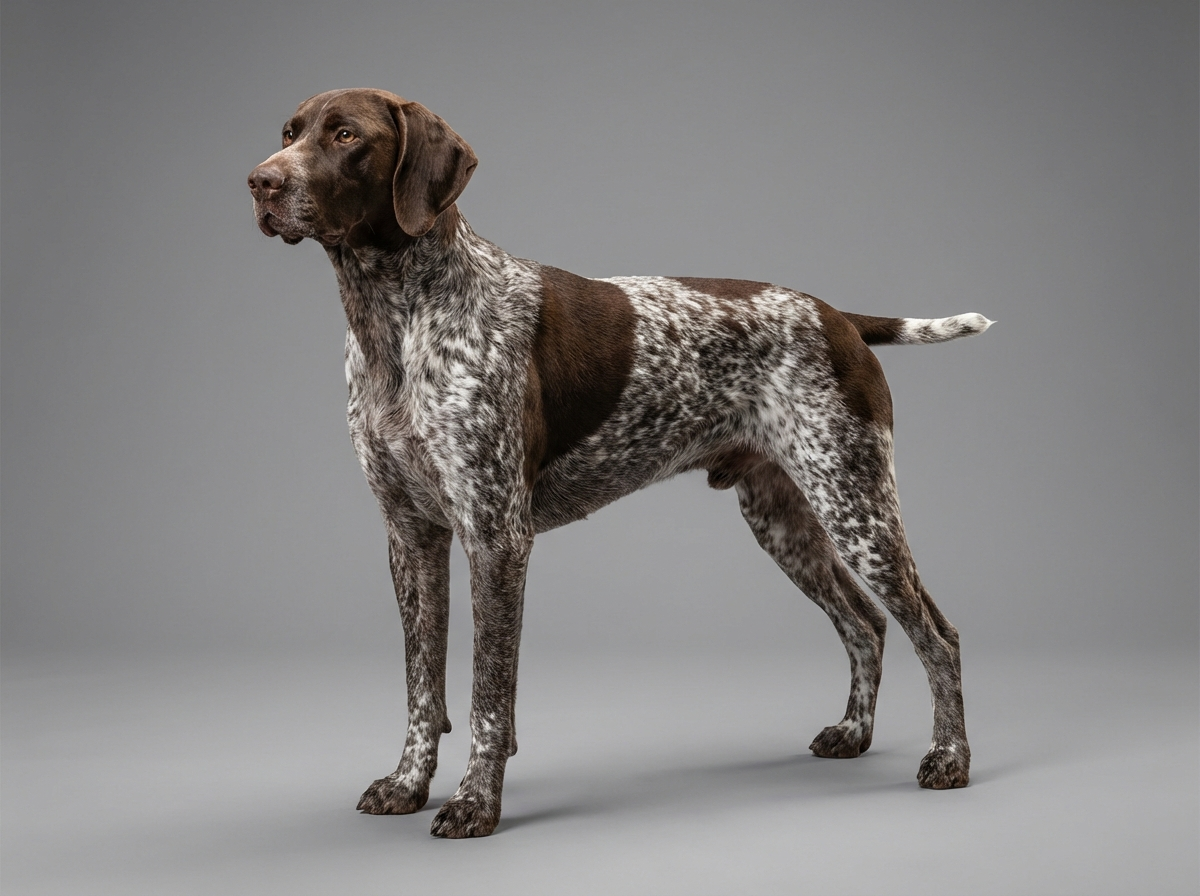
Hip dysplasia is a developmental failure of the hip joint to form a tight ball-and-socket fit. The femoral head slides within a shallow socket, concentrating force on a small area of cartilage and stretching the joint capsule, and the body responds by laying down new bone. In German Shorthaired Pointers the practical picture is often a young dog that is briefly sore during growth, apparently fine through its athletic prime, then increasingly stiff from middle age as arthritis accumulates.
Hip dysplasia is the first entry on this breed's documented health list, which places it among the conditions GSP owners are most likely to encounter, though the majority of individual dogs still live without a clinically significant hip problem. Because the breed ranks about tenth in popularity there are a great many GSPs, so affected dogs are visible in breed communities in numbers that can make the condition feel inevitable when it is not.
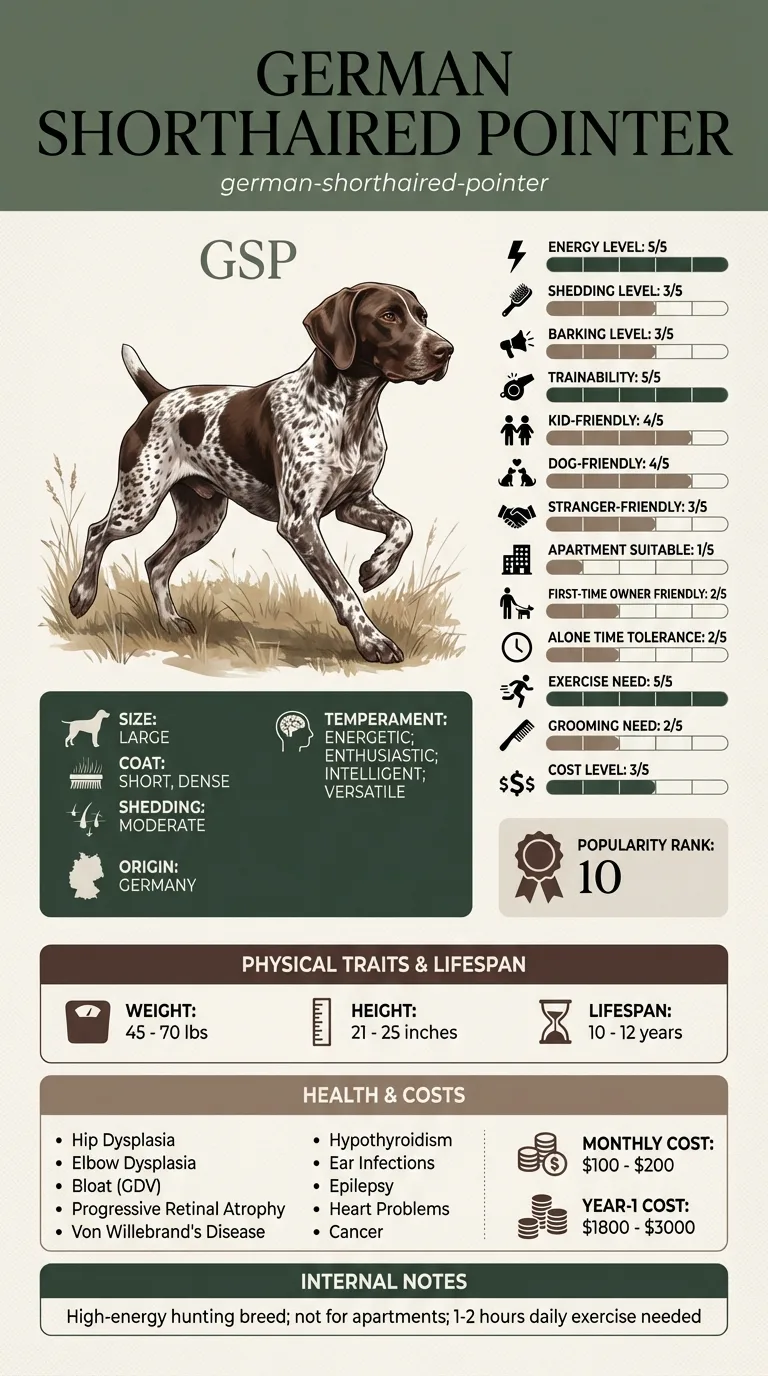
Size and growth rate are the structural drivers. A German Shorthaired Pointer goes from a small puppy to a 45 to 70 pound, 21 to 25 inch adult in under a year, and joints assembling that quickly have less margin for error. The breed's documented inclusion of hip dysplasia indicates heritable predisposition in the population, so parentage genuinely matters. Athleticism then interacts with the anatomy in a specific way: a dog rated five out of five for exercise need loads its hips harder and more often than a sedentary dog of the same conformation, which shortens the interval between laxity and visible arthritis.
Rearing choices in the first year carry more weight than anything that happens later. Overfeeding, calorie-dense adult food given to a growing puppy, and encouragement of fast growth all worsen outcomes. Household surfaces matter, particularly laminate and tile in the corridors a puppy sprints down. Exercise type matters more than exercise quantity: self-directed play is protective, while forced repetition on hard ground is not. In adulthood, the swing between sedentary weekdays and intense weekends is a poor pattern for an already compromised joint.
Book promptly for a young dog that is bunny-hopping, reluctant to rise, or newly unwilling to jump into a vehicle, since intervention during growth has options that are unavailable later. Seek urgent care for a sudden non-weight-bearing lameness, which suggests an acute injury such as a cruciate rupture rather than gradual dysplasia, and for any hind-limb weakness accompanied by cold feet or an inability to stand. Book a routine appointment to discuss long-term pain management if you notice stiffness after rest, loss of muscle over the rump, or a dog that is choosing shorter walks. Never give human pain medication to a dog; several common ones are seriously toxic.
See all German Shorthaired Pointer health problems, which breeds are prone to hip dysplasia, or the full German Shorthaired Pointer breed guide for temperament, exercise needs and ownership costs.
Diagnosis usually follows a lameness workup and radiographs within a few weeks. Conservative management shows meaningful change over two to three months once weight loss and a rehabilitation programme are genuinely underway, not in a fortnight. If surgery is chosen, recovery and rehabilitation typically run three to six months. Hip dysplasia is then a lifelong management project measured in years, not a course of treatment.
Success is a comfortable dog with a full daily routine at a modified intensity, stable body weight, maintained hind-end muscle, and no bad days after ordinary exercise. For a working GSP it may mean shorter, more frequent outings instead of all-day hunts. Success does not mean normal radiographs, because the joint shape will not change, and chasing that goal leads owners toward interventions their dog does not need.
A normal hip is a deep socket holding a round femoral head snugly, so force travels evenly across a wide surface. In dysplasia the socket is shallower and the fit is loose, so during movement the head slides rather than rotating cleanly in place.
That sliding does two things. It concentrates force onto a small rim of cartilage rather than spreading it, and it repeatedly stretches the joint capsule. The body's response to an unstable joint is to stiffen it with new bone, which is what arthritis actually is in this context: a structural repair job that trades range of motion for stability.
This sequence explains the odd two-phase pattern owners describe. Many affected dogs are sore between roughly five and twelve months, when laxity is worst and the joint is still remodelling, then improve markedly through young adulthood as the joint stabilises, then decline again in middle age as accumulated arthritis takes over.
A German Shorthaired Pointer that limped at eight months, seemed cured at two years, and is stiff at seven has not developed a new problem. It is the same problem finishing its arc.
Genetics set the range of possible outcomes. Rearing decides where in that range a particular dog lands, and the decisions are made before twelve months.

If you think your GSP has hip dysplasia, the plan is three steps: write down what you have seen and when it started, book a veterinary appointment rather than waiting for the next flare, and take video of the behaviour or symptom before you go — the thing you are worried about rarely happens in the consulting room. Screening in the parents covers hip dysplasia, elbow dysplasia, bloat (gdv).
What the vet visit should produce is a diagnosis and a written plan, not just reassurance: what is being ruled out, what the monitoring interval is, and which signs mean you come back sooner. Ask what the treatment costs across a year rather than per visit, because that is the number that decides whether you are managing this condition or reacting to it.
Between appointments, keep a short log — dates, what you saw, what changed. It is the single most useful thing an owner brings to a follow-up, and for hip dysplasia it is often what separates a clear pattern from a guess.
Juno limped after a long beach day at eight months old. Radiographs showed shallow sockets on both sides. Her owner, Beatriz, was told to keep her lean, stop the bike runs and revisit if things worsened. Juno then had six unremarkable years. She hunted, swam, and gave no trouble at all, and Beatriz half assumed the diagnosis had been overcautious. At seven she started taking a moment to stand up after a nap, and a phone video Beatriz had filmed each spring showed her rear track had narrowed noticeably compared with the year before. A rehabilitation programme, a small weight reduction and a change from long weekend hunts to daily hour-long trots kept her working two more seasons.
Key takeaway: The quiet middle years are not remission, and they are the time to build the habits that pay off later. A short video of your dog trotting away, filed once a year, is the cheapest monitoring tool available.
Watch for a bunny-hopping gait where both hind legs move together at speed, reluctance to jump into the car, difficulty rising after sleep, a narrow hind stance, and a shifting of weight forward that gradually builds shoulder muscle while the rump muscle thins. Many affected dogs never obviously limp, which is why the muscle asymmetry is such a useful sign.
Yes, and in this breed that is common. Radiographic changes correlate poorly with how much a dog complains, and a stoic, driven sporting dog will work through discomfort that would make a less motivated dog stop. Radiographs and how a dog behaves are two different pieces of information.
There is evidence that early removal of sex hormones delays growth plate closure and alters limb proportions, and studies in several large breeds have found associations with joint disease. It is a genuine discussion to have with your vet for a dog of this size rather than a settled matter, and the right answer varies with the individual dog and household.
Often not. Many dogs are managed for years with weight control, structured exercise, physiotherapy and veterinary pain management. Surgical options exist and range from procedures done in young puppies to joint replacement in adults, but they are chosen for specific situations rather than applied to every diagnosis. Severity and the dog's function drive the decision.
Consistent, moderate, low-impact work beats weekend intensity. Swimming is excellent because it builds the gluteal and hamstring muscles that stabilise the joint without loading it. Steady trotting on soft, even ground is good. Repeated sprinting, sharp turns, and jumping are the activities that cost the most.
Not with certainty, but it substantially shifts the odds. Hip scoring on both parents, and ideally on grandparents and siblings, is the single most informative thing a breeder can show you. A breeder who scores hips and shares the numbers openly, including mediocre ones, is giving you more useful information than one who simply says the line is sound.
It is listed first among the breed's documented health issues. That means it occurs meaningfully often, not that most GSPs are affected.
Signs often appear between five and twelve months during the phase of greatest joint laxity, though many dogs stay comfortable until arthritis accumulates in middle age.
Free play the puppy controls itself, in short frequent bouts, rather than forced repetitive distance work. Save structured endurance work until after growth plates close.
It is the most powerful thing an owner controls. Lean body condition during growth and throughout life measurably reduces both the severity of hip disease and how early it becomes painful.
Ongoing costs sit in physiotherapy, veterinary pain management and rechecks, added to typical GSP running costs of 100 to 200 dollars monthly. Surgical management is a far larger one-off.
A one-page prep sheet for this condition: the signs, the questions to ask, what to get priced. Unlocks here.
You get: Vet visit prep sheet
No spam. One-click unsubscribe. See our privacy policy.
Preview page 1 before you decide.