Health
Is the POMC obesity gene found in GSPs?
No, it is documented in Labrador and Flat-Coated Retrievers, not in German Shorthaired Pointers.

Quick answer
Is the POMC obesity gene found in GSPs?
No, it is documented in Labrador and Flat-Coated Retrievers, not in German Shorthaired Pointers.
A viral headline about a 'fat gene' in dogs is usually about retrievers, not pointers, and borrowing it to explain a GSP's rising weight skips past the causes that actually apply to this breed.
Owners who have read about the retriever appetite gene and want to know whether it explains their own dog's weight gain, or whether they are missing something more relevant.
This guide is not medical advice. If your dog shows pain, sudden behavior change, or worsening symptoms, consult a licensed veterinarian.
Some links may be affiliate links. We may earn a commission at no extra cost to you. We only suggest products we believe are helpful for dog owners.
A specific, well-studied gene mutation linked to increased appetite exists in dogs, but it has been documented in Labrador and Flat-Coated Retrievers, not in the German Shorthaired Pointer. Borrowing that explanation for a GSP's weight gain overlooks the causes that genuinely apply to this breed, chief among them hypothyroidism, which is on its documented health list.
The POMC deletion itself is not documented in this breed at all. Weight gain generally is common in the breed for the reasons already established elsewhere on the health list, but the specific single-gene explanation that gets attached to it online does not apply here.
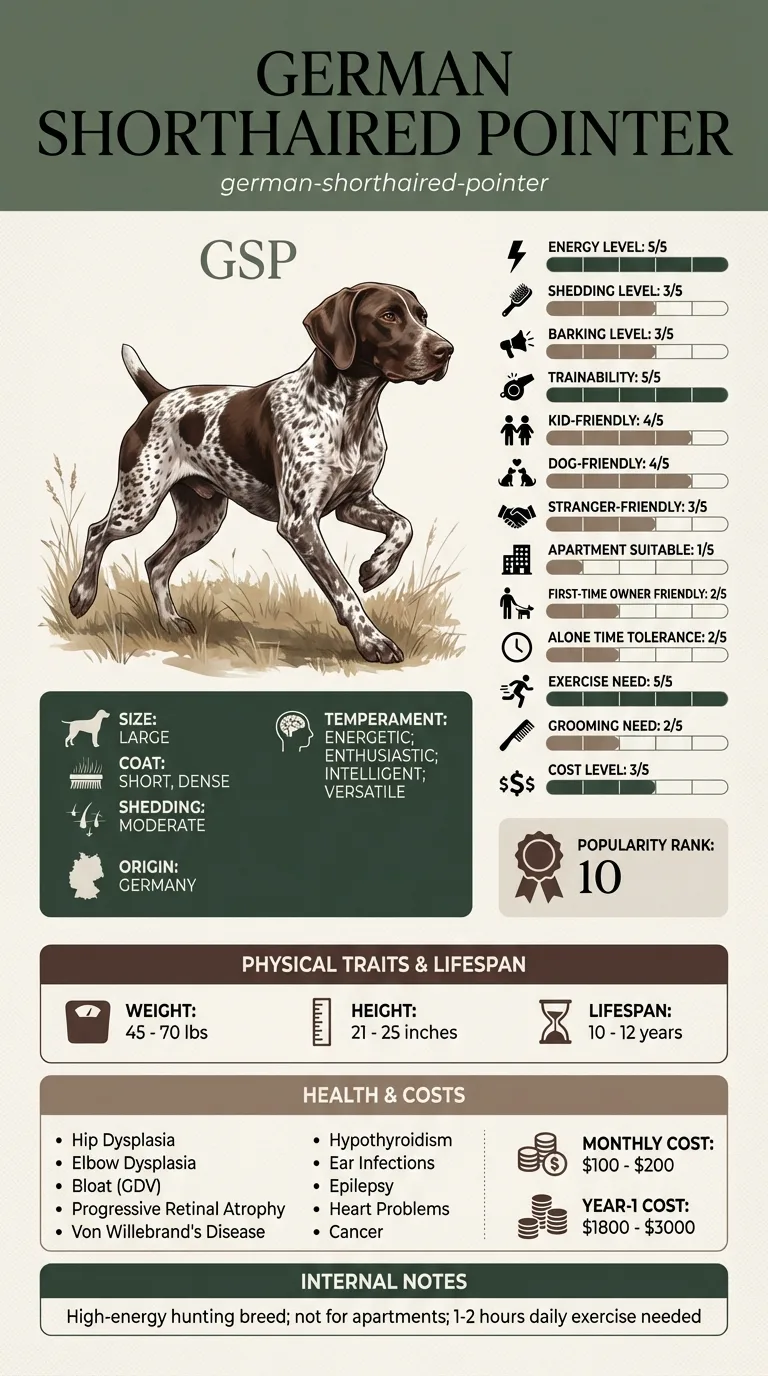
The German Shorthaired Pointer's documented health list includes hypothyroidism, which is the genuinely relevant endocrine explanation for unexplained appetite and weight changes in this breed. Its trainability rating of five out of five also means these dogs are trained often and rewarded often, creating a treat-calorie stream that has nothing to do with genetics and everything to do with how the dog spends its day.
A demanding exercise requirement, rated five out of five with one to two hours of daily activity expected, combined with a low apartment-suitability rating, describes a dog whose energy needs are genuinely difficult to fully meet in many modern households. When exercise supply drops below what the breed requires, weight gain follows regardless of any genetic explanation.
Book a vet visit for any unexplained increase in appetite or weight gain despite unchanged feeding, sluggishness, coat changes, or weight gain that does not respond to a genuine increase in exercise and reduction in food. These are the pattern that points toward hypothyroidism rather than simple lifestyle mismatch, and only bloodwork can tell the two apart.
See all German Shorthaired Pointer health problems, which breeds are prone to genetic predisposition to obesity, or the full German Shorthaired Pointer breed guide for temperament, exercise needs and ownership costs.
A thyroid panel returns results within days. If hypothyroidism is confirmed and treated, appetite and energy typically improve within four to eight weeks. If the cause is lifestyle mismatch rather than a medical condition, steady weight loss with consistent measured feeding and increased exercise is realistic over two to four months.
A clear answer about which explanation actually applies, followed by a stable, appropriate weight maintained through measured feeding and exercise that matches the breed's real needs, rather than continued uncertainty about an unlikely genetic cause.
The POMC deletion disrupts production of hormones that normally signal satiety after eating, so affected dogs feel hungrier and beg more persistently than littermates without the mutation, independent of how much they are actually fed. It is a specific, identified deletion, discovered through genetic research concentrated in Labrador and Flat-Coated Retrievers, and it is testable in those breeds through commercial DNA panels.
Genetic findings in one breed do not automatically apply to another, even a related sporting breed. The German Shorthaired Pointer has not been shown to carry this deletion, and it does not appear on the breed's documented health list in any form. Treating a retriever-specific finding as an explanation for a GSP's appetite skips past a genuine, breed-relevant answer that is sitting on the same documented list: hypothyroidism, an endocrine condition that slows metabolism and increases apparent hunger, and one this breed is actually recognised to carry.
None of these require a single-gene mutation to explain, and all are worth ruling out or addressing before assuming genetics is the cause.

If you think your GSP has genetic predisposition to obesity, the plan is three steps: write down what you have seen and when it started, book a veterinary appointment rather than waiting for the next flare, and take video of the behaviour or symptom before you go — the thing you are worried about rarely happens in the consulting room. Screening in the parents covers hip dysplasia, elbow dysplasia, bloat (gdv).
What the vet visit should produce is a diagnosis and a written plan, not just reassurance: what is being ruled out, what the monitoring interval is, and which signs mean you come back sooner. Ask what the treatment costs across a year rather than per visit, because that is the number that decides whether you are managing this condition or reacting to it.
Between appointments, keep a short log — dates, what you saw, what changed. It is the single most useful thing an owner brings to a follow-up, and for genetic predisposition to obesity it is often what separates a clear pattern from a guess.
Tomas noticed his spayed GSP, Clove, seemed hungrier than ever about a year after her surgery, and had read about the retriever appetite mutation online. Wondering if GSPs carried something similar, he raised it with his vet, who explained the mutation was specific to retriever breeds and not something relevant to test for in Clove. A physical exam and bloodwork instead found low thyroid hormone levels. Clove's persistent hunger, weight gain and recently duller coat all fit a hypothyroidism picture far better than an untested genetic theory borrowed from a different breed. Her vet started thyroid hormone replacement, and within two months Tomas noticed her appetite settling and her energy picking back up.
Key takeaway: The genetic explanation that felt like an answer was the wrong one for this breed. The real cause was sitting on Clove's own documented health list the whole time, and a simple blood test found it.
Yes, the POMC deletion is a real, well-documented mutation, but it has been identified specifically in Labrador Retrievers and Flat-Coated Retrievers, not in German Shorthaired Pointers.
It has not been documented in this breed, and there is no established basis for testing a GSP for a retriever-specific deletion and expecting a meaningful result. If appetite and weight are a genuine concern, a thyroid panel is a more relevant test for this breed.
Persistent hunger in this breed is more usefully investigated through hypothyroidism screening, feeding amount relative to activity level, and neuter status, rather than assumed to be an inherited appetite gene.
Yes, it appears on the German Shorthaired Pointer's recognised health list, and it is a genuine, testable cause of both weight gain and increased appetite that is far more relevant here than a retriever-specific gene.
Yes, altered dogs generally have a lower metabolic rate than intact dogs of the same size, and feeding amounts set before neutering are a common, overlooked cause of gradual weight gain afterward.
It is more accurate to call it manageable than to call it anyone's fault. A demanding, high-energy breed in a household that cannot fully match its exercise needs is a common and fixable mismatch, not a moral failing.
No, it is documented in Labrador and Flat-Coated Retrievers, not in German Shorthaired Pointers.
A thyroid panel, since hypothyroidism is documented in this breed and directly affects appetite and weight.
Yes, altered dogs typically need less food than before the procedure, and feeding amounts are often not adjusted downward.
It is a routine bloodwork add-on at most general veterinary practices, considerably less than ongoing costs of untreated obesity-related joint disease.
Yes, in a breed trained heavily because it learns quickly, treat calories add up in a way that is easy to underestimate over months.
A one-page prep sheet for this condition: the signs, the questions to ask, what to get priced. Unlocks here.
You get: Vet visit prep sheet
No spam. One-click unsubscribe. See our privacy policy.
Preview page 1 before you decide.