Health
What does stage B2 mean for a German Shorthaired Pointer?
The heart has measurably enlarged but the dog still feels well. This is usually where daily medication begins, because starting before symptoms appear extends the symptom-free period.

Quick answer
What does stage B2 mean for a German Shorthaired Pointer?
The heart has measurably enlarged but the dog still feels well. This is usually where daily medication begins, because starting before symptoms appear extends the symptom-free period.
Nobody treats a diagnosis. Vets treat a stage, and a GSP can sit in an early stage for years without a single pill.
People handed a letter-and-number label such as stage B2 with no explanation, owners deciding whether to change food after reading about grain-free diets, and anyone trying to work out whether their dog is sick now or only might be later.
This guide is not medical advice. If your dog shows pain, sudden behavior change, or worsening symptoms, consult a licensed veterinarian.
Some links may be affiliate links. We may earn a commission at no extra cost to you. We only suggest products we believe are helpful for dog owners.
Acquired heart disease in German Shorthaired Pointers usually presents one of two ways: a murmur picked up on a routine exam, or a stretched, weakened heart muscle found when someone investigates falling stamina. Neither is a single event. Both are staged conditions that can sit quietly for years, and the practical work of ownership is monitoring the rung rather than reacting to the label.
Most German Shorthaired Pointers never receive a cardiac stage. Heart problems appear on the breed's documented health list because they occur more than incidentally, not because they are typical. What is common is the intermediate experience: a soft murmur noted in a middle-aged dog that never progresses past the first rung of the ladder.
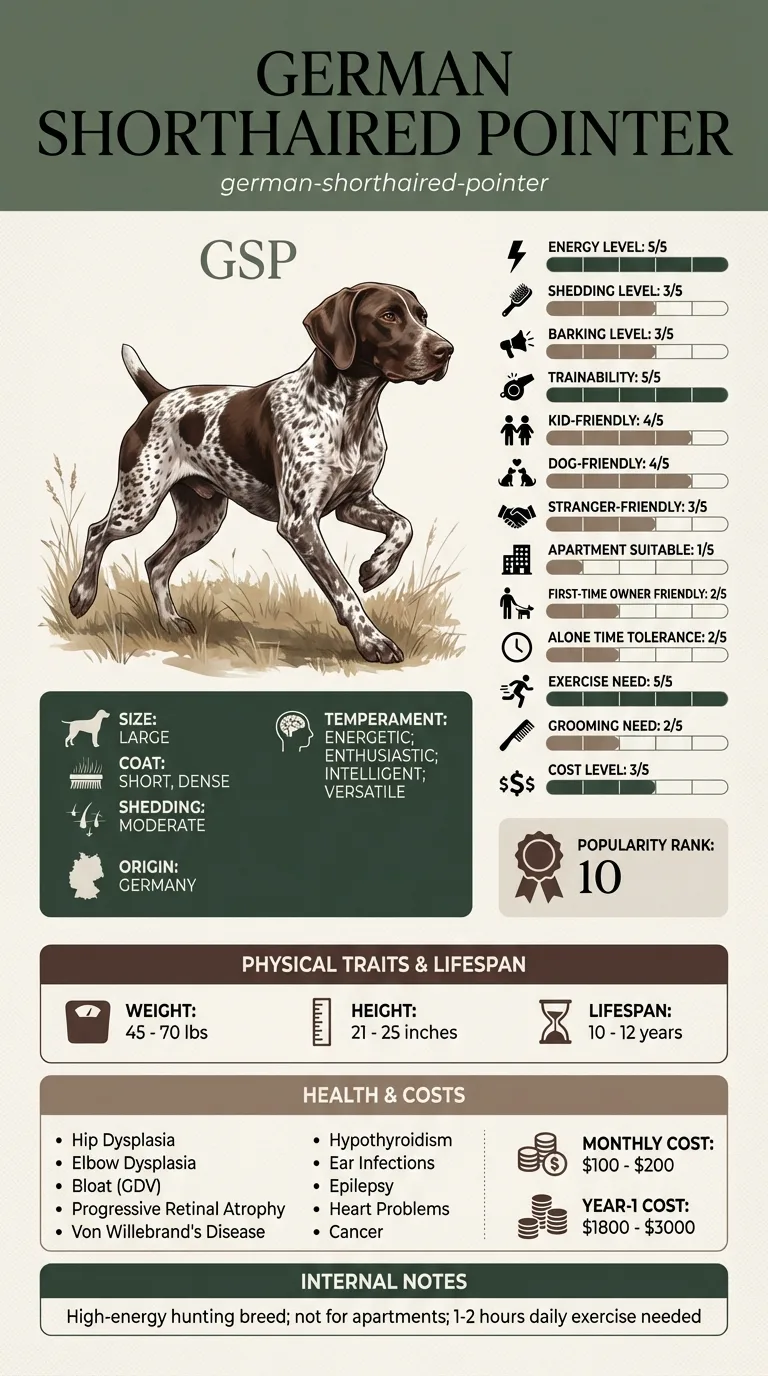
The German Shorthaired Pointer is a large, deep-chested dog of 45 to 70 pounds and 21 to 25 inches, built in Germany for all-day fieldwork. Larger sporting breeds are disproportionately represented in muscle disease rather than valve disease, which is why a heart complaint in a GSP is investigated differently from the same complaint in a small companion breed. Heart problems being named on the breed's documented list also means line-specific inheritance is plausible, so a sibling or parent history is genuinely relevant information.
Diet composition is the environmental factor with the clearest cardiac link, and in a food-motivated working dog the treats and field snacks matter as much as the kibble. Body condition is the second: a GSP allowed to drift above the lean end of its weight range carries that load continuously. Exercise patterning is the third. Long inactive weekdays followed by an all-day weekend hunt is a harder demand profile on a compromised heart than consistent daily work would be.
Treat these as same-day emergencies: laboured or open-mouth breathing at rest, a sleeping breath rate far above baseline, gums that look grey or bluish, collapse, or a swollen abdomen combined with lethargy. Book within days for a new cough that is worse when lying down, a sudden reluctance to climb stairs or jump into the vehicle, or unexplained weight loss in a dog eating normally. Book at the next available slot for a newly detected murmur, a stage recheck that has slipped past its due date, or any change in your recorded stamina log.
See all German Shorthaired Pointer health problems, which breeds are prone to heart disease, or the full German Shorthaired Pointer breed guide for temperament, exercise needs and ownership costs.
Staging usually takes a single specialist visit once you are in the door, but getting there commonly runs three to eight weeks. After medication begins at stage B2, expect a reassessment within a few months and then a settled rhythm of rechecks. Many dogs hold a stage for a year or more. Nobody can tell you at diagnosis how long your dog will hold his.
Success at an early stage means nothing changes: same dog, same walks, one extra appointment a year. Success at a treated stage means a stable sleeping breath rate, a normal appetite on medication, and rechecks where the measurements have not moved much. It does not mean returning to the previous field season, and it does not mean the heart returns to normal shape.
Veterinary cardiology uses a four-rung ladder. Knowing which rung your dog is on tells you more than the disease name does.
Owners of sporting breeds hear a lot about food and heart muscle disease, usually framed as a warning about grain-free or boutique formulas. Here is the honest position.
There is a recognised association between certain unconventional diets and a dilated heart in dogs, and in some of those cases the heart improved after the food changed. There is also inherited muscle disease that has nothing to do with what is in the bowl. The two look similar on an ultrasound.
What that means practically is not that you should panic about a bag of food. It means that if your GSP is diagnosed with a dilated heart, your cardiologist will want a complete diet history, including treats, table scraps and whatever gets fed in the field, because a diet-associated case has a genuinely better outlook.
Do not change food yourself the week before an appointment. You will erase the information the specialist needs. Photograph the label, bring it, and let the diet review happen properly.

If you think your GSP has heart disease, the plan is three steps: write down what you have seen and when it started, book a veterinary appointment rather than waiting for the next flare, and take video of the behaviour or symptom before you go — the thing you are worried about rarely happens in the consulting room. Screening in the parents covers hip dysplasia, elbow dysplasia, bloat (gdv).
What the vet visit should produce is a diagnosis and a written plan, not just reassurance: what is being ruled out, what the monitoring interval is, and which signs mean you come back sooner. Ask what the treatment costs across a year rather than per visit, because that is the number that decides whether you are managing this condition or reacting to it.
Between appointments, keep a short log — dates, what you saw, what changed. It is the single most useful thing an owner brings to a follow-up, and for heart disease it is often what separates a clear pattern from a guess.
Bode was six when a locum vet noted a soft murmur during a nail trim. His owner, Idris, expected bad news and got something stranger: an echocardiogram, a stage B1 label, and instructions to come back in a year with no medication at all. Idris found the waiting harder than treatment would have been. He started counting Bode's sleeping breaths on Sunday evenings, wrote the number on the kitchen calendar, and kept hunting him through three more autumns. At the fourth recheck the measurements had barely shifted. Bode was still B1 at nine years old. The calendar had roughly a hundred and fifty numbers on it, all in the same narrow range, which the cardiologist called the most useful chart in the file.
Key takeaway: An early cardiac stage is not a countdown. For many German Shorthaired Pointers the correct response is a boring annual recheck and a habit of counting breaths, sustained for years without drama.
Generally no. B1 means the murmur exists but the heart has not changed shape, and current evidence does not support treating a heart that has not remodelled. What B1 does earn is a scheduled recheck, usually six to twelve months out, so the move to B2 is caught the moment it happens.
There is no fixed rate. Muscle disease tends to move faster than valve degeneration, and a GSP diagnosed at six years may look very different from one diagnosed at ten. Serial imaging is the only way to know your own dog's trajectory, which is why the recheck interval matters more than the original label.
Count sleeping breaths. A rate that climbs above your dog's established baseline and stays there for two or three days is the earliest reliable indicator that fluid is accumulating, and it often gives you several days of warning before anything is visible.
It can. Hypothyroidism is on this breed's documented health list, and low thyroid hormone slows heart rate and reduces contractile strength. That is one reason a cardiac workup in a GSP frequently includes a thyroid panel, and why treating the thyroid sometimes improves cardiac numbers.
At stage B1, usually yes with sensible heat management. From B2 onward it becomes a specific conversation about intensity ceilings. At stage C, sustained field work is generally off the table, though scent games and short controlled outings usually are not.
They sound different once you know what to listen for. A cardiac cough tends to be soft, wet and worse after lying down, and it comes with faster resting breathing. An infectious cough is typically harsh, honking and comes in fits regardless of position. Both need a vet, but the urgency differs.
The heart has measurably enlarged but the dog still feels well. This is usually where daily medication begins, because starting before symptoms appear extends the symptom-free period.
Discuss it with your vet rather than changing on your own, and never change diet right before a cardiac appointment. The specialist needs an accurate diet history to interpret the ultrasound.
Typically every six to twelve months in early stages, tightening to every three to six months once medication starts or the chambers begin enlarging.
The breed rates one out of five for apartment suitability regardless of health. A cardiac diagnosis lowers the exercise ceiling but does not lower the mental stimulation the dog needs.
Keep recall sharp but stop rewarding it with a sprint back. Reward at a trot, so the most-practised behaviour in your dog's repertoire is not a maximal effort.
A one-page prep sheet for this condition: the signs, the questions to ask, what to get priced. Unlocks here.
You get: Vet visit prep sheet
No spam. One-click unsubscribe. See our privacy policy.
Preview page 1 before you decide.