Health
What's the difference between a scratch and cumulative eye irritation?
A scratch is sudden, one-sided and obviously painful. Cumulative irritation is mild, gradual and often symmetrical, building over a season rather than a single outing.

Quick answer
What's the difference between a scratch and cumulative eye irritation?
A scratch is sudden, one-sided and obviously painful. Cumulative irritation is mild, gradual and often symmetrical, building over a season rather than a single outing.
Not every eye problem in this breed arrives as an emergency. Some arrive as a dog who squints a little more by the end of every hunting season than at the start of it.
Owners who hunt or field-trial their GSP regularly and have noticed the eyes look a bit redder or waterier by late season, without ever having had one single obvious injury.
This guide is not medical advice. If your dog shows pain, sudden behavior change, or worsening symptoms, consult a licensed veterinarian.
Some links may be affiliate links. We may earn a commission at no extra cost to you. We only suggest products we believe are helpful for dog owners.
We research and check what we publish, but we do not warrant that any figure, date, price, or statement is accurate, complete, or current, and we accept no liability for any loss, cost, injury, or other harm arising from the use of this site. Use it as one reference among several. You remain responsible for your own decisions and for your dog's care - confirm anything that matters with a licensed veterinarian or another qualified professional before you act on it. Full disclaimer.
Not every eye problem in a working German Shorthaired Pointer is a single dramatic injury. A season of repeated low-grade exposure to dust, pollen, seed husks and grit builds cumulative irritation that shows up as mild chronic redness and tearing, distinct from the sudden, painful, one-sided injury that needs same-day treatment.
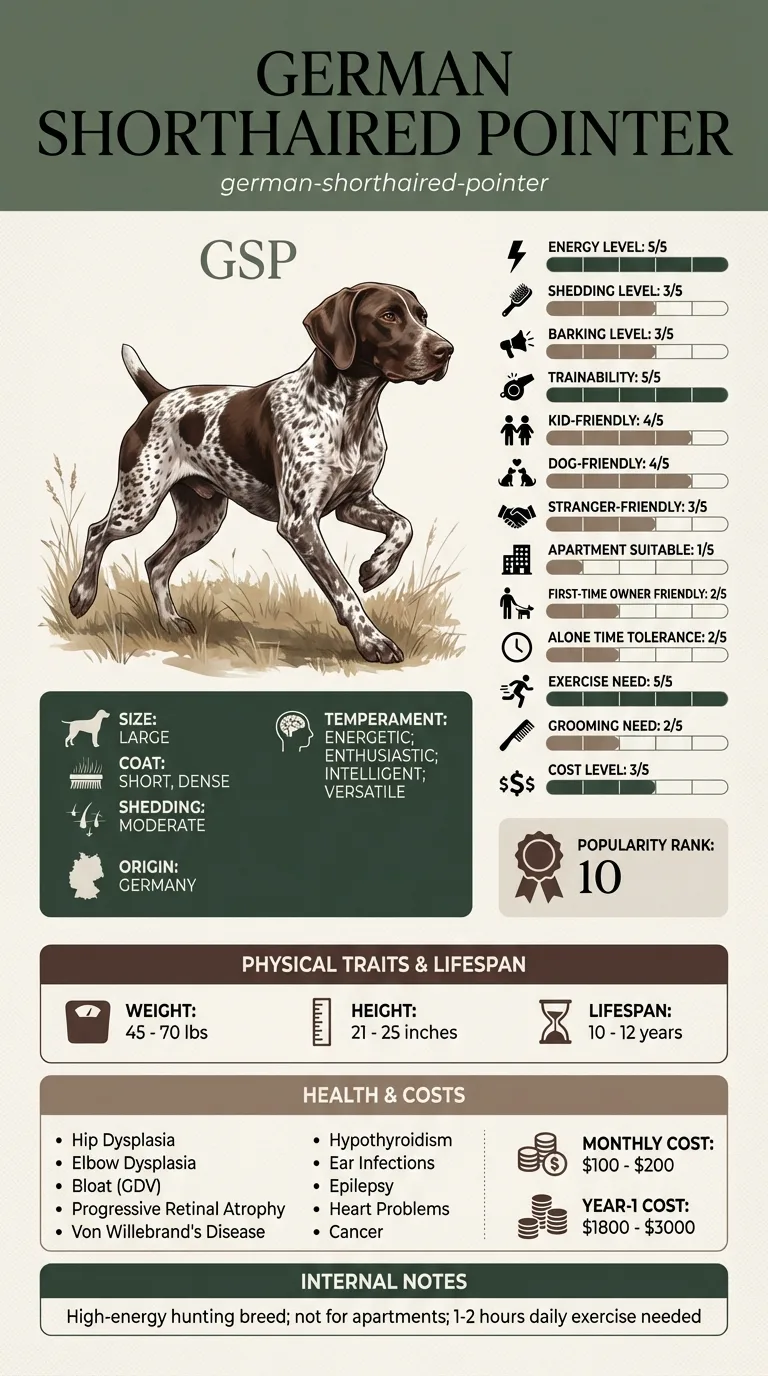
This pattern is common in any breed worked hard in cover, and the German Shorthaired Pointer's rating of five out of five for exercise need, with one to two hours of daily activity expected, puts it squarely among the breeds most likely to experience it. It is a consequence of lifestyle rather than an inherited condition on the breed's documented health list.
The relevant breed trait is not the eye itself but the job. A dog rated five out of five for energy and worked one to two hours daily at a gallop through cover spends far more time with its face pushed into vegetation than a companion breed ever will. Its build gives it no heavy brow ridge or long facial hair to deflect debris, so exposure lands directly on the eye's surface.
Dry, dusty, high-wind conditions concentrate the irritants that cause this pattern. Late-summer seeding grasses shed the sharp husks that do the most damage. A long season with no scheduled break from dense cover, and no routine of checking or rinsing the eyes afterward, is what turns occasional minor exposure into a persistent, season-long irritation.
See a vet the same day for a held-shut or heavily squinting eye, visible new cloudiness, thick or coloured discharge, or a dog pawing repeatedly at its face. Book a routine appointment if redness or tearing persists for more than a couple of weeks despite reduced exposure, since that has moved past ordinary environmental irritation.
See all German Shorthaired Pointer health problems, which breeds are prone to eye problems, or the full German Shorthaired Pointer breed guide for temperament, exercise needs and ownership costs.
Mild cumulative irritation typically settles within two to four weeks of reduced exposure and a rinse routine. An acute injury follows its own separate timeline once treated. Expect the pattern to recur each season unless the routine changes, since it is driven by exposure rather than a one-time cause.
Eyes that look the same in the last week of the season as they did on opening day: no persistent redness, no chronic squinting, and no gradual reluctance to push into cover the dog previously worked without hesitation.
An acute injury is easy to recognise: the dog comes back from a run holding one eye shut, there is visible redness or discharge, and the timeline is obvious because you were there when it happened. This needs same-day attention and usually gets it, because the dog's behaviour makes the urgency hard to miss.
Cumulative exposure is a different pattern entirely. A dog working dense cover several days a week picks up a steady low dose of dust, pollen, seed husks and fine debris on the surface of each eye. Most of it is blinked or tears away without incident. But over a season, an eye that is repeatedly irritated tends to develop mild chronic conjunctivitis: a persistent low-grade redness, slightly increased tearing, and a tendency to squint faintly in bright sun or wind that was not there in spring. Owners often notice this only in hindsight, comparing a photo from opening weekend to one from the last week of the season.
The distinction matters because the two need different responses. An acute injury needs a vet, today. Cumulative irritation needs a change in routine, not a diagnosis.
None of these require a diagnosis, and all of them are aimed at reducing how much debris the eye has to deal with in the first place.

Sedge's owner, Colm, hunted him hard from September through December and noticed nothing alarming week to week. It was only when he compared a photo from the last weekend of the season to one from opening day that he saw it: both eyes slightly redder, a faint squint in bright light that had not been there in September, and noticeably more tearing. A vet exam found mild bilateral conjunctivitis with no ulceration and no foreign material lodged in either eye, consistent with cumulative low-grade irritation rather than a single injury. There was nothing dramatic to treat, just a routine to change. The next season, Colm introduced protective eyewear in July, well before opening day, and added a saline rinse after every outing in heavy cover. His end-of-season photo that year looked almost identical to his opening-day one.
Key takeaway: The problem never announced itself with an obvious symptom. It only became visible by comparing photographs months apart, which is exactly the kind of slow change that is easy to miss in the moment and easy to prevent once you know to look for it.
On its own, usually not, but it lowers the eye's resilience and makes a genuine injury more likely to become an ulcer rather than heal cleanly. Treat it as a reason to change routine, not as background noise.
Cumulative irritation is mild, symmetrical or slowly shifting, and builds over weeks. A dog that is suddenly holding one eye shut, pawing at its face, or producing thick discharge has moved into acute-injury territory and needs same-day attention regardless of the season's history.
Field reports and some working-dog programs support them for reducing eye injuries in dense cover, though a dog has to be conditioned to wear them calmly or they become their own distraction. Introduce them at home, well before the season, with no pressure attached.
They more commonly cause irritation and mild conjunctivitis rather than a true infection, but a chronically irritated eye is easier for bacteria to take hold in if the surface becomes compromised.
Not necessary for a short walk on a lawn. It becomes worthwhile after time spent in dense, dry, or windy cover, which is where most of the exposure this page describes actually happens.
Usually, yes, over several weeks of reduced exposure. If redness or tearing persists after a genuine break from heavy cover, that is a reason to have the eye examined rather than continue assuming it is environmental.
A scratch is sudden, one-sided and obviously painful. Cumulative irritation is mild, gradual and often symmetrical, building over a season rather than a single outing.
It helps after time in dense or dusty cover. A quick saline rinse clears debris before it can sit against the eye overnight.
For a dog worked hard through brush and stubble, many owners find them worthwhile once the dog is conditioned to wear them without fuss.
When one eye looks different from the other, or the dog is squinting hard, pawing at its face, or producing thick discharge.
A chronically uncomfortable eye can make a dog reluctant to push through cover it would normally work confidently, which is often the first sign an owner actually notices.
A one-page prep sheet for this condition: the signs, the questions to ask, what to get priced. Unlocks here.
You get: Vet visit prep sheet
No spam. One-click unsubscribe. See our privacy policy.
See a sample page before you decide.
Early access list
The free prep sheet covers the same-day warning signs, a symptom log and the questions to ask. We are considering a fuller kit that adds a cost worksheet for the usual tests and treatments (US price ranges with their sources) and a plain-English guide to ways of covering the bill. It is not built yet; this list tells us whether it is worth building.
One email, no spam, unsubscribe anytime. Information only, not veterinary advice.