Health
What is immune-mediated thyroiditis in dogs?
An autoimmune process in which the body's own immune cells progressively destroy thyroid tissue. It is the underlying cause of most canine hypothyroidism, including in German Shorthaired Pointers.

Quick answer
What is immune-mediated thyroiditis in dogs?
An autoimmune process in which the body's own immune cells progressively destroy thyroid tissue. It is the underlying cause of most canine hypothyroidism, including in German Shorthaired Pointers.
By the time hormone levels finally fall, roughly three quarters of the gland is already gone. The disease has been running for years without a single symptom.
Breeders deciding whether to use a dog with positive antibodies but normal hormone levels, owners of a young GSP whose screening flagged something ambiguous, and people who want to understand why their dog developed thyroid failure in the first place.
This guide is not medical advice. If your dog shows pain, sudden behavior change, or worsening symptoms, consult a licensed veterinarian.
Some links may be affiliate links. We may earn a commission at no extra cost to you. We only suggest products we believe are helpful for dog owners.
We research and check what we publish, but we do not warrant that any figure, date, price, or statement is accurate, complete, or current, and we accept no liability for any loss, cost, injury, or other harm arising from the use of this site. Use it as one reference among several. You remain responsible for your own decisions and for your dog's care - confirm anything that matters with a licensed veterinarian or another qualified professional before you act on it. Full disclaimer.
Immune-mediated thyroiditis is the autoimmune destruction of thyroid tissue that underlies most cases of hypothyroidism, a condition documented on the German Shorthaired Pointer's health list. Its defining feature is a long asymptomatic phase: antibodies against thyroid proteins can be detected years before hormone levels fall, because the gland compensates until the majority of it has been lost. For owners this means the disease is detectable early but not treatable early, and its practical importance is largely in breeding screening.
Autoimmune thyroiditis accounts for the majority of canine hypothyroidism, so wherever hypothyroidism appears on a breed's documented list, as it does for the German Shorthaired Pointer, this process is the usual explanation. Most GSPs never develop it. Among those that do, a proportion remain compensated and clinically normal for their whole lives, which is one reason antibody-positive results should not be read as a diagnosis of illness.
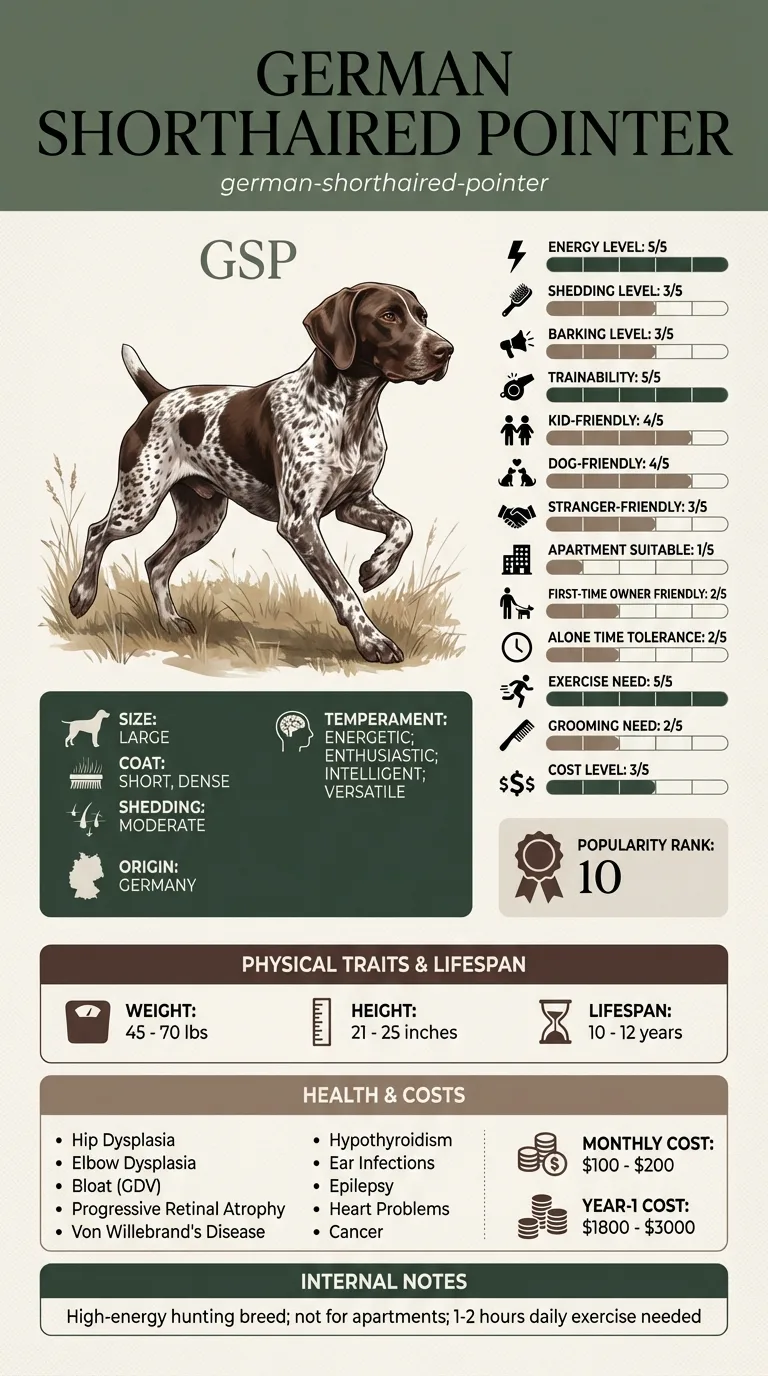
Hypothyroidism is documented in the German Shorthaired Pointer, and since autoimmune thyroiditis is its usual cause, a heritable predisposition to this immune process exists in the breed. Two features of the breed shape how it plays out. First, the very high working demand, with an exercise-need rating of five out of five, means a compensated dog behaves entirely normally and gives no early clue. Second, the breed's popularity at around tenth place produces a large enough population for line-specific screening to be genuinely feasible, provided breeders participate consistently rather than testing once.
No environmental exposure has been established as a cause of canine thyroid autoimmunity, and owners should be sceptical of confident claims otherwise. What the environment does influence is detection. Whether a dog is ever antibody tested depends almost entirely on whether it enters a breeding programme or has an unusually thorough veterinarian. Testing during unrelated illness or while on certain medications also distorts the accompanying hormone results, which can turn a straightforward picture into an ambiguous one.
There is no emergency version of this condition in its early phase, and an antibody-positive result in a well dog does not require an urgent appointment. Book a routine consultation to plan a retesting schedule and to discuss breeding implications. Arrange a prompt appointment if a previously well antibody-positive dog develops falling stamina, weight gain without a change in feeding, symmetrical coat thinning, cold intolerance, or infections that keep recurring, since these suggest the gland has stopped compensating. Seek emergency care in the rare situation of a profoundly weak, cold, mentally dull dog, which is a severe decompensated state.
See all German Shorthaired Pointer health problems, which breeds are prone to immune mediated thyroiditis, or the full German Shorthaired Pointer breed guide for temperament, exercise needs and ownership costs.
Antibodies can be present for several years before hormone levels fall, so an antibody-positive young adult may remain clinically normal well into middle age or indefinitely. Annual monitoring is the realistic commitment. Once deficiency develops, the timeline shifts to the treatment picture: brighter behaviour in weeks, coat recovery over months, and lifelong replacement thereafter.
For a compensated dog, success is uneventful: normal working life, annual bloodwork in range, and a considered breeding decision made with full information. For a dog that progresses, success is catching the transition through scheduled testing rather than after a season of unexplained decline. Success cannot mean stopping the autoimmune process, because no treatment currently does that.
The thyroid gland carries an enormous functional reserve. It can lose a substantial proportion of its tissue and still produce enough hormone to keep everything running normally, which is why this disease is so quiet for so long.
Infiltrating immune cells accumulate in the gland and gradually replace working tissue with scar. During this phase the dog is entirely well and standard hormone testing is normal. What can be detected, if anyone looks, is the presence of antibodies directed against thyroid proteins, which appear well before function falls.
Eventually the reserve runs out. From the owner's point of view the hypothyroidism seems to arrive over a few months, but the underlying destruction has usually been progressing since the dog was young.
This explains a pattern that confuses owners: a dog can test antibody-positive at three years old, remain clinically normal for years, and then become hypothyroid at seven. Nothing changed suddenly. A slow process simply crossed a threshold.
Antibody testing answers a different question from a hormone panel, and conflating the two causes most of the confusion in this area.

If you think your GSP has immune-mediated thyroiditis, the plan is three steps: write down what you have seen and when it started, book a veterinary appointment rather than waiting for the next flare, and take video of the behaviour or symptom before you go — the thing you are worried about rarely happens in the consulting room. Screening in the parents covers hip dysplasia, elbow dysplasia, bloat (gdv).
What the vet visit should produce is a diagnosis and a written plan, not just reassurance: what is being ruled out, what the monitoring interval is, and which signs mean you come back sooner. Ask what the treatment costs across a year rather than per visit, because that is the number that decides whether you are managing this condition or reacting to it.
Between appointments, keep a short log — dates, what you saw, what changed. It is the single most useful thing an owner brings to a follow-up, and for immune-mediated thyroiditis it is often what separates a clear pattern from a guess.
Halvard screened his stud dog, Rune, for thyroid autoantibodies at two years old as part of a breed club recommendation. The result was negative, and he considered the matter closed. Four years later a puppy buyer asked whether Rune had been retested. He had not. Halvard ran the panel again, largely to close the question, and it came back positive with hormone levels still comfortably normal. Rune was clinically perfect and stayed that way, still hunting hard at eight. But Halvard retired him from stud work and moved his kennel to a policy of retesting breeding animals every year rather than once. He describes the single test at two years old as the least useful health screening he ever paid for, precisely because it made him stop asking.
Key takeaway: One negative antibody test in a young dog proves very little. This disease appears across the years a dog is likely to be bred, so repeated testing is the only version of screening that means anything.
Generally not. Replacement therapy treats a hormone deficiency, and if hormone levels are adequate there is nothing to replace. Starting medication early does not protect the gland. What the result does justify is a schedule of repeat testing, typically annually, so the transition to genuine deficiency is caught promptly.
A heritable predisposition is well established across many breeds, which is why thyroid autoantibody screening is part of responsible breeding programmes rather than only a clinical test. It is not a simple single-gene trait, so no pairing eliminates risk, but selecting against antibody-positive breeding animals is the practical tool available.
Because antibodies can appear at any point through the years when a dog is likely to be bred, a single early test has limited value. Repeat screening through the breeding years, with the frequency your veterinarian advises, gives a far more meaningful picture than one certificate issued at a convenient moment.
There is no established treatment that halts the immune destruction of thyroid tissue in dogs. Management is directed at the consequence, replacing hormone once levels fall, rather than at the process. This is genuinely disappointing to owners hoping for an early intervention, and it is the honest position.
No specific diet has been shown to slow or reverse the process. Feed a complete, balanced food appropriate to the dog's life stage and keep body condition lean, which is good practice regardless. Be sceptical of products marketed as thyroid support, particularly any containing glandular material, and discuss anything you are considering with your vet.
Dogs with one autoimmune process can be predisposed to others, and clustering is recognised across species. In practice this means an antibody-positive GSP is worth watching a little more attentively for unexplained skin, joint or blood abnormalities, without assuming anything further will develop.
An autoimmune process in which the body's own immune cells progressively destroy thyroid tissue. It is the underlying cause of most canine hypothyroidism, including in German Shorthaired Pointers.
Yes, and for years. The gland's reserve masks the loss until roughly three quarters of it is gone, so antibody-positive dogs are often clinically normal for a long time.
The predisposition is heritable, so breeding an antibody-positive dog passes on elevated risk even if that dog never becomes hypothyroid. Discuss it with your veterinarian and breed club.
Usually annual hormone testing, so the point at which the gland stops compensating is caught early rather than after months of reduced stamina.
No. A compensated dog with normal hormone levels has normal capacity and should keep the one to two hours of daily work the breed needs.
A one-page prep sheet for this condition: the signs, the questions to ask, what to get priced. Unlocks here.
You get: Vet visit prep sheet
No spam. One-click unsubscribe. See our privacy policy.
See a sample page before you decide.
Early access list
The free prep sheet covers the same-day warning signs, a symptom log and the questions to ask. We are considering a fuller kit that adds a cost worksheet for the usual tests and treatments (US price ranges with their sources) and a plain-English guide to ways of covering the bill. It is not built yet; this list tells us whether it is worth building.
One email, no spam, unsubscribe anytime. Information only, not veterinary advice.