Living
Which is the better overall pick?
If you're active outdoors most days, the GSP is a capable, trainable partner. If you live in an apartment or keep a lower-key routine, the Boston fits that life far better.

Quick answer
Which is the better overall pick?
If you're active outdoors most days, the GSP is a capable, trainable partner. If you live in an apartment or keep a lower-key routine, the Boston fits that life far better.
Boston Terrier or German Shorthaired Pointer? On paper they differ most on apartment suitability, and on the scales German Shorthaired Pointer is the heavier at 45–70 lbs. Here is how the two compare on everything that shapes an ordinary week.
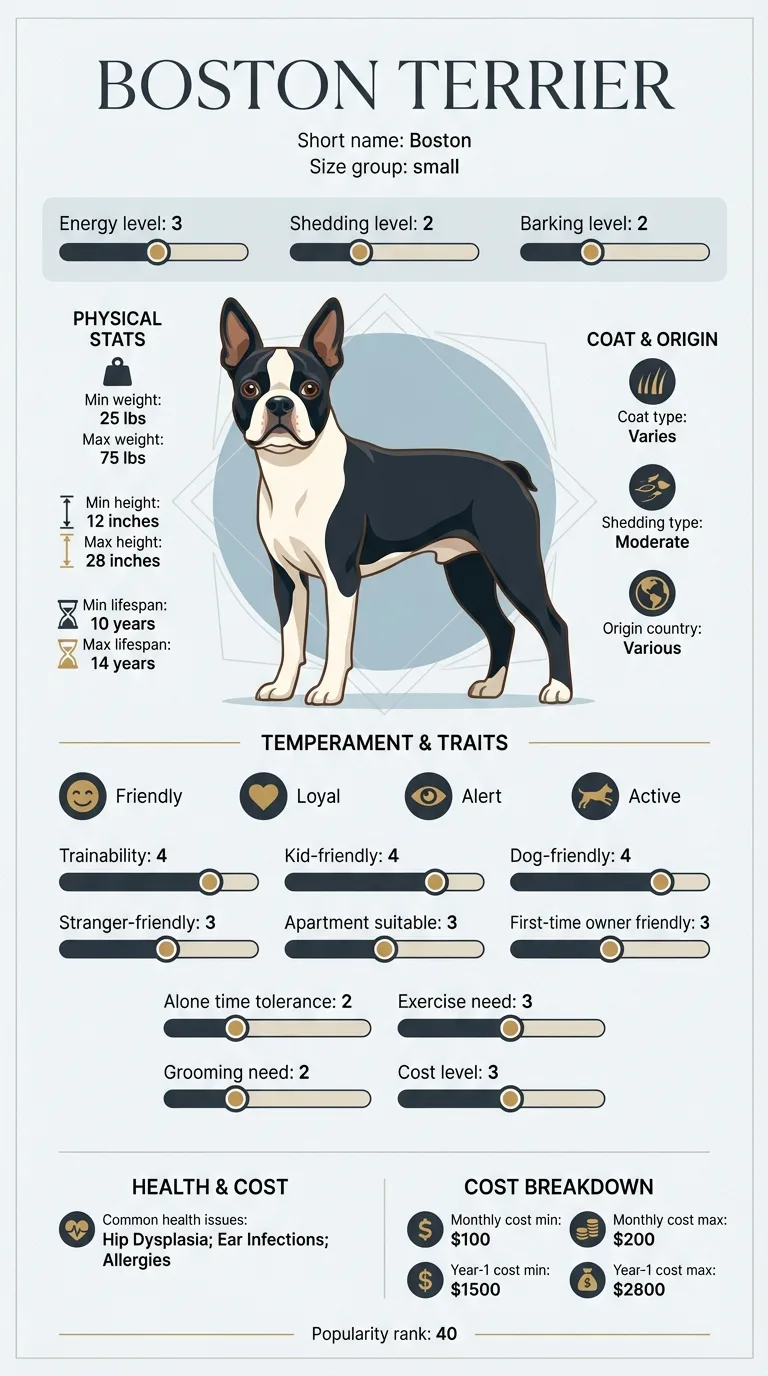
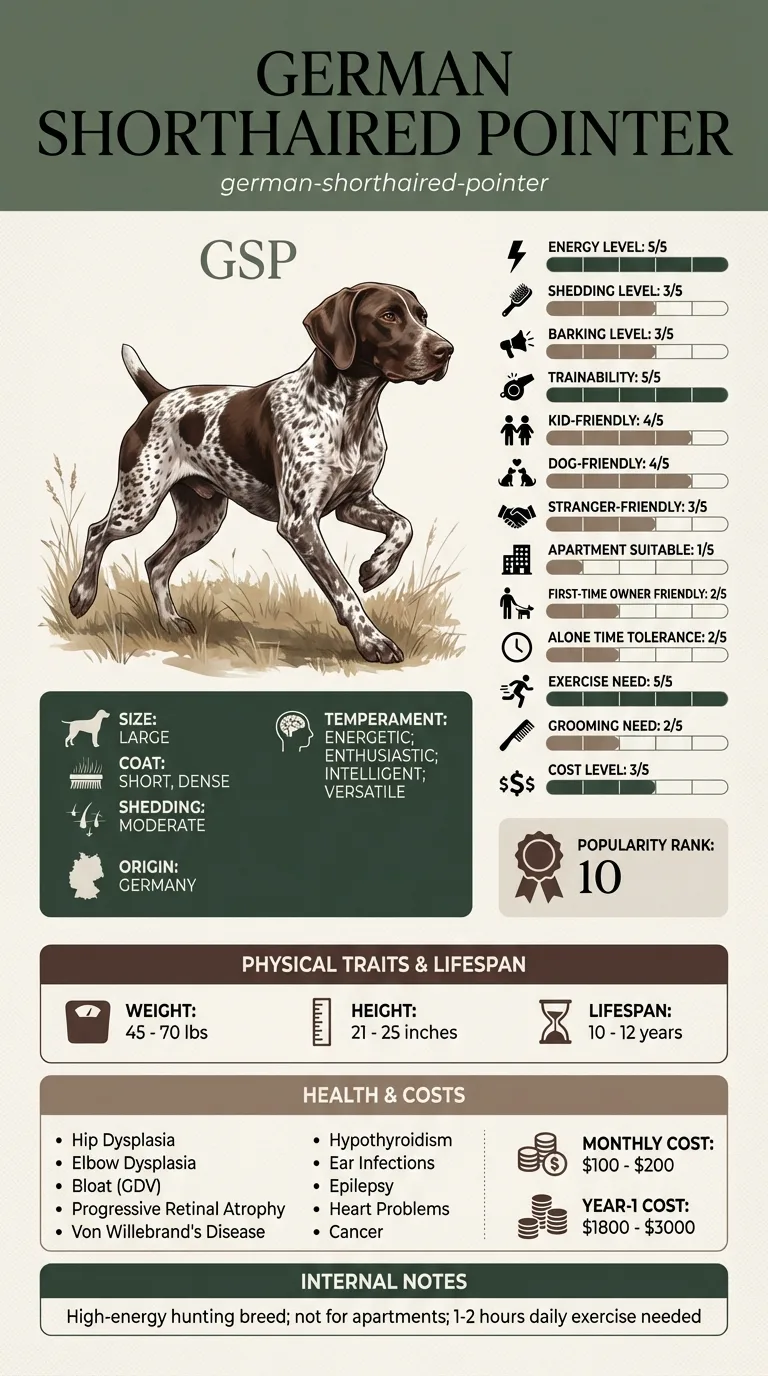
This is for someone already down to Boston Terrier and German Shorthaired Pointer and deciding between them. For this pair the decision usually turns on apartment suitability and exercise need, so those are covered first and in most detail. Anyone choosing from a flat has a clear answer here: Boston Terrier rates 5/5 against 1/5. It is written for the decision rather than the breed history.
Between Boston Terrier and German Shorthaired Pointer, apartment suitability is what separates them, and Boston Terrier is the lower-effort dog of the two to keep.
Choose Boston Terrier if you are in a flat or a smaller home, this is your first dog and you do not want a standing grooming appointment.
Choose German Shorthaired Pointer if you want a dog that picks up training quickly, you want a dog that can keep up with an active routine and you want a dog that is more watchful with visitors.
| Feature | boston terrier | german shorthaired pointer | Winner |
|---|---|---|---|
| Size class | small | large | Equal |
| Weight | 12–25 lbs | 45–70 lbs | Equal |
| Height | 15–17 in | 21–25 in | Equal |
| Lifespan | 11–13 years | 10–12 years | boston terrier |
| Exercise need | Low (2/5) | Very high (5/5) | boston terrier |
| Grooming need | Very low (1/5) | Low (2/5) | boston terrier |
| Shedding | Low (2/5) | Moderate (3/5) | boston terrier |
| Energy level | Moderate (3/5) | Very high (5/5) | Equal |
| Barking | Low (2/5) | Moderate (3/5) | boston terrier |
| Apartment suitability | Very high (5/5) | Very low (1/5) | boston terrier |
| Good for first-time owners | Very high (5/5) | Low (2/5) | boston terrier |
| Tolerates being alone | Moderate (3/5) | Low (2/5) | boston terrier |
| Trainability | High (4/5) | Very high (5/5) | german shorthaired pointer |
| Good with kids | Very high (5/5) | High (4/5) | boston terrier |
| Good with other dogs | High (4/5) | High (4/5) | Equal |
| Friendly to strangers | High (4/5) | Moderate (3/5) | boston terrier |
| Cost level | Moderate (3/5) | Moderate (3/5) | Equal |
| Coat | Short and smooth | Short, dense | Equal |
| Origin | Various | Germany | Equal |
| Typical monthly cost | $80–$150 | $100–$200 | Equal |
| Typical first-year cost | $1,100–$2,300 | $1,800–$3,000 | Equal |
The Boston stands 15-17 inches and weighs 12-25 lbs; the GSP stands 21-25 inches and weighs 45-70 lbs, roughly triple the Boston at the top end. The GSP's lean, athletic build is purpose-made for covering ground all day in the field, while the Boston's compact frame was never meant for that kind of distance work.
This pairing has one of the widest exercise gaps on the site: very high (5/5) for the GSP against low (2/5) for the Boston. Energy level shows the same split, very high (5/5) versus moderate (3/5). A GSP that doesn't get real daily exercise, running, not strolling, tends to develop the kind of restless, destructive habits that give the breed its high-maintenance reputation.
Coat care favors the Boston, though not by a huge margin here, very low (1/5) versus the GSP's low (2/5), with shedding at low for the Boston and moderate for the GSP. A quick weekly brush handles the GSP's short, dense coat just fine, this is one category where the two breeds are closer than the exercise numbers suggest.
The gap here is stark: 5/5 apartment suitability for the Boston against a very low 1/5 for the GSP. That's as low as this scale goes. A GSP's exercise and space needs make small-unit living genuinely difficult, not just suboptimal, this is a dog that does best with a yard and regular off-leash time, neither of which an apartment reliably offers.
The GSP trains slightly faster on paper, very high (5/5) versus the Boston's high (4/5), but first-time-owner fit tells the real story: low (2/5) for the GSP against very high (5/5) for the Boston. A quick learner that also needs very high exercise and doesn't do apartments is a demanding first dog, regardless of how responsive it is to commands.
The Boston edges the GSP with kids (5/5 vs 4/5) and strangers (4/5 vs moderate 3/5), while both tie at high (4/5) for getting along with other dogs. Temperament lists reflect the difference in purpose: the Boston is friendly, lively, comical, adaptable, a companion breed through and through, while the GSP is energetic, enthusiastic, intelligent, versatile, a description that could just as easily be a job posting for a hunting partner.
The Boston lives slightly longer, 11-13 years versus 10-12 for the GSP. The GSP's health list is long, ten conditions including bloat, progressive retinal atrophy, Von Willebrand's disease, hypothyroidism, heart problems, and cancer, versus five for the Boston, whose risks stay concentrated around its flat face and eyes. Bloat in particular is worth knowing about with a deep-chested breed like the GSP.
Both breeds land at a moderate 3/5 for overall cost, with monthly figures close, $80-$150 for the Boston, $100-$200 for the GSP, and first-year totals of $1,100-$2,300 versus $1,800-$3,000. The GSP's longer health list means its lifetime vet costs may run higher than the monthly numbers alone suggest, even though the day-to-day gap is modest.
Boston Terrier weighs 12–25 lbs and lives 11–13 years; German Shorthaired Pointer weighs 45–70 lbs and lives 10–12 years. The two diverge most on apartment suitability, exercise need and good for first-time owners and 1 other rated axes. They are level on cost level and good with other dogs, so those cannot decide it. In the table, a "winner" means easier for an ordinary household — not better. Size, coat and origin are recorded without a verdict. Because both breeds are scored the same way, the gaps are reliable even where the absolute numbers are rough.

Substantially, 45-70 lbs versus 12-25 lbs, roughly two to three times the Boston's weight, with several extra inches of height (21-25 in versus 15-17).
No, it rates very low (1/5), the bottom of the scale, against the Boston's 5/5. Its exercise needs make small-space living genuinely difficult.
It's rated low (2/5) for first-time owners versus the Boston's very high (5/5). Despite training quickly, its exercise and space demands are a lot for a beginner.
The GSP, moderate (3/5) versus the Boston's low (2/5), though neither needs much grooming effort overall.
The GSP's list is longer, ten conditions including bloat, PRA, and cancer, versus five for the Boston centered on its flat face and eyes. The GSP also lives slightly shorter on average, 10-12 years versus 11-13.
Moderately, similar to the Boston, $100-$200 a month versus $80-$150. The bigger cost difference is likely to show up in vet bills over the dog's lifetime given its longer health-risk list.
If you're active outdoors most days, the GSP is a capable, trainable partner. If you live in an apartment or keep a lower-key routine, the Boston fits that life far better.
$80-$150 for the Boston, $100-$200 for the GSP, both moderate.
Very high, 5/5, the top of the scale. It's a hunting breed built to run, not stroll.
The Boston, slightly, 11-13 years versus 10-12 for the GSP.
Secure checkout on Stripe. We never see your card.
7-day money-back guarantee. Instant access.

Health information here is general and is not veterinary advice. If your dog shows pain, sudden behaviour change, or worsening symptoms, consult a licensed veterinarian.
Some links on this site are affiliate links. We may earn a commission at no extra cost to you, and we only suggest products we believe are helpful for dog owners.
We research and check what we publish, but we do not warrant that any figure, date, price, or statement is accurate, complete, or current, and we accept no liability for any loss, cost, injury, or other harm arising from the use of this site. Use it as one reference among several. You remain responsible for your own decisions and for your dog's care - confirm anything that matters with a licensed veterinarian or another qualified professional before you act on it. Full disclaimer.
Match your lifestyle to the right dog.
Take quizNot sure which breed is right for you? Take our 2-minute quiz to find out.
Take the quiz