Health
Is entropion a GSP breed trait?
No, it isn't documented for this breed and is treated as an individual conformational fault when it occurs, not something bred into the line.

Quick answer
Is entropion a GSP breed trait?
No, it isn't documented for this breed and is treated as an individual conformational fault when it occurs, not something bred into the line.
A lid that rolls in, a lash that grows in the wrong direction, or a scratch that will not heal: three separate mechanisms that all end up looking like the same red, weeping eye.
Owners of a puppy whose eye looks slightly off from the litter average, and owners of an adult dog with one eye that keeps watering no matter what they try.
This guide is not medical advice. If your dog shows pain, sudden behavior change, or worsening symptoms, consult a licensed veterinarian.
Some links may be affiliate links. We may earn a commission at no extra cost to you. We only suggest products we believe are helpful for dog owners.
Structural eyelid and eyelash disorders are not part of the German Shorthaired Pointer's documented health profile, and they are uncommon in a breed with tight, well-fitting lids. When they occur they are individual faults rather than an inherited breed pattern, and their main significance is what they can lead to if ignored: a cornea worn down by constant rubbing until it ulcerates.
None of these is on the German Shorthaired Pointer's documented health list, and the breed's conformation works against them rather than for them. Reported cases exist as individual anomalies rather than a breed pattern, and a GSP owner is far more likely to be dealing with field trauma than an inherited lid fault.
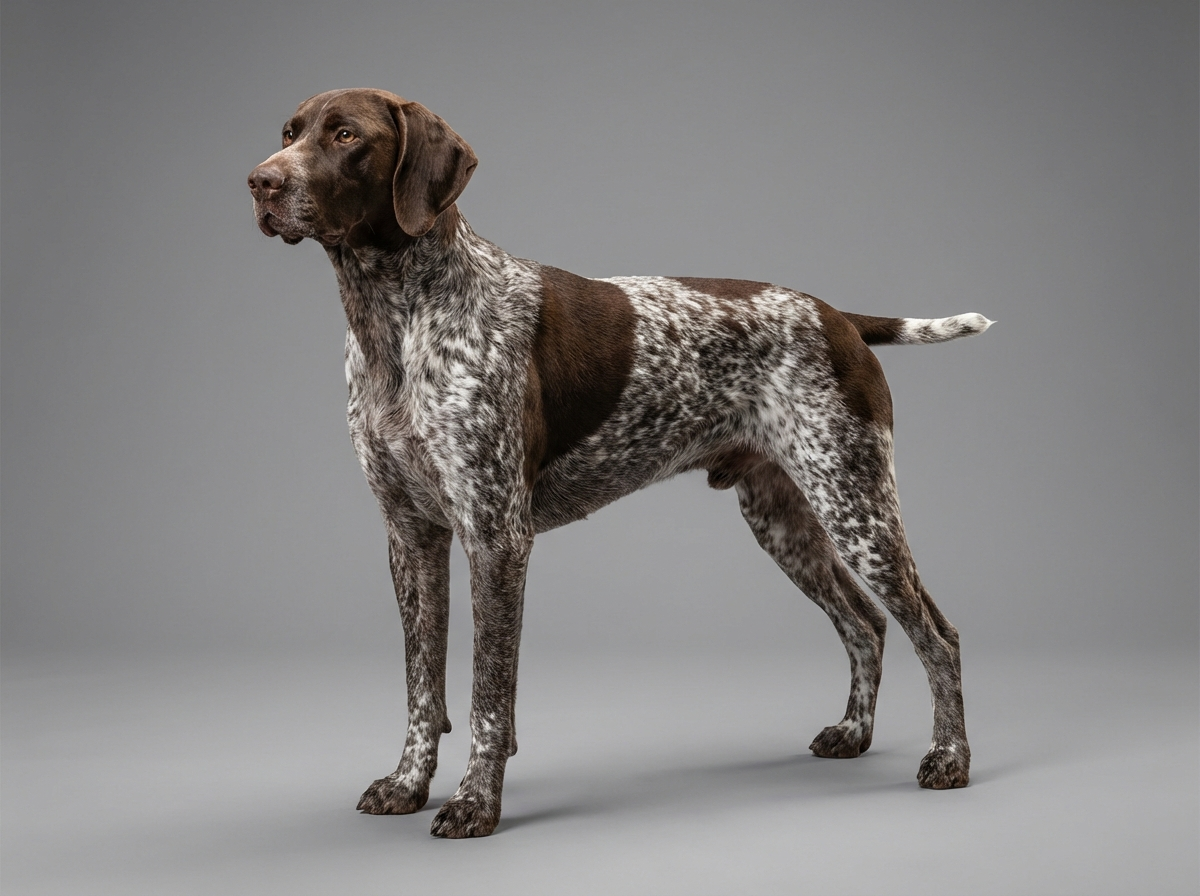
The German Shorthaired Pointer's head is built with tight-fitting lids and no loose facial skin, which is close to the opposite of the conformation that predisposes other breeds to rolled lids. Where a fault does occur, it is an individual variation rather than something the standard encourages. The breed's real contribution to this topic is exposure: a dog that quarters cover at a run, head down, gives any existing lid or lash fault far more opportunities to become a corneal problem than a dog that spends its day on a sofa.
Dusty, dry conditions make any borderline lid fault worse by increasing general eye irritation. Thick cover, brambles and stubble raise the odds that an already-vulnerable cornea takes a scratch. A household that does not routinely look closely at both eyes in good light is the environmental factor most likely to let a slow-building lash problem go unnoticed for months.
Book a routine exam for any puppy with a squint, a rolled-looking lid, or watering that does not resolve within a few days. Go the same day for a held-shut eye, visible cloudiness that appeared suddenly, coloured or thick discharge, or a dog pawing repeatedly at its face. A corneal ulcer in this breed can be reopened by the next day's fieldwork, so speed matters more than it would in a housebound dog.
See all German Shorthaired Pointer health problems, which breeds are prone to eye disorders, or the full German Shorthaired Pointer breed guide for temperament, exercise needs and ownership costs.
Diagnosis is a single exam. Surgical correction, when needed, is typically one procedure with a follow-up two to three weeks later to confirm healing. A straightforward corneal ulcer resolves over one to three weeks of medical treatment once the underlying lid or lash cause is fixed.
A dog with dry, comfortable, symmetrical eyes and no recurring rub marks or discharge. Once corrected, these are one-time fixes rather than lifelong conditions, which sets them apart from the breed's inherited retinal disease.
Each of these has its own cause and its own fix. Confusing them delays the right one.
A puppy with entropion usually squints on the affected side and the eye waters constantly, sometimes with a visible inward roll of the lower lid that gets worse when the pup is tired or the face is relaxed. It is easy to miss in a wriggly ten-week-old and easy to blame on a normal newborn squint, which is why breeders and new owners both tend to catch it late rather than early.
Distichiasis is quieter still. A dog can carry a handful of misdirected lashes for years with nothing more than occasional light rubbing at the face, and an owner may never connect years of intermittent watering to lashes they cannot see without an ophthalmoscope and good light.
An ulcer looks different from either: sudden onset, a held-shut or half-shut eye, and a dog that is clearly uncomfortable rather than mildly irritated. This is the one item on the list that does not wait for a routine appointment. The German Shorthaired Pointer's own recognised eye condition is retinal, not lid or lash related, so none of this is a breed-specific expectation - it is the general run of things that can happen to any dog's eyelids, seen through the lens of a breed that also happens to run its face through cover several times a week and therefore gets more chances for a lash or a fold to become a problem worth noticing.

Reed's breeder mentioned at pickup that his left eye 'watered a bit more than his littermates,' and his new owner, Mara, put it down to a new-puppy adjustment. By twelve weeks the watering had not stopped, and a closer look in good light showed the lower lid margin tucking faintly inward at the inner corner, just enough to lay two or three hairs against the surface of the eye. A veterinary ophthalmologist confirmed mild entropion and recommended temporary tacking sutures to protect the cornea through the rest of Reed's growth, with a plan to reassess for permanent correction once his skull had finished developing around fourteen months. The tacking held for a year. A short outpatient procedure at fifteen months corrected the lid permanently, and Reed has had no recurrence and no lasting mark on the cornea.
Key takeaway: One-sided watering that persists past the newborn stage is worth a proper look, even in a breed with no documented predisposition to lid problems. Individual faults still happen, and this one was cheap to fix early and expensive to ignore.
No. The German Shorthaired Pointer has a clean-cut head with well-fitting lids and no documented predisposition to rolled eyelids. When it appears it is an individual fault in that puppy, not a breed trait, and it is still worth reporting to the breeder.
Not always. Very mild rolling is sometimes watched through the growth phase, since the face can change shape enough to resolve it. A vet will usually recommend a temporary tacking procedure if the lashes are actively scratching the cornea, with permanent correction only once the skull has finished growing.
You generally can't tell without a vet examining the lid margin under magnification. The clue that prompts a look is one-sided or persistent rubbing and tearing that does not track with anything in the environment.
Yes, if the misdirected lash sits against the cornea rather than clearing it. Constant low-grade rubbing can wear a defect into the surface over time, which is one reason a mildly irritated eye that never quite settles is worth a proper look rather than ongoing tolerance.
It is an emergency in any breed, but the stakes are higher here because this is a dog that keeps working the same eye through the same cover the next day if nobody stops it. An ulcer that would slowly heal in a couch dog can be reopened before it closes.
Most lid and lash problems are fixed once, in a single procedure, and do not recur. This is different from the inherited retinal condition on this breed's documented list, which has no surgical fix and is managed rather than cured.
A lid-tacking procedure or lash removal is a routine day surgery at most general practices, while a deep or non-healing ulcer that needs a surgical graft is considerably more, closer to a specialist referral bill. Ask for a written estimate before agreeing to a plan.
No, it isn't documented for this breed and is treated as an individual conformational fault when it occurs, not something bred into the line.
One-sided watering, squinting or rubbing at the face that doesn't clear up on its own within a day or two.
Same-day. A held-shut, painful eye should not wait for a routine slot, especially in a dog that will be back out in cover tomorrow.
A routine tacking or lash removal procedure sits at the lower end of eye surgery costs; a non-healing ulcer needing a graft costs considerably more.
Once corrected, most dogs return to full work. The bigger risk is delaying correction while a treatable irritation quietly wears at the cornea.
A one-page prep sheet for this condition: the signs, the questions to ask, what to get priced. Unlocks here.
You get: Vet visit prep sheet
No spam. One-click unsubscribe. See our privacy policy.
Preview page 1 before you decide.