Health
How early can kidney disease be detected in dogs?
Newer blood markers can flag change while around two thirds of function remains, considerably earlier than traditional values, which only rise after about three quarters is lost.

Quick answer
How early can kidney disease be detected in dogs?
Newer blood markers can flag change while around two thirds of function remains, considerably earlier than traditional values, which only rise after about three quarters is lost.
Drinking more is not an early sign. It is the sign that the reserve has already gone.
Owners of ageing GSPs wondering which senior screening is worth paying for, people whose dog's bloodwork came back with one borderline kidney value, and anyone managing a working dog through hot seasons who wants to understand what dehydration actually costs.
This guide is not medical advice. If your dog shows pain, sudden behavior change, or worsening symptoms, consult a licensed veterinarian.
Some links may be affiliate links. We may earn a commission at no extra cost to you. We only suggest products we believe are helpful for dog owners.
Chronic kidney disease is the progressive, irreversible loss of the filtering units that clean the blood and regulate water balance. It hides behind an enormous functional reserve, so the familiar signs of increased thirst, weight loss and reduced appetite appear only after most of that reserve has gone. For German Shorthaired Pointers, a breed living roughly 10 to 12 years, it is primarily a senior concern, and the practical opportunity lies in routine screening rather than in symptom-watching.
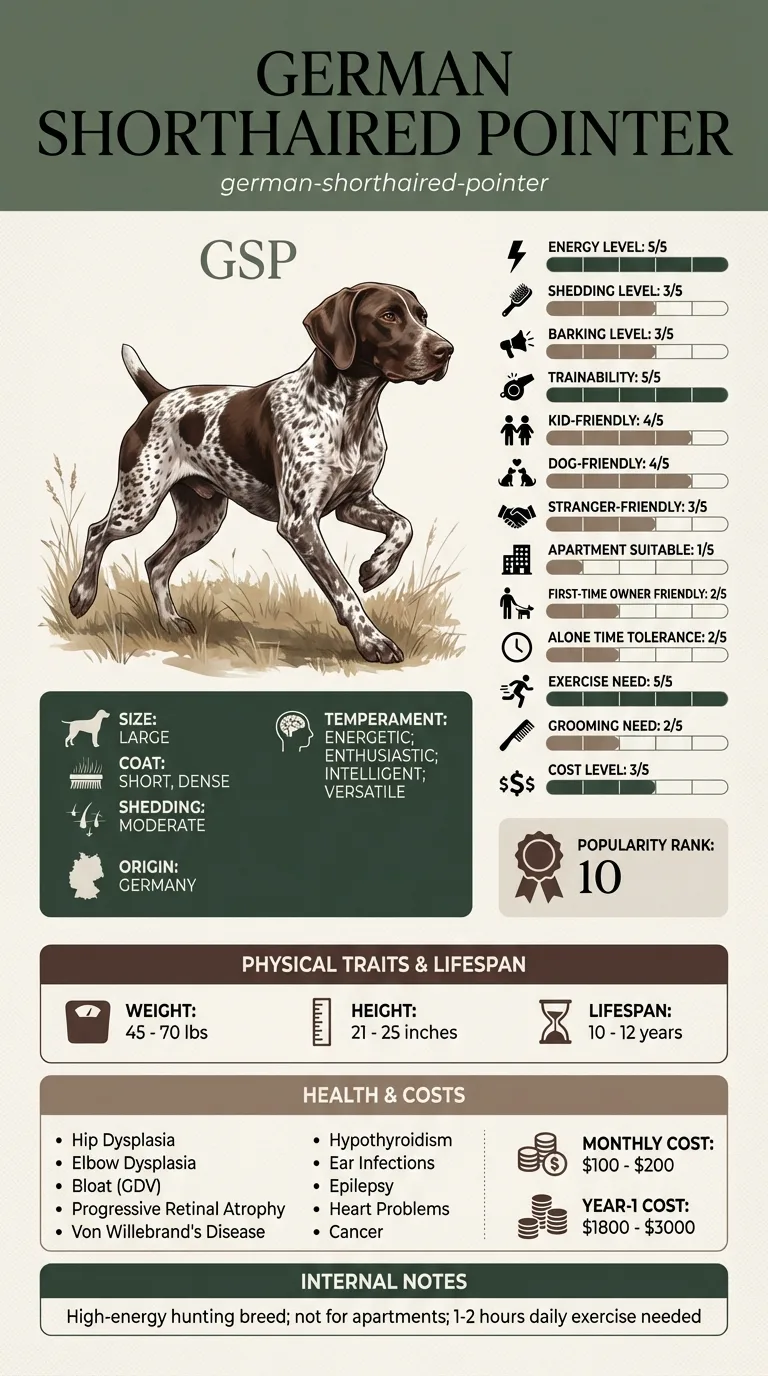
Kidney disease is not listed among the German Shorthaired Pointer's documented breed concerns, which name hip and elbow dysplasia, bloat, retinal atrophy, von Willebrand's disease, hypothyroidism, ear infections, epilepsy, heart problems and cancer. It is nonetheless one of the more common conditions of ageing dogs in general, so GSP owners encounter it as a senior issue rather than as a breed-specific inheritance.
There is no documented breed predisposition to kidney disease in German Shorthaired Pointers, and owners should not read one into a general senior diagnosis. What breed traits do influence is presentation and detection. A lean 45 to 70 pound dog with a short, dense coat shows weight loss earlier than a heavy-coated breed, which can help. A dog rated five out of five for energy may keep working through the early stages, masking the lethargy that prompts other owners to seek help. And a 10 to 12 year lifespan means the senior window in which this disease typically appears arrives sooner than it does in smaller, longer-lived breeds.
Lifestyle exposures matter more than genetics here. Working dogs drink from ponds, ditches and puddles, and water-borne bacterial infections that damage kidneys are a real occupational risk in wet country. Repeated dehydration on hot working days reduces renal blood flow. Garages and outbuildings on rural properties are where antifreeze exposure happens. Anti-inflammatory medications, often prescribed for the joint problems this breed is prone to, need careful use in an older dog because they reduce renal perfusion.
Seek urgent care for a dog that has stopped urinating, is straining without producing urine, is vomiting repeatedly and refusing water, or has become suddenly weak and depressed, since these suggest acute kidney injury or an obstruction and both are emergencies. Also treat any suspected antifreeze exposure as an immediate emergency, because the window for effective treatment is very short and dogs may seem normal at first. Book promptly for increased thirst and urination, unexplained weight loss, poor appetite, or bad breath with a chemical smell. Discuss senior screening including urine testing at your annual visit from around seven years, and always tell your vet about any anti-inflammatory your dog is receiving.
See all German Shorthaired Pointer health problems, which breeds are prone to kidney disease, or the full German Shorthaired Pointer breed guide for temperament, exercise needs and ownership costs.
Chronic kidney disease is measured in months to years rather than weeks. Early-stage dogs identified on screening may remain stable for a long period with diet and monitoring every three to six months. Once staging advances, review intervals shorten and medication increases. Progression is not steady; dogs often hold a plateau and then step down, which is why regular monitoring beats reacting to symptoms.
Success is slowing the decline and keeping the dog comfortable, not restoring the kidney. Practically it looks like stable weight, a maintained appetite on a therapeutic diet, controlled blood pressure and phosphorus, and a dog still enjoying modified daily outings. For a dog diagnosed early on screening, success may mean years of unremarkable life with a diet change and periodic bloodwork.
A dog has vastly more filtering units than daily life requires. As they are lost, the survivors simply work harder, and blood values stay normal.
The first function to fail is not filtration but concentration. Failing kidneys cannot pull water back out of the urine efficiently, so the dog produces more dilute urine and then drinks more to compensate. That is why increased thirst and urination are the classic first signs owners notice, and why they signal a stage well past the beginning.
Standard blood markers of kidney function only rise once roughly three quarters of function has gone. A newer marker, which rises earlier, can flag change at around the point where two thirds remain, and it is the main reason senior screening panels are worth more now than they were a decade ago.
Urine concentration is the other cheap tool, and it is often overlooked. A urine sample that is persistently dilute alongside normal bloodwork is meaningful information, and collecting one costs almost nothing compared with the panel it accompanies.
Dehydration does not cause chronic kidney disease, but repeated episodes of reduced kidney blood flow are genuinely unhelpful to an organ that never repairs itself.

If you think your GSP has kidney disease, the plan is three steps: write down what you have seen and when it started, book a veterinary appointment rather than waiting for the next flare, and take video of the behaviour or symptom before you go — the thing you are worried about rarely happens in the consulting room. Screening in the parents covers hip dysplasia, elbow dysplasia, bloat (gdv).
What the vet visit should produce is a diagnosis and a written plan, not just reassurance: what is being ruled out, what the monitoring interval is, and which signs mean you come back sooner. Ask what the treatment costs across a year rather than per visit, because that is the number that decides whether you are managing this condition or reacting to it.
Between appointments, keep a short log — dates, what you saw, what changed. It is the single most useful thing an owner brings to a follow-up, and for kidney disease it is often what separates a clear pattern from a guess.
Kaisa's GSP, Marek, turned eight and her clinic offered a senior wellness panel with urine testing. She almost said no; he was hunting well and looked superb. The panel showed a mildly elevated early kidney marker with everything else normal. The urine, which she had collected in a takeaway container that morning, was more dilute than it should have been. Repeat testing six weeks later confirmed the pattern. Marek went onto a therapeutic diet at eight and a half, years before he had a single symptom. Kaisa also started adding water to his food and carrying a collapsible bowl on shoots. He was rechecked twice a year after that. At eleven his values had moved, but slowly, and he was still doing short mornings in the field.
Key takeaway: The most valuable kidney intervention happens in a dog that looks completely healthy. Ask for urine alongside the blood panel, because that is where the earliest evidence usually is.
Increased thirst and increased urination, often noticed as needing to go out at night or emptying the water bowl faster. Weight loss, reduced appetite, occasional vomiting and a dull coat follow. In a lean, short-coated breed, weight loss can be spotted early if you are weighing rather than looking.
Chronic kidney disease is not. Nephrons that have been lost do not regenerate, and treatment aims to slow progression and manage consequences rather than restore function. Acute kidney injury, caused by a toxin, an infection or a sudden circulatory event, is a different situation and can sometimes be substantially recovered with prompt intensive treatment.
Vets stage chronic kidney disease from one to four based on blood values in a stable, well-hydrated patient, with substages reflecting protein loss in urine and blood pressure. The stage determines the diet, the medications and the monitoring interval, which is why a single value in isolation cannot tell you what to do.
Therapeutic renal diets are among the better-supported interventions in canine kidney medicine, with restricted phosphorus being particularly important. The practical difficulty is palatability in a dog that already has a reduced appetite, and a diet the dog refuses helps nobody. Transition slowly and involve your vet if intake falls.
Annual bloodwork including a kidney panel and a urine sample from around seven years is a reasonable default for a breed with a 10 to 12 year lifespan, moving to twice yearly if anything is borderline. Ask specifically that urine is included, since it is frequently omitted and carries information blood alone does not.
Normal exercise in a well-hydrated dog does not. What causes concern is severe exertional heat injury, which can produce acute kidney damage as part of a multi-organ insult, and repeated significant dehydration. Both are avoidable with sensible scheduling rather than by reducing a healthy dog's workload.
Newer blood markers can flag change while around two thirds of function remains, considerably earlier than traditional values, which only rise after about three quarters is lost.
It is an important sign but not an early one. Increased thirst means the kidneys have already lost the ability to concentrate urine properly.
Offer water on a fixed schedule rather than on demand, and add water or broth to meals. Driven dogs routinely ignore thirst while working.
Yes, particularly through phosphorus restriction, and it is one of the best-supported measures available. Palatability is the main practical obstacle in a dog with poor appetite.
Prescription diet, medications and monitoring bloodwork every few months, on top of typical GSP costs of 100 to 200 dollars a month. It is a steady ongoing expense rather than a one-off.
A one-page prep sheet for this condition: the signs, the questions to ask, what to get priced. Unlocks here.
You get: Vet visit prep sheet
No spam. One-click unsubscribe. See our privacy policy.
Preview page 1 before you decide.