DogBreedCompass
← Back to breed profile

Kidney and Bladder Stones in German Shorthaired Pointers

Quick answer

Are German Shorthaired Pointers prone to kidney stones?

Stones are not on the breed's documented health list. The risk in this breed comes from lifestyle: hard work, panting losses and long intervals without urinating all concentrate the urine.

Stones form in urine that sits too long and is too concentrated. A driven gun dog that will not stop to drink or squat is manufacturing exactly those conditions.

Kidney and Bladder Stones in German Shorthaired Pointers infographic

Owners whose dog has had blood in the urine or has been straining, people told their dog needs a lifelong prescription diet and wanting to understand why, and anyone whose male dog has started producing only drips.

Important reminder

This guide is not medical advice. If your dog shows pain, sudden behavior change, or worsening symptoms, consult a licensed veterinarian.

Some links may be affiliate links. We may earn a commission at no extra cost to you. We only suggest products we believe are helpful for dog owners.

What this problem looks like

Urinary stones form when minerals dissolved in urine reach a concentration at which they crystallise and aggregate. Stones are not a documented breed concern for German Shorthaired Pointers, but the way these dogs are worked creates favourable conditions: heavy panting losses, reluctance to drink or urinate while occupied, long transport in crates, and dry feeding. The clinical stakes differ sharply by sex, because a male dog's narrowing urethra turns a small stone into a complete, life-threatening obstruction.

Common triggers

  • Concentrated urine from panting water loss during long working sessions
  • Extended intervals without urinating, during transport or while a driven dog is occupied
  • Urinary tract infection, which directly promotes formation of certain stone types
  • Exclusively dry feeding, which supplies very little dietary water
  • An unaddressed underlying metabolic or liver abnormality in the less common stone types

Urinary stones are a common presentation across dogs generally without being a documented German Shorthaired Pointer concern. Most GSPs will never form one. Those that do are often working dogs in hot climates or dogs with a history of urinary infection, and recurrence is the defining feature: without knowing the stone type and changing the urine chemistry, a dog that has formed one stone is likely to form another.

Why this happens

Breed factors

The predisposing factors here are behavioural and physiological rather than genetic. A German Shorthaired Pointer rated five out of five for energy and exercise need, requiring one to two hours of daily work, loses a great deal of water through the airway and returns it to the body's balance sheet by concentrating urine. Breed temperament compounds it: an animal described as energetic, enthusiastic and versatile does not interrupt a hunt to relieve itself. Adult size of 45 to 70 pounds means male dogs have a long urethra that narrows near its end, which is where obstruction happens.

Environment factors

How and where the dog is worked drives most of the risk. Hot, dry conditions raise water loss. Long journeys in a crate, common for hunting and trialling, extend bladder holding time considerably. Feeding entirely on dry food without added water reduces total intake. Access to clean drinking water in the field is often assumed rather than arranged. Recurrent urinary infections, sometimes secondary to another problem, create the alkaline conditions in which one major stone family thrives.

What you can do at home (once it is not an emergency)

When to talk to your vet

A dog straining repeatedly to urinate and producing little or nothing may be obstructed, and this is a life-threatening emergency requiring care within hours; male dogs are at particular risk. Treat vomiting, collapse or abdominal pain alongside straining as an immediate emergency. Book a same-day or next-day appointment for blood in the urine, frequent small urinations, discomfort while urinating, or new indoor accidents in a house-trained dog. Book routinely to discuss preventive diet and monitoring if your dog has had stones before, since recurrence is the norm rather than the exception without a plan.

At home, alongside your vet's plan

  • Add water to every meal as a permanent habit rather than a treatment, which raises total daily water intake more reliably than encouraging drinking does.
  • Build scheduled toilet stops into long travel days and working sessions, giving the dog an opportunity roughly every few hours whether or not it asks.
  • Carry a collapsible bowl and offer water at fixed intervals during work, because a driven dog will not request it.
  • Watch the first urination of the morning occasionally, checking for straining, unusual posture, repeated small attempts, or any pink tinge on snow or pale ground.
  • If a stone is retrieved or passed, insist it is submitted for analysis, and keep the report, since it determines prevention for the rest of your dog's life.
  • Feed any prescribed therapeutic diet exclusively, since treats and table food can undo its effect on urine chemistry entirely.

See all German Shorthaired Pointer health problems, which breeds are prone to kidney stones, or the full German Shorthaired Pointer breed guide for temperament, exercise needs and ownership costs.

What to expect, and how you know it is working

Dissolution of a susceptible stone type with diet and infection treatment typically takes several weeks to a few months, with imaging to confirm progress. Surgical removal is a single event with a recovery of roughly two weeks, but the prevention plan that follows is permanent. Expect periodic urine testing and occasional imaging indefinitely, since recurrence is common and is most easily managed when caught small.

Success is a dog that never obstructs, whose monitoring urine samples stay free of significant crystal formation, and who tolerates the diet well enough to stay on it. It is not the absence of any future stone, since some dogs form them despite good management. For an owner, success also means having the stone analysis report in hand, because prevention without it is guesswork.

The type of stone changes everything

Stones are not interchangeable. Two dogs with identical symptoms can need completely different management, because the mineral composition determines whether the stone can be dissolved or must be removed.

One common family forms in alkaline urine and is closely associated with urinary tract infection, particularly in females. These can often be dissolved with a therapeutic diet and by clearing the underlying infection, avoiding surgery altogether.

Another common family forms in acidic, concentrated urine and cannot be dissolved at all. They must be removed physically, and the whole management strategy afterwards is about preventing new ones, mainly by diluting the urine.

Other types point at specific underlying problems: some indicate a metabolic transport defect, some point toward liver abnormalities, and some are associated with particular infections. This is why stones retrieved during surgery are sent for analysis rather than discarded. Skipping that analysis leaves the owner guessing at prevention for the rest of the dog's life, which is the most common avoidable mistake in this whole area.

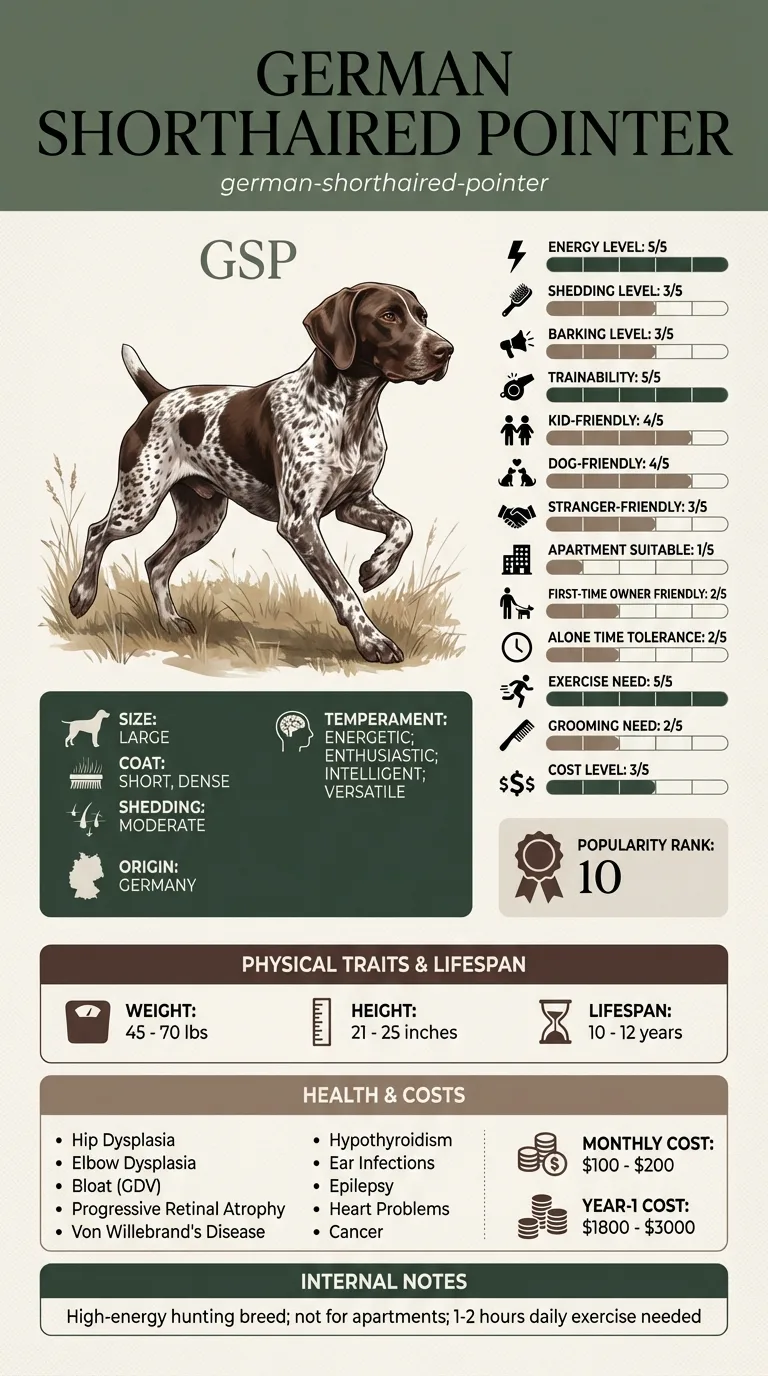
Why a working dog concentrates urine more than a house dog

Dilution is the single most effective preventive measure for most stone types, and a hard-working GSP fights against it constantly.

Kidney and Bladder Stones in German Shorthaired Pointers - Why a working dog concentrates urine more than a house dog
  • Panting through one to two hours of daily exercise loses substantial water through the airway, which the kidneys then compensate for by concentrating urine.
  • Driven dogs frequently ignore both thirst and the need to urinate while they are working, so urine sits in the bladder for longer.
  • Long transport in a crate before and after work extends the interval between opportunities to empty the bladder, sometimes by hours.
  • Dry food alone provides very little dietary water compared with wetted or moist feeding, and many sporting dogs are fed exclusively on kibble.
  • Hot-weather work multiplies all of the above, which is why summer and early hunting season are the periods when the risk profile is worst.
  • Male anatomy matters for consequences rather than formation: a long, narrowing urethra means a stone that would pass unnoticed in a female can obstruct completely in a male.

The pink patch on the frost

Marius noticed it walking out to the truck one December morning: his GSP, Halla, had left a faintly pink patch on the frosted grass. She was bright, keen and had eaten breakfast normally. He nearly ignored it. Instead he collected a sample later that morning in a clean jar and dropped it at the clinic on his way past. The urine grew an infection and showed crystals. Imaging found several small bladder stones. Because the type was one that responds to dietary dissolution and the infection was treated, Halla avoided surgery entirely, though it took eleven weeks of strict feeding with no treats at all. Marius now wets her food every day and stops the truck every couple of hours on the drive to the moors, which he says is the least interesting thing he has ever done for a dog and probably the most useful.

Key takeaway: A faint colour change in urine is worth a sample, not a wait. Caught early, some stones dissolve on a diet; caught late, the same stones become surgery.

Frequently asked questions

What are the signs of urinary stones in a dog?

Straining to urinate, going frequently but producing little, blood-tinged urine, licking at the genitals, and sometimes accidents in a previously reliable dog. Kidney stones specifically can be silent for a long time and are often found incidentally on imaging done for another reason.

When are urinary stones an emergency?

A dog that is straining repeatedly and producing nothing may have a complete obstruction, which is a genuine life-threatening emergency. The bladder cannot empty, pressure backs up into the kidneys, and toxins accumulate in the blood. This needs veterinary attention within hours, not the next day.

Can stones be dissolved without surgery?

Some types can, using a therapeutic diet and by resolving any underlying infection, and this can take several weeks of strict feeding. Other types cannot be dissolved by any means and must be removed. Knowing which you are dealing with requires either analysis of a passed stone or an informed assessment based on imaging, urine chemistry and culture.

Will my dog need a prescription diet forever?

Often yes, for the stone types that recur readily. The diet works by altering urine chemistry and by encouraging dilution, and both effects stop the day you stop feeding it. This is a genuine long-term commitment and worth factoring into the ownership budget rather than treating as a temporary course.

How do I get my GSP to drink more?

Wet the food, which is more reliable than any trick involving bowls. Add water or unsalted broth to each meal, offer water on a fixed schedule during work rather than on demand, and provide multiple water stations at home. A measurable increase in urine volume is the goal, not the dog's apparent enthusiasm for drinking.

Do stones mean my dog has a kidney problem?

Not necessarily. Most stones form in the bladder and have no direct relationship to kidney function. Stones lodged in the kidney or ureter are a different matter and can damage kidney tissue through obstruction, which is one reason imaging looks at the whole urinary tract rather than just the bladder.

Quick answers

View more answers
Health

Are German Shorthaired Pointers prone to kidney stones?

Stones are not on the breed's documented health list. The risk in this breed comes from lifestyle: hard work, panting losses and long intervals without urinating all concentrate the urine.

Health

Is a dog straining to urinate an emergency?

If it is producing little or nothing, yes. Complete urinary obstruction is life-threatening and needs veterinary care within hours, particularly in male dogs.

Health

Why does stone type matter so much?

Some types dissolve with a therapeutic diet and infection treatment; others cannot be dissolved at all and must be removed. Analysis of the stone determines lifelong prevention.

Living

How can I lower my working dog's stone risk?

Wet the food, offer water on a schedule during work, and build in regular toilet opportunities on long travel days so urine does not sit for hours.

Costs

What do stones cost to treat?

Imaging and analysis are modest; surgical removal plus hospitalisation is a large single expense, and a lifelong prescription diet adds a steady monthly cost thereafter.

Related DogBreedCompass guides

  • kidney disease in German Shorthaired PointersKidney function is a related but distinct concern with its own screening path.
  • liver shunts in GSPsSome stone types point toward an underlying liver abnormality.
  • heat sensitivity in GSPsHydration management overlaps heavily with hot-weather planning.
  • GSP insurance and claim patternsSurgical and diet costs are relevant to the insurance decision.
  • German Shorthaired Pointer ownership costsPrescription diets change the long-term feeding budget.

Bring the right questions to the vet

A one-page prep sheet for this condition: the signs, the questions to ask, what to get priced. Unlocks here.

You get: Vet visit prep sheet

No spam. One-click unsubscribe. See our privacy policy.

Preview page 1 before you decide.

Related guides