Health
Is IVDD common in Chow Chows?
No. It is not on the breed's documented health list, and the Chow is not chondrodystrophic. Hip dysplasia is a far more likely explanation for hind-end trouble.

Quick answer
Is IVDD common in Chow Chows?
No. It is not on the breed's documented health list, and the Chow is not chondrodystrophic. Hip dysplasia is a far more likely explanation for hind-end trouble.
In this breed the harder question is usually not how bad the disc is. It is whether the problem is the disc at all, or the hips pretending to be one.
Owners of middle-aged and older Chows who have noticed a reluctance to jump, a hunched back, or a change in how the dog turns, and anyone who has searched IVDD and been frightened by content written about a different body type.
This guide is not medical advice. If your dog shows pain, sudden behavior change, or worsening symptoms, consult a licensed veterinarian.
Some links may be affiliate links. We may earn a commission at no extra cost to you. We only suggest products we believe are helpful for dog owners.
Intervertebral disc disease describes degeneration of the cushions between vertebrae, which can bulge or rupture into the spinal canal and compress the cord. In a Chow Chow the realistic version is gradual age-related protrusion rather than the sudden catastrophic extrusion that defines the disease in short-legged breeds, and it competes for the diagnosis with documented hip disease.
Disc disease is not among the Chow Chow's ten documented health issues, and the breed lacks the chondrodystrophic conformation that makes it common elsewhere. It should be regarded as an uncommon but possible finding in older dogs, and as a genuine emergency in the rare case where it presents acutely.
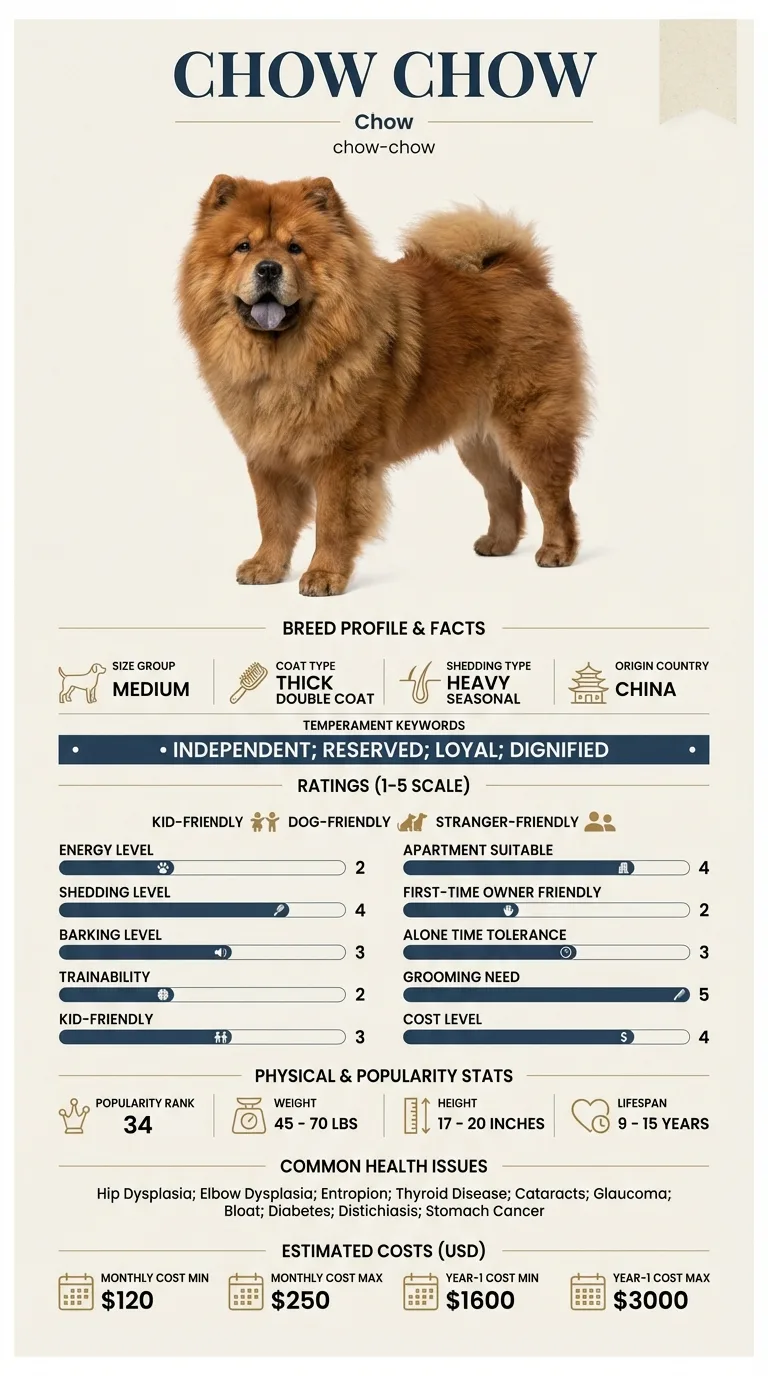
The most useful breed fact here is a negative one: the Chow does not carry the short-legged, long-bodied conformation associated with early disc calcification, so the single largest risk factor for IVDD does not apply. What the breed does bring is confusion. Documented hip and elbow dysplasia generate hind-end signs that overlap heavily with early spinal disease, and a stoic, independent temperament rated 2 out of 5 for trainability means the dog neither performs pain nor cooperates readily with the neurological examination that would separate them. Dense coat further hides muscle wastage, which is one of the clearest physical clues to chronic nerve compression.
Household surfaces and furniture access do most of the mechanical damage over a lifetime. A Chow that launches off a sofa onto laminate several times a day is applying repeated impact to both spine and joints. Body condition compounds it, and the coat conceals weight gain so effectively that owners underestimate load. Cold, damp conditions increase stiffness and can make a chronic problem look like a sudden one on a particular morning.
Some presentations here are genuine emergencies. Go immediately for sudden inability to stand or walk, dragging of one or both hind legs, loss of bladder or bowel control, or a dog crying out on movement and refusing to be handled. Where surgery is appropriate, outcome depends heavily on how quickly the cord is decompressed, and the difference between a few hours and a day can be the difference between walking and not. Book a prompt appointment, within days rather than weeks, for a hunched back, reluctance to jump or lower the head, a shortened stride, or scuffed hind nails. Never give human anti-inflammatory or painkiller medication, which is toxic to dogs and can also complicate the surgical decision.
See all Chow Chow health problems, which breeds are prone to intervertebral disc disease ivdd, or the full Chow Chow breed guide for temperament, exercise needs and ownership costs.
Conservative management of a mild protrusion usually involves four to six weeks of genuinely strict confinement followed by a slow return to activity over a further month. Post-surgical recovery is typically eight to twelve weeks with rehabilitation. Chronic protrusion is managed rather than cured, and function is often maintained rather than restored.
For a slow protrusion, success is a dog whose hind legs still place correctly, who walks his usual short route without scuffing, and whose comfort is maintained with a stable plan. Expect adaptation, ramps and permanent changes to how your house works rather than a return to jumping onto beds.
A spinal disc is a tough outer ring around a gel-like centre, sitting between vertebrae as a shock absorber. There are two broad ways it goes wrong. In the extrusion pattern, the centre calcifies early and eventually bursts through the outer ring into the spinal canal, striking the cord hard and fast. This is the version that produces a dog who was fine at breakfast and paralysed by lunch, and it is overwhelmingly a chondrodystrophic breed problem.
In the protrusion pattern, the outer ring degenerates gradually with age and bulges upward against the cord over months or years. The cord is squeezed rather than struck. Signs come on slowly: a stiff back, reluctance to jump onto the sofa, a shortened stride, sometimes scuffed toenails on one hind foot from dragging. This is the pattern typical of larger, non-chondrodystrophic breeds and it is the one a Chow is more likely to develop.
The practical consequence is about tempo, not seriousness. Slow protrusion gives you time to investigate properly, and it responds differently to treatment. It also means a Chow presenting with genuinely sudden paralysis is unusual enough to be an emergency demanding immediate imaging rather than a wait-and-see plan.

Hip dysplasia is documented in this breed and produces overlapping signs, so this distinction matters more for a Chow than for a Dachshund. None of these checks replaces an examination, but they tell your vet where to look first.
Song was nine and had been managed for hip dysplasia since he was five. When his owner Katrin noticed he had started scuffing his right hind toenail flat, she assumed the arthritis had progressed and asked for stronger pain relief. Her vet did the neurological part of the examination properly. Song knuckled when his right hind paw was placed upside down, took several seconds to correct it, and flinched to pressure over his lower back. His hips were arthritic, but they were not what had changed. MRI showed a chronic disc protrusion compressing the cord. Song was managed conservatively with weight loss, a rehabilitation programme and floor grip throughout the house. Three years on he still walks twice daily, and the nail on that foot still wears faster than the others.
Key takeaway: A documented breed problem can absorb the blame for a different disease for years. When something new appears in an old diagnosis, ask for the neurological exam specifically.
Disc disease is not among the ten documented health issues for this breed, and the Chow lacks the chondrodystrophic body type that drives early disc disease in Dachshunds, Corgis and French Bulldogs. Age-related disc degeneration can still occur, as it can in any dog.
That is an emergency and it needs a vet now, not tomorrow. Acute hind-limb paralysis can come from a disc extrusion, a spinal blood-supply event, trauma or other causes, and the treatment window for some of them is measured in hours.
Very possibly. Hip dysplasia is documented in the Chow and it is far more common in this breed than disc disease. Nerve signs such as knuckling, toe dragging and symmetrical weakness point at the spine; stiffness that eases with warm-up and asymmetric lameness point at the hips.
Plain radiographs can show narrowed disc spaces and rule out fractures or tumours, but they cannot show the spinal cord. MRI, or CT in some circumstances, is what actually visualises compression and locates it precisely. Referral is usually required, and general anaesthesia is involved.
Strict confinement combined with prescribed pain control is a legitimate treatment for many cases without severe neurological deficit, and strict means genuinely restricted, not simply calm. It is not appropriate for a dog that is losing function, and continuing it while a dog deteriorates is how surgical windows are missed.
Its proportions help, since the breed is not built long and low. Its weight does not: 45 to 70 pounds on a compact frame is real load. Slippery floors, jumping from furniture and excess body weight remain worth managing regardless of breed type.
No. It is not on the breed's documented health list, and the Chow is not chondrodystrophic. Hip dysplasia is a far more likely explanation for hind-end trouble.
Look for knuckling, toe dragging, symmetrical hind weakness and back pain on palpation. Those point at the spine. Stiffness that eases as the walk goes on points at the hips.
Sudden inability to walk, dragging both hind legs, or any loss of bladder control. Go the same hour, not the same week.
Reduce repetitive stair use and block jumping down from furniture. Both add spinal and joint load in a compact 45 to 70 pound dog.
A one-page prep sheet for this condition: the signs, the questions to ask, what to get priced. Unlocks here.
You get: Vet visit prep sheet
No spam. One-click unsubscribe. See our privacy policy.
Preview page 1 before you decide.