Behavior
Which should most people choose?
A household with yard access and time for daily exercise gets more out of the welsh springer -- better trained, better with kids and other dogs. A lower-energy household fits the chow's needs better.

Quick answer
Which should most people choose?
A household with yard access and time for daily exercise gets more out of the welsh springer -- better trained, better with kids and other dogs. A lower-energy household fits the chow's needs better.
Chow Chow or Welsh Springer Spaniel? On paper they differ most on exercise need, and on the scales Chow Chow is the heavier at 45–70 lbs. Here is how the two compare on everything that shapes an ordinary week.
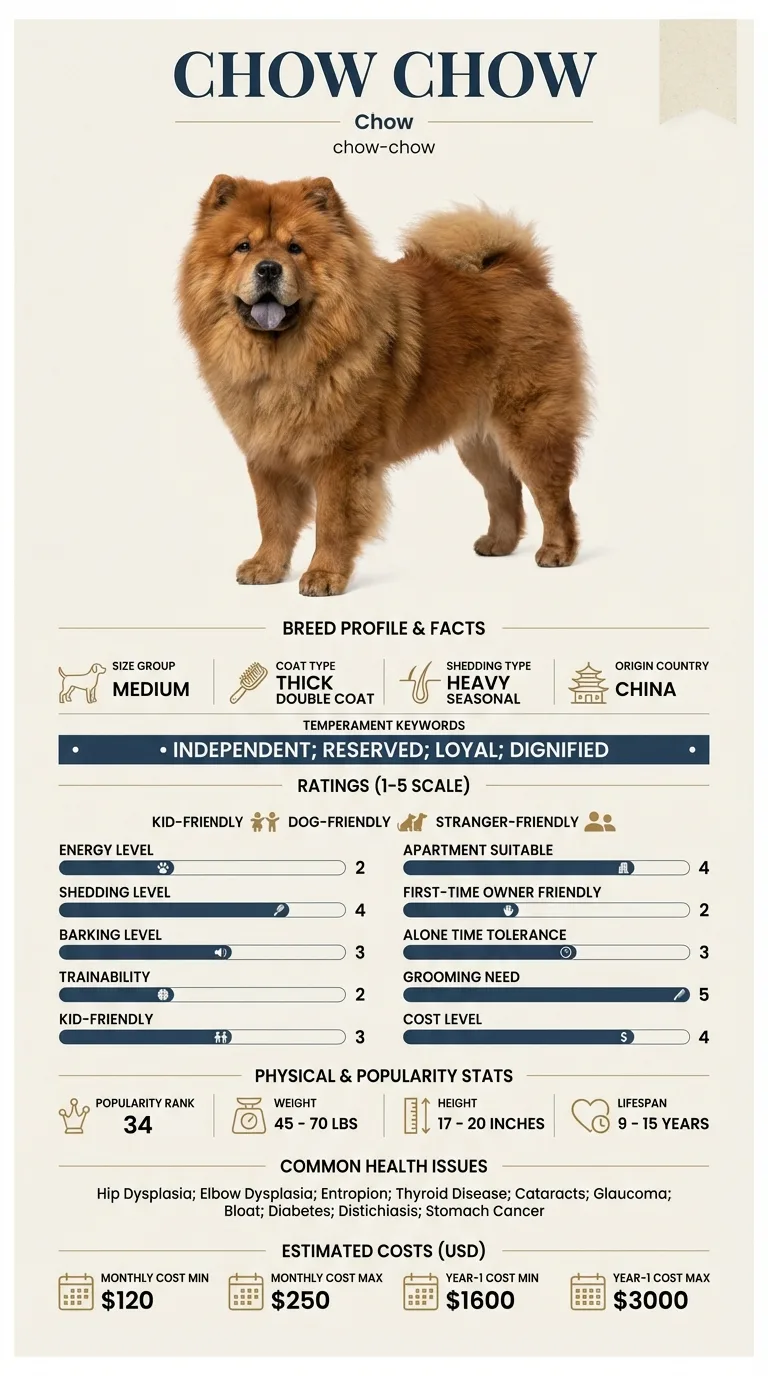
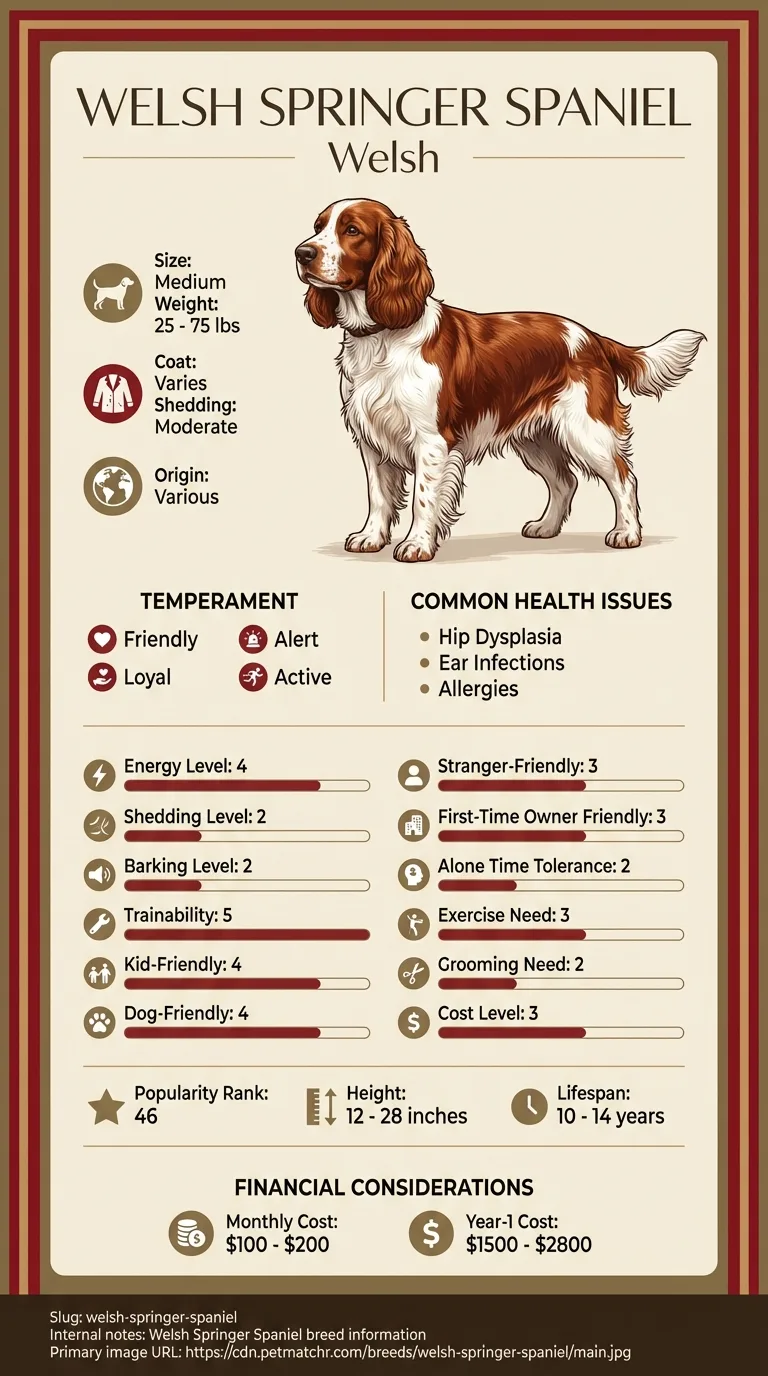
This is for someone already down to Chow Chow and Welsh Springer Spaniel and deciding between them. For this pair the decision usually turns on exercise need and grooming need, so those are covered first and in most detail. Anyone choosing from a flat has a clear answer here: Chow Chow rates 4/5 against 2/5. The focus throughout is on daily consequences rather than breed background.
Between Chow Chow and Welsh Springer Spaniel, exercise need is what separates them, and Chow Chow is the lower-effort dog of the two to keep.
Choose Chow Chow if you are in a flat or a smaller home, your walking routine is modest and the dog will be alone during the working day.
Choose Welsh Springer Spaniel if this is your first dog, you do not want a standing grooming appointment and shedding is a problem in your house.
| Feature | chow chow | welsh springer spaniel | Winner |
|---|---|---|---|
| Size class | medium | medium | Equal |
| Weight | 45–70 lbs | 35–55 lbs | Equal |
| Height | 17–20 in | 17–19 in | Equal |
| Lifespan | 9–15 years | 12–15 years | welsh springer spaniel |
| Exercise need | Low (2/5) | High (4/5) | chow chow |
| Grooming need | Very high (5/5) | Moderate (3/5) | welsh springer spaniel |
| Shedding | High (4/5) | Moderate (3/5) | welsh springer spaniel |
| Energy level | Low (2/5) | High (4/5) | Equal |
| Barking | Moderate (3/5) | Moderate (3/5) | Equal |
| Apartment suitability | High (4/5) | Low (2/5) | chow chow |
| Good for first-time owners | Low (2/5) | Moderate (3/5) | welsh springer spaniel |
| Tolerates being alone | Moderate (3/5) | Low (2/5) | chow chow |
| Trainability | Low (2/5) | High (4/5) | welsh springer spaniel |
| Good with kids | Moderate (3/5) | High (4/5) | welsh springer spaniel |
| Good with other dogs | Low (2/5) | High (4/5) | welsh springer spaniel |
| Friendly to strangers | Low (2/5) | Moderate (3/5) | welsh springer spaniel |
| Cost level | High (4/5) | Moderate (3/5) | welsh springer spaniel |
| Coat | Thick double coat | Medium, straight and water-resistant | Equal |
| Origin | China | Various | Equal |
| Typical monthly cost | $120–$250 | $100–$200 | Equal |
| Typical first-year cost | $1,600–$3,000 | $1,400–$2,900 | Equal |
Height is nearly identical -- chow 17-20 in, welsh springer 17-19 in -- but weight diverges, 45-70 lbs for the chow against 35-55 for the springer. Both are classed medium. The springer's leaner, sporting-dog build carries less bulk per inch than the chow's dense, heavily coated frame, so two dogs of similar height can end up looking like different weight classes at a glance.
Welsh springer spaniel rates high (4/5) on exercise need, chow low (2/5). Springers are gundogs bred to work a field all day, and that heritage shows up as a genuine daily exercise requirement -- not a stroll, but the kind of activity a chow simply doesn't ask for. An unexercised springer tends to get restless and destructive indoors; an unexercised chow mostly just sleeps through the afternoon.
Chow is the higher-maintenance coat on both counts -- very high (5/5) grooming against the springer's moderate (3/5), and high (4/5) shedding against the springer's moderate (3/5). The springer's medium, water-resistant coat needs regular brushing, especially around the feathering, but nothing close to the chow's weekly commitment. Field-bred coats like the springer's are built to shed debris more than they shed hair indoors.
Chow rates high (4/5) for apartment living; welsh springer rates low (2/5). Barking ties at moderate (3/5) for both, so the springer's weaker apartment fit comes down to its exercise needs and its lower (2/5) tolerance for being left alone, not noise. A house with yard access suits the springer far better than a flat does, particularly if daily exercise is likely to slip on busy weeks.
Welsh springer rates high (4/5) on trainability and moderate (3/5) for first-time owners; chow rates low (2/5) on both. Gundog breeds are generally built to take direction, and the springer's temperament -- even-tempered, loyal -- backs up an easier obedience path than the chow's independent streak allows. A first-time owner willing to put in consistent short sessions should see faster progress with the springer than most breed comparisons on this site would predict.
Welsh springer scores better with kids (high, 4/5, versus the chow's moderate, 3/5) and with other dogs (high, 4/5, versus low, 2/5). Strangers are closer -- moderate (3/5) for the springer against low (2/5) for the chow -- and it's worth noting both breeds carry a reserved streak in their temperament profile, even if the numbers show the springer warming up faster.
Welsh springer's lifespan (12-15 years) runs a bit longer and more consistently than the chow's wider 9-15 range. The two share hip dysplasia and glaucoma risk, plus thyroid-related concerns on both sides. The springer's list is notably shorter overall -- five conditions against the chow's ten -- for whatever that's worth in a data set like this, though a shorter list is never a guarantee against surprises.
Welsh springer is the cheaper breed to keep across every line -- cost level moderate (3/5) against the chow's high (4/5), monthly $100-200 versus $120-250, first-year $1,400-2,900 versus $1,600-3,000. Grooming again explains most of the gap, and it's a difference that compounds every month rather than showing up as a one-time cost, so the total spread widens the longer you own the dog.
Chow Chow weighs 45–70 lbs and lives 9–15 years; Welsh Springer Spaniel weighs 35–55 lbs and lives 12–15 years. The two diverge most on exercise need, grooming need and energy level and 3 other rated axes. Almost every rated axis separates them at least slightly. The table below marks a winner only where one breed is genuinely easier for a typical owner; size and origin are facts rather than merits and stay level. Ratings come from one source applied to both breeds, so they are meaningful against each other rather than as absolute scores.

Height is close (17-20 in for the chow, 17-19 for the springer) but the chow outweighs it, 45-70 lbs against 35-55. Both are officially medium-sized breeds.
The welsh springer spaniel -- high (4/5) exercise need against the chow's low (2/5). It's a gundog breed bred for daily fieldwork, and that need doesn't disappear indoors.
The springer -- moderate (3/5) grooming need and moderate (3/5) shedding, against the chow's very high (5/5) grooming need and high (4/5) shedding.
The springer is the better bet, rated moderate (3/5) for first-timers with high (4/5) trainability. The chow rates low (2/5) on both, being a more independent, harder-to-motivate breed.
The chow, at high (4/5) apartment suitability against the springer's low (2/5) -- mostly because the springer's exercise needs and lower alone-tolerance don't suit small-space living.
The springer runs a bit cheaper, $100-200 against the chow's $120-250, with a similar gap in first-year costs.
Hip dysplasia and glaucoma appear on both lists, along with thyroid-related risk. The springer's overall health-risk list is shorter than the chow's in this data.
A household with yard access and time for daily exercise gets more out of the welsh springer -- better trained, better with kids and other dogs. A lower-energy household fits the chow's needs better.
Springer runs $100-200, chow $120-250 -- a modest gap from grooming.
Springer needs high (4/5) daily exercise; chow needs low (2/5).
The welsh springer, typically -- 12-15 years against the chow's wider but lower-averaging 9-15 range.
Secure checkout on Stripe. We never see your card.
7-day money-back guarantee. Instant access.
Health information here is general and is not veterinary advice. If your dog shows pain, sudden behaviour change, or worsening symptoms, consult a licensed veterinarian.
Some links on this site are affiliate links. We may earn a commission at no extra cost to you, and we only suggest products we believe are helpful for dog owners.
We research and check what we publish, but we do not warrant that any figure, date, price, or statement is accurate, complete, or current, and we accept no liability for any loss, cost, injury, or other harm arising from the use of this site. Use it as one reference among several. You remain responsible for your own decisions and for your dog's care - confirm anything that matters with a licensed veterinarian or another qualified professional before you act on it. Full disclaimer.
Match your lifestyle to the right dog.
Take quizNot sure which breed is right for you? Take our 2-minute quiz to find out.
Take the quiz