Health
How brachycephalic is this breed?
Moderately. Shorter-muzzled than an average dog but far less extreme than the flat-faced breeds most people picture.

Quick answer
How brachycephalic is this breed?
Moderately. Shorter-muzzled than an average dog but far less extreme than the flat-faced breeds most people picture.
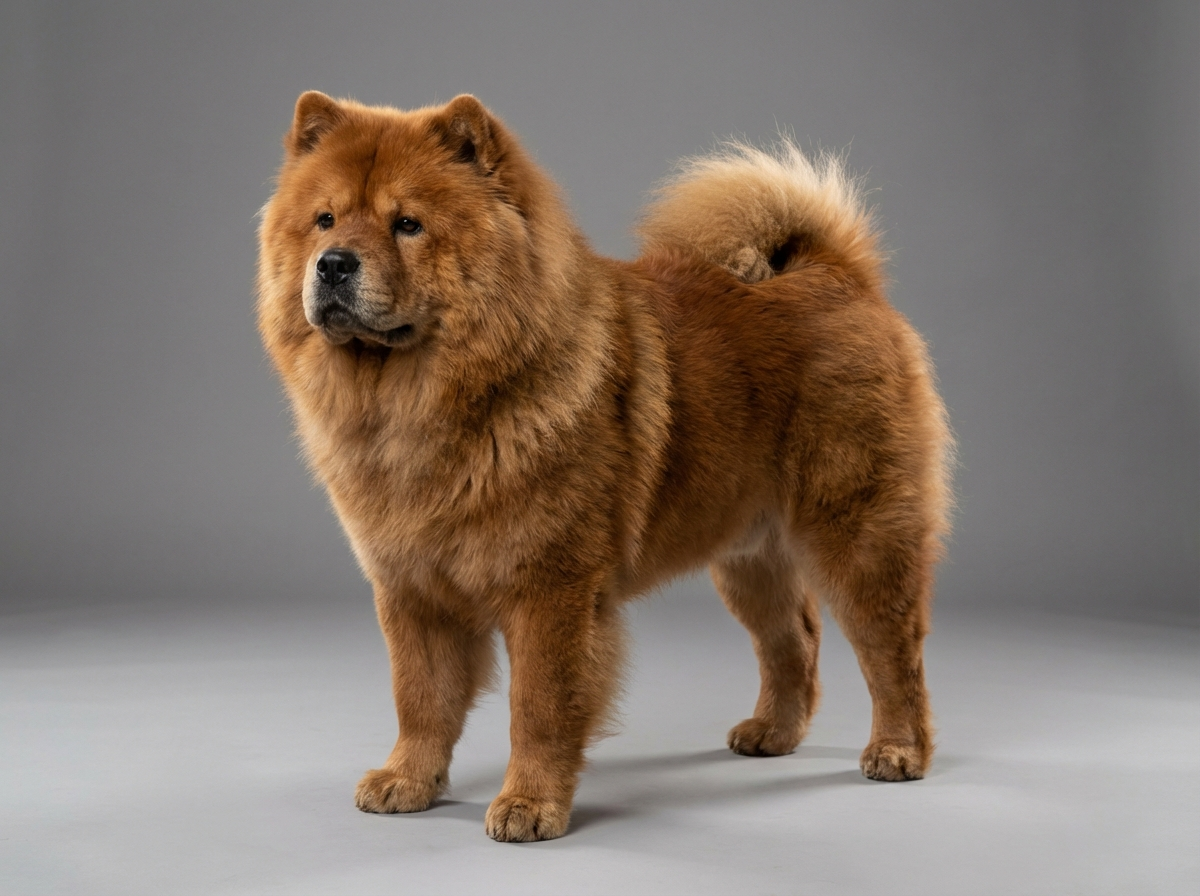
Two Chow Chows from different lines can have visibly different muzzles, and the difference is not cosmetic. A dog with a reasonable amount of nose has a materially easier life in warm weather than one bred towards a flatter, heavier head, and you can see the difference from across a room once you know what you are looking at.
People choosing a puppy or a breeder, who want to know what to look at and what to ask. It also matters for owners trying to work out whether their adult dog's snoring is normal breed character or a sign of something worth investigating.
This guide is not medical advice. If your dog shows pain, sudden behavior change, or worsening symptoms, consult a licensed veterinarian.
Some links may be affiliate links. We may earn a commission at no extra cost to you. We only suggest products we believe are helpful for dog owners.
We research and check what we publish, but we do not warrant that any figure, date, price, or statement is accurate, complete, or current, and we accept no liability for any loss, cost, injury, or other harm arising from the use of this site. Use it as one reference among several. You remain responsible for your own decisions and for your dog's care - confirm anything that matters with a licensed veterinarian or another qualified professional before you act on it. Full disclaimer.
Brachycephalic features describe a shortened, broadened muzzle in which soft tissue is compressed into less space than it evolved to occupy. The Chow Chow sits in the moderate part of this spectrum, which means airway limitation that shows up under load rather than constantly. The individual variation within the breed is wide enough that assessing your own dog matters more than knowing the breed average.
Moderate shortening of the muzzle is a defining feature of the breed rather than a defect within it, so in that sense every Chow Chow has it. What varies is the degree and its consequences. Some individuals breathe quietly and cope reasonably with warm weather; others are audible at rest and struggle every summer, and the difference is usually visible in the nostrils and the profile.
The Chow Chow's head is broad and deep with a comparatively short muzzle, a conformation established long before any modern discussion of brachycephaly. The result is mild compression of the nasal passages and pharyngeal soft tissue - enough to reduce airflow reserve, not usually enough to obstruct a resting dog. Because the breed also carries a thick double coat, a heavy ruff around the neck and documented heat sensitivity, the modest airway limitation matters more here than the same anatomy would in a short-coated dog. Selection within lines for a heavier, broader head has widened the variation, which is why two Chows can differ so visibly.
Climate is the dominant factor. A moderately short-muzzled dog in a temperate climate with cool nights may never show a problem; the same dog in a humid subtropical region may struggle for four months of the year. Indoor temperature matters as much as outdoor, since a home that holds heat overnight gives the dog no recovery period. Collars that press on the throat, rather than a harness, add avoidable restriction at exactly the wrong point.
Raise it at a routine appointment if your dog is audible at rest, snores loudly, gags or retches after eating or drinking, tires faster than it used to, or sleeps in unusual positions with the neck extended. Ask specifically whether the nostrils would benefit from assessment. Seek emergency care for breathing that is laboured and not settling with rest, any blue or grey colour to the tongue, collapse, or extreme distress with noisy breathing, since airway obstruction in a shortened-muzzled dog can escalate quickly and is worse in warm conditions.
See all Chow Chow health problems, which breeds are prone to brachycephalic features, or the full Chow Chow breed guide for temperament, exercise needs and ownership costs.
Nothing about skull shape changes over time. Weight loss shows a measurable difference in breathing effort over roughly two to three months. If surgery on nostrils or palate is undertaken, improvement is usually assessed at six to twelve weeks. The seasonal pattern - comfortable winters, restricted summers - is permanent and should be planned for as a fixed feature of owning the breed.
For a moderately affected dog, success is a dog that breathes quietly at rest, recovers from a cool-weather walk within a few minutes, holds a lean body condition, and has a documented baseline in its notes so that any future change is measurable. It is not the absence of snoring. Owners who track their own dog's recovery time have a far better handle on this than owners relying on how the breed is described in general.
In an extremely shortened skull, the soft tissue inside the head has not shortened along with the bone. The same amount of palate, tongue and nasal tissue is packed into a much smaller space, which is why the most affected breeds have obstructed airways as a structural certainty rather than a possibility.
A moderately short muzzle, such as the Chow's, means that compression exists but is less severe. Practically, that translates into a breed where many individuals breathe adequately at rest and in cool conditions, and where trouble emerges under load - exertion, excitement and above all heat. It is a conditional problem rather than a constant one.
That is genuinely better news than an extreme brachycephalic diagnosis, and it is also a trap. Because a moderately affected dog seems fine most of the time, owners do not build the habits that a Pug owner learns in the first month. The Chow's dense double coat then removes the safety margin that a moderate airway would otherwise provide, which is why this breed's heat problems are more serious than its skull shape alone would predict.

You are assessing an individual dog, not a breed. These observations take a couple of minutes and separate a comfortable dog from one that will struggle every August.
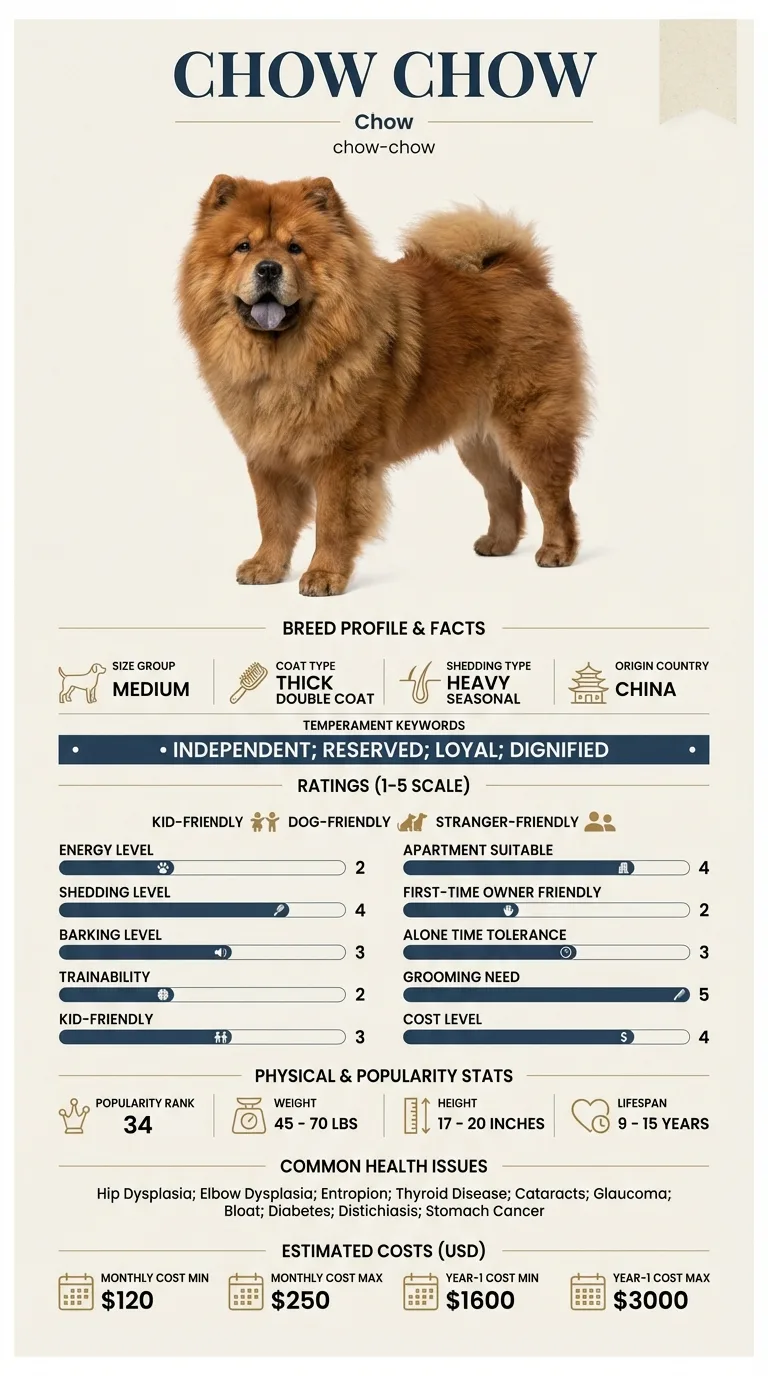
If you think your Chow has brachycephalic features, the plan is three steps: write down what you have seen and when it started, book a veterinary appointment rather than waiting for the next flare, and take video of the behaviour or symptom before you go — the thing you are worried about rarely happens in the consulting room. Screening in the parents covers hip dysplasia, elbow dysplasia, entropion.
What the vet visit should produce is a diagnosis and a written plan, not just reassurance: what is being ruled out, what the monitoring interval is, and which signs mean you come back sooner. Ask what the treatment costs across a year rather than per visit, because that is the number that decides whether you are managing this condition or reacting to it.
Between appointments, keep a short log — dates, what you saw, what changed. It is the single most useful thing an owner brings to a follow-up, and for brachycephalic features it is often what separates a clear pattern from a guess.
Pepper's owner, Idris, visited two breeders before choosing. He had read enough to know he should look at the faces, and the difference between the litters surprised him. The first litter had heavy, broad heads with muzzles that dropped away sharply, and two of the puppies were making a soft snoring sound while asleep in the pen. The breeder described this as normal for the breed. The second litter had noticeably more length in front of the eyes and open, rounded nostrils, and none of them was audible. Idris asked the second breeder how the mother coped in summer. She said honestly that the bitch avoided midday walks from June to September, that she kept the house cool, and that one dog she had bred years earlier had needed nostril surgery. That answer was the reason he bought from her. Pepper is now four. He snores lightly when deeply asleep and settles within three minutes after a walk. Idris still keeps him in from ten until seven every summer day, because the coat has not read any of this.
Key takeaway: Moderate is a range, not a reassurance. Nostril shape and muzzle length are visible before you commit, and a breeder who will talk frankly about how their dogs cope in August is telling you more than any label applied to the breed as a whole.
It is generally classed as moderately brachycephalic - shortened relative to a typical long-muzzled dog, but far less extreme than the breeds most associated with the term. Where a particular list places it varies, which is why assessing your own dog's nostrils, profile and exercise recovery tells you more than the label does.
Snoring means air is not moving freely somewhere in the upper airway. Whether that matters depends on how loud it is, whether it happens at rest as well as in sleep, and whether the dog tires quickly. Mention it at a routine appointment and let your vet decide whether it warrants investigation.
Airway signs often become more apparent as a dog matures and gains weight, and soft tissue changes over time in some dogs. A puppy that is already noisy at rest is worth having assessed rather than watching, because early intervention on narrow nostrils is more straightforward than late intervention on a whole airway.
It is a real consideration, though the coat weighs more heavily than the muzzle. A Chow in a hot region can be kept well with air conditioning, night walks and seasonal restriction, but it takes commitment. Anyone unable to guarantee a cool indoor environment should think carefully.
Yes. A short broad muzzle affects dental crowding, since the same number of teeth occupy less jaw, and it influences how much room exists for soft tissue swelling after an anaesthetic tube. Both are worth raising with your vet at routine check-ups.
Not the bone. What can be improved is airflow through the parts that are soft tissue - narrow nostrils and an over-long palate can be surgically addressed in appropriate cases - and body weight, which affects the airway more than most owners expect. Everything else is management.
Moderately. Shorter-muzzled than an average dog but far less extreme than the flat-faced breeds most people picture.
Nostril shape from the front, muzzle length in profile, and whether the puppy is audible while lying still.
For a Chow, the coat. A moderate airway would be manageable if the dog were not also wearing arctic insulation.
Conformation-related conditions can be excluded or loaded by some insurers, so read the wording carefully before signing rather than after a claim.
A one-page prep sheet for this condition: the signs, the questions to ask, what to get priced. Unlocks here.
You get: Vet visit prep sheet
No spam. One-click unsubscribe. See our privacy policy.
Preview page 1 before you decide.