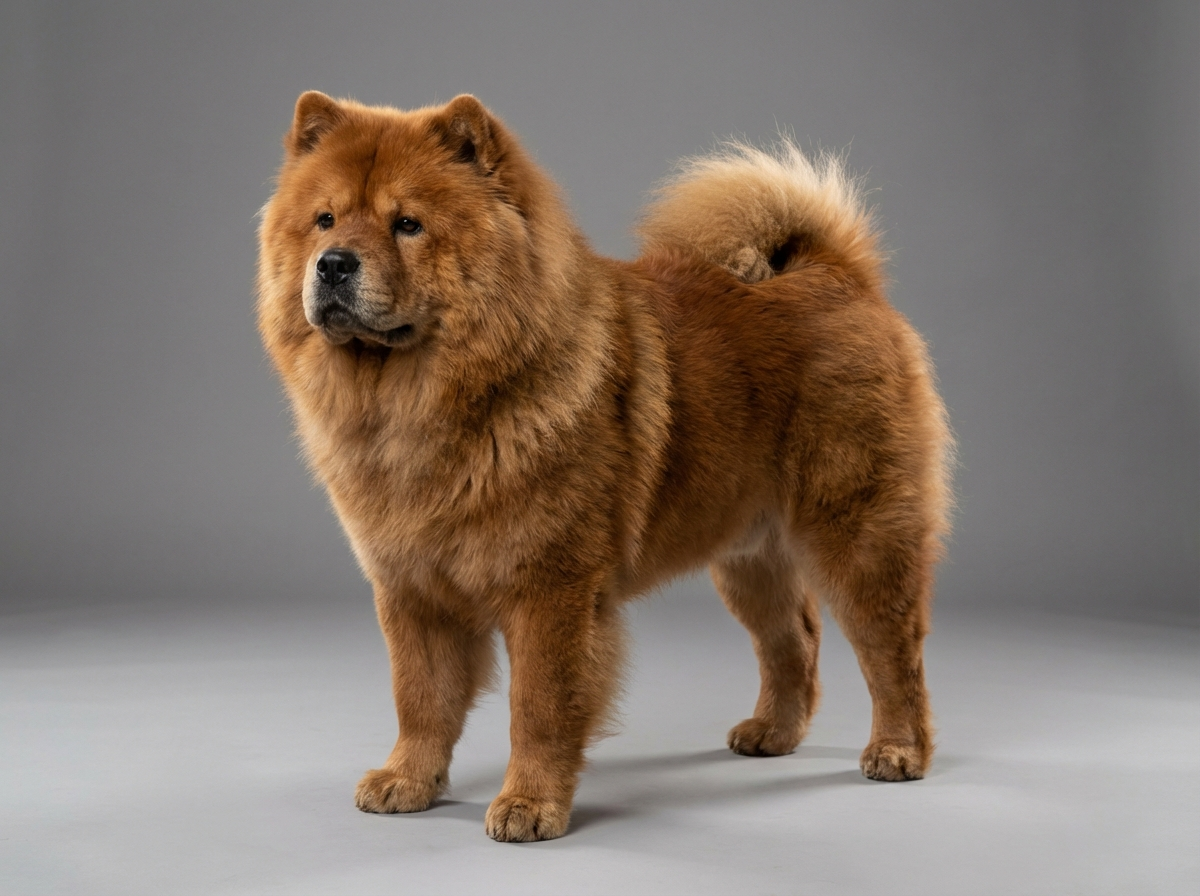
Health
Why is heat so dangerous for this breed?
Because both halves of the cooling system are compromised: a narrowed airway limits panting, and a dense double coat holds heat in.

Quick answer
Why is heat so dangerous for this breed?
Because both halves of the cooling system are compromised: a narrowed airway limits panting, and a dense double coat holds heat in.
The Chow Chow is the awkward case where both halves of the cooling system are working against the dog. The airway is shorter and narrower than a long-muzzled breed's, so the radiator is undersized. And the thick double coat, built for northern Chinese winters, is insulation the dog cannot take off. In July those two facts multiply rather than add.
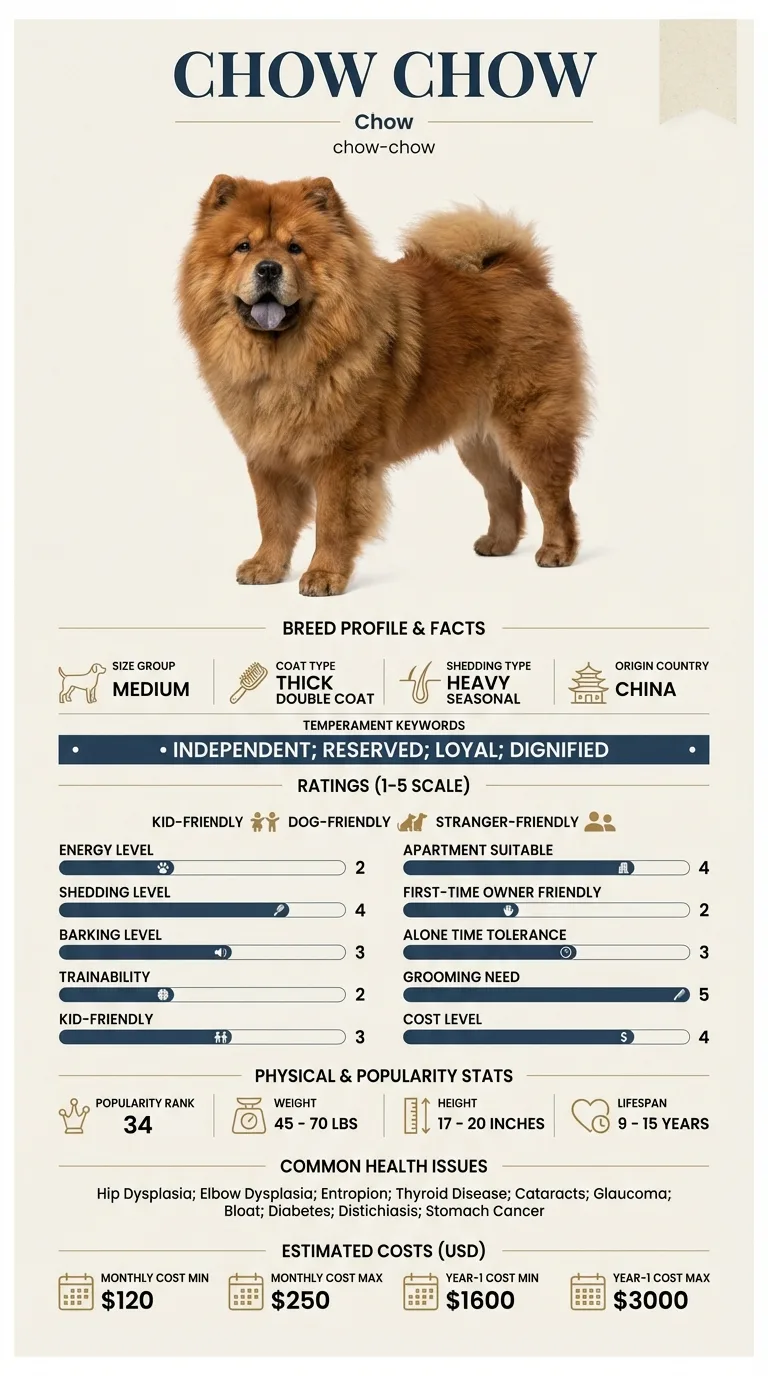
Owners in hot or humid climates, and anyone who moved somewhere warmer with a dog that coped fine before. It also affects owners of older or overweight Chows, whose margin has narrowed, and anyone whose routine has a walk in it at a fixed time of day regardless of the weather.
This guide is not medical advice. If your dog shows pain, sudden behavior change, or worsening symptoms, consult a licensed veterinarian.
Some links may be affiliate links. We may earn a commission at no extra cost to you. We only suggest products we believe are helpful for dog owners.
We research and check what we publish, but we do not warrant that any figure, date, price, or statement is accurate, complete, or current, and we accept no liability for any loss, cost, injury, or other harm arising from the use of this site. Use it as one reference among several. You remain responsible for your own decisions and for your dog's care - confirm anything that matters with a licensed veterinarian or another qualified professional before you act on it. Full disclaimer.
Airway limitation in a shortened-muzzled dog means reduced airflow and therefore reduced cooling capacity, because panting is how dogs shed heat. In the Chow Chow this combines with a thick insulating double coat to produce a dog that is unusually poor at managing warm weather, and for which heat represents a genuine emergency risk rather than mere discomfort.
Heat sensitivity is a recognised characteristic of the Chow Chow rather than an occasional complication, and virtually every owner of the breed will need to manage it seasonally. The severity of the airway component varies between individuals, and dogs with a more shortened muzzle, narrower nostrils or excess weight sit at the harder end of that range.
Two documented breed characteristics create the problem together. The Chow has a comparatively short, broad muzzle, which shortens the passage available for the air exchange that cools a dog, and narrower nostrils in some individuals reduce intake further. Separately, the breed carries a thick double coat with dense undercoat and heavy seasonal shedding - equipment designed for a cold northern climate. Neither feature alone would be critical; together they leave the dog with a small radiator wrapped in insulation. The breed's low energy and exercise requirements are, in this one respect, a mercy, since a Chow does not need the activity that would push it into trouble.
Ambient temperature, humidity and airflow determine how far the dog's limited system has to stretch. Still, humid air is worse than hot dry air because evaporation slows. Homes without air conditioning that hold heat overnight leave the dog with no recovery window. Cars are the classic hazard and remain so even with windows cracked. Ground surface temperature matters too, since a low dog is closer to radiating asphalt than its owner is.
Book an appointment if your dog snores heavily, makes noise breathing at rest, tires unusually quickly on short walks, or has become noticeably worse over a summer. Treat as an immediate emergency, cooling on the way and phoning ahead: distressed noisy breathing that does not settle within a few minutes of rest, a blue, grey or brick-red tongue, staggering or collapse, vomiting or diarrhoea in a hot dog, or a dog that seems disoriented. Heatstroke damages organs and can kill within a short period, and it is far more survivable when cooling starts before the drive rather than after it.
See all Chow Chow health problems, which breeds are prone to brachycephalic airway syndrome boas, or the full Chow Chow breed guide for temperament, exercise needs and ownership costs.
Environmental changes work immediately - a routine shifted to dawn walks pays off the same week. Weight loss improves breathing measurably over two to four months. Surgery, where indicated, is assessed over six to twelve weeks post-operatively. What does not change on any timeline is the coat and the underlying skull shape, which means heat management is a permanent seasonal commitment rather than a problem you solve once.
A realistic good summer is one where the dog is walked in the dark, sleeps on tile, recovers from activity within a few minutes, and never has an episode that frightens you. Success does not look like a Chow that can join a family hike in August. Owners who accept the seasonal restriction early have easier summers than those who keep testing the boundary.
Panting cools by evaporation, and evaporation needs airflow. When the airway is narrowed, the dog has to work harder for the same volume of air. That work generates heat of its own. So a hot Chow pants harder, generates more heat by panting, and needs to pant harder still. That feedback loop is why heat trouble in these breeds accelerates rather than plateaus.
The soft tissue lining a compromised airway also swells when it is working hard, which narrows the passage further as the episode goes on. A dog that was breathing noisily twenty minutes ago can be in genuine obstruction now.
The coat closes the trap. A double coat with dense undercoat traps a layer of warm air against the skin, which is exactly its purpose in cold weather and exactly the wrong property at thirty degrees. And unlike the airway, this part cannot be surgically improved - shaving a Chow removes its protection from sun and does not restore normal thermoregulation.
What is left, then, is environmental control. For this breed, heat management is not a comfort measure. It is the primary treatment.

Because the airway is the constraint, everything in a hot-weather plan is about lowering the demand placed on it rather than improving its capacity.
Han had walked the same twenty-five minute loop with his owner, Beatriz, every morning at eight for three years. In April it was a pleasant walk. In late June, on a still and humid morning, Han stopped about two thirds of the way round and would not go on. Beatriz got him into the shade of a wall and phoned her partner to bring the car. By the time it arrived Han was panting in a way she described afterwards as sounding mechanical, and his tongue looked wrong. They drove straight to the clinic with the air conditioning on full. He was treated for early heat exhaustion, kept for the afternoon and sent home. The vet was blunt: the same loop in the same conditions could have killed him, and the fact that it was a familiar route made it more dangerous rather than less, because nobody was assessing it. Beatriz moved the walk to half past five in the morning and stopped going out at all on humid days.
Key takeaway: For this breed the danger is the routine rather than the exertion. A walk your Chow has done a hundred times can become unsurvivable when the weather changes, and the only reliable safeguard is to judge every outing by the conditions rather than by habit.
Loud snoring and snorting are evidence that air is not moving freely, so it is worth mentioning at a check-up rather than accepting as breed character. What matters more than the noise at rest is what happens on exertion and in warmth, since that is when a narrow airway becomes limiting rather than merely audible.
There is no single number, because humidity matters as much as temperature and individual dogs differ considerably. A practical approach is to judge by the dog's recovery: if it is still panting hard ten minutes after coming in, that walk was too much for those conditions, and you should adjust the next one.
Generally no. The double coat provides insulation against heat as well as cold and protects skin from sun, and it may not regrow properly after clipping. Removing dead undercoat by raking gives you real airflow benefit without any of the downsides. Discuss any clipping decision with your vet or a groomer experienced with the breed.
Move it into shade or air conditioning, apply cool - not ice-cold - water to the belly, groin, armpits and feet, get air moving over it with a fan, offer small amounts of water to drink, and get to a vet. Do not immerse the dog in ice water, and do not wrap it in wet towels, which traps heat against a coat like this one.
Substantially. Fat around the chest and neck reduces the airway further and adds insulation, while the extra mass generates more heat during any activity. In a breed with low exercise needs, weight has to be controlled through the bowl, and it is one of the few genuine improvements available to a Chow's breathing.
For dogs with significant obstruction there are procedures that widen the nostrils or shorten an over-long soft palate, and they can meaningfully improve airflow. Whether your dog is a candidate is a veterinary assessment, not a breed assumption, and it should be discussed alongside the heat management that will still be needed afterwards.
Because both halves of the cooling system are compromised: a narrowed airway limits panting, and a dense double coat holds heat in.
Before dawn and after dark, or not at all on the hottest days. Skipping a walk is far cheaper than an emergency visit.
Cool water on the belly, groin, armpits and paws, with a fan moving air. Never ice water, and never wet towels left lying on the coat.
Emergency cooling with intensive care and monitoring is a serious bill, and severe cases require multi-day hospitalisation.
A one-page prep sheet for this condition: the signs, the questions to ask, what to get priced. Unlocks here.
You get: Vet visit prep sheet
No spam. One-click unsubscribe. See our privacy policy.
Preview page 1 before you decide.