Living
Bigger dog?
The Chow Chow, at 45-70 lbs versus the Cocker Spaniel's 20-30 lbs.

Quick answer
Bigger dog?
The Chow Chow, at 45-70 lbs versus the Cocker Spaniel's 20-30 lbs.
Chow Chow or Cocker Spaniel? On paper they differ most on good for first-time owners, and on the scales Chow Chow is the heavier at 45–70 lbs. Here is how the two compare on everything that shapes an ordinary week.
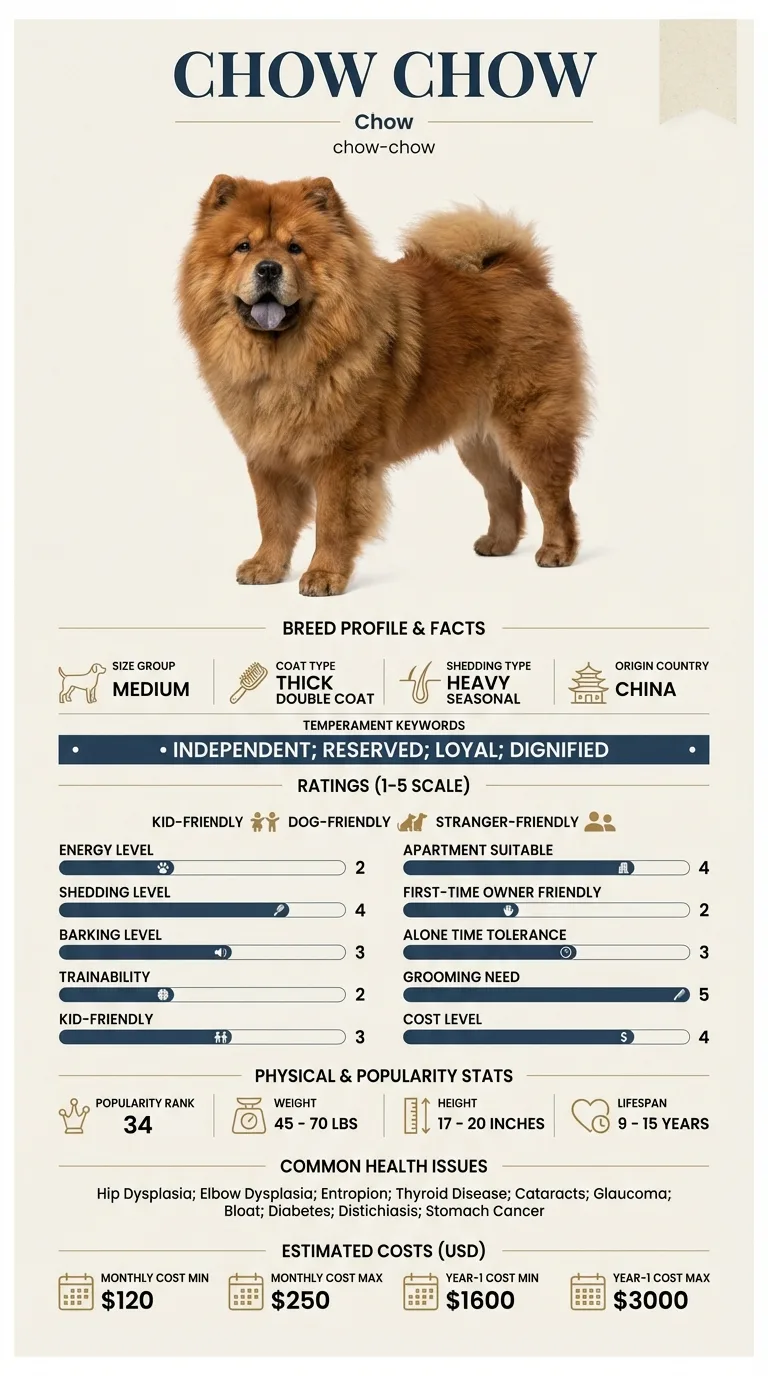
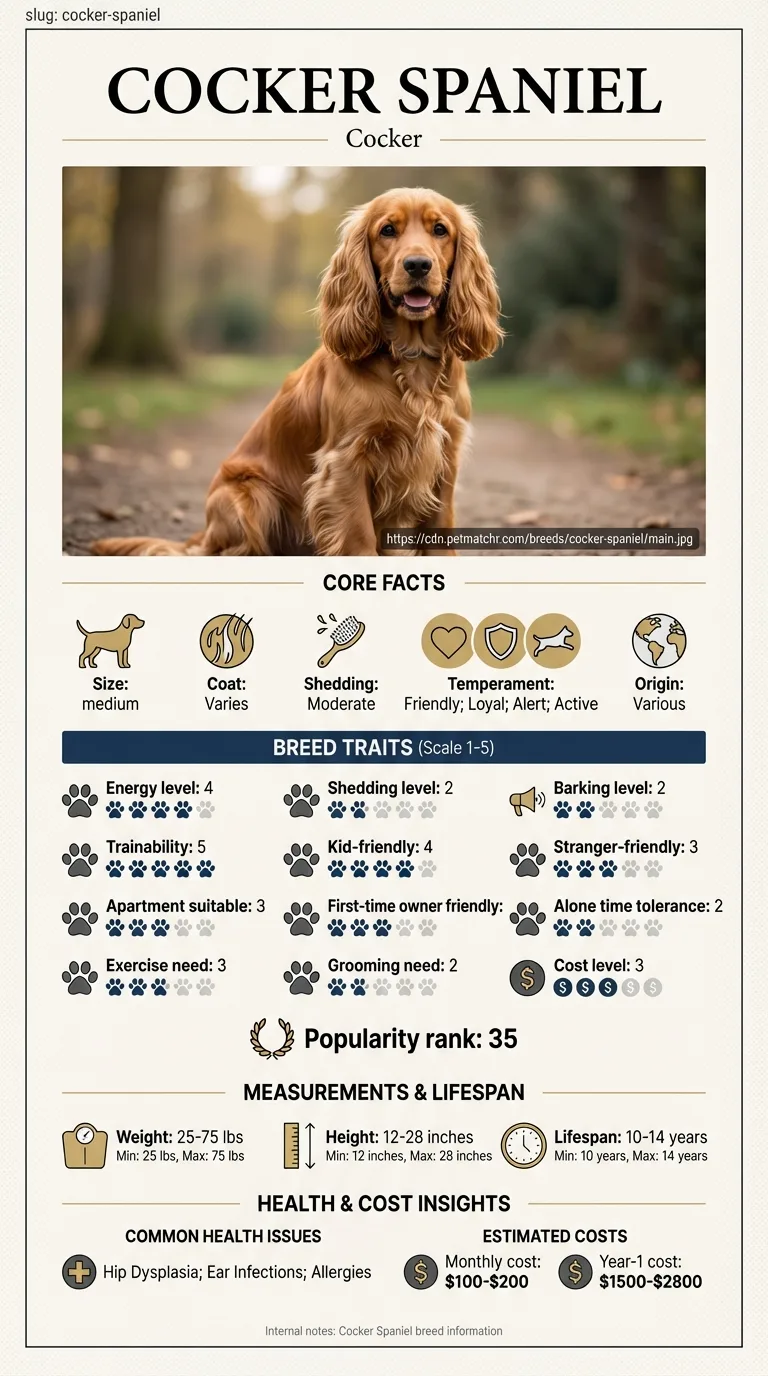
This is for someone already down to Chow Chow and Cocker Spaniel and deciding between them. For this pair the decision usually turns on good for first-time owners and good with kids, so those are covered first and in most detail. Both rate 4/5 for flats, so housing does not settle this one. Breed history is left out; what follows is what you will actually live with.
Between Chow Chow and Cocker Spaniel, good for first-time owners is what separates them; neither is the lower-effort dog overall.
Choose Chow Chow if your walking routine is modest, the dog will be alone during the working day and you want a dog that is more watchful with visitors.
Choose Cocker Spaniel if this is your first dog, shedding is a problem in your house and there are young children at home.
| Feature | chow chow | cocker spaniel | Winner |
|---|---|---|---|
| Size class | medium | small | Equal |
| Weight | 45–70 lbs | 20–30 lbs | Equal |
| Height | 17–20 in | 13–16 in | Equal |
| Lifespan | 9–15 years | 10–14 years | Equal |
| Exercise need | Low (2/5) | Moderate (3/5) | chow chow |
| Grooming need | Very high (5/5) | Very high (5/5) | Equal |
| Shedding | High (4/5) | Moderate (3/5) | cocker spaniel |
| Energy level | Low (2/5) | Moderate (3/5) | Equal |
| Barking | Moderate (3/5) | Moderate (3/5) | Equal |
| Apartment suitability | High (4/5) | High (4/5) | Equal |
| Good for first-time owners | Low (2/5) | High (4/5) | cocker spaniel |
| Tolerates being alone | Moderate (3/5) | Low (2/5) | chow chow |
| Trainability | Low (2/5) | High (4/5) | cocker spaniel |
| Good with kids | Moderate (3/5) | Very high (5/5) | cocker spaniel |
| Good with other dogs | Low (2/5) | High (4/5) | cocker spaniel |
| Friendly to strangers | Low (2/5) | High (4/5) | cocker spaniel |
| Cost level | High (4/5) | Moderate (3/5) | cocker spaniel |
| Coat | Thick double coat | Silky and feathered | Equal |
| Origin | China | Various | Equal |
| Typical monthly cost | $120–$250 | $80–$150 | Equal |
| Typical first-year cost | $1,600–$3,000 | $1,100–$2,300 | Equal |
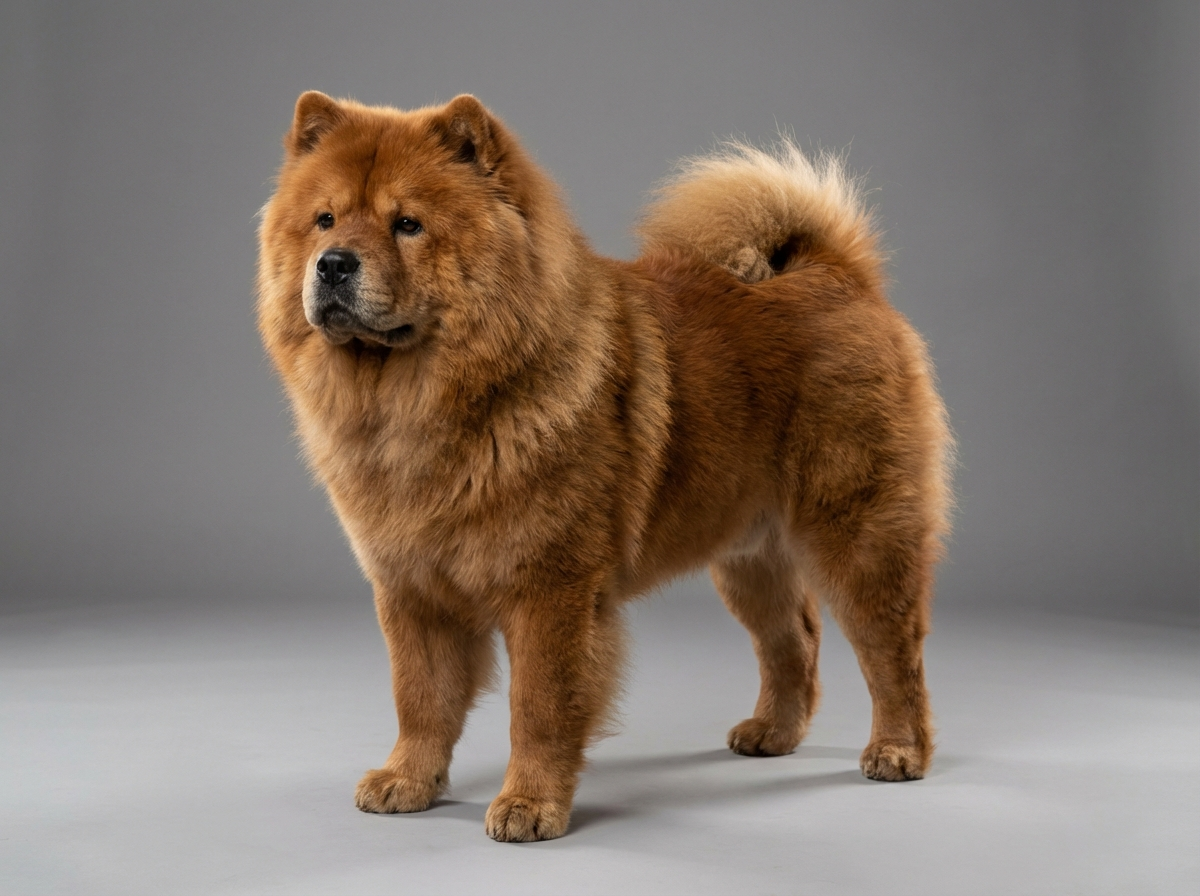
Fifteen pounds separates a small Chow Chow, 45 lbs, from a large Cocker Spaniel, 30 lbs — closer than you'd guess from a medium-versus-small breed matchup, especially since Chow Chows range up to 70 lbs at the top end. Height splits them more cleanly: 17 to 20 inches for the Chow against 13 to 16 for the Cocker. Picture a dense, lion-maned block of muscle standing next to a compact, silky-eared sporting dog, and the visual gap looks bigger than the numbers suggest. The Chow's origin in China as an all-purpose guard dog explains its thick bone structure; the Cocker's field-dog ancestry produced a lighter, quicker frame built for flushing birds, not standing sentry.
Neither of these dogs will drag you out of bed for a 6 a.m. run, but the Cocker Spaniel comes closer to wanting one. It rates Moderate, 3/5, on both exercise need and energy level, while the Chow Chow sits at Low, 2/5, on both — a genuinely sedate dog once past puppyhood, partly a function of its independent, dignified temperament rather than any physical limitation. A Cocker's field-dog instincts still surface as enthusiasm for sniffing walks and retrieving games even in a pet-only household. Owners picturing a lazy afternoon nap companion will get closer to that with the Chow; owners wanting a dog that still wants a proper walk most days should lean Cocker.
Five out of five. That's where both breeds land on grooming need — a rare full tie between a Chow Chow's thick double coat and a Cocker Spaniel's silky, feathered one, and it means neither is a wash-and-go dog. Shedding is where they split: High, 4/5, for the Chow against Moderate, 3/5, for the Cocker. The Chow's dense double coat blows out seasonally in dramatic fashion, while the Cocker's feathering — the long fringe on its ears, legs, and belly — tangles easily and needs regular brushing to avoid mats, even though less actual fur ends up on the floor. Budget real time or a groomer's bill for either dog; neither coat forgives neglect.
A downtown renter comparing these two on paper alone would see two ties and assume it's a coin flip: both rate High, 4/5, for apartment suitability, and both bark at a Moderate, 3/5, rate. The real difference shows up when the owner leaves for the day. The Chow tolerates solitude at a Moderate, 3/5, level, drawing on its independent streak, while the Cocker Spaniel drops to Low, 2/5 — it's a breed that genuinely wants company and can develop separation-related whining or barking without it. So the apartment-suitability tie is misleading on its own; factor in daily absences and the Chow becomes the steadier solo-hours roommate despite weighing twice as much.
Four points separate these breeds on trainability alone: High, 4/5, for the Cocker Spaniel against Low, 2/5, for the Chow Chow. That gap tracks directly with temperament — the Cocker is described as gentle, merry, and eager to please, textbook traits for a dog that wants to work with its handler, while the Chow's independent, reserved, dignified nature makes it more likely to decide a command isn't worth following. First-time-owner suitability follows the same pattern, High for the Cocker against Low for the Chow. Anyone without prior experience training a strong-willed, independent breed should expect the Chow to demand real patience, ideally with help from a trainer who's worked with guardian-type dogs before.
Very High versus Moderate. That's the kids comparison — the Cocker Spaniel rated 5/5 with children, the Chow Chow at 3/5 — and the gap widens further with other dogs, High 4/5 versus Low 2/5, and strangers, High 4/5 versus Low 2/5. None of this makes the Chow a bad dog, but it does mean a household with a revolving door of kids' friends, dog-park visits, and drop-in guests puts real pressure on a breed whose loyal, reserved temperament is built for a smaller, more consistent social circle. The Cocker's merry, affectionate nature is simply better suited to chaos and new faces on a regular basis.
Ten health conditions are listed for the Chow Chow against five for the Cocker Spaniel, a two-to-one gap that includes serious entries like Bloat, Stomach Cancer, and Glaucoma alongside more common issues such as Hip Dysplasia, Elbow Dysplasia, and Entropion — three separate eye-and-joint concerns tied to the breed's dense build and folded features. The Cocker's shorter list — Ear Infections, Cataracts, Progressive Retinal Atrophy, Hip Dysplasia, and Autoimmune Hemolytic Anemia — still isn't trivial, with the autoimmune condition in particular requiring prompt veterinary attention if it appears. Lifespans overlap substantially, 9 to 15 years for the Chow against 10 to 14 for the Cocker, so longevity itself won't strongly favor either dog, but the Chow's longer conditions list argues for more vigilant, more frequent veterinary checkups over its lifetime.
$1,600 to $3,000. That's the first-year cost range for a Chow Chow, noticeably steeper than the Cocker Spaniel's $1,100 to $2,300, and the monthly figures track the same gap: $120-$250 against $80-$150. The overall cost ratings confirm it, High, 4/5, for the Chow versus Moderate, 3/5, for the Cocker. Some of that gap comes down to size and food volume, but the Chow's Very High grooming need — tied with the Cocker's own Very High rating — means coat care isn't actually the differentiator here; it's the Chow's longer list of potential health conditions, several of them serious, that likely explains the wider spending range at the top end.
Chow Chow weighs 45–70 lbs and lives 9–15 years; Cocker Spaniel weighs 20–30 lbs and lives 10–14 years. The two diverge most on good for first-time owners, good with kids and trainability and 2 other rated axes. They are level on apartment suitability, barking and grooming need, so those cannot decide it. The comparison marks an easier option only where one exists. Facts like weight and country of origin are not scored. Both dogs are rated from the same dataset, which is what makes the numbers comparable with each other even though any individual dog sits somewhere inside its breed's range.

Both wear a coat demanding regular brushing — the Chow's thick double coat and the Cocker's silky feathering — so both land at Very High (5/5) despite different textures and lengths.
The Chow Chow, rated Moderate (3/5) tolerance for solitude against the Cocker Spaniel's Low (2/5) — the Cocker is more prone to separation-related whining.
Not really — it rates Low (2/5) for first-time owners and Low (2/5) trainability, both well behind the Cocker Spaniel's High (4/5) scores on each.
Ten for the Chow Chow, including Bloat and Stomach Cancer, against five for the Cocker Spaniel, including Autoimmune Hemolytic Anemia.
The Chow Chow, with a High (4/5) cost rating and a first-year range of $1,600-$3,000, versus the Cocker's Moderate (3/5) rating and $1,100-$2,300.
Yes, rated Very High (5/5), the top score on this page, well above the Chow Chow's Moderate (3/5).
Likely so — bred in China as an all-purpose guard dog, it carries an independent, reserved, dignified temperament suited to a smaller social circle rather than constant new company.
The Chow Chow, at 45-70 lbs versus the Cocker Spaniel's 20-30 lbs.
The Cocker Spaniel, rated High (4/5) versus the Chow Chow's Low (2/5).
The Chow Chow, rated High (4/5) versus the Cocker Spaniel's Moderate (3/5).
The Cocker Spaniel, at roughly $1,100-$2,300 versus the Chow Chow's $1,600-$3,000.
Secure checkout on Stripe. We never see your card.
7-day money-back guarantee. Instant access.
Health information here is general and is not veterinary advice. If your dog shows pain, sudden behaviour change, or worsening symptoms, consult a licensed veterinarian.
Some links on this site are affiliate links. We may earn a commission at no extra cost to you, and we only suggest products we believe are helpful for dog owners.
We research and check what we publish, but we do not warrant that any figure, date, price, or statement is accurate, complete, or current, and we accept no liability for any loss, cost, injury, or other harm arising from the use of this site. Use it as one reference among several. You remain responsible for your own decisions and for your dog's care - confirm anything that matters with a licensed veterinarian or another qualified professional before you act on it. Full disclaimer.
Match your lifestyle to the right dog.
Take quizNot sure which breed is right for you? Take our 2-minute quiz to find out.
Take the quiz