Health
Why does my Chihuahua's back hurt?
Most often from repeated landings off furniture, a fall from someone's arms, or being lifted by the front legs so the spine hangs unsupported.

Quick answer
Why does my Chihuahua's back hurt?
Most often from repeated landings off furniture, a fall from someone's arms, or being lifted by the front legs so the spine hangs unsupported.
A Chihuahua jumping off a sofa is dropping about four times its own height. Nobody would let a Labrador leap off a first-floor balcony, but we let this happen twenty times a day and call it normal.
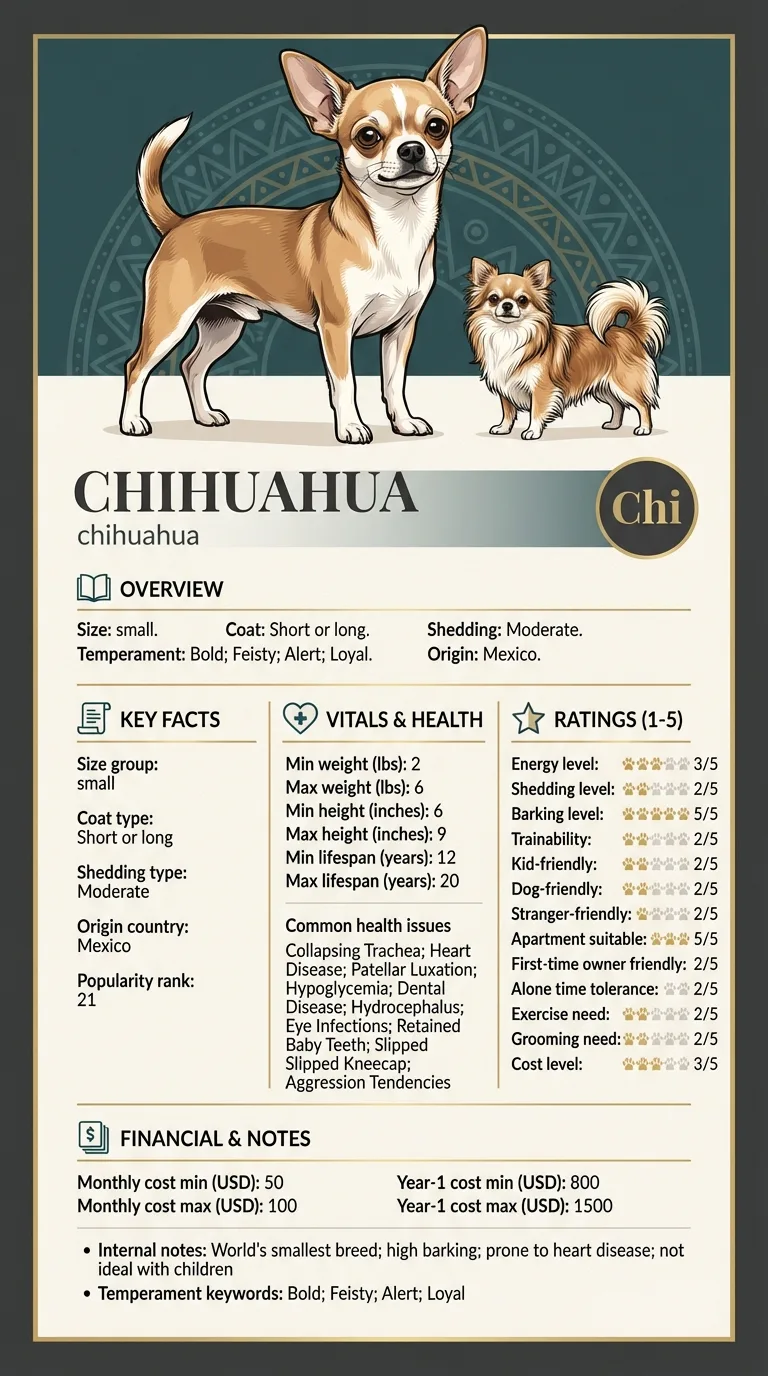
Owners whose Chihuahua has suddenly gone hunched, tense and reluctant to be picked up, and owners of a bouncy young dog who want to know which household habits are quietly storing up a spinal injury.
This guide is not medical advice. If your dog shows pain, sudden behavior change, or worsening symptoms, consult a licensed veterinarian.
Some links may be affiliate links. We may earn a commission at no extra cost to you. We only suggest products we believe are helpful for dog owners.
We research and check what we publish, but we do not warrant that any figure, date, price, or statement is accurate, complete, or current, and we accept no liability for any loss, cost, injury, or other harm arising from the use of this site. Use it as one reference among several. You remain responsible for your own decisions and for your dog's care - confirm anything that matters with a licensed veterinarian or another qualified professional before you act on it. Full disclaimer.
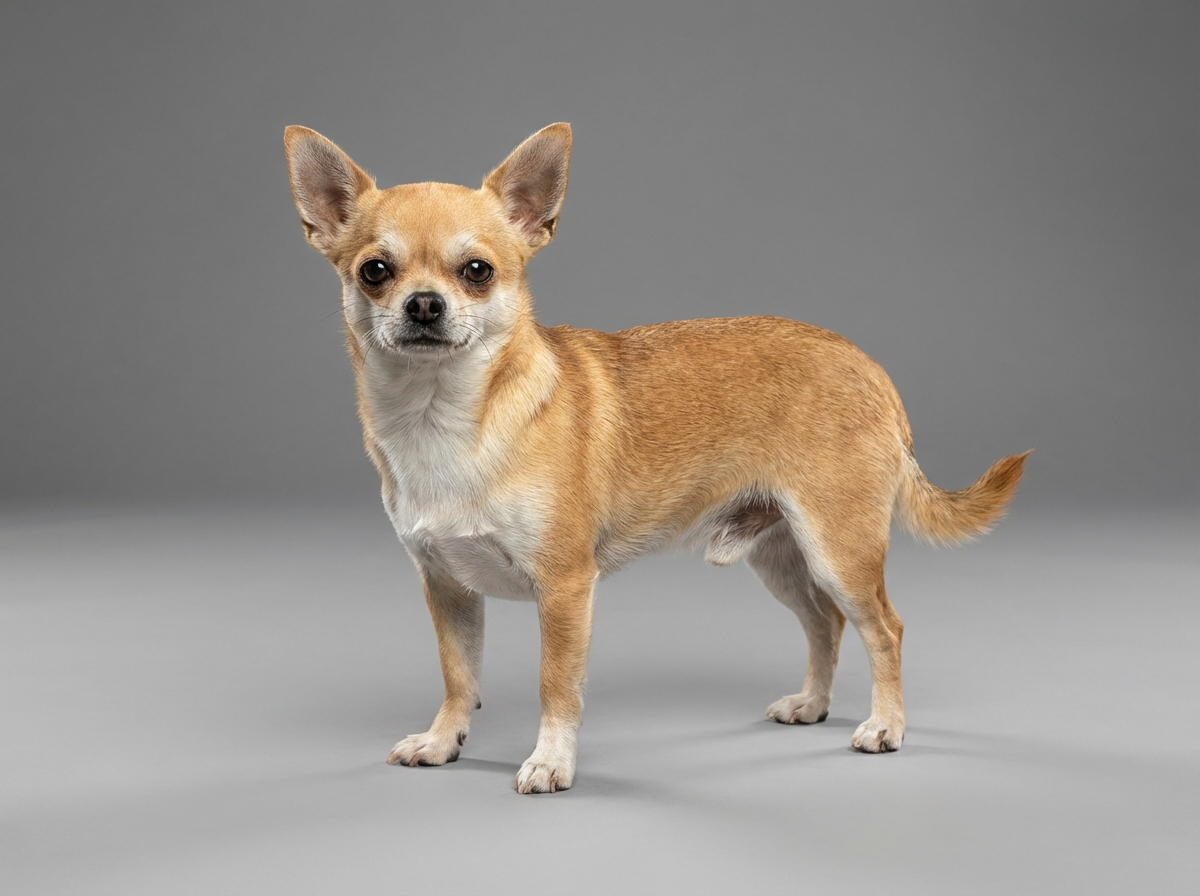
Back problems in Chihuahuas cover a range from soft-tissue strain and bruising through to fractures and disc injury. The unifying cause in this breed is mechanical: a dog standing six to nine inches tall and weighing two to six pounds lives in a house scaled for humans, is carried constantly, and absorbs repeated impacts landing from furniture built for people. Most episodes are painful rather than catastrophic, but the ones involving the spinal cord are time-critical.
Common enough that most small-animal clinics see it regularly, and under-reported because owners attribute a hunched, quiet dog to a mood rather than to pain. Serious disc disease is far less frequent than simple strain and bruising, but Chihuahuas are among the small breeds in which it does occur, so any back pain accompanied by weak or dragging hind legs must be treated as urgent.
The Chihuahua's contribution is scale rather than shape. At six to nine inches at the shoulder, everyday furniture represents a drop of several body heights, and the impact of each landing travels through a skeleton weighing only a couple of pounds. Being the world's smallest breed also means being handled more than any other kind of dog: picked up, passed around, carried in bags and lifted onto laps dozens of times a day, and every one of those is an opportunity for a bad lift or a drop. The breed's bold, reactive temperament and top-of-scale barking drive add a further mechanical factor, since a dog that hurls itself at a window on a neck collar is repeatedly loading its own neck.
Household layout does most of the damage. High beds with hard floors beside them, sofas that the dog treats as a permanent base, and polished laminate that offers no grip on landing are the three big ones. Homes with young children see more drop injuries. Homes where the dog follows one person from room to room see more crush injuries in doorways and under feet. And a household that uses a collar rather than a harness on a lunging, vocal Chihuahua puts a repeated load on the neck that a larger dog would absorb without noticing.
Go the same day, and treat it as an emergency, for any hind leg that drags, knuckles over onto the top of the foot, or cannot bear weight, and for a dog that cannot stand or has lost bladder control. Spinal cord compression has a treatment window measured in hours and the outcome depends heavily on how fast it is addressed. Book within a day or two for a hunched posture, a hard tense belly, trembling, or a yelp on being lifted, even if the dog seems to settle between episodes. Never give human painkillers; several are toxic to dogs and the dosing margin in a 4-pound patient is tiny.
See all Chihuahua health problems, which breeds are prone to back problems, or the full Chihuahua breed guide for temperament, exercise needs and ownership costs.
Simple soft-tissue strain in a Chihuahua usually settles over one to three weeks with restricted activity and prescribed pain relief. A significant disc injury managed conservatively needs four to six weeks of genuinely strict confinement followed by a graded return, and improvement over that period is rarely linear. Surgical cases have their own timeline set by the surgeon. What stays permanent is the household: the furniture stays high and the dog stays small, so the preventive changes are for life rather than for the recovery.
Success is a Chihuahua that moves with a level topline, a soft relaxed belly and no objection to being picked up, in a house where it no longer has to leap off anything. For dogs that have had one significant episode, success also means accepting a permanently modified environment, because the strongest predictor of a second back injury is a home that has changed nothing since the first.
Furniture is built for people. A sofa seat sits around eighteen inches off the floor and a bed around twenty-five. For a dog whose shoulder is seven inches high, those are drops of roughly two and a half to four times its own body height, absorbed by front legs the thickness of a pencil and transmitted straight up the spine.
The force arrives at the moment of landing, and it is repeated. A Chihuahua that lives on the sofa may make that landing a dozen times a day across fifteen years. Individually each one is harmless. Cumulatively they are a loading history that no wild canid of this size would ever accumulate.
Then there is being carried. This breed is picked up more than almost any other, and the standard mistake is scooping a dog under the front legs so the entire body weight hangs from the shoulders and the spine dangles unsupported. A correct lift puts one hand under the chest and the other under the rump, so the back stays horizontal.
Drops are the other half of that story. A Chihuahua wriggling out of a child's arms at chest height falls further, relative to its size, than most owners appreciate, and a fall onto a hard floor from that height can fracture as well as bruise. Being stepped on and being shut in a door are the other two household injuries that clinics see repeatedly in this breed, for the simple reason that a 4-pound dog underfoot is genuinely hard to see.

A dog in spinal pain rarely limps. It changes posture, and the changes are subtle enough that owners often describe them as mood.
Frijolito is a three-year-old, 4.5-pound Chihuahua in Leeds who slept on his owner Nadia's bed every night and launched himself off it every morning to beat her to the kitchen. One Tuesday he landed, screamed, and stood in the hallway hunched with his head down and his belly drawn tight. Nadia got him seen that morning. There was no weakness in his back legs and no dragging, which was the reassuring part, and he was diagnosed with an acute soft-tissue back injury and sent home on pain relief with two weeks of confinement. The confinement was the hard bit. Frijolito barks at every passing car, and a crate in the front room made things worse until Nadia moved him to a back bedroom with a covered pen and a frozen food toy each morning. He recovered fully. The bed is now off limits, with a ramp to a low armchair as the compromise, and the hallway has a runner along it.
Key takeaway: The injury took one second and the prevention took one afternoon. In a breed this small, the tallest piece of furniture in the house is usually the thing that eventually causes the problem.
No, and this is worth correcting because it changes the advice. The Chihuahua is a compact breed, roughly as long as it is tall, without the exaggerated body length that defines a Dachshund. It does still suffer disc disease, but the driver is not spinal proportion. It is repeated impact from height, handling injuries and falls in a very small, frequently carried dog.
Reducing it is realistic; eliminating it is not, and a ramp your dog refuses to use achieves nothing. Aim to make the ramp the easiest route by putting treats on it, and block access to the highest surfaces such as beds. The single biggest win is usually the bed, because it is the tallest surface and the landing is often onto a hard floor.
One hand flat under the chest between the front legs, the other supporting the rump, so the spine stays level and the weight is shared. What causes harm is lifting under the armpits so the whole dog hangs vertically from the shoulders, and doing it quickly enough that the back end swings. Teach children the two-handed lift or ask them to let the dog come to the floor instead.
Yes, and in this breed it is a genuine issue for the windpipe as well as the neck. A Chihuahua with a high barking drive lunges at windows and passers-by, and each lunge concentrates force on a very small neck through a narrow strap. A well-fitted harness spreads that load across the chest, and it is one of the cheapest protective changes available.
Book a check within a day or two even if the dog appears recovered, because spinal pain waxes and wanes and the quiet interval is not proof of healing. Go immediately instead of waiting if there is any weakness, dragging or unsteadiness in the back legs, since that indicates the spinal cord is involved and the useful treatment window can be short.
When your vet prescribes it, yes, and it has to be genuinely strict rather than approximate. Rest means confinement with lead-only toilet breaks, not a quiet dog with the run of the house. This is difficult in an alert, bold breed that reacts to every doorbell, which is exactly why so many small dogs re-injure themselves during recovery.
Most often from repeated landings off furniture, a fall from someone's arms, or being lifted by the front legs so the spine hangs unsupported.
Hunched topline, hard tucked belly, low head carriage, trembling, and a yelp at the moment of being lifted rather than touched.
Harness, without much debate. It spreads lunging force across the chest instead of concentrating it on a small neck and a narrow windpipe.
Any dragging hind foot, knuckled toes, wobbliness or inability to stand. That is spinal cord involvement and it needs same-day assessment.
Block bed access, add a ramp to the sofa, put rugs where the dog lands, and teach a two-handed lift to everyone in the house.
A one-page prep sheet for this condition: the signs, the questions to ask, what to get priced. Unlocks here.
You get: Vet visit prep sheet
No spam. One-click unsubscribe. See our privacy policy.
Preview page 1 before you decide.