Malamute or Chihuahua: The Biggest Gap on This Site
Quick answer
Malamute vs Chihuahua: which should I choose?
The Chihuahua if you want a very cheap, very long-lived dog for a flat and will socialise it as seriously as a large one. The Malamute if you are athletic, have space, and want a sociable dog that is good with children.
A Malamute can weigh fifty times what a Chihuahua weighs and costs three times as much to keep. It also lives, at the pessimistic end, half as long. Two of their ratings match exactly, and both are the ones that say neither breed is an easy first dog.
This page is for someone comparing the two extremes of the size scale. It covers cost and lifespan, barking, the exercise gap, dental and tracheal care in a tiny breed, and what each actually asks of a household.
Quick verdict
The Chihuahua is the cheapest and longest-lived dog here and the noisiest by a wide margin; the Malamute costs three times as much, needs two hours a day, and is quieter.
Choose alaskan malamute if...
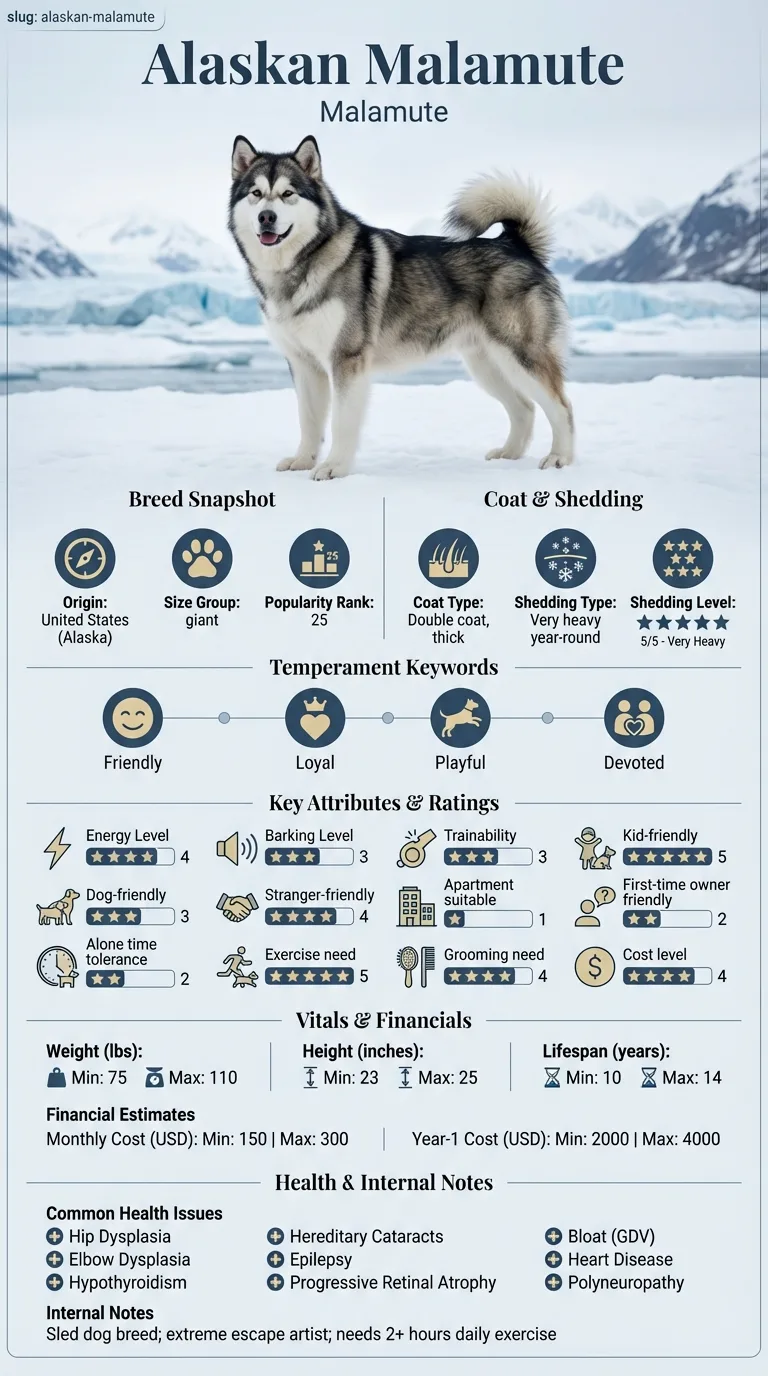
Choose the Alaskan Malamute if you are athletic, have space and want a sociable large dog. It rates 5/5 with children against the Chihuahua's 2/5 and 4/5 with strangers against 2/5, and barks at 3/5 against 5/5. You are accepting $150–$300 a month against $50–$100, 5/5 exercise and 5/5 shedding.
Choose chihuahua if...
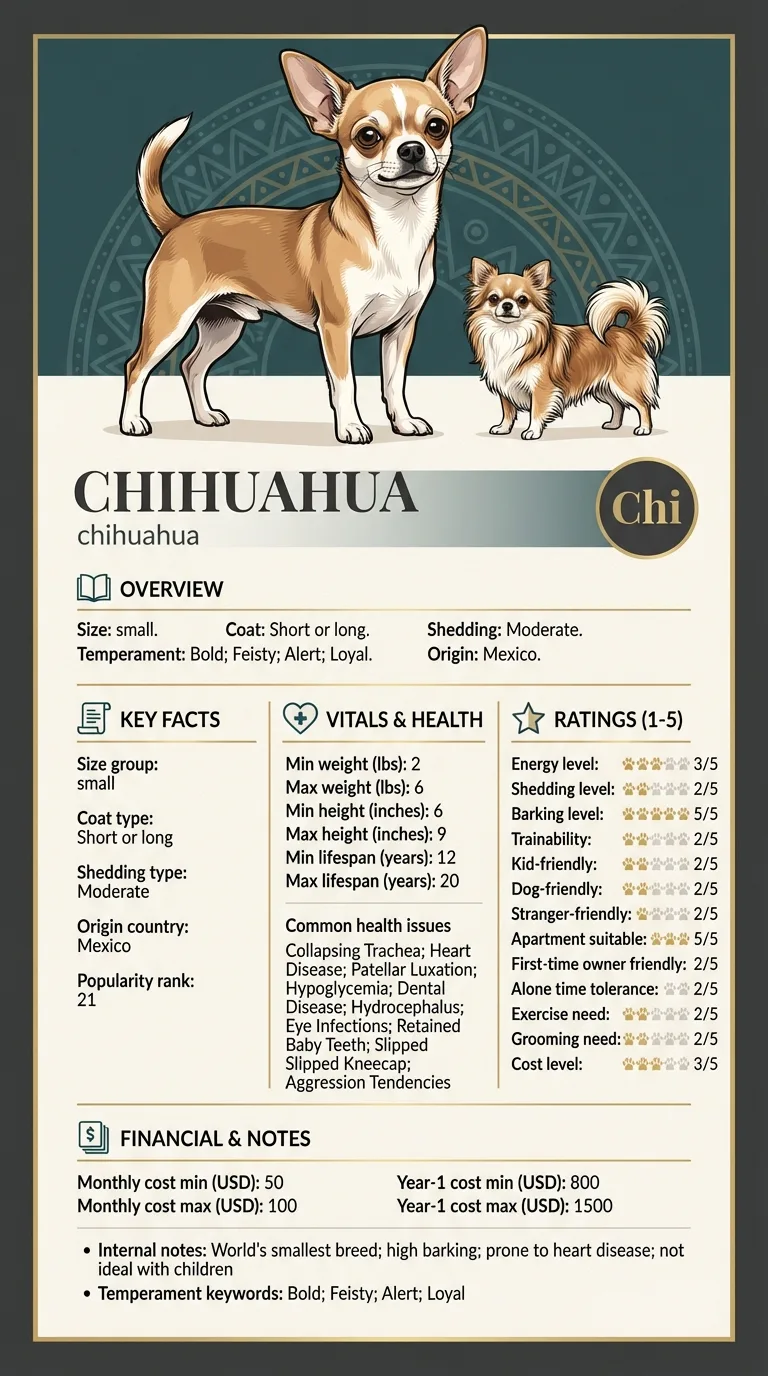
Choose the Chihuahua if you want a small, very cheap, very long-lived dog and will socialise it as seriously as a large one. It rates 5/5 for apartments, needs only 2/5 exercise, costs $50–$100 a month and can live 12 to 20 years. You are accepting 5/5 barking, 2/5 with children and a fragile frame.
Head-to-head comparison
Feature
alaskan malamute
chihuahua
Winner
Weight
75–110 lbs
2–6 lbs
Equal
Height
23–25 in
6–9 in
Equal
Lifespan
10–14 years
12–20 years
chihuahua
Coat
Thick double coat
Short or long
Equal
Grooming need
High (4/5)
Low (2/5)
chihuahua
Shedding
Very high (5/5)
Low (2/5)
chihuahua
Energy level
High (4/5)
Moderate (3/5)
Equal
Exercise need
Very high (5/5)
Low (2/5)
chihuahua
Trainability
Moderate (3/5)
Low (2/5)
alaskan malamute
Barking
Moderate (3/5)
Very high (5/5)
alaskan malamute
Good with kids
Very high (5/5)
Low (2/5)
alaskan malamute
Good with other dogs
Moderate (3/5)
Low (2/5)
alaskan malamute
Friendly to strangers
High (4/5)
Low (2/5)
alaskan malamute
Apartment suitability
Very low (1/5)
Very high (5/5)
chihuahua
Good for first-time owners
Low (2/5)
Low (2/5)
Equal
Tolerates being alone
Low (2/5)
Low (2/5)
Equal
Typical monthly cost
$150–$300
$50–$100
chihuahua
Typical first-year cost
$2,000–$4,000
$800–$1,500
chihuahua
Deep dive
The cheapest dog here, and possibly the longest-lived
$50–$100 a month and $800–$1,500 in the first year make the Chihuahua the least expensive dog in any comparison on this site. A four-pound dog eats almost nothing, and parasite treatments, medications and boarding are all priced by weight.
The Malamute at $150–$300 and $2,000–$4,000 is at the other end for the same reasons in reverse, with grooming adding to it.
The lifespan figures deserve as much attention. A Chihuahua can reach twenty, which few breeds of any size do, and twelve is the low end. That is a genuinely long commitment — a dog bought when a child is eight may still be there when that child is twenty-eight.
The Malamute's 10 to 14 years is normal for a large working breed.
The one adjustment to the Chihuahua's cheap monthly figure is dentistry. A full set of teeth in a very small jaw means crowding, plaque and extractions, and anaesthetic dental work every couple of years across fifteen or more years is a real cumulative sum. Daily brushing genuinely reduces it.
5/5 barking against 3/5
The Chihuahua's 5/5 is the top of the scale and the most common reason people give up on the breed.
It announces the door, the corridor, the lift, the neighbour's television and any dog it can see from a window. It is alert, opinionated, and physiologically built to produce a sound that carries far further than its size suggests. In a flat with shared walls, that becomes a relationship with your neighbours rather than a habit of your dog.
It trains down and not out. Blocking sightlines, teaching a settled alternative and rewarding quiet all reduce it substantially, but the breed's baseline is high.
The Malamute at 3/5 is not quiet either, and its voice is a different problem: Malamutes howl, and a howling hundred-pound dog in a garden carries across a neighbourhood. The difference is frequency rather than volume — a well-exercised Malamute is largely silent, while a Chihuahua's barking is not primarily an exercise problem.
Both rate 2/5 for solitude, and in both breeds noise is worst when the dog is alone.
Fragility, socialisation and the harness rule
Three things change how a Chihuahua is handled day to day.
Collapsing trachea is the first and it produces a firm rule: a harness, never a collar, for the dog's whole life. The cartilage rings supporting the windpipe soften and flatten, and the sign is a honking cough that worsens with excitement or pressure on the throat.
Hypoglycaemia is the second and it is a puppy risk. A two-to-six-pound body has almost no glycogen reserve, so a missed meal or a stressful day can cause weakness, wobbling or collapse. Frequent small meals through the first months are standard.
Socialisation is the third and it is the one most often skipped. Aggression tendencies appear on the breed's condition list, and the reason is largely environmental: a four-pound dog that growls gets picked up rather than trained, so the behaviour is rehearsed daily and never interrupted. Treat a Chihuahua like a dog — let it walk, introduce it to calm adult dogs, and allow nothing you would not allow from a Rottweiler.
The Malamute's handling problem is the opposite: a hundred-pound dog that pulls, digs and travels, where the answer is equipment and fencing rather than delicacy.
Two hours against twenty minutes
The Malamute rates 5/5 and wants resistance — carting, scootering, canicross, loaded hikes. Two hours a day, moved to the cool ends of the day in summer because a thick Arctic coat holds heat.
The Chihuahua rates 2/5: two short walks and some indoor play. It rates 3/5 for energy and is a busy little dog rather than a sedentary one, but the requirement is met quickly and in almost any weather short of cold, where a short-coated four-pound dog genuinely needs a coat.
The apartment ratings follow directly: 5/5 against 1/5.
Containment differs too. The Malamute's own breed notes call it an extreme escape artist — it digs, climbs, works at latches and travels once loose — so a fence dug in at the base and secured gates are the baseline.
A Chihuahua's outdoor risks are different in kind: birds of prey in some areas, larger dogs, being stepped on, and gaps in fencing that no larger dog would fit through.
Alaskan Malamute vs Chihuahua: two matching 2/5s
First-time owners ties at 2/5 and time alone ties at 2/5. Those two rows are the useful ones, because they say something people rarely expect: the tiny dog is not the easy option.
A Chihuahua is difficult for reasons of temperament and management. It rates 2/5 with children, 2/5 with other dogs, 2/5 with strangers, 2/5 for trainability and 5/5 for barking. Raised carelessly it becomes a reactive adult, and small-dog reactivity is almost never addressed because lifting the dog away always works.
A Malamute is difficult for reasons of scale and output: 5/5 exercise, a fence it tests daily, and a coat that produces sheets of undercoat twice a year.
On sociability the Malamute is far the friendlier animal — 5/5 with children, 4/5 with strangers — and it is a hopeless guard as a result.
On money and years the Chihuahua wins outright: a third of the cost and potentially six more years.
Malamute or Chihuahua: The Biggest Gap on This Site - Alaskan Malamute vs Chihuahua: two matching 2/5s
Frequently asked questions
Why do both breeds rate 2/5 for first-time owners?
For unrelated reasons. The Chihuahua rates 2/5 with children, other dogs, strangers and trainability, and 5/5 for barking — raised carelessly it becomes reactive, and small-dog reactivity is rarely addressed. The Malamute is difficult through scale: 5/5 exercise, a fence it tests daily and an enormous coat.
How long do Chihuahuas live?
12 to 20 years, and the upper end is exceptional for any breed. The Malamute lives 10 to 14. A Chihuahua is potentially a two-decade commitment, which is worth thinking through properly — it will outlast most life changes you currently have planned.
Do Chihuahuas bark a lot?
More than any breed on this site — 5/5, against the Malamute's 3/5. It announces the door, the lift, passing dogs and the neighbours, in a voice that carries far beyond its size. Blocking sightlines and training a settled alternative reduces it substantially; nothing produces a quiet dog.
Which is cheaper to keep?
The Chihuahua, by a wide margin — $50–$100 a month against the Malamute's $150–$300, and $800–$1,500 against $2,000–$4,000 in the first year. The offsetting cost is dentistry: anaesthetic dental work every couple of years across a very long life.
Should a Chihuahua wear a collar?
No — a harness, for life. Collapsing trachea is on the breed's condition list, and pressure on a windpipe with softening cartilage makes it worse. The sign is a honking cough that gets worse with excitement or pulling on the lead.
Which is better with children?
The Malamute at 5/5 against the Chihuahua's 2/5. A two-to-six-pound dog is genuinely at risk from a toddler and tends to defend itself when handled roughly. The Malamute's caveat is momentum rather than temperament — a hundred pounds of enthusiasm knocks small people over.
Which is harder to contain?
Different problems entirely. The Malamute digs, climbs and travels once loose, so a fence dug in at the base is the baseline. A Chihuahua fits through gaps no larger dog would notice, and its outdoor risks are larger dogs, traffic and being stepped on rather than distance.
The Chihuahua if you want a very cheap, very long-lived dog for a flat and will socialise it as seriously as a large one. The Malamute if you are athletic, have space, and want a sociable dog that is good with children.
Costs
How much does each cost per month?
The Malamute runs $150–$300 a month and the Chihuahua $50–$100, with first-year totals of $2,000–$4,000 and $800–$1,500 — the widest cost gap on this site.
Behavior
Which is quieter?
The Malamute at 3/5 against the Chihuahua's 5/5, though it howls rather than barks and a howling hundred-pound dog carries across a neighbourhood. The difference is frequency: a well-exercised Malamute is largely silent.
Health
What is the most useful daily habit for a Chihuahua?
Tooth brushing. Dental disease is close to a certainty in a jaw this small, and daily brushing reduces the number of anaesthetics the dog needs across a life that may run to twenty years.
Health information here is general and is not veterinary advice. If your dog shows pain, sudden behaviour change, or worsening symptoms, consult a licensed veterinarian.
Some links on this site are affiliate links. We may earn a commission at no extra cost to you, and we only suggest products we believe are helpful for dog owners.
We research and check what we publish, but we do not warrant that any figure, date, price, or statement is accurate, complete, or current, and we accept no liability for any loss, cost, injury, or other harm arising from the use of this site. Use it as one reference among several. You remain responsible for your own decisions and for your dog's care - confirm anything that matters with a licensed veterinarian or another qualified professional before you act on it. Full disclaimer.