Health
What are the first signs of disc disease in a Chihuahua?
A hunched, tense dog that yelps when moved, then unsteadiness behind, scuffed nails or crossing back feet. Sudden onset is typical.

Quick answer
What are the first signs of disc disease in a Chihuahua?
A hunched, tense dog that yelps when moved, then unsteadiness behind, scuffed nails or crossing back feet. Sudden onset is typical.
Every decision in disc disease hangs on one question a vet asks in the first two minutes: can the dog still feel a firm pinch on a hind toe? Everything upstream of that answer is negotiable. Downstream of it, the clock is running in hours.
Owners of a Chihuahua that has gone suddenly weak or wobbly behind, owners choosing between conservative management and referral for surgery, and owners partway through a prescribed six weeks of confinement wondering whether it can possibly be this strict.
This guide is not medical advice. If your dog shows pain, sudden behavior change, or worsening symptoms, consult a licensed veterinarian.
Some links may be affiliate links. We may earn a commission at no extra cost to you. We only suggest products we believe are helpful for dog owners.
We research and check what we publish, but we do not warrant that any figure, date, price, or statement is accurate, complete, or current, and we accept no liability for any loss, cost, injury, or other harm arising from the use of this site. Use it as one reference among several. You remain responsible for your own decisions and for your dog's care - confirm anything that matters with a licensed veterinarian or another qualified professional before you act on it. Full disclaimer.
Intervertebral disc disease is failure of the shock-absorbing disc between two vertebrae, with inner disc material rupturing into the spinal canal and compressing the spinal cord. In Chihuahuas the onset is typically sudden and datable to a particular moment. Severity is described on a five-point scale from pain alone to complete loss of deep pain sensation, and where a dog sits on that scale determines whether it is managed with confinement or referred urgently for surgery.
Disc disease is far less common than simple back strain, but it is a recognised problem in small breeds including the Chihuahua and it accounts for a disproportionate share of small-dog neurological emergencies. Most affected dogs present at the milder end of the scale with pain and mild wobbliness; a minority present unable to walk, and it is that minority for whom the timing of referral changes the outcome.
The Chihuahua's disc problem is not driven by the exaggerated body length that explains it in a Dachshund; this is a compact breed standing six to nine inches tall. What it does have is the small-breed pattern of early disc degeneration, in which the soft gel centre of the disc hardens and calcifies years before old age, turning a shock absorber into a brittle lump. A brittle disc fails suddenly under a load a healthy one would absorb. Add a dog that weighs two to six pounds yet routinely lands from furniture several body heights high, and the mechanical trigger is never far away. The breed's bold, reactive temperament also means a lot of sudden twisting sprints at doorbells.
The controllable factors are the same ones that cause simple back injury, and they matter more once discs are already degenerate. High beds and sofas with hard floors beneath them, slippery laminate that makes every landing a scrabble, stairs used many times a day, and neck collars on a dog that lunges are the main four. Body condition matters too: extra weight on a two-to-six-pound frame is proportionally enormous and increases the load through every disc. During recovery, a pen positioned where the dog can see the street undermines the entire treatment.
Treat as an emergency and go now, at any hour, if your Chihuahua cannot use its back legs, is dragging or knuckling a hind foot, cannot stand, or cannot pass urine. Loss of the ability to feel a hind toe pinch is the most time-critical finding in this whole condition and outcomes fall with every hour of delay, so this is a tonight problem rather than a tomorrow one. Book the same day for a hunched painful back, a yelp on being lifted, unsteadiness, or scuffed hind nails. During conservative management, call if there is any deterioration in leg function, which means the plan needs revisiting rather than more patience.
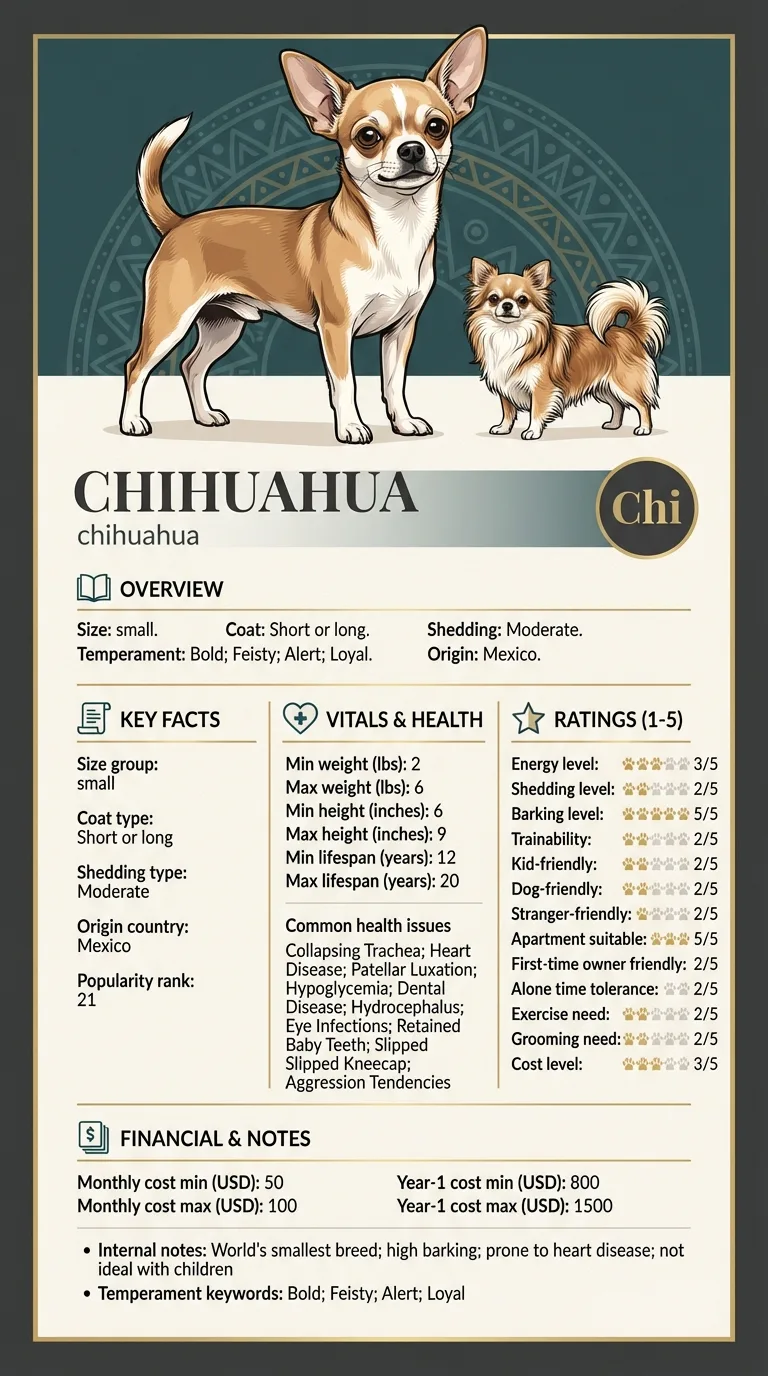
See all Chihuahua health problems, which breeds are prone to backspine issues, or the full Chihuahua breed guide for temperament, exercise needs and ownership costs.
Conservative management runs four to six weeks of strict confinement plus two to four weeks of graded return, with pain usually easing in the first week and function improving unevenly after that. Surgical cases often show early improvement within days but need a comparable rehabilitation period. Dogs that lost the ability to walk may take weeks to months to regain it, and some never do. Recovery is not a straight line, and a flat week in the middle is normal rather than a failure.
For a mild case, success is a pain-free dog with a level topline walking normally, in a home that has permanently removed the jumps. For a severe case, honest success may be a dog that walks with a slightly drunken hind end, or that manages well in a wheeled cart with owner-assisted bladder care, and lives a genuinely good life. Chasing a return to exactly the previous dog leads to disappointment; measuring comfort, mobility and quality of life does not.
Veterinary neurologists grade disc disease by function lost, and the ladder is worth understanding because it explains why two dogs with identical scans get opposite advice.
Grade one is pain only. The dog is hunched, tense and sore, but walks normally. Grade two adds weakness: the dog still walks but is unsteady, scuffs its nails or crosses its back feet. Grade three means it can no longer walk but can still move the legs voluntarily. Grade four means no voluntary movement at all, and usually a bladder the dog cannot empty. Grade five is grade four plus loss of deep pain sensation, meaning the dog cannot feel a firm pinch of a hind toe.
That last step is the one that matters most. Deep pain is the deepest and most robust sensation in the cord and the last thing to go, so losing it means the injury is severe. It is also the strongest predictor of whether a dog will walk again, and the chance of recovery falls with every hour it stays lost. A grade five dog is a surgical emergency in the same sense that a bleeding wound is - the referral should happen tonight, not at the next convenient appointment.
Grades one and two are commonly managed without surgery. Grades three and above usually prompt a conversation about imaging and referral. None of this can be assessed from a description over the phone, which is why any Chihuahua that has gone wobbly behind needs hands on it the same day.

Conservative management is not rest in the ordinary sense. It is confinement, and it fails most often because owners apply a softer version of it than the vet described.
If you think your Chi has back/spine issues, the plan is three steps: write down what you have seen and when it started, book a veterinary appointment rather than waiting for the next flare, and take video of the behaviour or symptom before you go — the thing you are worried about rarely happens in the consulting room. Screening in the parents covers collapsing trachea, heart disease, patellar luxation.
What the vet visit should produce is a diagnosis and a written plan, not just reassurance: what is being ruled out, what the monitoring interval is, and which signs mean you come back sooner. Ask what the treatment costs across a year rather than per visit, because that is the number that decides whether you are managing this condition or reacting to it.
Between appointments, keep a short log — dates, what you saw, what changed. It is the single most useful thing an owner brings to a follow-up, and for back/spine issues it is often what separates a clear pattern from a guess.
Canela is a six-year-old, 5-pound Chihuahua in Cardiff who came out of her crate on a Sunday morning dragging both back feet. Her owner Priya had been told by a neighbour to give it until Monday and see. She rang the out-of-hours clinic instead. The examining vet spent most of two minutes on one question: whether Canela could feel a firm pinch of a hind toe. She could, clearly, and that single finding is why she was referred that evening rather than treated as a hopeless case. She had surgery the next morning. Recovery was slower than Priya expected. Canela stood on day four, took uncertain steps at two weeks, and walked with a wobble at six. Ten months on she runs, though she still crosses a back foot when she turns sharply. The bed is off limits permanently and she wears a harness.
Key takeaway: The neighbour's advice would have cost Canela her legs. In disc disease, the difference between a good outcome and a poor one is often measured in hours, and deep pain sensation is the finding that sets the clock.
Yes. Chihuahuas are among the small breeds in which disc extrusion is seen, though they are not the classic long-backed shape that makes Dachshunds the textbook example. The type they typically get involves the disc's inner material hardening and then rupturing suddenly into the spinal canal, which is why the onset is often dramatic and dated to a specific hour rather than creeping up over weeks.
Do not try to. It requires a firm painful pinch and a trained judgement of whether the dog genuinely perceived it or simply reflexed, and reflex withdrawal happens even in a dog that feels nothing. Owners routinely reassure themselves with a leg twitch that means nothing at all. What you should do is get the dog to a vet the same day and let them make that assessment.
No. Dogs with pain only or mild unsteadiness often do well with confinement and pain relief, and surgery brings its own risks and cost. Surgery becomes the strong recommendation as function is lost, particularly for dogs that cannot walk, and it becomes urgent when deep pain sensation is absent. Your vet or a neurologist makes that call on examination findings, not on the scan alone.
It depends almost entirely on deep pain. Dogs that still have deep pain sensation have a good chance of walking again with appropriate treatment. Dogs that have lost it have a substantially poorer outlook, and the longer it has been absent the worse it gets. That is the honest picture, and it is the reason no one should be advised to wait and see overnight.
Recurrence is a real possibility, since the same disc changes exist along the rest of the spine. Dogs that have had one episode should keep the preventive changes permanently: harness rather than collar, no jumping down from furniture, a lean body weight and ramps to anything the dog wants to be on. Those measures reduce the odds but cannot guarantee anything.
It is genuinely hard in a breed this alert and this vocal, and it is where conservative management most often falls apart. The dogs that manage best are in a quiet back room rather than near a window, get their mental exercise inside the pen, and were taught to settle in a crate before they ever needed to. Ask your vet about support for a dog that is distressed rather than accepting the situation as unavoidable.
A hunched, tense dog that yelps when moved, then unsteadiness behind, scuffed nails or crossing back feet. Sudden onset is typical.
When the dog cannot move its back legs at all, or has lost the ability to feel a firm toe pinch. Referral should happen the same night.
Typically four to six weeks of true confinement with lead toilet breaks only, then a graded return over another few weeks under vet direction.
Yes, a great deal. A foot that turns over onto its top surface means the dog cannot feel where its leg is, which is a spinal cord sign.
Advanced imaging plus neurosurgery and inpatient care makes this one of the most expensive events a Chihuahua owner can face. Ask for a written estimate at referral.
A one-page prep sheet for this condition: the signs, the questions to ask, what to get priced. Unlocks here.
You get: Vet visit prep sheet
No spam. One-click unsubscribe. See our privacy policy.
Preview page 1 before you decide.