Living
Bigger dog?
The Great Dane, by an enormous margin -- up to 175 lbs versus the Chihuahua's 6.

Quick answer
Bigger dog?
The Great Dane, by an enormous margin -- up to 175 lbs versus the Chihuahua's 6.
Chihuahua or Great Dane? On paper they differ most on apartment suitability, and on the scales Great Dane is the heavier at 110–175 lbs. Here is how the two compare on everything that shapes an ordinary week.
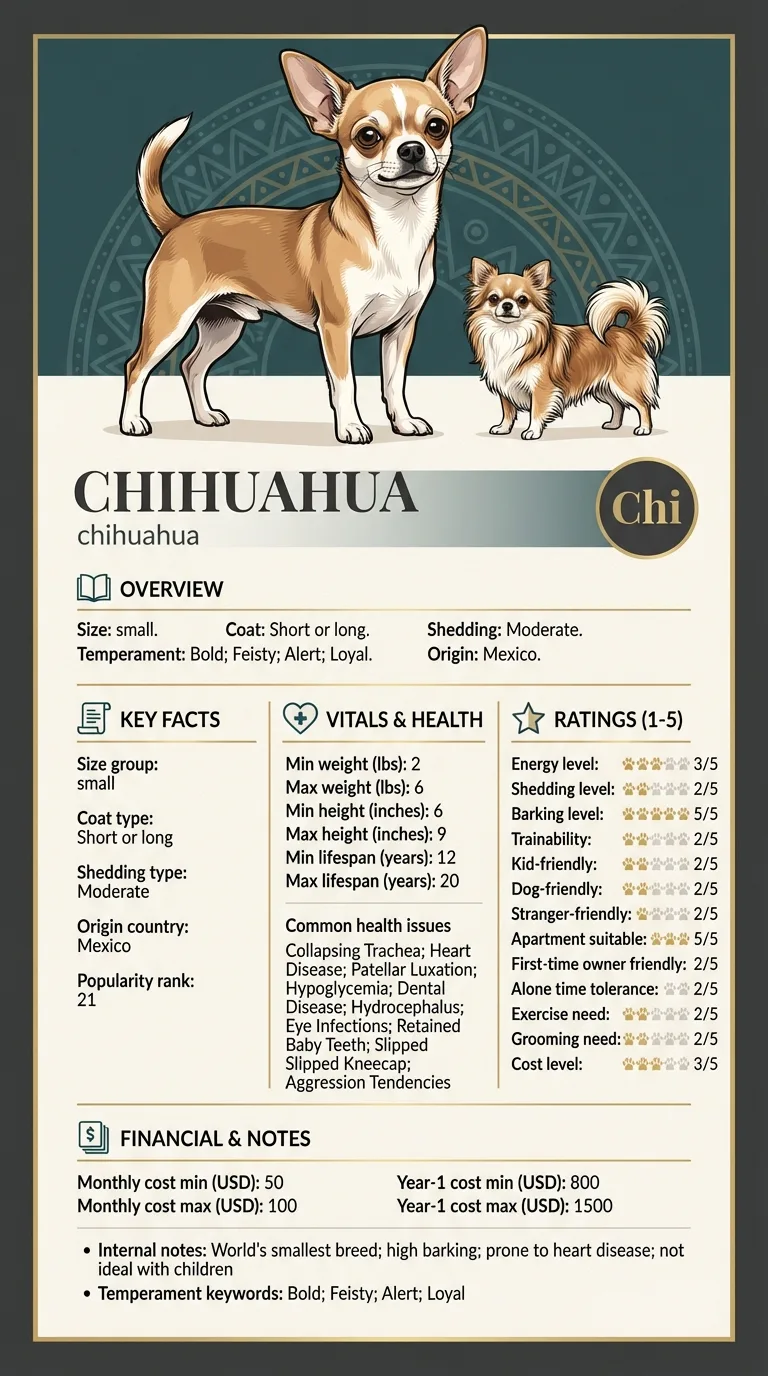
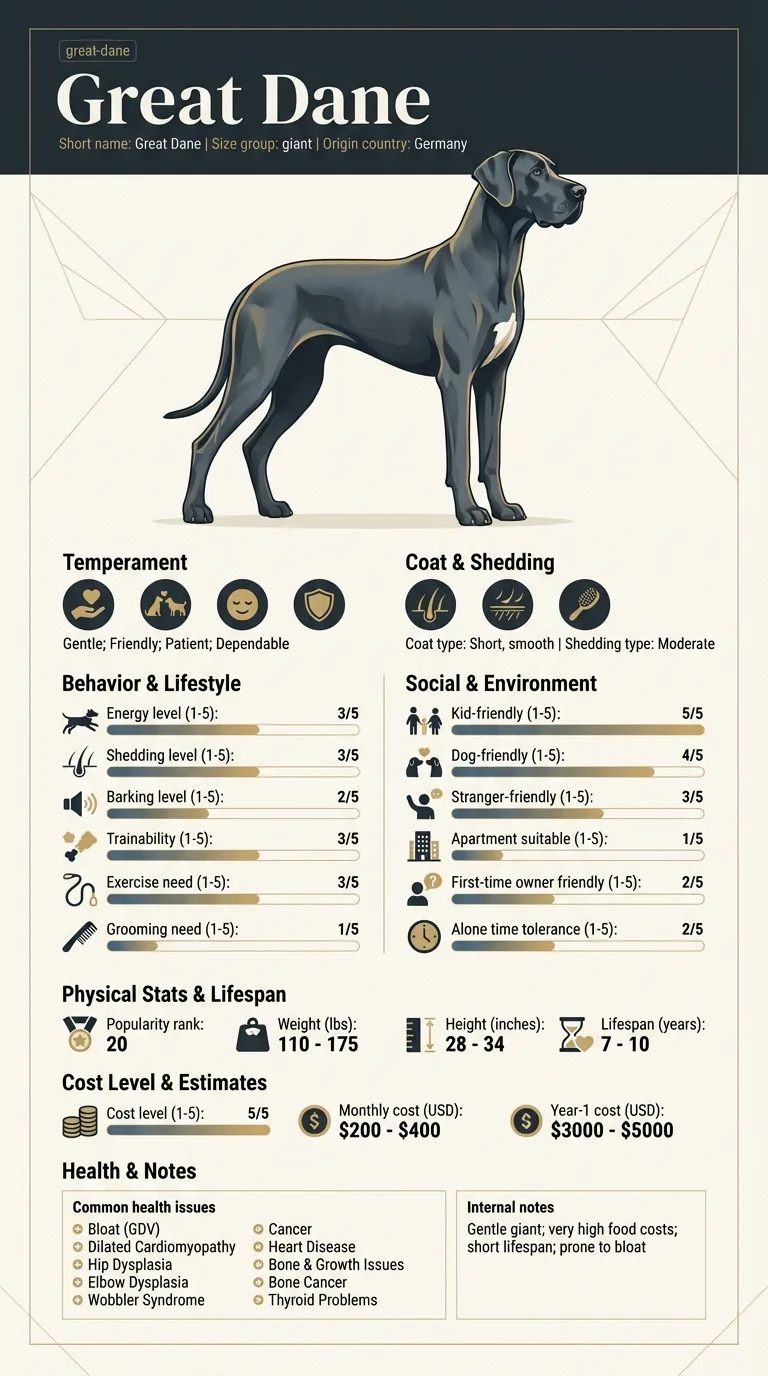
This is for someone already down to Chihuahua and Great Dane and deciding between them. For this pair the decision usually turns on apartment suitability and barking, so those are covered first and in most detail. Anyone choosing from a flat has a clear answer here: Chihuahua rates 5/5 against 1/5. There is no origin story here — only what changes about your week.
Between Chihuahua and Great Dane, apartment suitability is what separates them, and Chihuahua is the lower-effort dog of the two to keep.
Choose Chihuahua if you are in a flat or a smaller home, shedding is a problem in your house and your walking routine is modest.
Choose Great Dane if you do not want a standing grooming appointment, there are young children at home and you already have another dog.
| Feature | chihuahua | great dane | Winner |
|---|---|---|---|
| Size class | small | giant | Equal |
| Weight | 2–6 lbs | 110–175 lbs | Equal |
| Height | 6–9 in | 28–34 in | Equal |
| Lifespan | 12–20 years | 7–10 years | chihuahua |
| Exercise need | Low (2/5) | Moderate (3/5) | chihuahua |
| Grooming need | Low (2/5) | Very low (1/5) | great dane |
| Shedding | Low (2/5) | Moderate (3/5) | chihuahua |
| Energy level | Moderate (3/5) | Moderate (3/5) | Equal |
| Barking | Very high (5/5) | Low (2/5) | great dane |
| Apartment suitability | Very high (5/5) | Very low (1/5) | chihuahua |
| Good for first-time owners | Low (2/5) | Low (2/5) | Equal |
| Tolerates being alone | Low (2/5) | Low (2/5) | Equal |
| Trainability | Low (2/5) | Moderate (3/5) | great dane |
| Good with kids | Low (2/5) | Very high (5/5) | great dane |
| Good with other dogs | Low (2/5) | High (4/5) | great dane |
| Friendly to strangers | Low (2/5) | Moderate (3/5) | great dane |
| Cost level | Moderate (3/5) | Very high (5/5) | chihuahua |
| Coat | Short or long | Short, smooth | Equal |
| Origin | Mexico | Germany | Equal |
| Typical monthly cost | $50–$100 | $200–$400 | Equal |
| Typical first-year cost | $800–$1,500 | $3,000–$5,000 | Equal |
Few comparisons on this site span a wider gulf than this one: a 2-6 lb Chihuahua against a 110-175 lb Great Dane, a giant breed that can stand 28-34 inches at the shoulder -- taller than many kitchen counters. Despite that staggering size difference, the Great Dane actually needs less grooming than the Chihuahua, rated very low (1/5) against the Chihuahua's low (2/5), thanks to its short, smooth coat requiring almost no maintenance. Housing a Great Dane means rethinking furniture, doorways, and car space entirely; a Chihuahua asks for none of that. This is a pairing where sheer scale, not temperament, is the first thing any prospective owner has to reckon with.
Exercise need only rates moderate (3/5) for the Great Dane, surprising many people who expect a giant breed to demand marathon walks -- Danes are actually known as gentle giants content with a couple of solid walks a day rather than constant activity, still ahead of the Chihuahua's low (2/5). Energy level actually ties at moderate (3/5) for both breeds, an unusual result given the size gap. What a Great Dane needs isn't so much intense exercise as space to stretch out and move without bumping into furniture -- something the Chihuahua's tiny frame never requires regardless of the home's layout.
The Great Dane rates very low (1/5) for grooming, actually beating the Chihuahua's low (2/5), thanks to its short, smooth coat that needs little beyond occasional brushing and regular nail trims -- nail care matters more here given the weight those nails carry. Shedding tips slightly toward the Chihuahua, low (2/5) against the Dane's moderate (3/5), since a short coat on that much surface area still adds up around the house. Overall, though, this is one of the few areas where the giant breed doesn't demand significantly more upkeep than the toy breed, a genuine surprise for anyone assuming size and grooming effort always scale together.
Apartment suitability rates very high (5/5) for the Chihuahua and a very low (1/5) for the Great Dane -- the lowest score a breed can carry in this table, reflecting how much physical space a 175-lb dog genuinely needs just to turn around comfortably. Barking flips the expected pattern: the Chihuahua rates very high (5/5) while the gentle, Patient Great Dane rates just low (2/5), making the giant breed the quieter one despite its intimidating size. Both breeds score low (2/5) on tolerating time alone, so a Great Dane's calm temperament doesn't translate into comfort with long stretches of solitude any more than the Chihuahua's does.
Trainability rates moderate (3/5) for the Great Dane and low (2/5) for the Chihuahua -- not a dramatic gap, but the Dane's Gentle, Dependable temperament generally makes it easier to work with despite its size, since a poorly trained 150-lb dog is a far bigger practical problem than a poorly trained 5-lb one. Both breeds rate low (2/5) for first-time owners, the Dane because its sheer size demands confident handling and space, the Chihuahua because of its stubborn, independent streak. A first-time owner drawn to either breed should weigh whether they can physically manage a giant dog's leash pulling or patiently outlast a toy dog's willfulness.
Great Danes score very high (5/5) with kids, high (4/5) with other dogs, and moderate (3/5) with strangers, living up to their reputation as gentle giants whose Friendly, Patient nature makes them surprisingly good family dogs despite their size. Chihuahuas score low (2/5) across the same categories, tending toward wariness with unfamiliar people, animals, and rough handling. The practical caveat with a Great Dane around small children isn't temperament but physics -- an excited 150-lb dog can knock a toddler over without any aggressive intent, something supervision needs to account for even with a naturally gentle breed.
Lifespan is the starkest contrast in this comparison: the Chihuahua's 12-20 years against the Great Dane's 7-10, among the shortest lifespans of any breed on this site, a well-documented trade-off of giant-breed genetics. The Dane's health list reflects that reality directly -- Bloat (GDV), Dilated Cardiomyopathy, and Wobbler Syndrome, a spinal condition affecting large dogs, sit alongside Bone Cancer and general Bone & Growth Issues tied to rapid growth in puppyhood. The Chihuahua's list, by contrast, leans toward manageable small-breed concerns like Collapsing Trachea and Patellar Luxation. Anyone choosing a Great Dane should go in clear-eyed that a shorter, health-intensive lifespan is part of the package.
Cost level rates moderate (3/5) for the Chihuahua and very high (5/5) for the Great Dane -- the highest cost rating in this comparison -- with monthly costs of $50-$100 versus $200-$400 and first-year costs of $800-$1,500 versus a striking $3,000-$5,000. Food alone at 150-plus lbs is a major recurring expense, and giant-breed-specific needs like reinforced beds, large-capacity crates, and higher-dose medications all add up quickly. For a household weighing long-term affordability as heavily as temperament, the Chihuahua is dramatically cheaper across nearly every category measured here.
Chihuahua weighs 2–6 lbs and lives 12–20 years; Great Dane weighs 110–175 lbs and lives 7–10 years. The two diverge most on apartment suitability, barking and good with kids and 2 other rated axes. They are level on tolerates being alone, energy level and good for first-time owners, so those cannot decide it. Where the table declares a winner it means less work for the owner, nothing more; descriptive rows are left as ties on purpose. The value here is in the differences between the two columns; treat any single score as approximate.

Yes -- it carries the highest cost rating (5/5) in this comparison, with a first-year cost of $3,000-$5,000 versus the Chihuahua's $800-$1,500, driven largely by food volume and giant-breed gear.
Giant breeds generally trade size for longevity, and the Dane's 7-10 year range reflects known risks like Dilated Cardiomyopathy, Bloat, and Bone Cancer that are more common in large, fast-growing dogs.
According to this data, yes -- they rate very high (5/5) with kids, though their sheer size means supervision still matters to prevent accidental knock-overs during play.
The Chihuahua, rated very high (5/5), compared to the Great Dane's low (2/5) -- the giant breed is the quieter one here.
Less than most people assume -- it rates only moderate (3/5) for exercise need, needing space to move rather than intense daily activity.
Surprisingly, the Great Dane, rated very low (1/5) versus the Chihuahua's low (2/5), thanks to its short, smooth coat.
Not well -- it scores a very low 1/5 for apartment suitability, the lowest possible rating, due to the sheer space a 150-plus lb dog needs.
The Great Dane, by an enormous margin -- up to 175 lbs versus the Chihuahua's 6.
The Chihuahua, at roughly a third of the Great Dane's first-year cost.
The Chihuahua, 12-20 years versus the Great Dane's 7-10.
The Great Dane, low (2/5) barking versus the Chihuahua's very high (5/5).
Secure checkout on Stripe. We never see your card.
7-day money-back guarantee. Instant access.
Health information here is general and is not veterinary advice. If your dog shows pain, sudden behaviour change, or worsening symptoms, consult a licensed veterinarian.
Some links on this site are affiliate links. We may earn a commission at no extra cost to you, and we only suggest products we believe are helpful for dog owners.
We research and check what we publish, but we do not warrant that any figure, date, price, or statement is accurate, complete, or current, and we accept no liability for any loss, cost, injury, or other harm arising from the use of this site. Use it as one reference among several. You remain responsible for your own decisions and for your dog's care - confirm anything that matters with a licensed veterinarian or another qualified professional before you act on it. Full disclaimer.
Match your lifestyle to the right dog.
Take quizNot sure which breed is right for you? Take our 2-minute quiz to find out.
Take the quiz