Health
What is degenerative myelopathy?
A slow, painless degeneration of the spinal cord's white matter causing progressive hind limb weakness and loss of coordination over months to years.

Quick answer
What is degenerative myelopathy?
A slow, painless degeneration of the spinal cord's white matter causing progressive hind limb weakness and loss of coordination over months to years.
Pain is the discriminator. Disc disease hurts and arrives in an afternoon. Degenerative myelopathy does not hurt and arrives over a year, and a dog that is wobbly but entirely comfortable is telling you something specific.
Owners who have noticed their older Chihuahua's back end drifting, scuffing or crossing over, and who need to know how urgently to act. It is also for owners handed a genetic result for the associated variant and unsure what it means.
This guide is not medical advice. If your dog shows pain, sudden behavior change, or worsening symptoms, consult a licensed veterinarian.
Some links may be affiliate links. We may earn a commission at no extra cost to you. We only suggest products we believe are helpful for dog owners.
We research and check what we publish, but we do not warrant that any figure, date, price, or statement is accurate, complete, or current, and we accept no liability for any loss, cost, injury, or other harm arising from the use of this site. Use it as one reference among several. You remain responsible for your own decisions and for your dog's care - confirm anything that matters with a licensed veterinarian or another qualified professional before you act on it. Full disclaimer.
Degenerative myelopathy is a progressive deterioration of the white matter of the spinal cord, producing slow, painless loss of hind limb coordination and strength. It typically begins with subtle loss of position sense - scuffed nails, crossing feet - and advances over months to years to an inability to walk. It is uncommon in Chihuahuas and cannot be confirmed in a living dog, so it is diagnosed by excluding the treatable causes that produce similar weakness.
Rare in Chihuahuas and not among the breed's documented health problems. It is most reported in German Shepherds, Corgis and Boxers. In this breed a hind limb that is not working properly is far more likely to reflect intervertebral disc disease, patellar luxation or arthritis, all of which are either on the breed's list or are common consequences of what is.
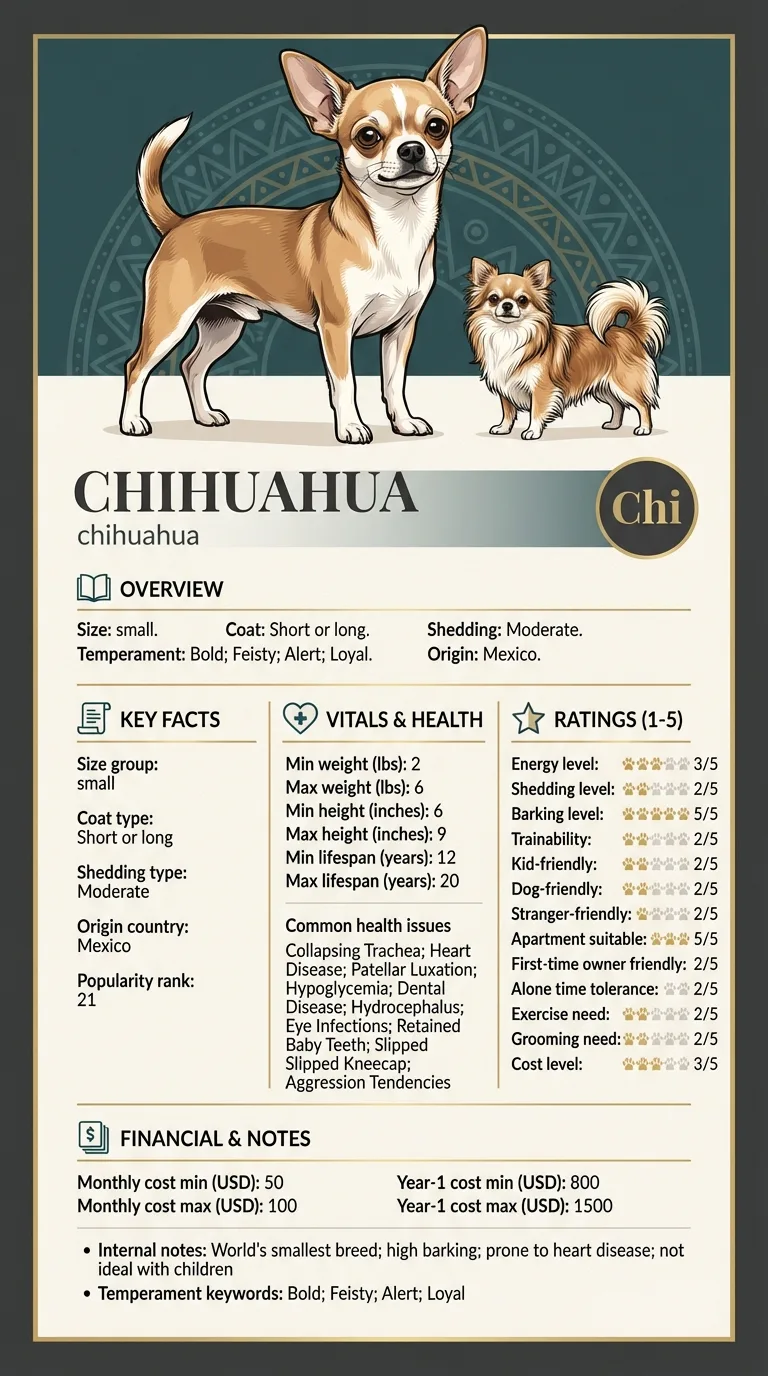
There is no Chihuahua-specific driver for this disease and it would be misleading to construct one. The variant most associated with degenerative myelopathy is found across many breeds, but the breeds that actually develop the condition in numbers are quite different from this one. What the Chihuahua does bring is a long life, commonly twelve to twenty years, which places a large proportion of the breed in the age bracket where progressive neurological disease of any kind becomes plausible. It also brings a set of far more likely competing explanations, since patellar luxation appears twice on the breed's health list and arthritis follows from it.
Environment does not cause degenerative myelopathy, but it heavily determines how disabling it becomes. A dog losing position sense in its hind feet is far worse off on polished laminate than on carpet, because it cannot compensate for slipping when it does not know precisely where the foot is. Homes with stairs, high furniture and hard floors accelerate the loss of confidence and therefore of muscle. Conversely, consistent gentle exercise on grippy ground maintains the muscle that keeps a weakening dog upright, and inactivity is the single most avoidable accelerator of functional decline.
Go urgently, the same day, for hind limb weakness that has appeared over hours rather than months, for any sign of pain, for a dog that cannot stand, or for loss of bladder control, because those point to a compressive problem where time genuinely matters. Book promptly for gradual, painless scuffing, crossing of the hind feet, or nails wearing on their upper surfaces, and ask for a neurological examination rather than an assumption of age. If a genetic result has already been obtained, bring the actual report and ask what would still need excluding before the label is applied.
See all Chihuahua health problems, which breeds are prone to degenerative myelopathy dm, or the full Chihuahua breed guide for temperament, exercise needs and ownership costs.
Where the disease is genuinely present, hind limb function usually declines over roughly six months to three years, moving from occasional scuffing through wobbliness to an inability to walk unaided, with front limb involvement in advanced cases. The decline is steady rather than punctuated by crises. Physiotherapy does not change the disease but reliably extends the period of useful mobility. There is no point at which the dog becomes painful, which shapes how the eventual decisions get made.
The first and most important success is a correct diagnosis, because a meaningful proportion of dogs investigated for this turn out to have something treatable. Where the diagnosis stands, success is maintained mobility for as long as possible: a dog that keeps its muscle, walks with support, has intact skin on its feet and remains bright, interested and comfortable. Comfort is the reliable part of this condition, and quality of life decisions rest on mobility and continence rather than on pain.
Several quite different problems produce a Chihuahua whose hind legs are not working properly, and they separate on three questions: how fast, how painful, and does it come and go.
Disc disease is fast and painful. It typically arrives within hours, the dog is hunched and tense, it objects to being lifted, and the hind limb signs appear alongside obvious discomfort. This is the urgent one.
Patellar luxation is intermittent and mechanical. The dog skips for two or three strides, then walks normally, and it has been doing it for years. It is not progressive over days and the dog is otherwise fine.
Arthritis is slow and stiff. It is worse on getting up, better after a few minutes of movement, and the dog is reluctant rather than unable.
Degenerative myelopathy is slow and painless. It begins with proprioceptive loss, meaning the dog stops knowing precisely where its back feet are. The earliest signs are subtle: nails worn flat on their upper surfaces from dragging, a scuffing sound on hard floors, an occasional crossing of one back foot behind the other. There is no yelping. Palpating the spine produces no reaction. It progresses over months, and it does not have good days and bad days in the way arthritis does.
That last point is worth holding onto. Waxing and waning suggests something mechanical. Steady one-directional decline in a comfortable dog suggests something in the cord.

There is no test that confirms degenerative myelopathy in a living dog. Understanding why saves owners from expecting an answer that does not exist.
If you think your Chi has degenerative myelopathy, the plan is three steps: write down what you have seen and when it started, book a veterinary appointment rather than waiting for the next flare, and take video of the behaviour or symptom before you go — the thing you are worried about rarely happens in the consulting room. Screening in the parents covers collapsing trachea, heart disease, patellar luxation.
What the vet visit should produce is a diagnosis and a written plan, not just reassurance: what is being ruled out, what the monitoring interval is, and which signs mean you come back sooner. Ask what the treatment costs across a year rather than per visit, because that is the number that decides whether you are managing this condition or reacting to it.
Between appointments, keep a short log — dates, what you saw, what changed. It is the single most useful thing an owner brings to a follow-up, and for degenerative myelopathy it is often what separates a clear pattern from a guess.
Bandido is a twelve-year-old Chihuahua in Christchurch whose owner Wiremu noticed a faint scratching sound when the dog walked across the kitchen tiles. Bandido was bright, ate well and showed no sign of discomfort at all, and Wiremu assumed it was simply age. At the appointment the vet turned Bandido's hind feet over. The nails on both back feet were worn flat across their upper surfaces, which does not happen from ordinary walking. A neurological examination found symmetrical hind limb deficits and, importantly, no pain anywhere along the spine. That absence of pain was what prompted imaging rather than a course of anti-inflammatories. The MRI found a compressive disc protrusion, not degeneration, and the outcome was entirely different from the one Wiremu had been quietly dreading after an evening of searching online.
Key takeaway: The scuffed nails were real and the painless presentation was real, but the assumption that painless equals untreatable was not. In an older dog with a failing back end, the workup is what separates a manageable diagnosis from an unmanageable one.
It is uncommon in the breed and is not on the Chihuahua's documented health list, which centres on dental disease, collapsing trachea, heart disease, patellar luxation, hypoglycemia, hydrocephalus and eye problems. The condition is most associated with German Shepherds, Corgis and Boxers. In a Chihuahua with hind limb weakness, disc disease, kneecap instability and arthritis are all considerably more likely.
No, and that is its most useful diagnostic feature. The disease destroys the pathways carrying signals rather than compressing pain-sensitive structures, so affected dogs remain comfortable while losing coordination. A wobbly dog that yelps, hunches or objects to having its back touched is telling you the cause is something else, and probably something more urgent.
It reports whether your dog carries the variant associated with increased risk, in one or two copies. It is a risk marker, not a diagnosis. Many dogs with two copies live full lives without ever developing signs, and a dog with the variant that becomes weak may be weak for an entirely different reason. Using the result to skip investigation is the mistake to avoid.
There is no treatment that halts or reverses the underlying degeneration. What genuinely helps is maintaining function for as long as possible: structured physiotherapy, controlled regular exercise to preserve muscle, good footing, protective boots for dragging feet, and eventually a supportive cart. Owners who start physiotherapy early generally maintain mobility longer than those who wait.
In affected dogs, hind limb function typically deteriorates over roughly six months to three years, with the front limbs eventually becoming involved in advanced cases. It is a steady decline rather than a series of crises. Because the dog remains comfortable throughout, decisions are usually made on mobility, continence and quality of life rather than on pain.
Quite possibly, and that is the strongest argument for a proper workup. Compressive disc disease, spinal narrowing, some tumours and even systemic problems can produce similar weakness, and several of those are treatable. Assuming an untreatable diagnosis without investigating is how genuinely fixable problems get missed in an older dog.
A slow, painless degeneration of the spinal cord's white matter causing progressive hind limb weakness and loss of coordination over months to years.
Speed and pain. Disc disease arrives in hours and hurts. Degenerative myelopathy arrives over months and does not hurt at all.
Nails worn flat on their upper surfaces from dragging, scuffing on hard floors, and occasional crossing of the back feet.
No. It is a risk marker only. Many carriers never develop signs, and the diagnosis is made by excluding treatable causes instead.
Early physiotherapy, regular controlled exercise to keep muscle, non-slip flooring, protective boots and eventually a supportive cart.
A one-page prep sheet for this condition: the signs, the questions to ask, what to get priced. Unlocks here.
You get: Vet visit prep sheet
No spam. One-click unsubscribe. See our privacy policy.
Preview page 1 before you decide.