Living
Chihuahua or Husky for a small apartment?
The Chihuahua, rated very high (5/5) for apartment suitability against the Husky's very low (1/5).

Quick answer
Chihuahua or Husky for a small apartment?
The Chihuahua, rated very high (5/5) for apartment suitability against the Husky's very low (1/5).
Chihuahua or Siberian Husky? On paper they differ most on apartment suitability, and on the scales Siberian Husky is the heavier at 45–60 lbs. Here is how the two compare on everything that shapes an ordinary week.
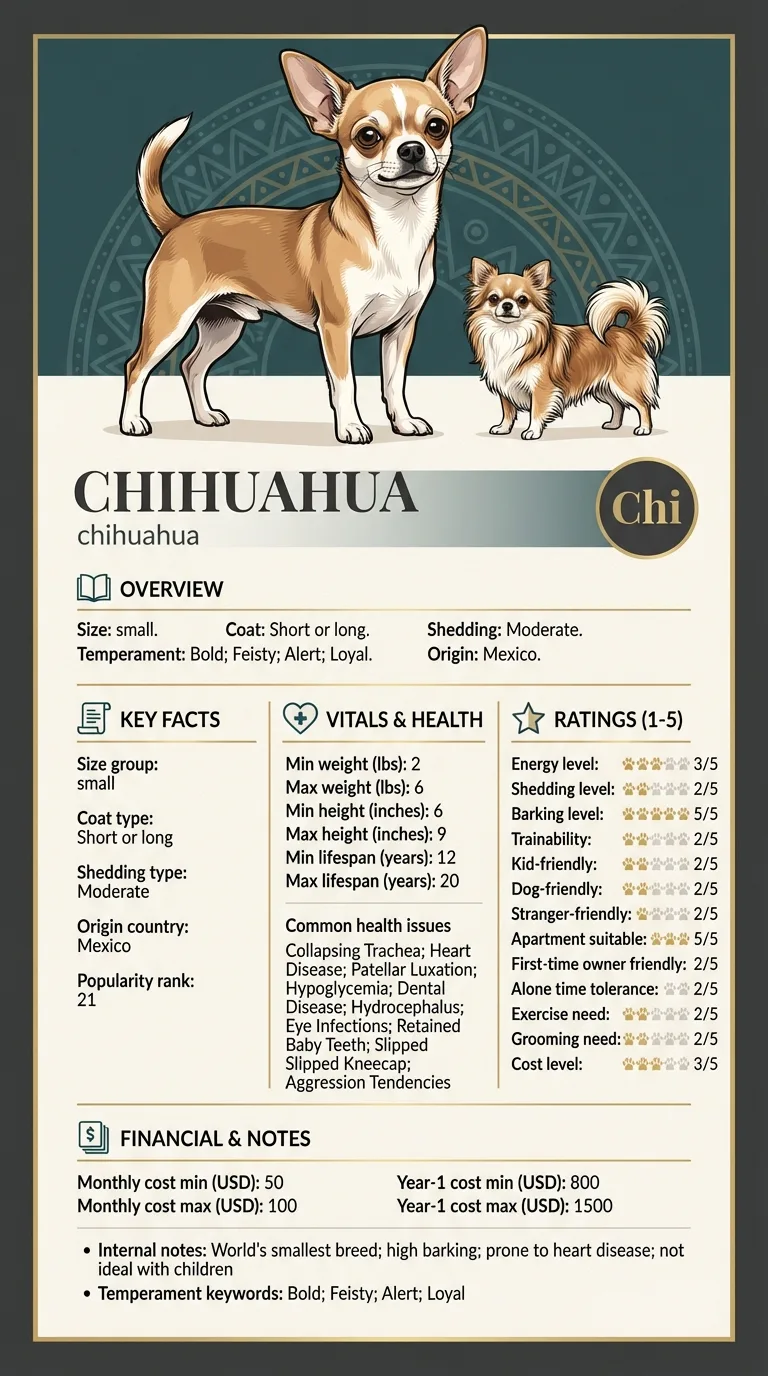
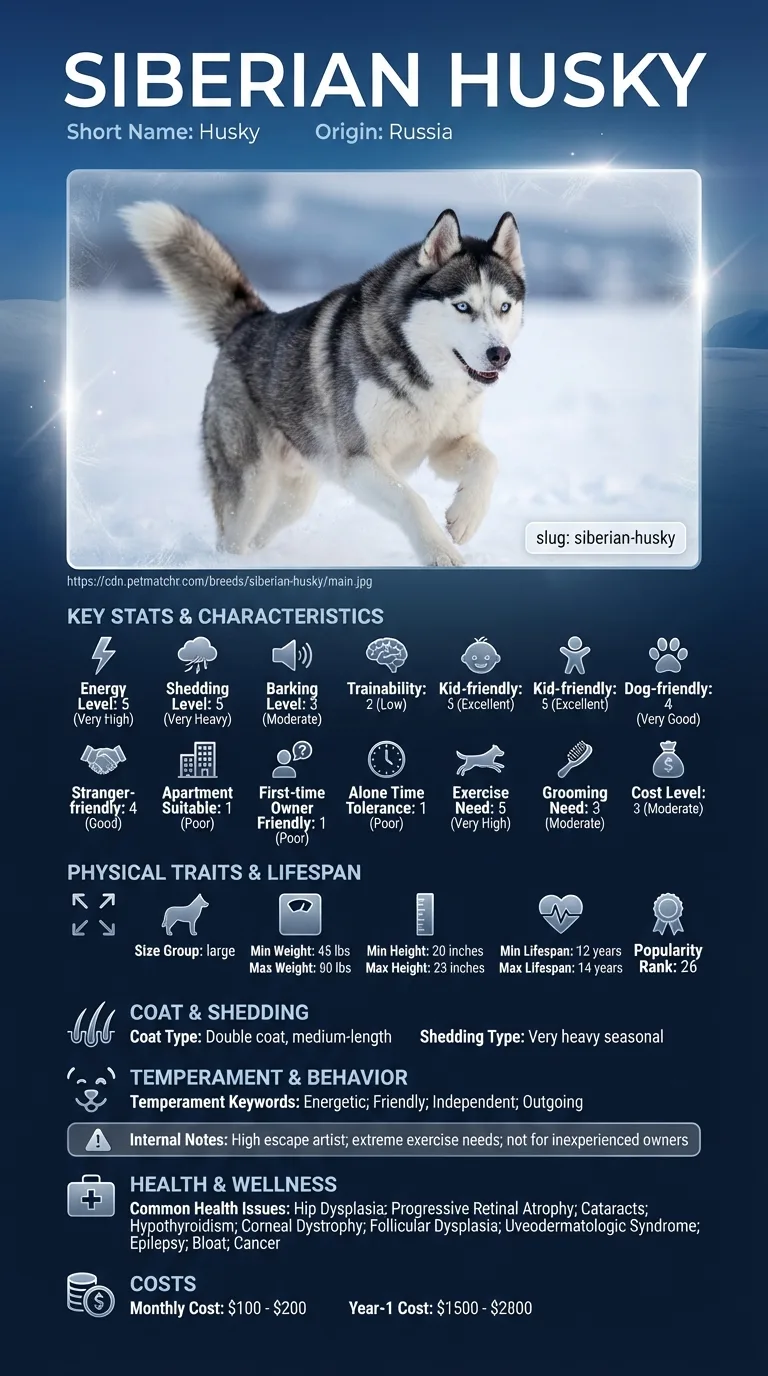
This is for someone already down to Chihuahua and Siberian Husky and deciding between them. For this pair the decision usually turns on apartment suitability and exercise need, so those are covered first and in most detail. Anyone choosing from a flat has a clear answer here: Chihuahua rates 5/5 against 1/5. There is no origin story here — only what changes about your week.
Between Chihuahua and Siberian Husky, apartment suitability is what separates them, and Chihuahua is the lower-effort dog of the two to keep.
Choose Chihuahua if you are in a flat or a smaller home, you do not want a standing grooming appointment and shedding is a problem in your house.
Choose Siberian Husky if there are young children at home, you already have another dog and you want a dog that can keep up with an active routine.
| Feature | chihuahua | siberian husky | Winner |
|---|---|---|---|
| Size class | small | large | Equal |
| Weight | 2–6 lbs | 45–60 lbs | Equal |
| Height | 6–9 in | 20–23 in | Equal |
| Lifespan | 12–20 years | 12–14 years | chihuahua |
| Exercise need | Low (2/5) | Very high (5/5) | chihuahua |
| Grooming need | Low (2/5) | Moderate (3/5) | chihuahua |
| Shedding | Low (2/5) | Very high (5/5) | chihuahua |
| Energy level | Moderate (3/5) | Very high (5/5) | Equal |
| Barking | Very high (5/5) | Moderate (3/5) | siberian husky |
| Apartment suitability | Very high (5/5) | Very low (1/5) | chihuahua |
| Good for first-time owners | Low (2/5) | Very low (1/5) | chihuahua |
| Tolerates being alone | Low (2/5) | Very low (1/5) | chihuahua |
| Trainability | Low (2/5) | Low (2/5) | Equal |
| Good with kids | Low (2/5) | Very high (5/5) | siberian husky |
| Good with other dogs | Low (2/5) | High (4/5) | siberian husky |
| Friendly to strangers | Low (2/5) | High (4/5) | siberian husky |
| Cost level | Moderate (3/5) | Moderate (3/5) | Equal |
| Coat | Short or long | Double coat, medium-length | Equal |
| Origin | Mexico | Russia | Equal |
| Typical monthly cost | $50–$100 | $100–$200 | Equal |
| Typical first-year cost | $800–$1,500 | $1,500–$2,800 | Equal |
The Siberian Husky's 45-60 pound, 20-23 inch large frame puts it in an entirely different weight class from the Chihuahua's 2-6 pounds and 6-9 inches - roughly ten times heavier at minimum. The Husky's medium-length double coat, built for sub-zero endurance work pulling sleds, gives it a substantial, athletic silhouette that couldn't be further from the Chihuahua's delicate, apple-headed build. Where the Chihuahua fits easily into a bag or a lap, the Husky's size and working-dog proportions demand real physical space, and its striking wolf-like appearance alone tends to draw a very different kind of public attention on walks.
This is one of the largest energy gaps in this comparison: the Husky rates very high (5/5) for exercise need against the Chihuahua's low (2/5), and energy level splits moderate (3/5) versus very high (5/5). A Husky was bred to run for miles pulling sleds, and that endurance drive doesn't disappear in a pet home - insufficient exercise routinely shows up as escape attempts, digging, and destructive behavior in the breed. The Chihuahua's modest needs, met with short walks and indoor play, sit at the opposite extreme. Anyone drawn to the Husky's striking looks needs to seriously commit to daily vigorous exercise, ideally an hour or more, not just a stroll.
Shedding is dramatic for the Husky at very high (5/5) against the Chihuahua's low (2/5), and grooming need follows at moderate (3/5) versus low (2/5) - Huskies famously 'blow their coat' twice a year, releasing enough undercoat to fill grocery bags during peak shedding season. Regular brushing, several times a week during blowouts, is essentially non-negotiable for keeping a Husky's coat and house manageable. The Chihuahua's coat, short or long, stays comparatively simple with a weekly brush. Anyone with allergy concerns or a low tolerance for household fur should think hard about the Husky's shedding volume before committing.
Apartment suitability makes the case starkly: the Chihuahua rates very high (5/5) while the Husky rates very low (1/5), reflecting how poorly a high-endurance sled dog adapts to confined city living without serious daily exercise commitments. Barking runs the opposite way, with the Chihuahua at very high (5/5) and the Husky at moderate (3/5) - though Huskies are known for distinctive howling and vocalizing rather than straightforward barking, which some neighbors find just as disruptive. Alone tolerance is low for both, but the Husky's very low (1/5) score is the worst in this comparison, meaning it's especially prone to separation-related destruction if left alone often.
Trainability ties at low (2/5) for both breeds, but for different reasons - the Chihuahua's independence versus the Husky's strong-willed, escape-artist reputation, which makes recall training notoriously difficult even with consistent effort. First-time-owner suitability tells an even clearer story: the Chihuahua rates low (2/5) but the Husky rates very low (1/5), the weakest score of any breed in this comparison, reflecting how much experience, exercise capacity, and secure fencing a Husky genuinely demands. Anyone considering a Husky as a first dog should be honest about whether they can meet its exercise needs and manage its independent streak, since both factors compound the training challenge significantly.
The Husky rates very high (5/5) for compatibility with kids and high (4/5) for both other dogs and friendliness to strangers, all well ahead of the Chihuahua's low (2/5) scores - its energetic, friendly, outgoing temperament makes it a genuinely social breed despite its working-dog intensity. Families with active kids or a household of frequent visitors will typically find the Husky's pack-friendly nature a good match, provided its exercise needs are met consistently. The Chihuahua's guarded, one-person loyalty makes it a poorer fit for busy, social households, though its small size means less risk of accidental knockdowns than the much larger, more boisterous Husky poses.
Lifespan is fairly close, with the Chihuahua's 12-20 year range extending well past the Husky's 12-14, though both breeds are relatively long-lived for their respective size classes. The Husky's health list runs long at ten items, including hip dysplasia, progressive retinal atrophy, cataracts, and the breed-specific uveodermatologic syndrome and follicular dysplasia, alongside epilepsy, bloat, and cancer risk. The Chihuahua's equally long list covers collapsing trachea, hypoglycemia, and heart disease. Both lists suggest regular veterinary screening matters regardless of which breed a household chooses, though the Husky's bloat risk in particular calls for feeding practices that reduce the chance of gastric torsion.
Cost level ties at moderate (3/5) for both breeds, with the Husky running higher in dollar terms at $100-200 monthly and $1,500-2,800 in year one against the Chihuahua's $50-100 and $800-1,500. The Husky's larger size means more food and larger medication doses, and its very-high exercise need often translates into costs for dog walkers, daycare, or secure fencing that a low-energy Chihuahua never requires. Given its very low score for tolerating time alone, many Husky owners also budget for professional pet care during work hours - an expense the Chihuahua's lower but still-present alone-time struggles share to a smaller degree.
Chihuahua weighs 2–6 lbs and lives 12–20 years; Siberian Husky weighs 45–60 lbs and lives 12–14 years. The two diverge most on apartment suitability, exercise need and shedding and 5 other rated axes. They are level on cost level and trainability, so those cannot decide it. Where the table declares a winner it means less work for the owner, nothing more; descriptive rows are left as ties on purpose. The value here is in the differences between the two columns; treat any single score as approximate.

No - it rates very low (1/5) for first-time-owner suitability, the weakest score in this comparison, well below even the Chihuahua's low (2/5), largely due to its intense exercise needs and independent streak.
Dramatically more - the Husky rates very high (5/5) for exercise need against the Chihuahua's low (2/5), reflecting its sled-dog endurance heritage.
Not well - it rates very low (1/5) for apartment suitability against the Chihuahua's very high (5/5), since a high-endurance working breed needs far more space and daily exercise than most apartments allow.
Yes, dramatically - the Husky rates very high (5/5) for shedding against the Chihuahua's low (2/5), with major seasonal coat blowouts twice a year.
Yes - they rate very high (5/5) for compatibility with kids, well above the Chihuahua's low (2/5), reflecting the breed's friendly, outgoing temperament.
Poorly - it rates very low (1/5) for alone tolerance, the worst score in this comparison, so Huskies are prone to separation-related destruction without company or enrichment.
The Husky, at $100-200 monthly and $1,500-2,800 in year one, compared to the Chihuahua's $50-100 monthly and $800-1,500 - largely driven by food, exercise-related costs, and pet care during work hours.
The Chihuahua, rated very high (5/5) for apartment suitability against the Husky's very low (1/5).
The Siberian Husky, rated very high (5/5) for exercise need versus the Chihuahua's low (2/5).
The Siberian Husky, rated very low (1/5) for alone tolerance, the lowest score of either breed.
The Siberian Husky, rated very high (5/5) for compatibility with kids against the Chihuahua's low (2/5).
Secure checkout on Stripe. We never see your card.
7-day money-back guarantee. Instant access.
Health information here is general and is not veterinary advice. If your dog shows pain, sudden behaviour change, or worsening symptoms, consult a licensed veterinarian.
Some links on this site are affiliate links. We may earn a commission at no extra cost to you, and we only suggest products we believe are helpful for dog owners.
We research and check what we publish, but we do not warrant that any figure, date, price, or statement is accurate, complete, or current, and we accept no liability for any loss, cost, injury, or other harm arising from the use of this site. Use it as one reference among several. You remain responsible for your own decisions and for your dog's care - confirm anything that matters with a licensed veterinarian or another qualified professional before you act on it. Full disclaimer.
Match your lifestyle to the right dog.
Take quizNot sure which breed is right for you? Take our 2-minute quiz to find out.
Take the quiz