Behavior
More active breed?
The German Shorthaired Pointer, rated very high (5/5) for exercise versus the Chihuahua's low (2/5).

Quick answer
More active breed?
The German Shorthaired Pointer, rated very high (5/5) for exercise versus the Chihuahua's low (2/5).
Chihuahua or German Shorthaired Pointer? On paper they differ most on apartment suitability, and on the scales German Shorthaired Pointer is the heavier at 45–70 lbs. Here is how the two compare on everything that shapes an ordinary week.
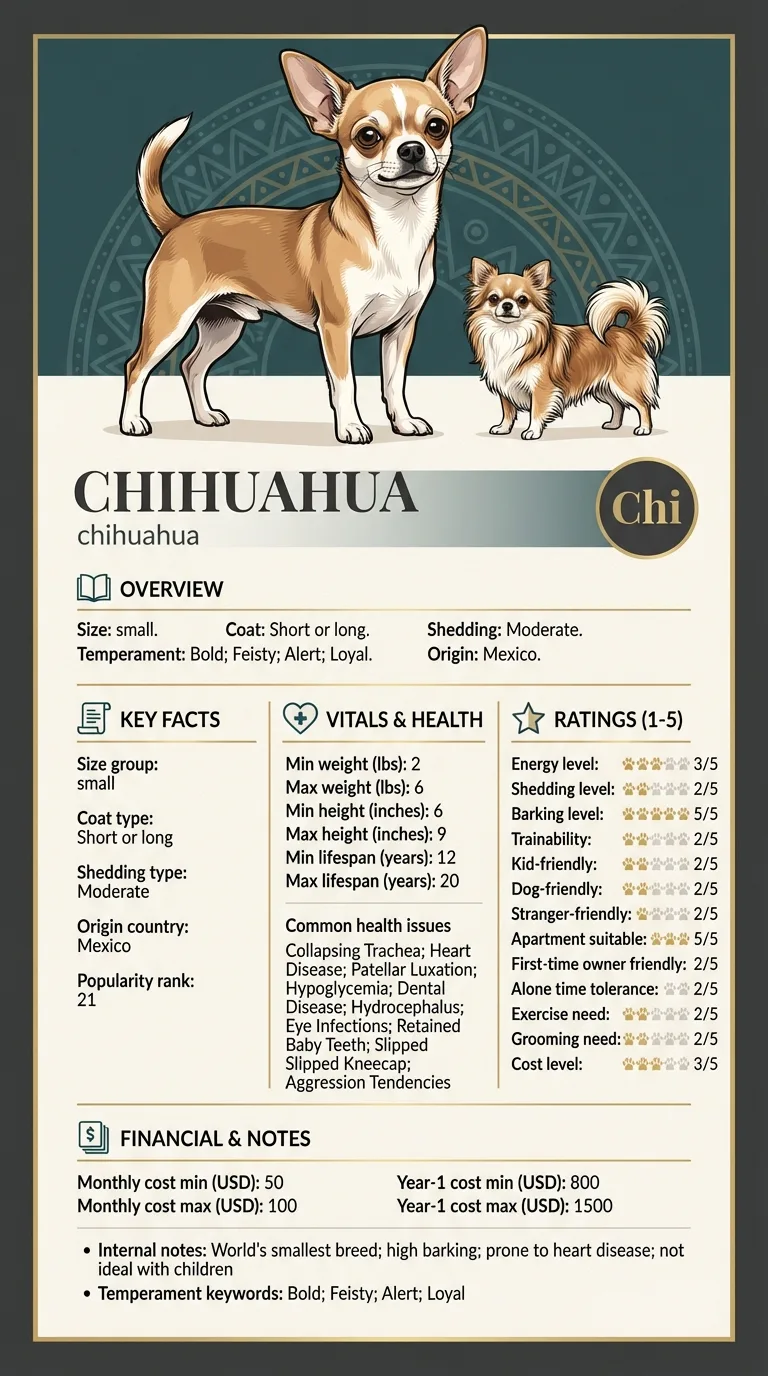
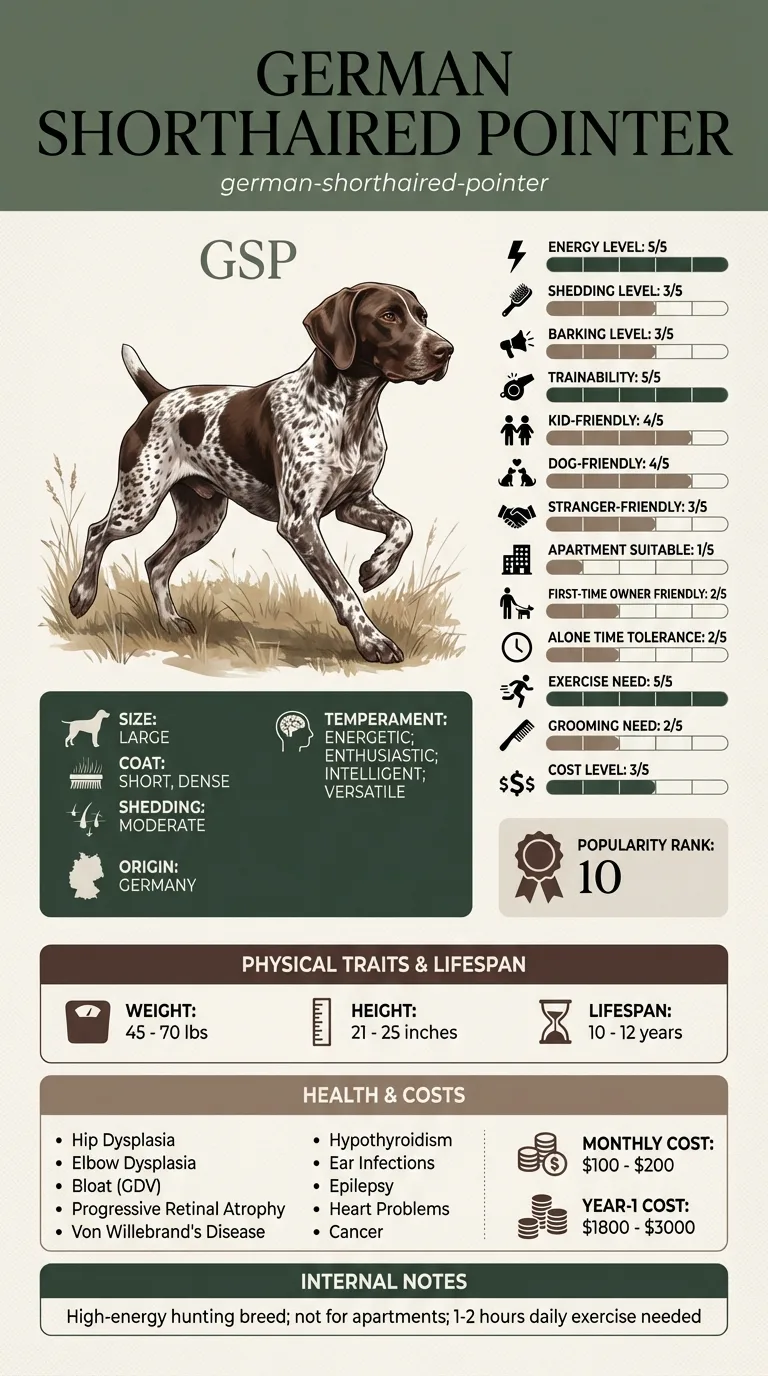
This is for someone already down to Chihuahua and German Shorthaired Pointer and deciding between them. For this pair the decision usually turns on apartment suitability and exercise need, so those are covered first and in most detail. Anyone choosing from a flat has a clear answer here: Chihuahua rates 5/5 against 1/5. The focus throughout is on daily consequences rather than breed background.
Between Chihuahua and German Shorthaired Pointer, apartment suitability is what separates them, and Chihuahua is the lower-effort dog of the two to keep.
Choose Chihuahua if you are in a flat or a smaller home, shedding is a problem in your house and your walking routine is modest.
Choose German Shorthaired Pointer if there are young children at home, you already have another dog and you want a dog that picks up training quickly.
| Feature | chihuahua | german shorthaired pointer | Winner |
|---|---|---|---|
| Size class | small | large | Equal |
| Weight | 2–6 lbs | 45–70 lbs | Equal |
| Height | 6–9 in | 21–25 in | Equal |
| Lifespan | 12–20 years | 10–12 years | chihuahua |
| Exercise need | Low (2/5) | Very high (5/5) | chihuahua |
| Grooming need | Low (2/5) | Low (2/5) | Equal |
| Shedding | Low (2/5) | Moderate (3/5) | chihuahua |
| Energy level | Moderate (3/5) | Very high (5/5) | Equal |
| Barking | Very high (5/5) | Moderate (3/5) | german shorthaired pointer |
| Apartment suitability | Very high (5/5) | Very low (1/5) | chihuahua |
| Good for first-time owners | Low (2/5) | Low (2/5) | Equal |
| Tolerates being alone | Low (2/5) | Low (2/5) | Equal |
| Trainability | Low (2/5) | Very high (5/5) | german shorthaired pointer |
| Good with kids | Low (2/5) | High (4/5) | german shorthaired pointer |
| Good with other dogs | Low (2/5) | High (4/5) | german shorthaired pointer |
| Friendly to strangers | Low (2/5) | Moderate (3/5) | german shorthaired pointer |
| Cost level | Moderate (3/5) | Moderate (3/5) | Equal |
| Coat | Short or long | Short, dense | Equal |
| Origin | Mexico | Germany | Equal |
| Typical monthly cost | $50–$100 | $100–$200 | Equal |
| Typical first-year cost | $800–$1,500 | $1,800–$3,000 | Equal |
Put a Chihuahua next to a German Shorthaired Pointer and the difference is almost comic: 2-6 lbs and 6-9 inches tall against 45-70 lbs and 21-25 inches at the shoulder. The GSP is a lean, athletic hunting breed built for covering ground in the field all day, with a short, dense coat suited to briars and water; the Chihuahua's short-or-long coat and toy-sized frame were never meant for fieldwork of any kind. Both share the same country of size-agnostic comparison charts, but in the yard or on a hike, only one of these dogs is built to keep pace with a jogging adult, and it isn't the one that fits in a jacket pocket.
Exercise need is about as lopsided as this comparison gets: low (2/5) for the Chihuahua, very high (5/5) for the German Shorthaired Pointer -- one of the most demanding exercise ratings any breed on this site carries. GSPs were bred to hunt for hours and need real daily output: running, swimming, or structured fieldwork, not just a walk around the block. Energy level tells a similar story, moderate (3/5) versus very high (5/5). A Chihuahua left under-exercised gets a little restless; a GSP left under-exercised tends to become genuinely difficult to live with, channeling that drive into digging, jumping fences, or nonstop pacing.
Grooming need is actually a tie here -- both rate low (2/5) -- but shedding tips slightly toward the Chihuahua, also low (2/5), against the GSP's moderate (3/5). The Pointer's short, dense coat sheds steadily year-round rather than in dramatic seasonal blowouts, which means more frequent vacuuming even without much brushing required. Neither breed demands a groomer's chair or elaborate coat care, so this is one of the few categories where the size gap between them doesn't translate into a dramatically different chore list. Owners choosing based on shedding alone will find the difference here modest rather than decisive.
Apartment suitability is where these two breeds diverge hardest: very high (5/5) for the Chihuahua against a very low (1/5) for the German Shorthaired Pointer, the lowest apartment score in this comparison's table. A GSP without a yard and serious daily exercise is, by most trainers' accounts, one of the worst-suited hunting breeds for apartment life. Barking favors the GSP somewhat -- moderate (3/5) versus the Chihuahua's very high (5/5) -- but both breeds rate low (2/5) on tolerating time alone, so neither is a reasonable choice for an owner working long hours away from home without a dog walker or midday break.
Trainability rates very high (5/5) for the German Shorthaired Pointer and low (2/5) for the Chihuahua, and the GSP's Energetic, Intelligent, Versatile temperament reflects a breed built to take direction in the field alongside a handler. Chihuahuas, by contrast, carry a Bold and Feisty streak that tends to resist obedience work, particularly housebreaking, which many owners describe as the single hardest part of raising one. Both breeds score low (2/5) for first-time owners, though the reasons differ sharply -- a GSP's demands are physical and require an active lifestyle, while a Chihuahua's challenges are behavioral and require patience with a strong-willed personality.
The German Shorthaired Pointer scores high (4/5) with kids, high (4/5) with other dogs, and moderate (3/5) with strangers -- a genuinely social, Enthusiastic breed profile. The Chihuahua rates low (2/5) across all three categories, a pattern consistent with its wariness toward anyone outside its chosen person and its tendency to react defensively around larger or unfamiliar dogs. Households with young children or a multi-dog home will generally find the GSP the more forgiving choice, provided its exercise needs are met; a tired, under-exercised GSP is a far less patient GSP. A Chihuahua tends to bond tightly to one or two people rather than the household at large.
The Chihuahua's 12-20 year lifespan comfortably outpaces the GSP's 10-12, a gap that shows up in how owners plan for the dog's later years. Chihuahua-specific concerns include Collapsing Trachea, Hypoglycemia, and Hydrocephalus, alongside dental crowding issues common to toy breeds. The GSP's list runs toward large, athletic-breed risks: Hip and Elbow Dysplasia from its active frame, Bloat (GDV) given its deep chest, and a notable Cancer risk alongside Von Willebrand's Disease, a clotting disorder worth discussing with a breeder or vet before purchase. Progressive Retinal Atrophy also appears on the GSP's list, an inherited eye condition absent from the Chihuahua's profile entirely.
Cost level ties at moderate (3/5) for both breeds, and the monthly figures are closer than the size difference might suggest: $50-$100 for the Chihuahua versus $100-$200 for the GSP. First-year costs run $800-$1,500 against $1,800-$3,000, with the gap driven mainly by the GSP's larger food needs and the higher price of gear sized for an active, 60-lb hunting dog -- proper leashes, crates, and orthopedic bedding all cost more at that scale. Neither breed carries the extreme cost profile of a giant breed, making this pairing more balanced financially than the size difference alone would predict.
Chihuahua weighs 2–6 lbs and lives 12–20 years; German Shorthaired Pointer weighs 45–70 lbs and lives 10–12 years. The two diverge most on apartment suitability, exercise need and trainability and 4 other rated axes. They are level on tolerates being alone, cost level and good for first-time owners, so those cannot decide it. The table below marks a winner only where one breed is genuinely easier for a typical owner; size and origin are facts rather than merits and stay level. Ratings come from one source applied to both breeds, so they are meaningful against each other rather than as absolute scores.

It can be -- GSPs rate low (2/5) for first-time owners due to their very high exercise needs, so someone without an active daily routine will likely struggle regardless of the breed's trainability.
The GSP, rated moderate (3/5) for barking against the Chihuahua's very high (5/5), though the Pointer's energy can turn into other noisy behaviors like whining if under-exercised.
They can, but the Chihuahua's low (2/5) rating with other dogs means a careful, slow introduction matters more than the GSP's naturally social (4/5) temperament.
The Chihuahua, typically 12-20 years versus the GSP's 10-12, a gap of up to eight years at the extremes.
According to this data, yes -- it scores a very low 1/5 for apartment suitability, the lowest rating in this entire comparison, driven by its very high exercise needs.
The GSP, at $1,800-$3,000 versus the Chihuahua's $800-$1,500, mostly due to food volume and larger-dog gear.
The GSP, rated high (4/5) versus the Chihuahua's low (2/5), assuming the Pointer's exercise needs are consistently met.
The German Shorthaired Pointer, rated very high (5/5) for exercise versus the Chihuahua's low (2/5).
The GSP, moderate (3/5), versus the Chihuahua's low (2/5).
The GSP -- its very low (1/5) apartment score signals it needs space to run.
The GSP, rated very high (5/5) against the Chihuahua's low (2/5).
Secure checkout on Stripe. We never see your card.
7-day money-back guarantee. Instant access.
Health information here is general and is not veterinary advice. If your dog shows pain, sudden behaviour change, or worsening symptoms, consult a licensed veterinarian.
Some links on this site are affiliate links. We may earn a commission at no extra cost to you, and we only suggest products we believe are helpful for dog owners.
We research and check what we publish, but we do not warrant that any figure, date, price, or statement is accurate, complete, or current, and we accept no liability for any loss, cost, injury, or other harm arising from the use of this site. Use it as one reference among several. You remain responsible for your own decisions and for your dog's care - confirm anything that matters with a licensed veterinarian or another qualified professional before you act on it. Full disclaimer.
Match your lifestyle to the right dog.
Take quizNot sure which breed is right for you? Take our 2-minute quiz to find out.
Take the quiz