Health
Why does von Willebrand's disease often go unnoticed?
It causes slower clotting, not absent clotting, so everyday bumps and scrapes still resolve normally. It typically only becomes obvious during surgery or a significant bleeding event.

Quick answer
Why does von Willebrand's disease often go unnoticed?
It causes slower clotting, not absent clotting, so everyday bumps and scrapes still resolve normally. It typically only becomes obvious during surgery or a significant bleeding event.
Most dogs with von Willebrand's disease look and act perfectly normal for years, right up until a routine nail trim or spay bleeds far longer than it should.
This affects owners whose Bichon has been diagnosed or flagged as a carrier, and who are trying to work out what that actually changes about daily life versus what only matters in specific, higher-risk moments.
This guide is not medical advice. If your dog shows pain, sudden behavior change, or worsening symptoms, consult a licensed veterinarian.
Some links may be affiliate links. We may earn a commission at no extra cost to you. We only suggest products we believe are helpful for dog owners.
We research and check what we publish, but we do not warrant that any figure, date, price, or statement is accurate, complete, or current, and we accept no liability for any loss, cost, injury, or other harm arising from the use of this site. Use it as one reference among several. You remain responsible for your own decisions and for your dog's care - confirm anything that matters with a licensed veterinarian or another qualified professional before you act on it. Full disclaimer.
Von Willebrand's disease is a clotting disorder caused by reduced levels of a blood protein that helps platelets stick together. It causes slower, not absent, clotting, and in most affected dogs it stays completely invisible in daily life until a bleeding challenge like surgery, a dental extraction, or a significant injury reveals it.
Von Willebrand's disease Type 1, the mild to moderate form, is one of the more frequently identified inherited bleeding disorders on veterinary genetic panels across several breeds, though most affected dogs never show a symptom outside a specific bleeding challenge.
The Bichon Frise appears on genetic testing panels for von Willebrand's disease Type 1, the mild to moderate form of the condition caused by reduced levels of von Willebrand factor. This is a documented, testable, inherited trait rather than something that develops from environment or lifestyle.
The condition itself is genetic and unaffected by environment, but the situations that reveal it, surgery, dental work, injury, are shaped by ordinary life events rather than anything specific to how a dog is raised or kept.
Talk to your vet before any planned surgery or dental procedure to discuss pre-screening for this condition. Treat prolonged bleeding from a minor injury that does not stop within a reasonable time, or any significant unexplained bleeding, as a same-day concern.
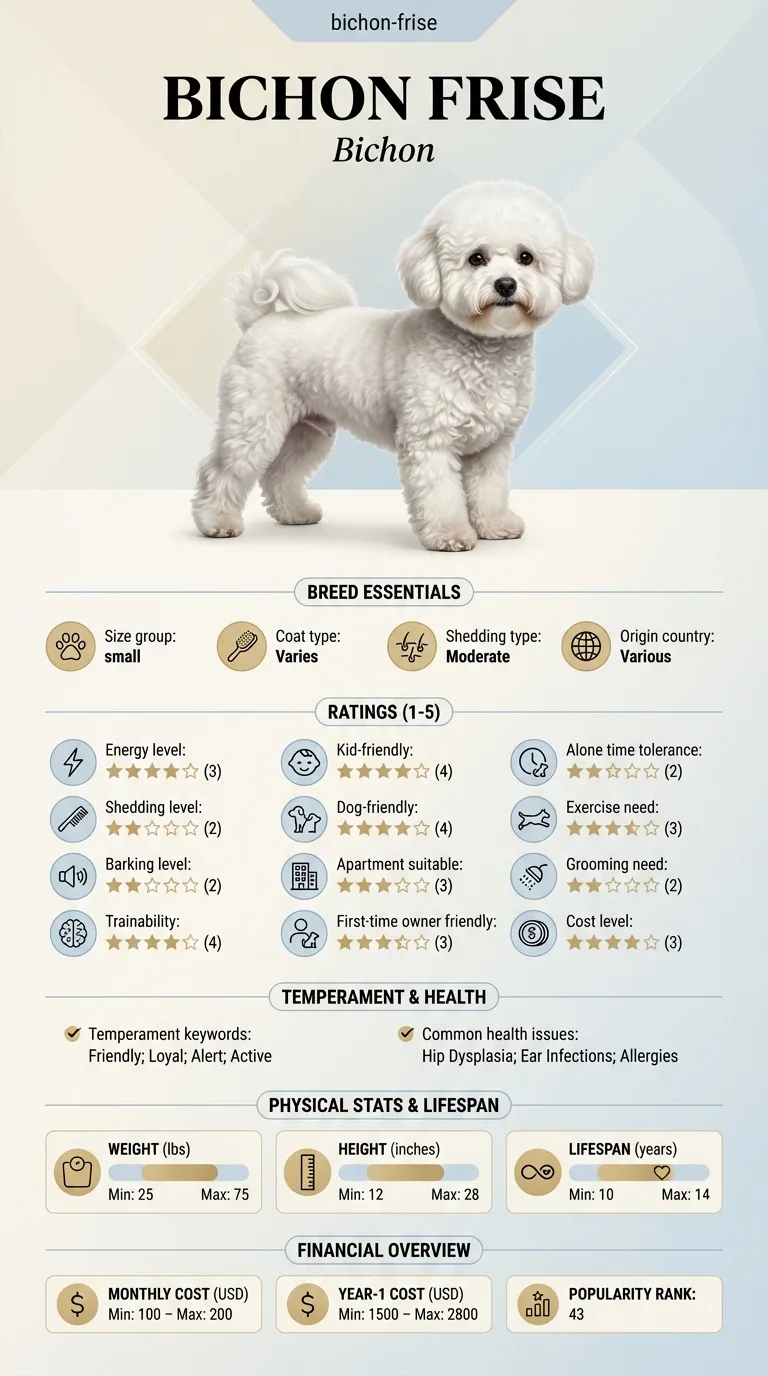
See all Bichon Frise health problems, which breeds are prone to von willebrands disease, or the full Bichon Frise breed guide for temperament, exercise needs and ownership costs.
There is no treatment timeline in the usual sense, since this is a lifelong trait rather than a progressing illness. Its relevance is tied to specific events like surgery rather than to an ongoing daily schedule.
Success looks like a dog that lives an entirely normal life, with the condition surfacing only as a planning consideration before surgery or dental work, never as an unmanaged surprise.
Von Willebrand factor is a blood protein that helps platelets stick together and start the clotting process at the site of an injury. A dog with reduced levels of this factor has a mild to moderate clotting delay, not an absence of clotting altogether, which is exactly why the condition can go unnoticed for years. Everyday bumps and scrapes that a normal dog clots quickly still happen and still stop bleeding in an affected dog, just somewhat more slowly, and that slower pace is easy to miss without something specifically testing the clotting system, like surgery or a significant wound.
Spay and neuter surgery, dental extractions, and any procedure involving a cut into tissue are the classic moments where von Willebrand's disease becomes obvious, because these create a bleeding challenge routine bumps do not. A nail trimmed slightly too short, normally a minor annoyance, can bleed for an unusually long time. Nosebleeds without an obvious cause, small bruises appearing without known trauma, or blood in urine or stool without other illness are the other patterns worth noticing at home, even though most affected dogs never show any of them until a specific triggering event occurs.

Because the condition is silent until tested, the practical management strategy is knowing about it before a bleeding challenge happens, not reacting after one starts. A simple blood test can measure von Willebrand factor levels or confirm the condition through genetic testing, and either result changes how a vet approaches any future surgery: adjusting technique, having blood products on standby, or simply building in extra recovery monitoring time. This is a planning problem, solved well in advance, not a crisis-management one.
If you think your Bichon has von willebrand's disease, the plan is three steps: write down what you have seen and when it started, book a veterinary appointment rather than waiting for the next flare, and take video of the behaviour or symptom before you go — the thing you are worried about rarely happens in the consulting room. Screening in the parents covers skin allergies, patellar luxation, bladder stones.
What the vet visit should produce is a diagnosis and a written plan, not just reassurance: what is being ruled out, what the monitoring interval is, and which signs mean you come back sooner. Ask what the treatment costs across a year rather than per visit, because that is the number that decides whether you are managing this condition or reacting to it.
Between appointments, keep a short log — dates, what you saw, what changed. It is the single most useful thing an owner brings to a follow-up, and for von willebrand's disease it is often what separates a clear pattern from a guess.
Willow's spay surgery at six months old was scheduled as routine, with no reason to expect complications. Partway through recovery, her incision site continued oozing well beyond what her vet typically saw, and bloodwork afterward confirmed reduced von Willebrand factor levels. Willow recovered fully, but her vet was candid that knowing beforehand would have allowed for a more cautious surgical approach and blood products on standby rather than a reactive scramble mid-procedure. Willow's owner had her vWD status genetically confirmed afterward, and that information now travels with her to every vet visit, every dental cleaning, and every future procedure, turning what was a surprise once into a known, planned-for factor going forward.
Key takeaway: Von Willebrand's disease usually gives no warning until a bleeding challenge occurs, which is exactly why testing before, rather than discovering during, a planned procedure makes the biggest practical difference.
It is a reduced level of von Willebrand factor, a blood protein that helps platelets stick together and start clotting. Affected dogs clot more slowly than normal, not not at all, which is why the condition often goes unnoticed until a significant bleeding challenge occurs.
Most affected dogs show no obvious signs day to day. Nosebleeds without cause, small unexplained bruises, prolonged bleeding from a minor nail trim, or unusually long bleeding after a small cut are the patterns worth noticing, though many dogs never show any of them until surgery.
It increases bleeding risk during and after surgery, which is why pre-surgical screening matters. A vet aware of the diagnosis in advance can adjust technique and have blood products available if needed, substantially reducing the risk this poses.
No, it is a lifelong condition, but it is manageable. Most affected dogs live entirely normal lives, with the condition only becoming relevant during surgery, significant injury, or dental procedures.
A blood test measuring von Willebrand factor levels, or a genetic test confirming the underlying variant, can both diagnose it. Testing is often recommended before any planned surgery in breeds where the condition is documented.
No, but trim conservatively and keep styptic powder on hand in case of a slightly-too-short cut, since bleeding may take longer than usual to stop even from a minor trim.
It does not typically progress or worsen with age on its own. The risk it poses stays tied to specific bleeding challenges like surgery or significant injury rather than accumulating over time.
It causes slower clotting, not absent clotting, so everyday bumps and scrapes still resolve normally. It typically only becomes obvious during surgery or a significant bleeding event.
Unexplained nosebleeds, small bruises without known trauma, or unusually prolonged bleeding from a minor cut or nail trim are the patterns worth noticing, though many affected dogs never show them.
Pre-surgical screening for von Willebrand factor levels is a sound precaution in this breed, since it allows a vet to plan for increased bleeding risk in advance rather than reacting during surgery.
It cannot be cured, but it is well managed through awareness and planning, particularly around surgery, dental work, and significant injury.
A blood or genetic test for von Willebrand factor is typically a modest add-on cost at a routine vet visit, well below the cost of managing an unexpected bleeding complication during surgery.
A one-page prep sheet for this condition: the signs, the questions to ask, what to get priced. Unlocks here.
You get: Vet visit prep sheet
No spam. One-click unsubscribe. See our privacy policy.
Preview page 1 before you decide.