Health
Are back problems common in Bichon Frises?
Not as a breed trait. Back issues here are usually injury or age related rather than structural, and they are not on the breed's documented health list.

Quick answer
Are back problems common in Bichon Frises?
Not as a breed trait. Back issues here are usually injury or age related rather than structural, and they are not on the breed's documented health list.
A Bichon with a sore back is almost never suffering from the long spine and short legs explanation that fills the internet, and treating it as though it were sends owners down the wrong path.
Owners whose Bichon has suddenly gone quiet, is refusing to jump, or is yelping when picked up, and who want to know how worried to be. It is also for owners of young, bouncy Bichons who want to prevent the injuries that furniture and slippery floors cause.
This guide is not medical advice. If your dog shows pain, sudden behavior change, or worsening symptoms, consult a licensed veterinarian.
Some links may be affiliate links. We may earn a commission at no extra cost to you. We only suggest products we believe are helpful for dog owners.
We research and check what we publish, but we do not warrant that any figure, date, price, or statement is accurate, complete, or current, and we accept no liability for any loss, cost, injury, or other harm arising from the use of this site. Use it as one reference among several. You remain responsible for your own decisions and for your dog's care - confirm anything that matters with a licensed veterinarian or another qualified professional before you act on it. Full disclaimer.
Back problems in a Bichon Frise usually mean pain from strained muscle and ligament, from compensating for a sore hind leg, or from age-related change along the spine. They show up as a hunched posture, reluctance to jump or use stairs, a yelp when lifted, and a dog that has gone unusually quiet. Serious spinal cord compression is uncommon in this breed but must be recognised immediately when it happens.
Strains and mechanical back pain are seen regularly in small companion dogs and most resolve with rest. Genuine disc disease requiring surgery is far less common here than in the dwarfed long-backed breeds, and back problems do not appear on the Bichon Frise list of documented health issues. That list covers skin allergies, patellar luxation, bladder stones, cataracts and dental disease.
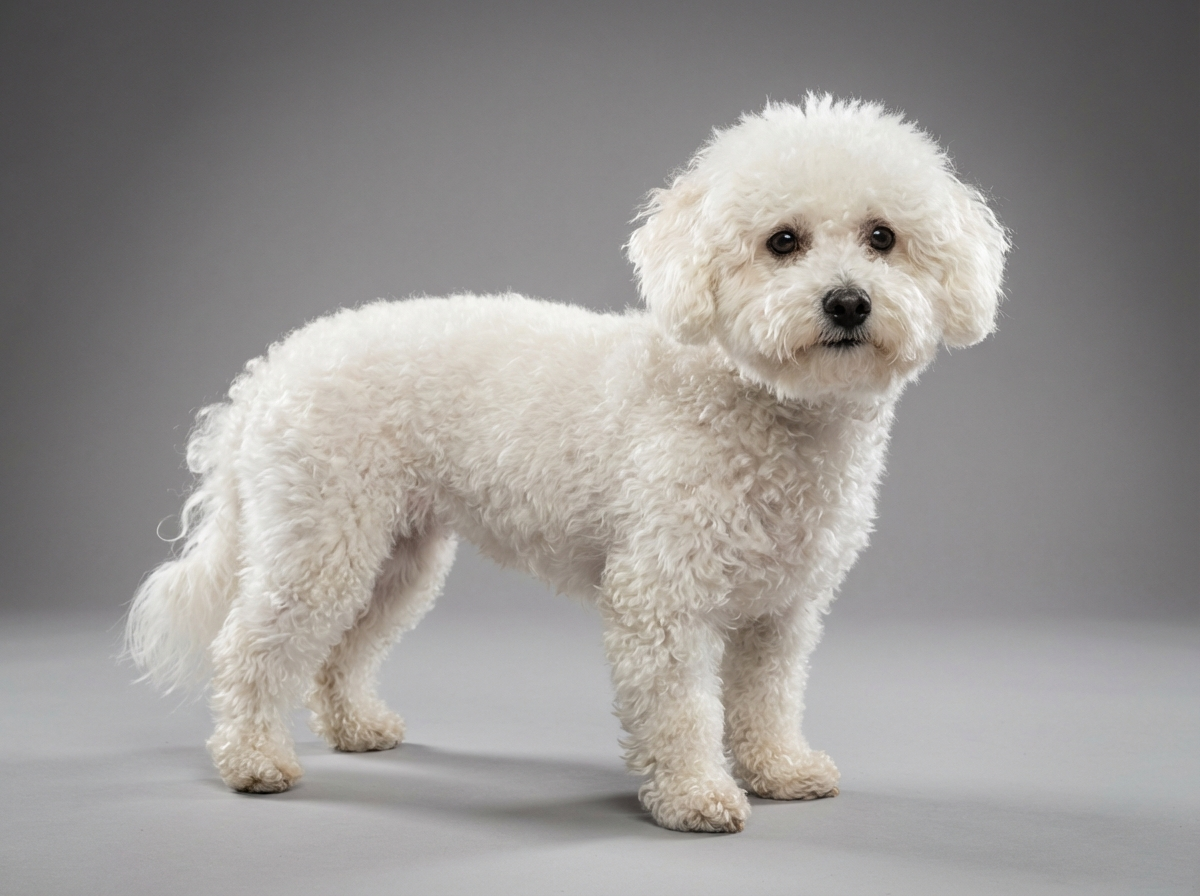
The Bichon Frise does not have a spinal design fault, and that is the honest breed answer. Where breed traits do contribute, they do so indirectly. Patellar luxation is documented in this breed, and a dog guarding an unstable knee changes how it distributes weight, holding the spine stiffly and overloading the muscle either side of it. Size contributes too: a small dog lives in a world scaled for humans, so ordinary furniture represents a proportionally huge drop. The dense curly coat then hides the muscle tension and postural change that would be obvious on a smooth-coated dog.
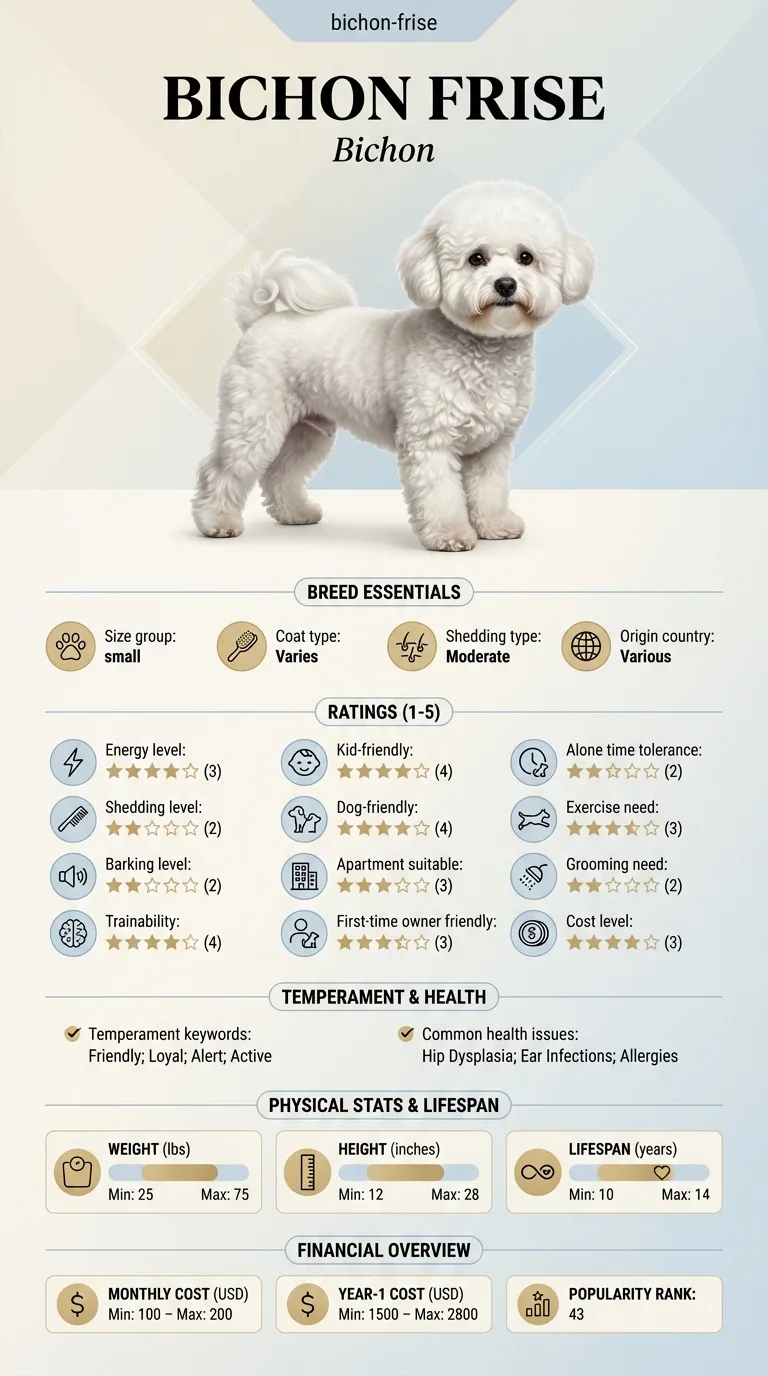
The homes Bichons live in do most of the damage. This breed rates five out of five for apartment suitability, and apartments mean hard floors, no soft landing surfaces and stairs. Slippery flooring produces the sudden splayed skid that strains a back. Sofa access without steps produces impact landings every single day. A dog with an exercise need of only two out of five that gets one burst of frantic activity at the weekend, rather than steady daily movement, is also poorly conditioned for the twists that daily life demands.
Book within a day or two for a dog that is hunched, reluctant to move, yelping when lifted or handled, or refusing stairs it managed last week. Go to an emergency clinic immediately, without waiting, if your Bichon is dragging one or both hind feet, is wobbly or knuckling over on its paws, cannot stand or bear weight, has lost bladder or bowel control, or is in severe unrelenting pain. Those signs suggest pressure on the spinal cord, where the window for effective treatment is measured in hours rather than days. Sudden hind limb weakness in any dog is an emergency until proven otherwise.
See all Bichon Frise health problems, which breeds are prone to back problems, or the full Bichon Frise breed guide for temperament, exercise needs and ownership costs.
A simple soft tissue strain usually improves noticeably within three to five days of genuine rest and settles over two to three weeks, provided the rest is real. Compensatory back pain does not resolve until the underlying leg problem is addressed, so expect no lasting improvement while a kneecap is still luxating. Age-related spinal change does not go away at all and is managed for the rest of a fourteen to fifteen year life.
Success is a dog that moves fluidly, lies down in one motion rather than in stages, tolerates being lifted without flinching, and uses its ramp instead of jumping. For an older Bichon with degenerative change, success is stiffness that eases within a few minutes of getting up and a dog that still wants its walk, rather than a spine that looks young on an X-ray.
Most back pain in this breed is soft tissue and mechanical rather than a structural fault of the skeleton. That is good news, because soft tissue heals and mechanics can be changed.
Dogs mask spinal pain well, and a coated white dog gives you very little to look at. You read this one from posture and behaviour instead.
Watch the topline. A dog holding its back in a slight arch, with the belly tucked and the head carried lower than usual, is guarding. Watch the head carriage too, because neck pain shows as a dog that will not look up at you and turns its whole body instead of its head.
Watch how your Bichon lies down. A painful back turns lying down into a slow, careful negotiation with a pause partway.
Then use your hands, gently. Run flat fingers down either side of the spine with light pressure, from shoulders to hips. A guarded dog will tense, dip, turn its head toward your hand, or lick its lips. Stop at the first sign; you are locating pain, not testing how much it can take.
What you must not do is stretch, manipulate or click anything. A back that hurts for an unknown reason should be rested and assessed, not adjusted.

Clementine, four years old and famously bouncy, yelped one evening jumping off the arm of the sofa and then spent the next day hunched with her tail down. Her owner, Sofia, took her in the same afternoon. The examination found pain over the mid-back muscle, no weakness in the legs, and normal reflexes. No imaging was needed at that stage. The prescription was pain relief and two weeks of strict rest. Sofia found the rest harder than the injury. Clementine felt better by day four and wanted to play, and the temptation to let her was constant. Sofia used a pen in the living room, lead-only toilet trips and a food puzzle twice a day to keep a bright dog occupied without moving much. At the recheck Clementine was sound. The sofa arm is now blocked, a small ramp sits at the end of the seat, and there are runners down the hall.
Key takeaway: The hard part of a Bichon back strain is not the diagnosis or the medication, it is enforcing rest on a cheerful dog who feels fine on day four and is not.
No. The long-and-low body plan comes from a specific form of skeletal dwarfism that the Bichon Frise does not carry. This breed has proportionate legs and a square outline, so the disc problems associated with dachshunds and corgis are not part of its expected health picture.
It deserves attention rather than panic. A single yelp with normal behaviour afterwards often means a strain, and forty-eight hours of genuine rest is reasonable. Repeated yelping, reluctance to move at all, a hunched posture, shaking, or any weakness in the legs changes it into a same-day veterinary matter.
More and stricter than most owners give. Two to three days of lead-only toilet breaks, no stairs, no sofa, no play, is the usual starting point, and let your vet extend it. The commonest reason a mild strain becomes a long problem is a dog allowed to feel better and immediately jump.
For walking, yes, in almost all cases. A small dog that pulls, lunges at another dog or is checked by a collar puts concentrated force through its neck. A well-fitted Y-shaped harness spreads that across the chest without restricting the shoulder.
Once recovered, ideally not without help. A set of steps or a ramp is a permanent change worth making. It removes the repeated landing impact that causes most of these injuries in the first place, and dogs learn to use them quickly with a food trail.
Manipulation of an undiagnosed painful back is a bad idea. If your vet has diagnosed the problem and thinks manual therapy is appropriate, ask for a referral to a qualified veterinary physiotherapist. The order matters: diagnosis first, hands-on treatment second.
Not as a breed trait. Back issues here are usually injury or age related rather than structural, and they are not on the breed's documented health list.
Stop the jumping down. Steps or a ramp to the sofa and bed removes the repeated impact that causes most Bichon back strains.
Any weakness, wobbliness, dragging of the hind feet, or inability to stand. Those suggest spinal cord involvement and need immediate veterinary care.
Neither without veterinary advice. Applying anything to an undiagnosed spine risks masking a problem that needs assessing, and burns are easy on thin small-dog skin.
A basic examination is modest, but advanced imaging under anaesthetic is one of the more expensive investigations in small animal practice. Ask for an estimate first.
A one-page prep sheet for this condition: the signs, the questions to ask, what to get priced. Unlocks here.
You get: Vet visit prep sheet
No spam. One-click unsubscribe. See our privacy policy.
Preview page 1 before you decide.