Health
What's the classic sign of a cruciate tear in a dog?
A hind-leg limp, often worse after exercise, that doesn't clear up within a day or two of rest.

Quick answer
What's the classic sign of a cruciate tear in a dog?
A hind-leg limp, often worse after exercise, that doesn't clear up within a day or two of rest.
A sudden hind-leg limp that doesn't improve after a day or two is one of the more common orthopedic emergencies a large-breed owner will face, and the Akita's size puts it squarely in the risk zone.
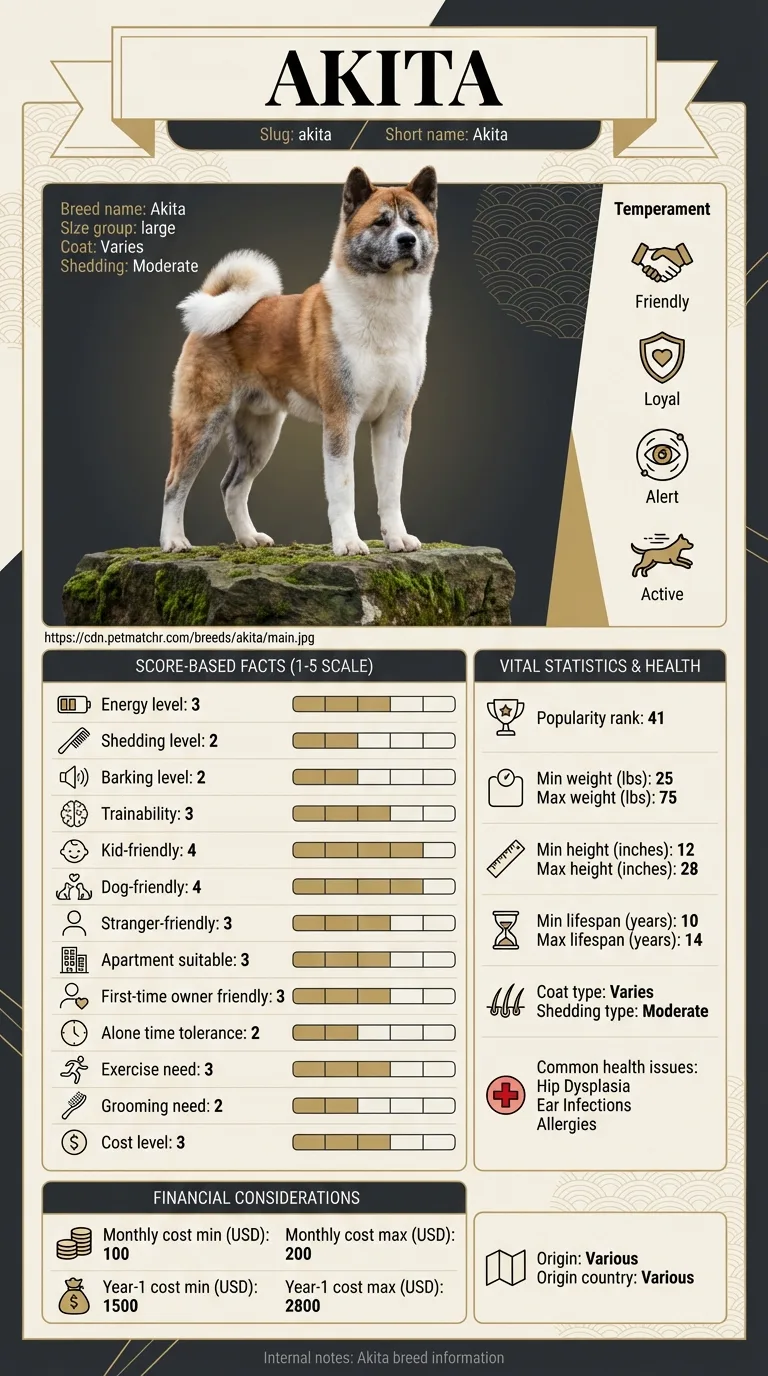
Owners of adult, active Akitas — especially those a little overweight or those whose dogs love hard sprinting and quick turns during fetch — see this most.
This guide is not medical advice. If your dog shows pain, sudden behavior change, or worsening symptoms, consult a licensed veterinarian.
Some links may be affiliate links. We may earn a commission at no extra cost to you. We only suggest products we believe are helpful for dog owners.
We research and check what we publish, but we do not warrant that any figure, date, price, or statement is accurate, complete, or current, and we accept no liability for any loss, cost, injury, or other harm arising from the use of this site. Use it as one reference among several. You remain responsible for your own decisions and for your dog's care - confirm anything that matters with a licensed veterinarian or another qualified professional before you act on it. Full disclaimer.
Check this first
A hind leg that's suddenly non-weight-bearing, especially after running, jumping, or an awkward turn, should be seen promptly. While a torn cruciate itself isn't typically life-threatening, an unstable knee joint can worsen quickly with continued use, and a concurrent meniscus tear can cause significant ongoing pain.
A toe-touching limp that appears after exercise and doesn't fully resolve within 24 to 48 hours of rest is the pattern most consistent with a cruciate injury and warrants a vet visit within a few days, even if it isn't a middle-of-the-night emergency.
What does warrant same-day care is a leg that's held completely off the ground, visible swelling around the knee, or a dog that's suddenly unwilling to bear any weight at all — these suggest either a complete rupture or another acute injury that needs prompt evaluation.
If any of these apply, call your vet or an emergency clinic now. The rest of this page is for the cases that are not an emergency.
A cruciate ligament injury is one of the most common orthopedic problems seen in large, active dogs, and the Akita's size and strength put real ongoing stress on that ligament during normal running, pivoting, and jumping. It usually shows up as a hind-leg limp rather than a dramatic collapse.
Cruciate ligament injuries are among the single most frequent reasons large-breed dogs see an orthopedic vet, and a heavy, athletic breed like the Akita carries above-average mechanical risk simply because of body size, even without any specific genetic predisposition being documented.
At 70 to 130 pounds, an Akita's knee joints absorb substantially more force during running and turning than a small dog's ever would. The ligament itself isn't structurally different from other breeds, but the sheer mechanical load placed on it, combined with this breed's strong, sometimes headstrong movement style, raises the wear and tear over a lifetime.
Hard surfaces, repeated sprint-and-stop games like fetch, and excess body weight all increase the load on the cruciate ligament during everyday activity. A dog that's kept lean and exercised on natural, varied terrain puts meaningfully less cumulative stress on this ligament than one that's overweight and does most of its running on pavement.
See a vet within a few days for a hind-leg limp that persists past 24 to 48 hours, and the same day for a leg your dog won't bear any weight on at all, visible knee swelling, or sudden inability to rise.
How an owner responds in the days after a limp starts can significantly affect the ligament's ultimate outcome. Avoid these missteps.
See all Akita health problems, which breeds are prone to cruciate ligament injuries, or the full Akita breed guide for temperament, exercise needs and ownership costs.
Most dogs are walking comfortably on a short leash within a couple of weeks post-surgery, with a full return to normal activity over 8 to 12 weeks under a structured rehab plan.
Success is a dog walking, trotting, and eventually running again without a limp, and ideally staying lean enough afterward to protect the opposite knee going forward.
Priya's five-year-old Akita, Bear, came up limping after a hard game of fetch in their Austin backyard. She gave it a couple of days of rest, but the limp never fully went away, and Bear started avoiding putting weight on the leg entirely by the end of the week. Her vet confirmed a torn cranial cruciate ligament and referred Bear to a surgeon for a TPLO procedure. The surgery and roughly ten weeks of restricted activity and rehab were a real commitment, but Bear returned to full off-leash hiking by the following spring, and Priya has kept him lean since to protect the other knee.
Key takeaway: A hind-leg limp that lingers past a couple of days in a large dog is worth a prompt vet visit — catching a cruciate tear early keeps the treatment options and the long-term outlook better.
The cruciate ligament in dogs weakens gradually with age and mechanical stress rather than staying strong until a single traumatic tear. A heavier dog puts more cumulative load on that ligament during normal running and turning, which raises the odds of a partial or complete tear over a dog's lifetime.
In dogs over roughly 30 pounds, most orthopedic surgeons recommend surgical stabilization because conservative management alone tends to lead to chronic instability and arthritis. Some smaller or lower-activity dogs might be managed conservatively, but that's a case-by-case decision for a large breed like the Akita.
Surgical repair for a large dog commonly runs from around $3,000 to $7,000 depending on the technique used, the region, and whether it's done by a general practitioner or a board-certified surgeon.
Most dogs need 8 to 12 weeks of restricted activity following surgery, with a structured return to normal exercise guided by rehabilitation and the surgeon's follow-up exams.
It's a real possibility — a meaningful percentage of dogs that tear one cruciate ligament go on to tear the other within a couple of years, especially if weight and activity level aren't managed afterward.
It helps meaningfully. Keeping an Akita lean reduces the mechanical load on the knee joint and is one of the few modifiable risk factors an owner has real control over.
Yes — structured rehabilitation, including controlled leash walks, underwater treadmill work, and range-of-motion exercises, generally produces a better functional outcome than rest alone.
A hind-leg limp, often worse after exercise, that doesn't clear up within a day or two of rest.
For a dog the size of an Akita, yes — most orthopedic surgeons recommend surgical stabilization over conservative management.
Plan for roughly $3,000 to $7,000 depending on technique and location; pet insurance can significantly offset this if it's already in place before the injury.
Yes — reducing sprinting, jumping, and rough play immediately after a suspected tear can prevent it from becoming a full rupture before surgery.
Leash-manners training that keeps a dog calm and controlled during the restricted-activity recovery period makes the process much easier to manage.
A one-page prep sheet for this condition: the signs, the questions to ask, what to get priced. Unlocks here.
You get: Vet visit prep sheet
No spam. One-click unsubscribe. See our privacy policy.
Preview page 1 before you decide.