Health
What should I check on a puppy's face?
Nostrils that are open holes rather than narrow slits, quiet breathing at rest, and how quickly noise settles after two minutes of play.

Quick answer
What should I check on a puppy's face?
Nostrils that are open holes rather than narrow slits, quiet breathing at rest, and how quickly noise settles after two minutes of play.
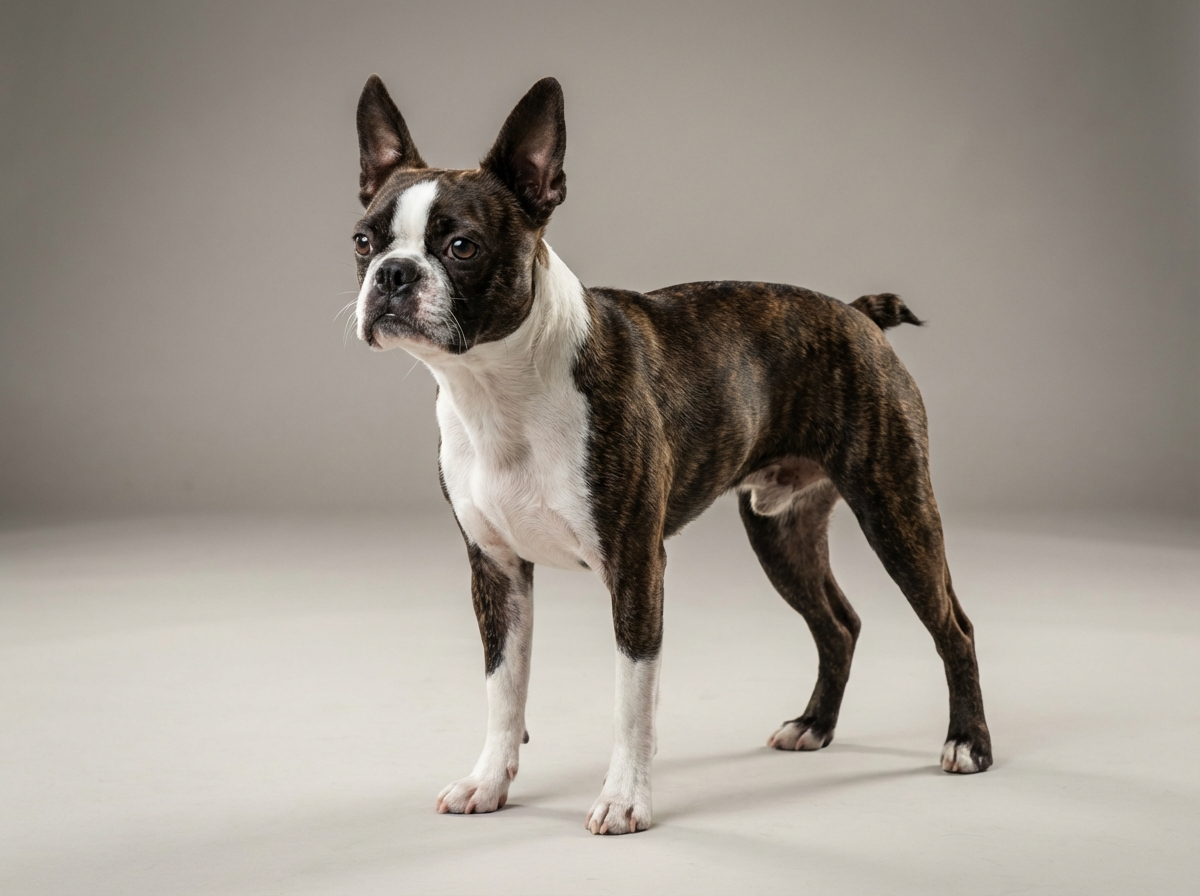
Boston Terriers are described as moderately brachycephalic. That word does a lot of work: it means the breed avoids the worst of the extremes while still carrying every one of the mechanisms in milder form.
People choosing between short-faced breeds and trying to understand what varies between them, owners wondering why their Boston's eyes and teeth need so much attention, and anyone assessing a puppy's face before committing.
This guide is not medical advice. If your dog shows pain, sudden behavior change, or worsening symptoms, consult a licensed veterinarian.
Some links may be affiliate links. We may earn a commission at no extra cost to you. We only suggest products we believe are helpful for dog owners.
We research and check what we publish, but we do not warrant that any figure, date, price, or statement is accurate, complete, or current, and we accept no liability for any loss, cost, injury, or other harm arising from the use of this site. Use it as one reference among several. You remain responsible for your own decisions and for your dog's care - confirm anything that matters with a licensed veterinarian or another qualified professional before you act on it. Full disclaimer.
Brachycephaly in the Boston Terrier is a shortened facial skeleton housing an unshortened set of soft tissues. Beyond the well-known airway restriction, it produces shallow eye sockets and exposed corneas, crowded teeth in a compressed jaw, skin creases that trap moisture, and difficulty at whelping. The breed sits at the moderate end of the short-faced range, which means milder average effects and unusually wide variation between individual dogs.
Universal in the breed by definition - every Boston Terrier is brachycephalic. What varies is degree, and it varies a great deal. Brachycephalic airway syndrome and corneal ulcers both appear on the breed's documented health list, which reflects how directly these two consequences follow from the skull shape.
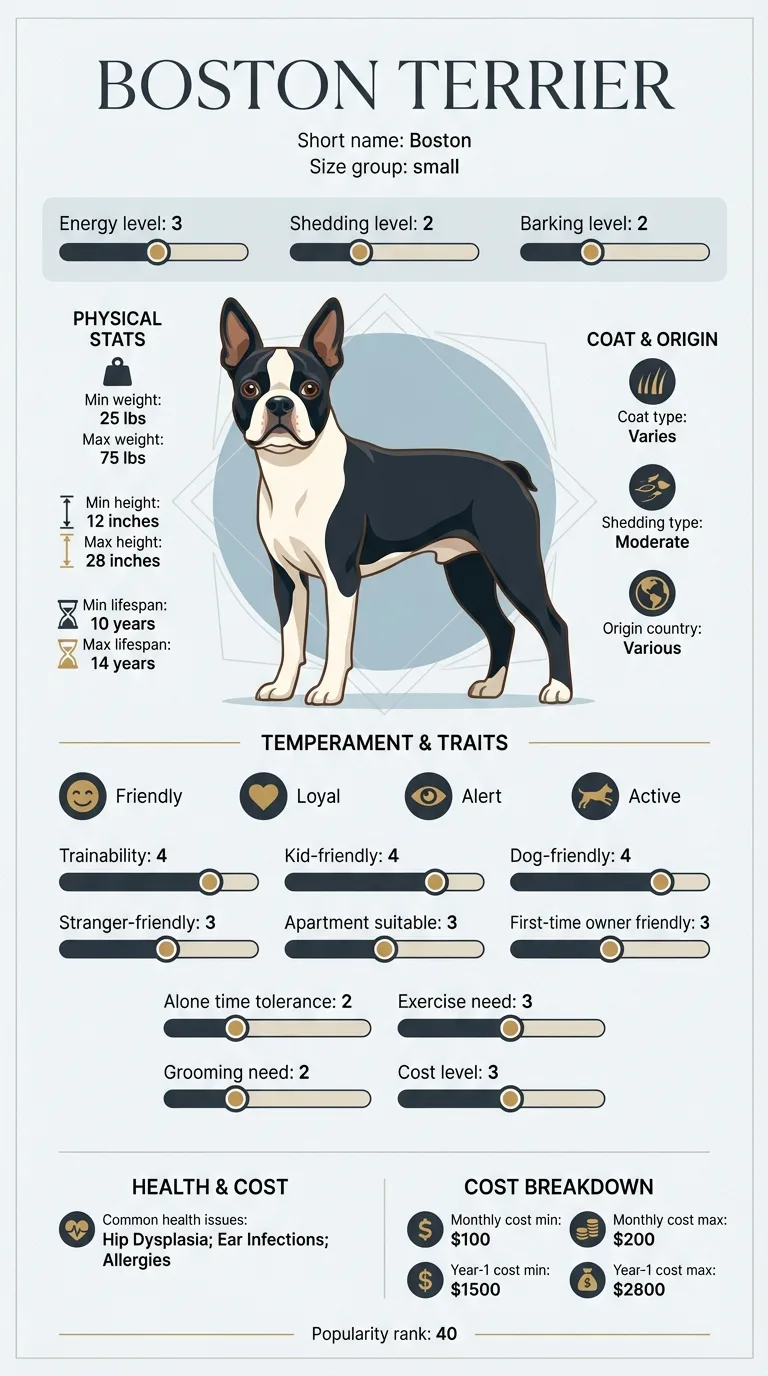
The Boston was developed toward a short, square head with a compact 12 to 25 pound body, and the skeletal shortening was achieved without a corresponding reduction in soft tissue. The palate keeps its length, the eyelids keep their dimensions over a socket that no longer contains the globe as deeply, and forty-two teeth keep their number in a shorter jaw. The short, smooth coat means facial creases are shallow and easy to manage compared with heavily folded breeds.
The environment does not create these features but decides how expensive they are. Hot climates punish an inefficient cooling system. Dense undergrowth, cat households and boisterous dog parks raise the odds of a corneal injury. Households with no toothbrushing routine convert a crowded mouth into periodontal disease within a few years, and damp facial creases in a warm house become infected ones.
Any eye that is squinting, held shut, cloudy, red or being rubbed needs same-day attention - corneal ulcers deteriorate quickly and are painful. Seek immediate care for a bulging eye, an eye that has been struck, or sudden severe eye pain, and for any breathing crisis with blue or grey gums. Book routine appointments for a mouth that smells, gums that bleed on brushing, persistent redness in facial creases, or breathing noise that is getting louder over months. Do not attempt to treat an eye at home with anything left over from a previous problem.
See all Boston Terrier health problems, which breeds are prone to brachycephalic features, or the full Boston Terrier breed guide for temperament, exercise needs and ownership costs.
None of this changes - the skull is the skull. What changes over the first few months is your routine: a workable daily care habit takes about six weeks to become automatic. Dental disease progresses over years, so consistency from puppyhood shows its value at seven or eight rather than immediately.
A dog whose eyes are checked before problems become ulcers, whose teeth are still present in double figures, who has never had an infected fold, and whose summer routine is built around a thermometer. The features remain; the complications largely do not.
Airway restriction is the headline, but a compressed skull reorganises several other structures at the same time. Each of these has practical consequences an owner meets in ordinary life.
Short-faced breeds are not interchangeable, and lumping them together does Boston owners a disservice in both directions.
At the extreme end sit the breeds with almost no muzzle at all, where a visible nose is barely present and the airway consequences are close to universal. The Boston Terrier has a genuine, if short, muzzle - typically about a third the length of the skull - and open nostrils are common enough in the breed that they are worth actively looking for in a puppy. Exercise tolerance in a well-built Boston can be entirely reasonable.
That is the reassuring half. The unreassuring half is that every mechanism is still present, just dialled down, and individual variation within the breed is wide. Some Bostons have pinched nostrils and a heavy overlong palate and struggle badly. Breeding choices, not breed membership, decide which dog you get.
When assessing a puppy, look at the nostrils in daylight - open apertures rather than commas - watch it play for two minutes and listen to whether the noise settles afterward, and look at the parents rather than only the puppy.

If you think your Boston has brachycephalic features, the plan is three steps: write down what you have seen and when it started, book a veterinary appointment rather than waiting for the next flare, and take video of the behaviour or symptom before you go — the thing you are worried about rarely happens in the consulting room. Screening in the parents covers brachycephalic airway syndrome (boas), patellar luxation, cataracts.
What the vet visit should produce is a diagnosis and a written plan, not just reassurance: what is being ruled out, what the monitoring interval is, and which signs mean you come back sooner. Ask what the treatment costs across a year rather than per visit, because that is the number that decides whether you are managing this condition or reacting to it.
Between appointments, keep a short log — dates, what you saw, what changed. It is the single most useful thing an owner brings to a follow-up, and for brachycephalic features it is often what separates a clear pattern from a guess.
Fiona kept two Bostons from the same litter - Bee and Custard - which turned out to be an unintended experiment. Bee had wide, open nostrils and a slightly longer muzzle. Custard's nostrils were narrow commas and his face was noticeably flatter. By three years old the difference was obvious in daily life. Bee walked forty minutes on a mild day and recovered in under a minute. Custard rasped through twenty and took five. Their teeth differed too: Custard's lower incisors were rotated and packed, and he needed a dental at four while Bee's mouth was still clean. Custard had his nostrils widened at four and improved markedly. Fiona's point, made to everyone who asks her about the breed, is that the two dogs shared parents, food and a house - and the only variable was how their faces had been built.
Key takeaway: Brachycephaly is a spectrum, and it runs within litters as well as between breeds. Choose the dog by its nostrils and its breathing, not by its breed's reputation.
Moderately. The breed retains a short but definite muzzle, unlike the flattest-faced breeds. That places it in a better position on average, with wide variation between individual dogs.
Because a shallow socket leaves the eye more prominent and less shielded by bone, and because lids that do not fully close leave the cornea drier. Corneal ulcers are one of the breed's documented health issues for exactly this reason.
They need consistent dental care. Crowded, rotated teeth trap debris that a longer jaw would not, so daily brushing and professional cleaning under anaesthesia when advised are more important here than in a long-muzzled dog of the same size.
Far less than the heavily wrinkled short-faced breeds, but there are creases at the muzzle that need drying after eating, drinking and wet walks. Weekly checking is usually enough for this breed.
Some do, but assisted delivery is common because of the mismatch between puppy head width and maternal pelvis. This is one of the reasons breeding should be left to people equipped for the veterinary costs and risks involved.
Partly. Open nostrils and quiet breathing after brief play are encouraging signs, and the parents' breathing is informative. But the palate cannot be assessed from outside, and secondary changes develop over years.
Indirectly. The breed's modest exercise requirement and adaptable, friendly temperament suit apartment life, and a dog that should not be running in the heat fits a walk-and-settle routine well. The limitation and the suitability come from the same place.
Nostrils that are open holes rather than narrow slits, quiet breathing at rest, and how quickly noise settles after two minutes of play.
Very little compared with heavily wrinkled breeds - drying the muzzle creases after meals and wet walks, and a look at the eyes each day.
It raises the likelihood of eye and dental treatment across a lifetime, and it makes any anaesthetic more involved. Budget for dental work as a recurring item.
It depends entirely on the breeder. Ask directly whether they select for open nostrils and functional breathing, and treat a vague answer as informative.
A one-page prep sheet for this condition: the signs, the questions to ask, what to get priced. Unlocks here.
You get: Vet visit prep sheet
No spam. One-click unsubscribe. See our privacy policy.
Preview page 1 before you decide.