Living
Which is better for a first-time owner?
The Boston Terrier, rated Very high (5/5) versus the Bichon's High (4/5).

Quick answer
Which is better for a first-time owner?
The Boston Terrier, rated Very high (5/5) versus the Bichon's High (4/5).
Bichon Frise or Boston Terrier? On paper they differ most on grooming need, and on the scales Boston Terrier is the heavier at 12–25 lbs. Here is how the two compare on everything that shapes an ordinary week.
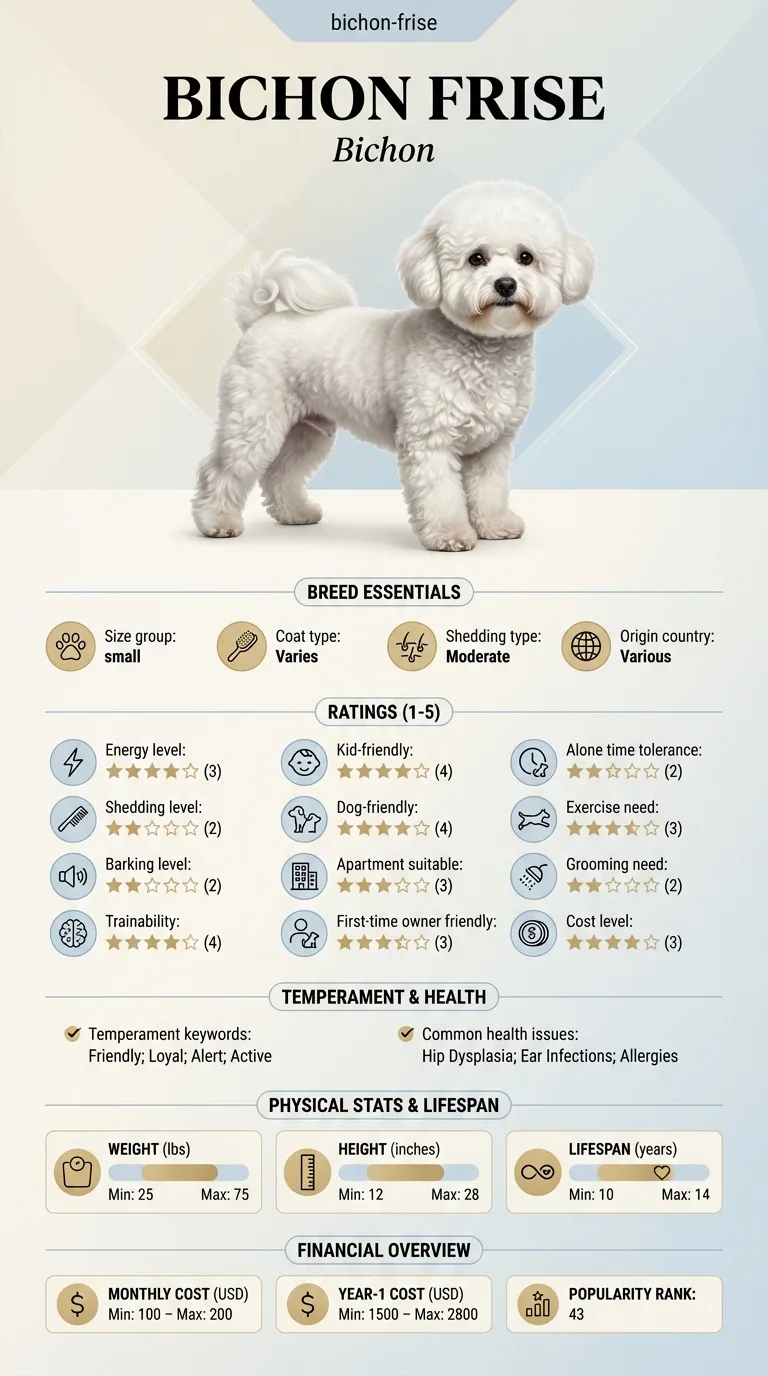
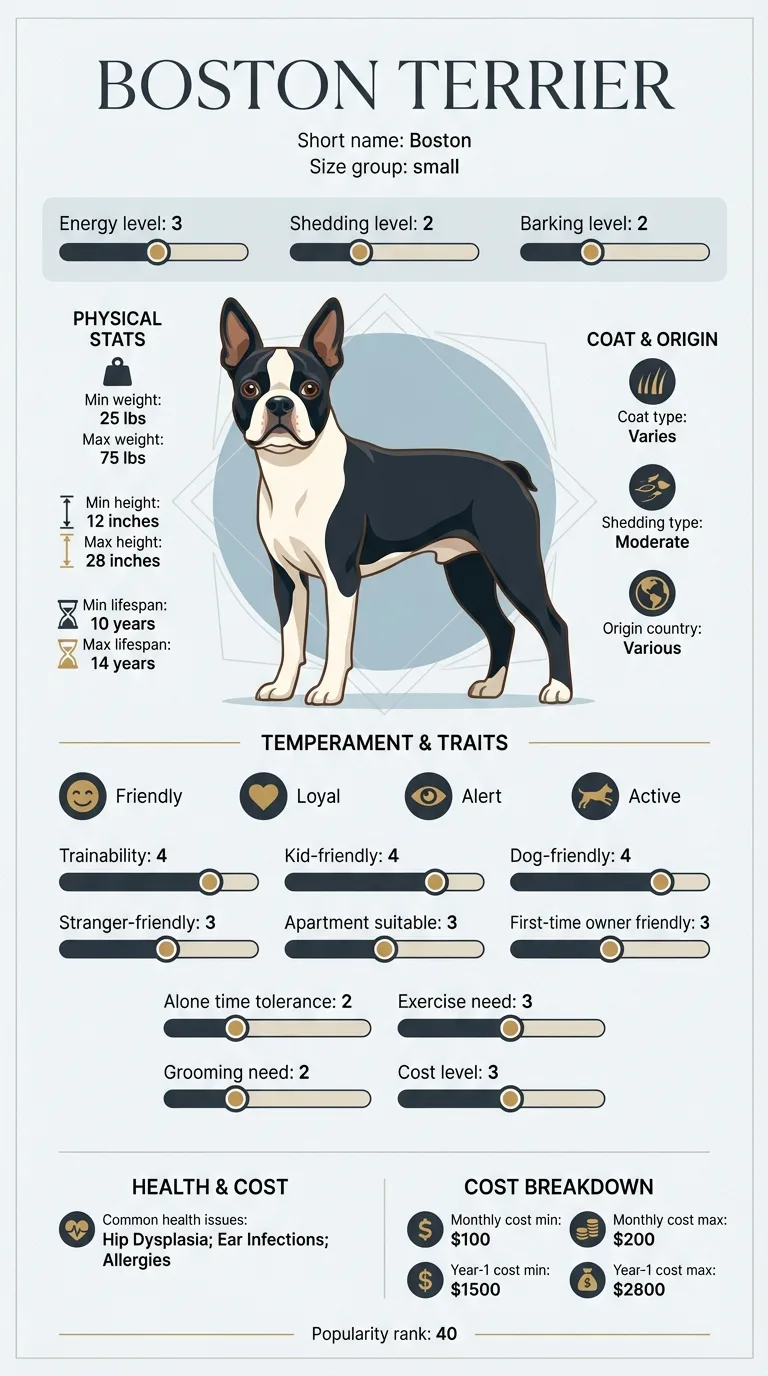
This is for someone already down to Bichon Frise and Boston Terrier and deciding between them. For this pair the decision usually turns on grooming need, so those are covered first and in most detail. Both rate 5/5 for flats, so housing does not settle this one. The focus throughout is on daily consequences rather than breed background.
Between Bichon Frise and Boston Terrier, grooming need is what separates them, and Boston Terrier is the lower-effort dog of the two to keep.
Choose Bichon Frise if shedding is a problem in your house and a smaller dog suits your car, your home or your back.
Choose Boston Terrier if this is your first dog, you do not want a standing grooming appointment and the dog will be alone during the working day.
| Feature | bichon frise | boston terrier | Winner |
|---|---|---|---|
| Size class | small | small | Equal |
| Weight | 12–18 lbs | 12–25 lbs | Equal |
| Height | 9–12 in | 15–17 in | Equal |
| Lifespan | 14–15 years | 11–13 years | bichon frise |
| Exercise need | Low (2/5) | Low (2/5) | Equal |
| Grooming need | Very high (5/5) | Very low (1/5) | boston terrier |
| Shedding | Very low (1/5) | Low (2/5) | bichon frise |
| Energy level | Moderate (3/5) | Moderate (3/5) | Equal |
| Barking | Moderate (3/5) | Low (2/5) | boston terrier |
| Apartment suitability | Very high (5/5) | Very high (5/5) | Equal |
| Good for first-time owners | High (4/5) | Very high (5/5) | boston terrier |
| Tolerates being alone | Low (2/5) | Moderate (3/5) | boston terrier |
| Trainability | Moderate (3/5) | High (4/5) | boston terrier |
| Good with kids | High (4/5) | Very high (5/5) | boston terrier |
| Good with other dogs | High (4/5) | High (4/5) | Equal |
| Friendly to strangers | High (4/5) | High (4/5) | Equal |
| Cost level | Moderate (3/5) | Moderate (3/5) | Equal |
| Coat | Curly, dense double coat | Short and smooth | Equal |
| Origin | Various | Various | Equal |
| Typical monthly cost | $80–$150 | $80–$150 | Equal |
| Typical first-year cost | $1,100–$2,300 | $1,100–$2,300 | Equal |
Size class ties at 'small' for both breeds, but the numbers show real variation: the Bichon Frise runs 12-18 lbs and 9-12 inches while the Boston Terrier spans a wider 12-25 lbs and stands taller at 15-17 inches. That wider weight range in the Boston reflects more individual variation within the breed than the tightly consistent Bichon. Neither breed will overwhelm a small living space, and the height difference of a few inches at the shoulder is unlikely to matter much day to day, both are comfortably lap-sized companions built for indoor life rather than field work.
Exercise need and energy level are both tied at Low (2/5) and Moderate (3/5) respectively, making this one of the closer matchups in the comparison. Neither the Playful, Curious Bichon nor the Friendly, Lively Boston Terrier demands a runner's commitment, a couple of short walks plus some indoor play satisfies both. The Boston Terrier's flat face does mean exercise should stay light in heat regardless of its energy score, since brachycephalic breeds overheat faster than their stamina alone suggests. For owners who want a companion rather than a training partner, either breed works.
This is one of the largest gaps in the whole comparison: the Bichon Frise's curly, dense double coat rates Very high (5/5) for grooming, requiring regular trims and near-daily brushing to prevent matting, while the Boston Terrier's short, smooth coat rates Very low (1/5), wipe-down maintenance at most. Shedding is closer but still favors the Boston, Low (2/5) versus the Bichon's Very low (1/5). For an owner who wants a wash-and-go dog with no salon budget, the Boston Terrier is the far simpler choice; for one drawn to the Bichon's fluffy look, the grooming commitment is the tradeoff.
Both breeds tie at Very high (5/5) for apartment suitability, and both are genuinely well-suited to compact living. Barking favors the Boston Terrier, Low (2/5) against the Bichon's Moderate (3/5), which matters for shared walls. Where they diverge is solitude: the Boston Terrier tolerates being alone at Moderate (3/5) while the Bichon sits at Low (2/5), meaning the Adaptable Boston copes noticeably better with an empty apartment during a workday than the more attention-dependent Bichon does.
The Boston Terrier edges ahead on both first-time-owner suitability (Very high 5/5 vs. High 4/5) and trainability (High 4/5 vs. Moderate 3/5), making it the marginally easier dog to raise from scratch. Neither breed is difficult by any stretch, both are companion breeds bred for cooperation rather than independence, but the Boston's Comical, Adaptable nature tends to respond quickly to positive reinforcement, while the Bichon's Cheerful, Affectionate personality sometimes prioritizes attention-seeking over obedience drills. A first-time owner choosing between them is choosing between two forgiving options, with a slight edge to the Boston.
The Boston Terrier rates Very high (5/5) with kids against the Bichon's already-strong High (4/5), and both tie at High (4/5) for getting along with other dogs and High (4/5) for friendliness to strangers. In practice, families with young, boisterous children may find the sturdier, more robust Boston Terrier better suited to rough play, while the Bichon's smaller 12-18 lb frame can be more easily injured by an enthusiastic toddler. Both breeds' outgoing temperaments, Playful and Cheerful for the Bichon, Friendly and Lively for the Boston, make either a sociable pick for a busy household.
The Bichon Frise's 14-15 year lifespan is notably longer than the Boston Terrier's 11-13 years, and the health lists reflect different risk profiles. The Bichon faces Skin Allergies, Patellar Luxation, Bladder Stones, Cataracts, and Dental Disease, while the Boston Terrier's flat face brings Brachycephalic Airway Syndrome (BOAS) and Corneal Ulcers into the picture alongside shared risks like Patellar Luxation and Cataracts. That BOAS entry is worth taking seriously, brachycephalic breeds like the Boston can struggle with breathing and heat regulation in ways the Bichon simply does not face.
Monthly and first-year costs are identical on paper, $80-150 monthly and $1,100-2,300 in year one for both breeds, with both rated Moderate (3/5) overall. The composition of that spending differs, though: the Bichon's budget leans toward recurring grooming appointments given its Very high (5/5) grooming need, while the Boston Terrier's Very low (1/5) grooming need frees up that money but may need to go toward monitoring brachycephalic health issues like BOAS as the dog ages, since flat-faced breeds often need more vigilant vet attention.
Bichon Frise weighs 12–18 lbs and lives 14–15 years; Boston Terrier weighs 12–25 lbs and lives 11–13 years. The two diverge most on grooming need. They are level on apartment suitability, cost level and good with other dogs, so those cannot decide it. The table below marks a winner only where one breed is genuinely easier for a typical owner; size and origin are facts rather than merits and stay level. Ratings come from one source applied to both breeds, so they are meaningful against each other rather than as absolute scores.

The Boston Terrier by far, its short, smooth coat rates Very low (1/5) for grooming need, compared to the Bichon Frise's Very high (5/5), which requires regular professional trims to prevent matting.
Both are good with kids, but the Boston Terrier edges ahead at Very high (5/5) versus the Bichon's High (4/5), and its sturdier build tolerates rough play a bit better.
The Bichon Frise, at 14-15 years typical lifespan versus the Boston Terrier's 11-13 years.
Yes, Brachycephalic Airway Syndrome (BOAS) appears on the Boston Terrier's health list due to its flat face, a risk the Bichon Frise doesn't share.
The Boston Terrier, rated Low (2/5) for barking versus the Bichon's Moderate (3/5).
The Boston Terrier, rated Moderate (3/5) for tolerating being alone versus the Bichon Frise's Low (2/5).
Yes, both share identical typical monthly ($80-150) and first-year ($1,100-2,300) cost ranges in this comparison.
The Boston Terrier, rated Very high (5/5) versus the Bichon's High (4/5).
The Bichon Frise, at Very low (1/5) versus the Boston's Low (2/5).
The Boston Terrier, rated Low (2/5) for barking.
The Boston Terrier by a wide margin, Very low (1/5) versus Very high (5/5).
Secure checkout on Stripe. We never see your card.
7-day money-back guarantee. Instant access.
Health information here is general and is not veterinary advice. If your dog shows pain, sudden behaviour change, or worsening symptoms, consult a licensed veterinarian.
Some links on this site are affiliate links. We may earn a commission at no extra cost to you, and we only suggest products we believe are helpful for dog owners.
We research and check what we publish, but we do not warrant that any figure, date, price, or statement is accurate, complete, or current, and we accept no liability for any loss, cost, injury, or other harm arising from the use of this site. Use it as one reference among several. You remain responsible for your own decisions and for your dog's care - confirm anything that matters with a licensed veterinarian or another qualified professional before you act on it. Full disclaimer.
Match your lifestyle to the right dog.
Take quizNot sure which breed is right for you? Take our 2-minute quiz to find out.
Take the quiz