Behavior
Which needs more exercise?
The French Spaniel, rated Very high (5/5) versus the Bichon's Low (2/5).

Quick answer
Which needs more exercise?
The French Spaniel, rated Very high (5/5) versus the Bichon's Low (2/5).
Bichon Frise or French Spaniel? On paper they differ most on exercise need, and on the scales French Spaniel is the heavier at 45–60 lbs. Here is how the two compare on everything that shapes an ordinary week.
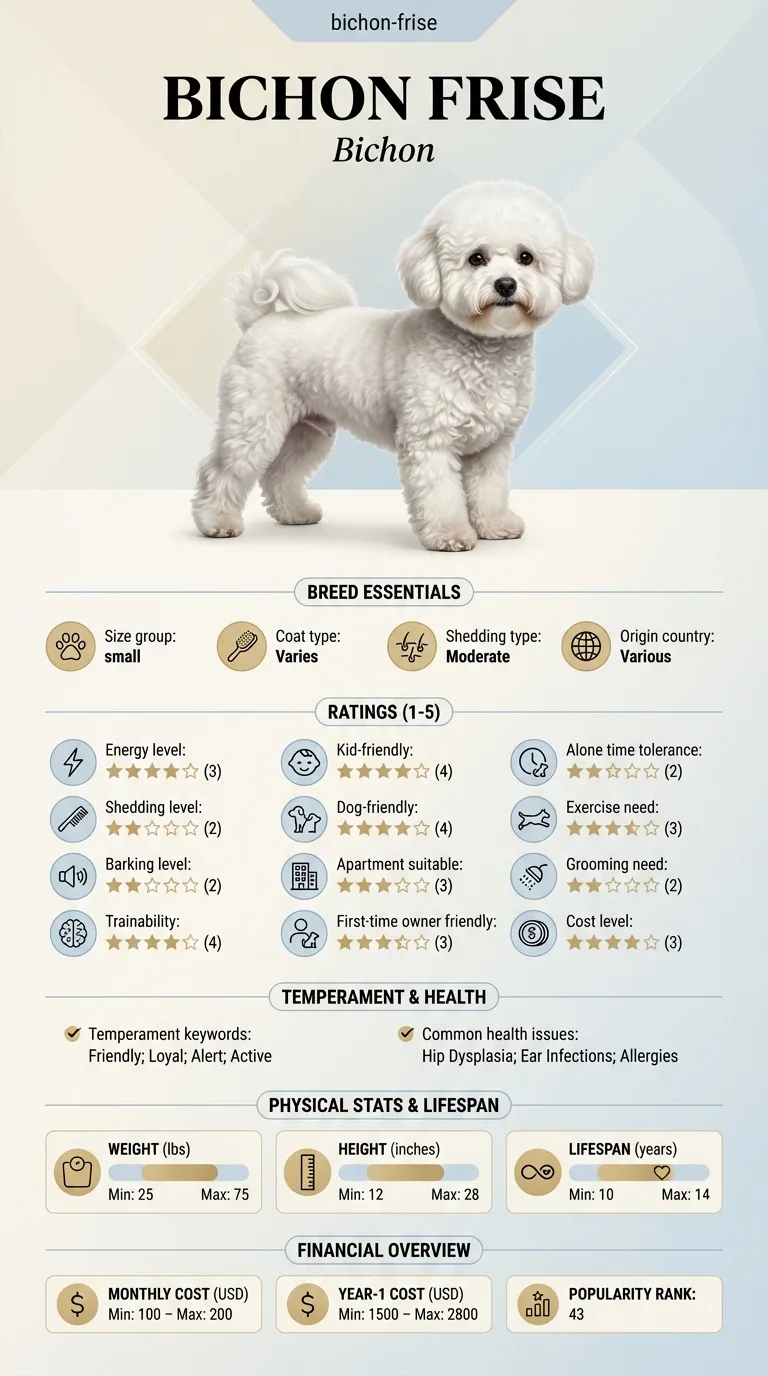
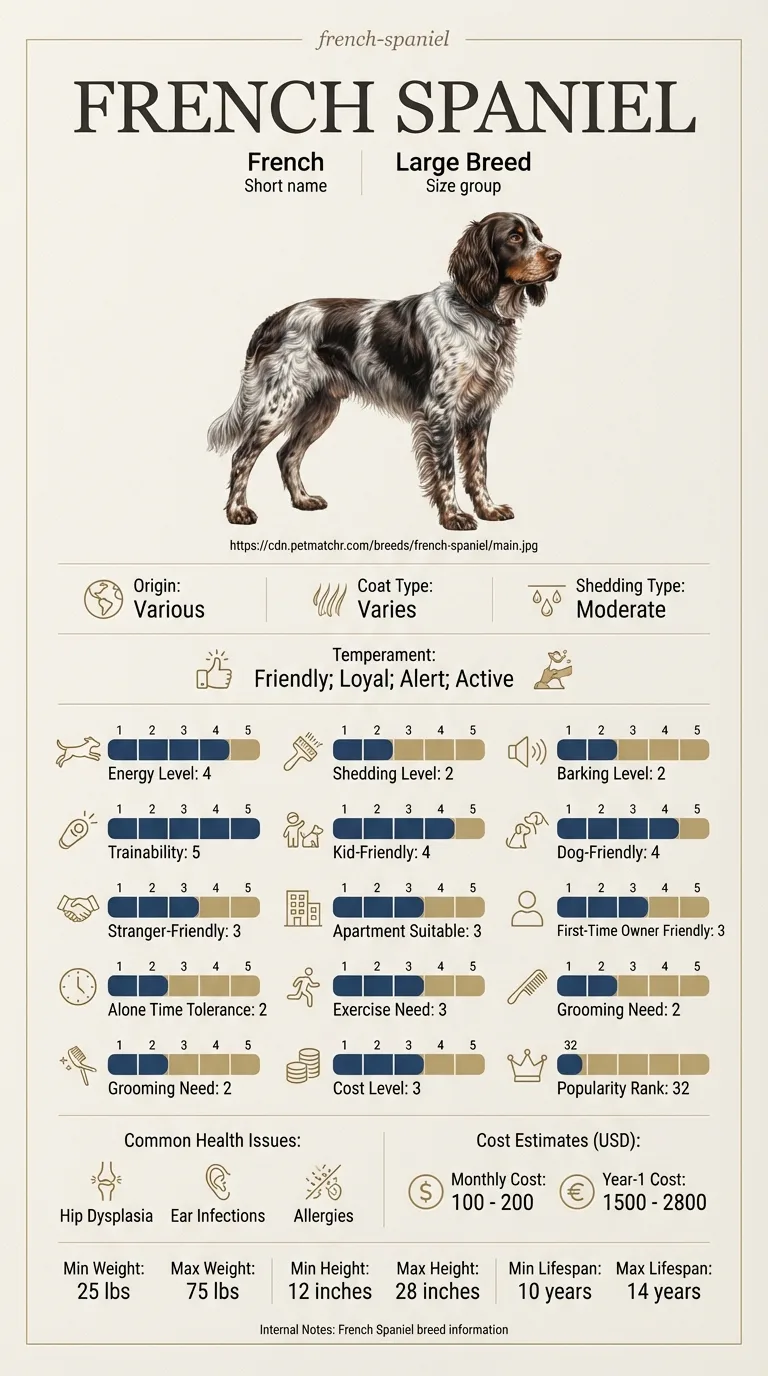
This is for someone already down to Bichon Frise and French Spaniel and deciding between them. For this pair the decision usually turns on exercise need and apartment suitability, so those are covered first and in most detail. Anyone choosing from a flat has a clear answer here: Bichon Frise rates 5/5 against 2/5. There is no origin story here — only what changes about your week.
Between Bichon Frise and French Spaniel, exercise need is what separates them, and Bichon Frise is the lower-effort dog of the two to keep.
Choose Bichon Frise if you are in a flat or a smaller home, this is your first dog and shedding is a problem in your house.
Choose French Spaniel if you do not want a standing grooming appointment, you want a dog that picks up training quickly and you want a dog that can keep up with an active routine.
| Feature | bichon frise | french spaniel | Winner |
|---|---|---|---|
| Size class | small | medium | Equal |
| Weight | 12–18 lbs | 45–60 lbs | Equal |
| Height | 9–12 in | 21–24 in | Equal |
| Lifespan | 14–15 years | 10–12 years | bichon frise |
| Exercise need | Low (2/5) | Very high (5/5) | bichon frise |
| Grooming need | Very high (5/5) | Moderate (3/5) | french spaniel |
| Shedding | Very low (1/5) | Moderate (3/5) | bichon frise |
| Energy level | Moderate (3/5) | High (4/5) | Equal |
| Barking | Moderate (3/5) | Low (2/5) | french spaniel |
| Apartment suitability | Very high (5/5) | Low (2/5) | bichon frise |
| Good for first-time owners | High (4/5) | Moderate (3/5) | bichon frise |
| Tolerates being alone | Low (2/5) | Low (2/5) | Equal |
| Trainability | Moderate (3/5) | High (4/5) | french spaniel |
| Good with kids | High (4/5) | High (4/5) | Equal |
| Good with other dogs | High (4/5) | High (4/5) | Equal |
| Friendly to strangers | High (4/5) | High (4/5) | Equal |
| Cost level | Moderate (3/5) | Moderate (3/5) | Equal |
| Coat | Curly, dense double coat | Medium, flat and feathered | Equal |
| Origin | Various | Various | Equal |
| Typical monthly cost | $80–$150 | $100–$200 | Equal |
| Typical first-year cost | $1,100–$2,300 | $1,400–$2,900 | Equal |
The French Spaniel is a medium breed at 45–60 lbs and 21–24 inches, dwarfing the Bichon Frise's small-class 12–18 lbs and 9–12 inches by a factor of roughly three to five times the weight. This lesser-known French gundog breed was developed for pointing and retrieving over varied terrain, and its rangy, athletic frame reflects that working purpose directly. The Bichon's compact, cushiony build couldn't be more different — bred purely for companionship rather than field stamina, it simply doesn't carry the muscle mass or leg length a hunting dog like the French Spaniel needs to cover ground all day.
The exercise gap here is substantial: Very high (5/5) for the French Spaniel against Low (2/5) for the Bichon Frise, with energy level following at High (4/5) versus Moderate (3/5). As a gundog bred to hunt alongside hunters for hours, the French Spaniel needs serious daily output — this isn't a breed that thrives on a short neighborhood walk. Its temperament keyword list actually includes "calm indoors," which is a useful nuance: once its exercise needs are genuinely met, this breed settles well at home, a pattern quite different from breeds that stay wound up regardless of how much they've run.
Grooming favors the French Spaniel here, rated Moderate (3/5) against the Bichon Frise's Very high (5/5), since its medium, flat, feathered coat needs regular but not constant brushing compared to the Bichon's demanding curly coat and professional-trim schedule. Shedding still tips toward the Bichon, though, Very low (1/5) versus the French Spaniel's Moderate (3/5) — even a lower-grooming-need coat like the Spaniel's still releases more hair around the house than the Bichon's near-zero baseline. For owners weighing total coat-care time rather than just shedding, the French Spaniel is meaningfully less demanding overall.
Apartment suitability splits sharply: Very high (5/5) for the Bichon Frise against Low (2/5) for the French Spaniel, driven almost entirely by the Spaniel's Very high exercise needs outstripping what small-space living can typically provide. Barking actually favors the French Spaniel, Low (2/5) against the Bichon's Moderate (3/5), making it the quieter breed on paper despite being the poorer apartment fit overall. Alone-time tolerance ties at Low (2/5) for both, so neither breed is well suited to long unsupervised stretches, regardless of how much space is available.
The French Spaniel rates High (4/5) on trainability, ahead of the Bichon Frise's Moderate (3/5), and its temperament — gentle, sociable, energetic, calm indoors — describes a dog that's genuinely cooperative once engaged properly. First-time-owner suitability favors the Bichon slightly, High (4/5) versus the French Spaniel's Moderate (3/5), largely because the Spaniel's substantial exercise and training needs require more upfront commitment than a novice owner might expect walking in. This is a capable, biddable working breed, but one that rewards experience with structured training routines rather than casual ownership.
Kids, other dogs, and strangers all tie at High (4/5) for both breeds — a genuinely even matchup in the social categories, unusual for a comparison this size-mismatched. The French Spaniel's gentle, sociable temperament makes it a warm family companion once its exercise needs are met, and its calm-indoors trait means it doesn't bring frantic energy into everyday family life the way some high-drive gundogs do. Families deciding between these two on social compatibility alone will find little separating them; the decision realistically comes down to size, exercise capacity, and living space rather than temperament.
The Bichon Frise's 14–15 year lifespan clearly outpaces the French Spaniel's 10–12 years, and the health lists show different areas of concern. Bichon issues are skin allergies, patellar luxation, bladder stones, cataracts, and dental disease. French Spaniel issues include hip dysplasia, ear infections, epilepsy, acral mutilation syndrome (a rare inherited nerve disorder affecting sensation in the paws), and general eye conditions. Acral mutilation syndrome is specific enough to a handful of spaniel breeds that it's worth discussing directly with a breeder, since it's not a widely known condition among general dog owners weighing this breed for the first time.
Cost level ties at Moderate (3/5), though the ranges tilt higher for the French Spaniel at $100–$200 monthly and $1,400–$2,900 first-year, versus the Bichon Frise's $80–$150 and $1,100–$2,300. The size difference drives most of that gap through food and medication dosing, while an owner without an existing active lifestyle may also need to budget for dog-walking help or off-leash exercise access to meet the Spaniel's Very high exercise needs. The Bichon's costs concentrate almost entirely in grooming rather than activity-related services.
Bichon Frise weighs 12–18 lbs and lives 14–15 years; French Spaniel weighs 45–60 lbs and lives 10–12 years. The two diverge most on exercise need, apartment suitability and grooming need and 1 other rated axes. They are level on tolerates being alone, cost level and good with other dogs, so those cannot decide it. Where the table declares a winner it means less work for the owner, nothing more; descriptive rows are left as ties on purpose. The value here is in the differences between the two columns; treat any single score as approximate.

It's a French gundog developed for pointing and retrieving, which explains its Very high (5/5) exercise need — far above the Bichon Frise's Low (2/5).
No — it rates Low (2/5) for apartment suitability due to its high exercise demands, compared with the Bichon Frise's Very high (5/5).
A rare inherited nerve disorder affecting sensation in the paws, seen in the French Spaniel and a few related breeds — worth asking a breeder about directly.
The Bichon Frise, rated Very low (1/5), versus the French Spaniel's Moderate (3/5).
Yes — they tie the Bichon Frise at High (4/5) with kids, and their gentle, sociable temperament suits family life well once exercised.
The French Spaniel, rated Low (2/5) on barking versus the Bichon Frise's Moderate (3/5).
The Bichon Frise, at 14–15 years, versus the French Spaniel's 10–12 years.
The French Spaniel, rated Very high (5/5) versus the Bichon's Low (2/5).
The French Spaniel, rated Low (2/5) versus the Bichon's Moderate (3/5).
The Bichon Frise, rated Very high (5/5) versus the French Spaniel's Low (2/5).
The French Spaniel, rated High (4/5) versus the Bichon's Moderate (3/5).
Secure checkout on Stripe. We never see your card.
7-day money-back guarantee. Instant access.
Health information here is general and is not veterinary advice. If your dog shows pain, sudden behaviour change, or worsening symptoms, consult a licensed veterinarian.
Some links on this site are affiliate links. We may earn a commission at no extra cost to you, and we only suggest products we believe are helpful for dog owners.
We research and check what we publish, but we do not warrant that any figure, date, price, or statement is accurate, complete, or current, and we accept no liability for any loss, cost, injury, or other harm arising from the use of this site. Use it as one reference among several. You remain responsible for your own decisions and for your dog's care - confirm anything that matters with a licensed veterinarian or another qualified professional before you act on it. Full disclaimer.
Match your lifestyle to the right dog.
Take quizNot sure which breed is right for you? Take our 2-minute quiz to find out.
Take the quiz