Behavior
Which needs more exercise?
The Doberman Pinscher, rated Very high (5/5) versus the Bichon's Low (2/5).

Quick answer
Which needs more exercise?
The Doberman Pinscher, rated Very high (5/5) versus the Bichon's Low (2/5).
Bichon Frise or Doberman Pinscher? On paper they differ most on grooming need, and on the scales Doberman Pinscher is the heavier at 60–100 lbs. Here is how the two compare on everything that shapes an ordinary week.
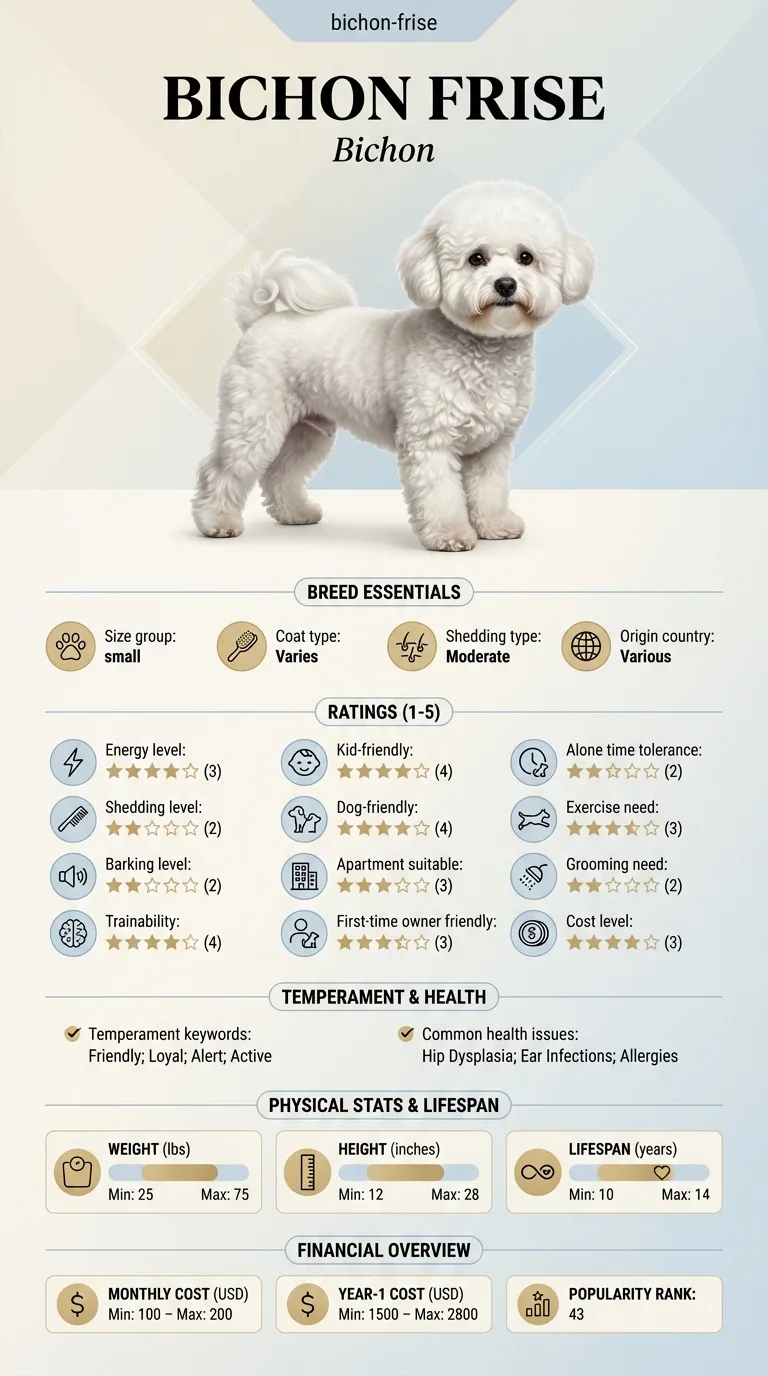
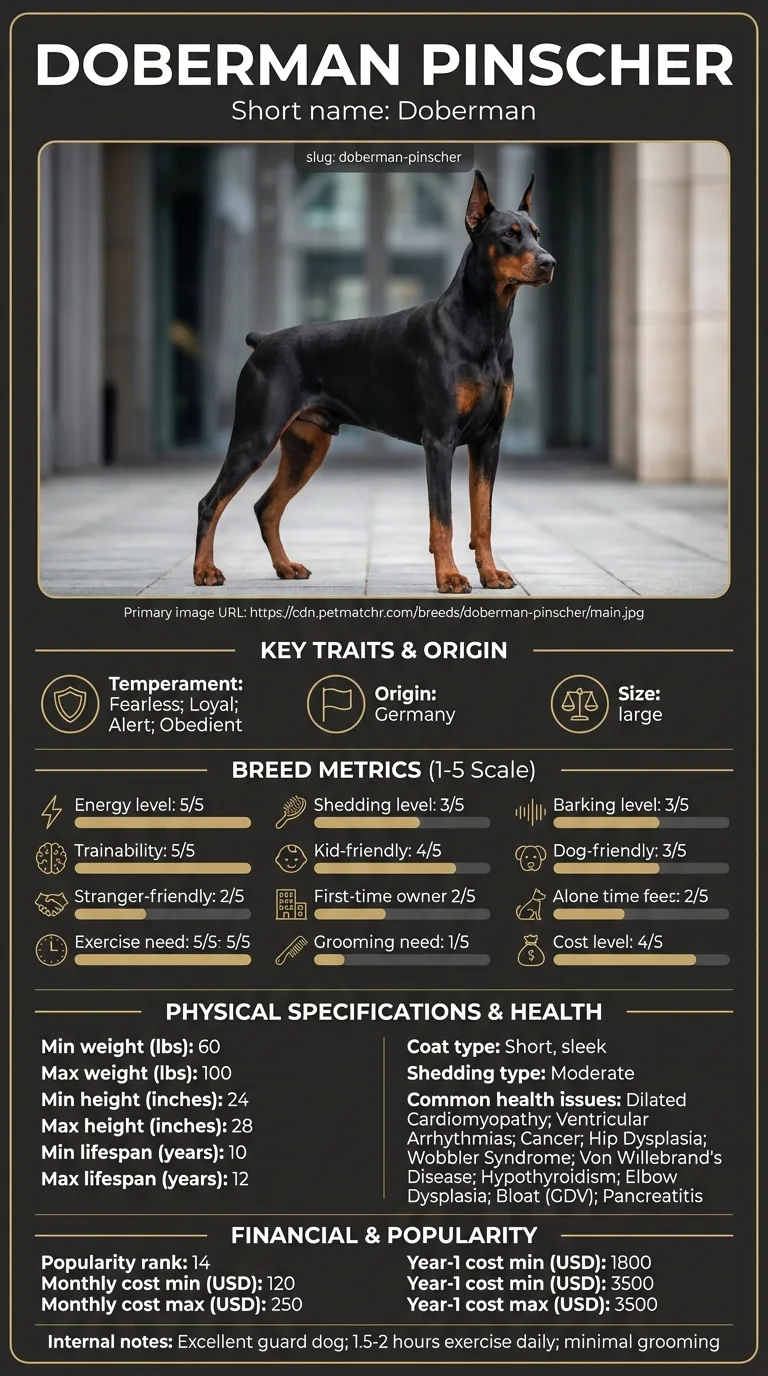
This is for someone already down to Bichon Frise and Doberman Pinscher and deciding between them. For this pair the decision usually turns on grooming need and exercise need, so those are covered first and in most detail. Anyone choosing from a flat has a clear answer here: Bichon Frise rates 5/5 against 2/5. There is no origin story here — only what changes about your week.
Between Bichon Frise and Doberman Pinscher, grooming need is what separates them, and Bichon Frise is the lower-effort dog of the two to keep.
Choose Bichon Frise if you are in a flat or a smaller home, this is your first dog and shedding is a problem in your house.
Choose Doberman Pinscher if you do not want a standing grooming appointment, you want a dog that picks up training quickly and you want a dog that can keep up with an active routine.
| Feature | bichon frise | doberman pinscher | Winner |
|---|---|---|---|
| Size class | small | large | Equal |
| Weight | 12–18 lbs | 60–100 lbs | Equal |
| Height | 9–12 in | 24–28 in | Equal |
| Lifespan | 14–15 years | 10–12 years | bichon frise |
| Exercise need | Low (2/5) | Very high (5/5) | bichon frise |
| Grooming need | Very high (5/5) | Very low (1/5) | doberman pinscher |
| Shedding | Very low (1/5) | Moderate (3/5) | bichon frise |
| Energy level | Moderate (3/5) | Very high (5/5) | Equal |
| Barking | Moderate (3/5) | Moderate (3/5) | Equal |
| Apartment suitability | Very high (5/5) | Low (2/5) | bichon frise |
| Good for first-time owners | High (4/5) | Low (2/5) | bichon frise |
| Tolerates being alone | Low (2/5) | Low (2/5) | Equal |
| Trainability | Moderate (3/5) | Very high (5/5) | doberman pinscher |
| Good with kids | High (4/5) | High (4/5) | Equal |
| Good with other dogs | High (4/5) | Moderate (3/5) | bichon frise |
| Friendly to strangers | High (4/5) | Low (2/5) | bichon frise |
| Cost level | Moderate (3/5) | High (4/5) | bichon frise |
| Coat | Curly, dense double coat | Short, sleek | Equal |
| Origin | Various | Germany | Equal |
| Typical monthly cost | $80–$150 | $120–$250 | Equal |
| Typical first-year cost | $1,100–$2,300 | $1,800–$3,500 | Equal |
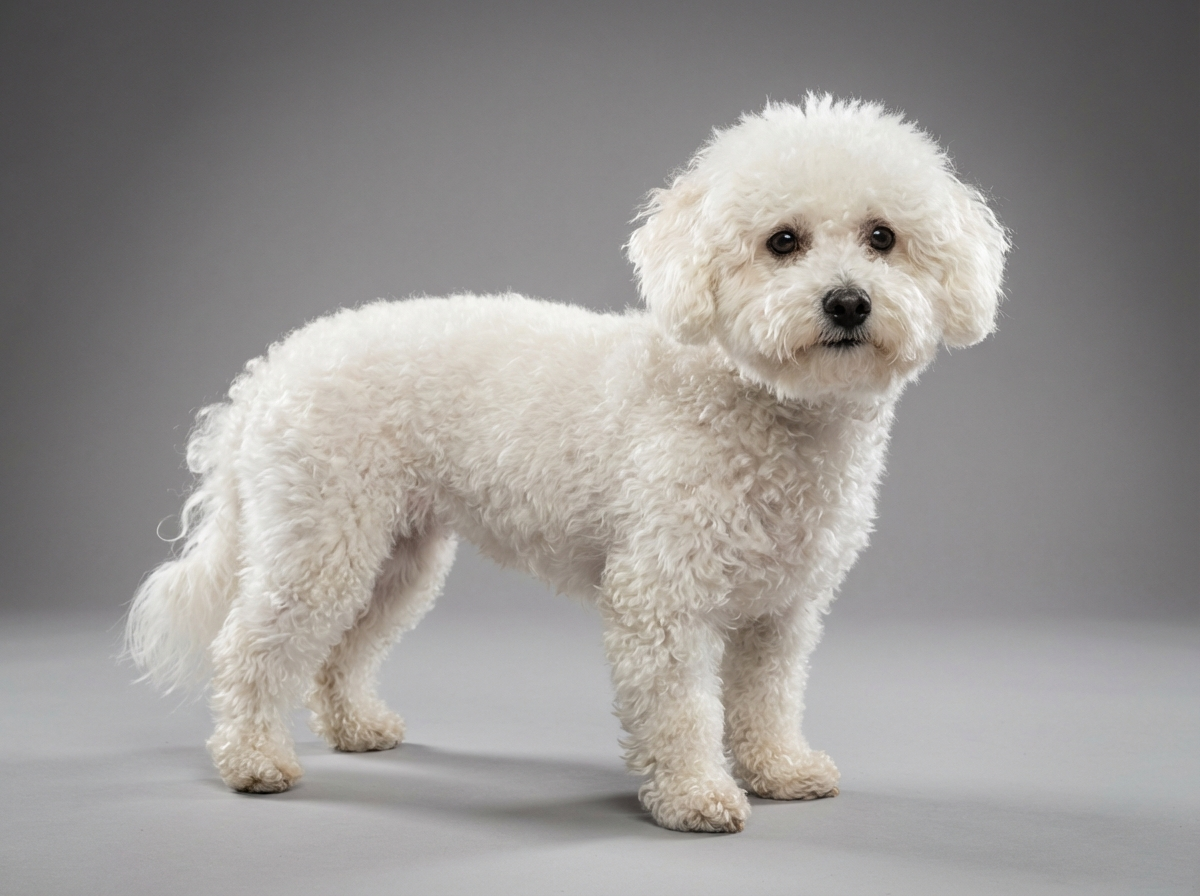
Few comparisons on this site span a wider gulf than this one: the Bichon Frise at 12–18 lbs and 9–12 inches against the Doberman Pinscher at a commanding 60–100 lbs and 24–28 inches. A large Doberman can outweigh a Bichon by more than five times over, and that scale difference isn't cosmetic — it changes the strength needed to handle the dog on leash, the size of crate and car space required, and even the physical risk calculus around small children or elderly family members. The Bichon's toy-sized frame and the Doberman's athletic, muscular build represent close to opposite ends of the size spectrum this site covers.
The gap in exercise need is stark: Very high (5/5) for the Doberman Pinscher against Low (2/5) for the Bichon Frise, and energy level follows the same pattern at Very high (5/5) versus Moderate (3/5). Dobermans were bred as working and guard dogs, and that heritage demands real daily output — long runs, structured training sessions, or working-style tasks, not just a stroll around the block. A Bichon's modest exercise needs are almost the polar opposite of what a Doberman requires to stay balanced and avoid destructive or anxious behavior. Anyone without the time or space for serious daily exercise should think hard before choosing the Doberman side of this comparison.
Coat care runs in the opposite direction from exercise here: the Doberman Pinscher needs just Very low (1/5) grooming thanks to its short, sleek coat, while the Bichon Frise needs Very high (5/5) for its curly double coat and regular trims. Shedding still favors the Bichon, though, at Very low (1/5) against the Doberman's Moderate (3/5) — short coats still shed, just in fine, easy-to-vacuum layers rather than clumps. In practical terms, Doberman owners spend little time at the groomer but deal with a steady trickle of short hairs on furniture, while Bichon owners spend real money and time on grooming appointments but keep a nearly hair-free home in between.
Apartment suitability heavily favors the Bichon Frise, Very high (5/5) against the Doberman Pinscher's Low (2/5) — a direct consequence of the Doberman's size and very high exercise requirement, which small living spaces struggle to satisfy. Barking ties at Moderate (3/5) for both, so neither is unusually quiet, but tolerance for being alone also ties, both at Low (2/5), meaning both breeds can develop anxiety-driven behaviors if left solo too long. A Doberman confined to an apartment without enough outdoor exercise is more likely to channel that pent-up drive into destructive behavior than a Bichon in the same undersized situation, given how much physical output the breed is bred to need.
The Doberman Pinscher rates Very high (5/5) on trainability, well above the Bichon Frise's Moderate (3/5), and its temperament words — fearless, loyal, alert, obedient — explain why the breed excels in police, military, and protection work. But first-time-owner suitability flips the picture: Low (2/5) for the Doberman versus High (4/5) for the Bichon. High trainability doesn't mean low effort; a Doberman needs an owner who can channel its intelligence and drive with consistent structure from puppyhood, or that same trainability can express itself in unwanted ways. The Bichon is simply the easier, lower-stakes learning curve for someone new to dog ownership.
Both breeds tie at High (4/5) with kids, which surprises people who picture the Doberman as purely a guard dog — properly socialized Dobermans are frequently loyal, gentle family companions. But the Bichon Frise pulls ahead with other dogs, High (4/5) versus the Doberman's Moderate (3/5), and with strangers, High (4/5) versus the Doberman's Low (2/5), reflecting the Doberman's naturally alert, protective instincts around unfamiliar people. Households that entertain often or live somewhere with frequent foot traffic — delivery drivers, neighbors dropping by — should factor in the extra socialization work a Doberman needs to stay comfortable around strangers rather than wary of them.
Lifespan tilts clearly toward the Bichon Frise at 14–15 years against the Doberman Pinscher's 10–12 years, and the Doberman's health list explains a meaningful chunk of that gap. Dilated cardiomyopathy and ventricular arrhythmias are serious heart conditions common enough in the breed that many Doberman owners schedule regular cardiac screening, alongside cancer, hip dysplasia, Wobbler syndrome, Von Willebrand's disease, hypothyroidism, elbow dysplasia, bloat (GDV), and pancreatitis. The Bichon's list — skin allergies, patellar luxation, bladder stones, cataracts, dental disease — is shorter and generally less life-threatening. Prospective Doberman owners should budget for cardiac diagnostics as a routine, not exceptional, part of ownership.
Cost level rates High (4/5) for the Doberman Pinscher against Moderate (3/5) for the Bichon Frise, with monthly ranges of $120–$250 versus $80–$150 and first-year costs of $1,800–$3,500 versus $1,100–$2,300. Larger food portions account for some of that gap, but the Doberman's serious cardiac and orthopedic risk list is the bigger long-term factor — cardiac screening, hip X-rays, and potential treatment for conditions like dilated cardiomyopathy add real expense over a dog's lifetime. The Bichon's costs concentrate almost entirely in grooming rather than medical care, which for many owners is the more predictable of the two budget profiles.
Bichon Frise weighs 12–18 lbs and lives 14–15 years; Doberman Pinscher weighs 60–100 lbs and lives 10–12 years. The two diverge most on grooming need, exercise need and apartment suitability and 5 other rated axes. They are level on tolerates being alone, barking and good with kids, so those cannot decide it. Where the table declares a winner it means less work for the owner, nothing more; descriptive rows are left as ties on purpose. The value here is in the differences between the two columns; treat any single score as approximate.

Not ideally — it rates Low (2/5) for first-time owners despite its Very high (5/5) trainability, because that intelligence needs consistent, experienced handling to channel well. The Bichon Frise, at High (4/5), is the easier starting point.
A lot more — Very high (5/5) versus the Bichon Frise's Low (2/5). Dobermans need substantial daily activity, not just short walks.
Yes, when socialized — they tie the Bichon Frise at High (4/5) with kids, contrary to their guard-dog reputation.
Cardiac disease — dilated cardiomyopathy and ventricular arrhythmias are common enough that regular cardiac screening is recommended, alongside cancer, hip dysplasia, and Wobbler syndrome.
The Bichon Frise, at Very low (1/5), versus the Doberman's Moderate (3/5), though the Doberman needs far less grooming overall at Very low (1/5) versus the Bichon's Very high (5/5).
The Bichon Frise, rated High (4/5), versus the Doberman Pinscher's Low (2/5) — the Doberman's alert, protective instincts make it naturally more reserved with unfamiliar people.
The Doberman Pinscher, rated High (4/5) on cost versus the Bichon Frise's Moderate (3/5), driven by larger food needs and a more serious health list.
The Doberman Pinscher, rated Very high (5/5) versus the Bichon's Low (2/5).
The Doberman Pinscher, rated Very low (1/5) versus the Bichon's Very high (5/5).
The Doberman Pinscher, rated Very high (5/5) versus the Bichon's Moderate (3/5).
The Bichon Frise, rated Very high (5/5) versus the Doberman's Low (2/5).
Secure checkout on Stripe. We never see your card.
7-day money-back guarantee. Instant access.
Health information here is general and is not veterinary advice. If your dog shows pain, sudden behaviour change, or worsening symptoms, consult a licensed veterinarian.
Some links on this site are affiliate links. We may earn a commission at no extra cost to you, and we only suggest products we believe are helpful for dog owners.
We research and check what we publish, but we do not warrant that any figure, date, price, or statement is accurate, complete, or current, and we accept no liability for any loss, cost, injury, or other harm arising from the use of this site. Use it as one reference among several. You remain responsible for your own decisions and for your dog's care - confirm anything that matters with a licensed veterinarian or another qualified professional before you act on it. Full disclaimer.
Match your lifestyle to the right dog.
Take quizNot sure which breed is right for you? Take our 2-minute quiz to find out.
Take the quiz