Behavior
Which needs less grooming?
The Papillon, Low (2/5) versus the Bichon Frise's Very High (5/5).

Quick answer
Which needs less grooming?
The Papillon, Low (2/5) versus the Bichon Frise's Very High (5/5).
Bichon Frise or Papillon? On paper they differ most on grooming need, and on the scales Bichon Frise is the heavier at 12–18 lbs. Here is how the two compare on everything that shapes an ordinary week.
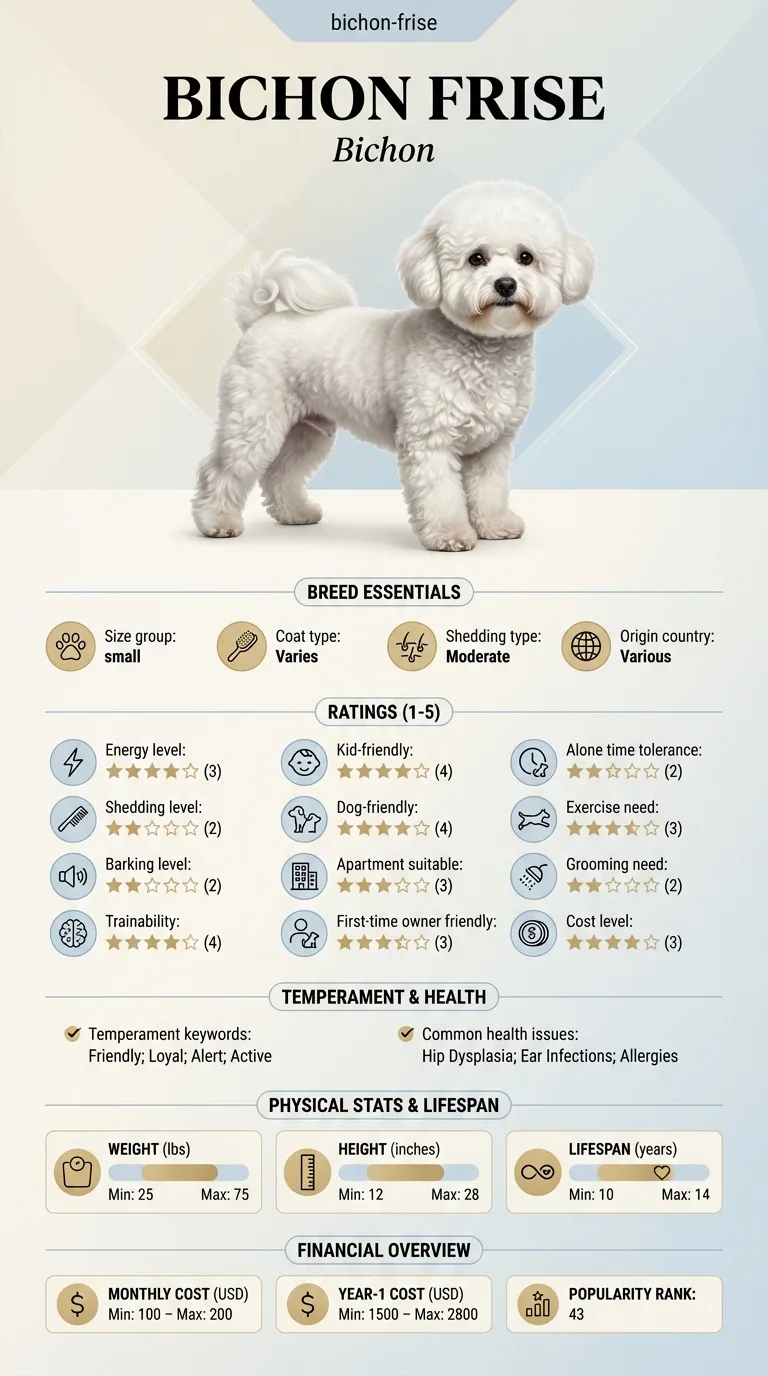
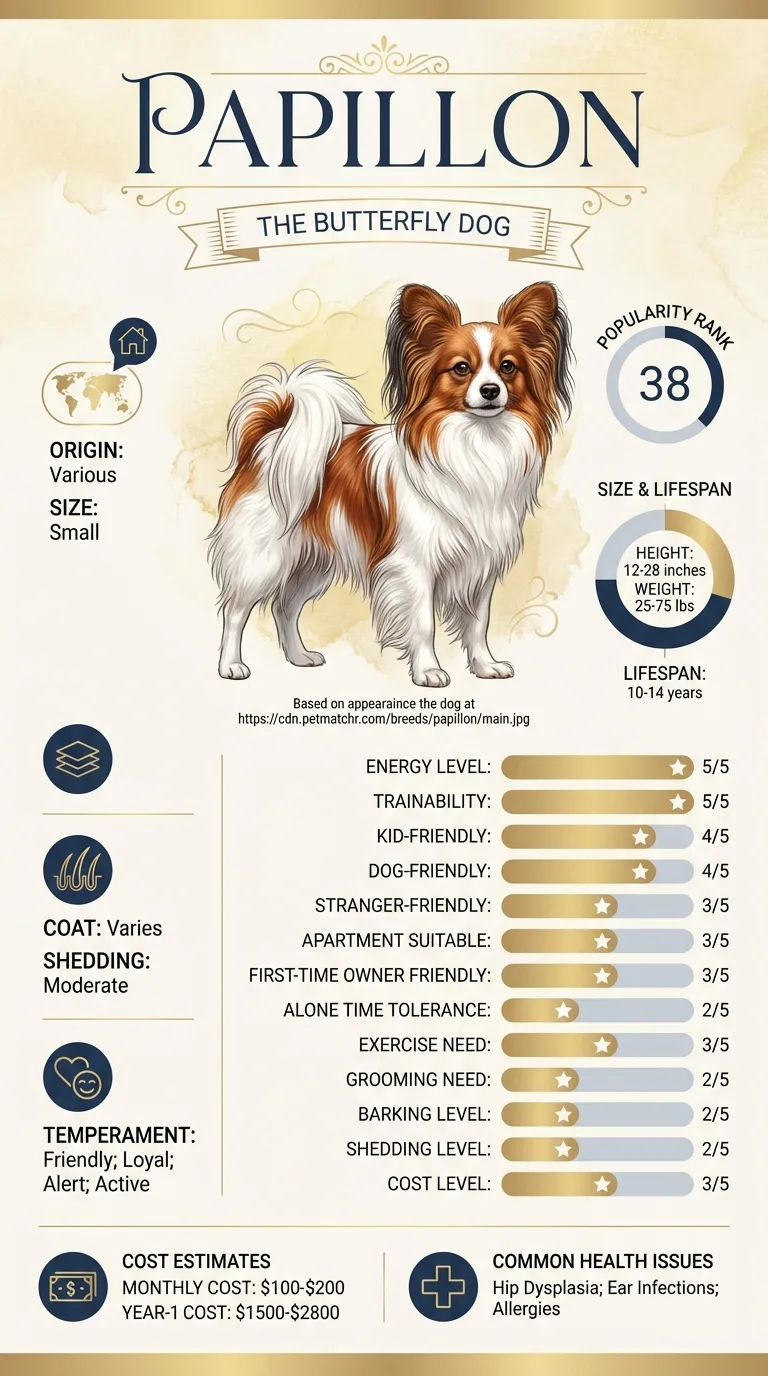
This is for someone already down to Bichon Frise and Papillon and deciding between them. For this pair the decision usually turns on grooming need and trainability, so those are covered first and in most detail. Both rate 5/5 for flats, so housing does not settle this one. The focus throughout is on daily consequences rather than breed background.
Between Bichon Frise and Papillon, grooming need is what separates them, and Papillon is the lower-effort dog of the two to keep.
Choose Bichon Frise if shedding is a problem in your house, your walking routine is modest and there are young children at home.
Choose Papillon if you do not want a standing grooming appointment, you want a dog that picks up training quickly and a smaller dog suits your car, your home or your back.
| Feature | bichon frise | papillon | Winner |
|---|---|---|---|
| Size class | small | small | Equal |
| Weight | 12–18 lbs | 5–10 lbs | Equal |
| Height | 9–12 in | 8–11 in | Equal |
| Lifespan | 14–15 years | 14–16 years | papillon |
| Exercise need | Low (2/5) | Moderate (3/5) | bichon frise |
| Grooming need | Very high (5/5) | Low (2/5) | papillon |
| Shedding | Very low (1/5) | Low (2/5) | bichon frise |
| Energy level | Moderate (3/5) | High (4/5) | Equal |
| Barking | Moderate (3/5) | High (4/5) | bichon frise |
| Apartment suitability | Very high (5/5) | Very high (5/5) | Equal |
| Good for first-time owners | High (4/5) | High (4/5) | Equal |
| Tolerates being alone | Low (2/5) | Low (2/5) | Equal |
| Trainability | Moderate (3/5) | Very high (5/5) | papillon |
| Good with kids | High (4/5) | Moderate (3/5) | bichon frise |
| Good with other dogs | High (4/5) | High (4/5) | Equal |
| Friendly to strangers | High (4/5) | High (4/5) | Equal |
| Cost level | Moderate (3/5) | Low (2/5) | papillon |
| Coat | Curly, dense double coat | Long, silky single coat | Equal |
| Origin | Various | Various | Equal |
| Typical monthly cost | $80–$150 | $80–$150 | Equal |
| Typical first-year cost | $1,100–$2,300 | $1,100–$2,300 | Equal |
Both breeds sit in the small category, but the Papillon is meaningfully lighter — 5–10 lbs against the Bichon Frise's 12–18 lbs — even though their heights are close, 8–11 inches versus 9–12. That weight gap is enough that a full-grown Papillon can weigh less than half a full-grown Bichon, which shows up in everyday handling: a Papillon is easier to carry one-armed, fits into a smaller carrier, and needs a lighter-weight harness. Visually the two couldn't be more different despite the similar footprint — the Bichon's round, powder-puff coat against the Papillon's fine, silky coat and signature butterfly-shaped ears.
The Papillon outranks the Bichon Frise on both exercise need (Moderate 3/5 vs Low 2/5) and energy level (High 4/5 vs Moderate 3/5), which tends to surprise people expecting the smaller of the two dogs to be the calmer one. In practice this means a Papillon is often the busier presence in the room — quick, alert, and ready to play at a moment's notice — while the Bichon's energy, though still Moderate, tends toward cuddly and playful rather than driven. Owners who want a small dog that will happily settle for a shorter walk should lean Bichon; those who want a small dog that acts like it doesn't know it's small should lean Papillon.
This is one of the sharpest grooming contrasts in the entire small-breed category: the Bichon Frise rates Very High (5/5) on grooming need, while the Papillon rates just Low (2/5) — a three-point gap despite both being compact, silky-coated dogs. The Papillon's single coat sheds Low (2/5) and needs only occasional brushing to prevent tangles around the ears, while the Bichon's dense curly double coat sheds Very Low (1/5) but demands frequent brushing and regular professional trims to avoid matting entirely. An owner drawn to a Bichon for its low shedding should budget real time and money for its coat upkeep; a Papillon owner gets easier maintenance with only slightly more loose hair.
Both breeds tie at Very High (5/5) for apartment suitability, so space isn't the deciding factor here. Noise is where they split: the Papillon rates High (4/5) on barking, a step above the Bichon Frise's Moderate (3/5), and its Alert, Quick-witted temperament means it tends to announce visitors, noises, and passersby more readily. Alone-time tolerance ties at Low (2/5) for both, so neither is a great fit for owners regularly gone ten-hour workdays without a plan for company or enrichment. A thin-walled apartment building leans the decision toward the quieter Bichon, while a detached house or tolerant neighbors make the Papillon's extra vocalness less of an issue.
The Papillon rates Very High (5/5) on trainability — among the top marks this site tracks for any small breed — against the Bichon Frise's Moderate (3/5), and it shows in the Papillon's Quick-witted, Confident temperament tags. Both breeds are still rated High (4/5) for first-time owners, so neither is off-limits for a newcomer, but a first-time owner who wants a dog that picks up tricks and obedience cues fast will likely be pleasantly surprised by the Papillon. Bichon owners, by contrast, should expect a bit more repetition and patience, particularly with recall, even though the breed remains entirely manageable for a beginner.
The Bichon Frise edges ahead with kids, High (4/5) against the Papillon's Moderate (3/5) — a reflection of the Papillon's smaller, more delicate frame, which makes it a better match for gentler, older children than for toddlers prone to rough handling. Other dogs and strangers both tie at High (4/5), so both breeds are equally sociable in mixed company. Households with young kids and a busy social calendar may lean Bichon for the kid-friendliness edge, while households without small children can lean into the Papillon's Alert, Friendly personality without that particular trade-off mattering much at all.
The Papillon actually edges out the Bichon Frise on lifespan, 14–16 years against 14–15 — both are long-lived small breeds, but the Papillon sits at the very top of that range. The two share patellar luxation as a tracked risk, unsurprising for small dogs with delicate joints, but otherwise diverge: the Papillon also carries progressive retinal atrophy, dental disease, open fontanel (an incompletely closed skull common in tiny-headed toy breeds), and collapsing trachea, while the Bichon's list includes skin allergies, bladder stones, and cataracts instead. The open fontanel risk in particular means Papillon puppies need extra head protection until that soft spot closes.
The dollar ranges are identical on paper — $80–$150 monthly and $1,100–$2,300 in the first year for both breeds — yet the Papillon rates Low (2/5) on overall cost level against the Bichon Frise's Moderate (3/5). That gap likely comes down to grooming: the Papillon's Low (2/5) grooming need means fewer professional appointments over a dog's lifetime compared to the Bichon's Very High (5/5) coat-maintenance demands, even when food and vet-visit costs land in the same ballpark. For a budget-conscious owner choosing between two similarly priced small breeds, the long-run difference in grooming bills is likely to be the deciding factor rather than anything in the base cost ranges themselves.
Bichon Frise weighs 12–18 lbs and lives 14–15 years; Papillon weighs 5–10 lbs and lives 14–16 years. The two diverge most on grooming need and trainability. They are level on tolerates being alone, apartment suitability and good with other dogs, so those cannot decide it. The table below marks a winner only where one breed is genuinely easier for a typical owner; size and origin are facts rather than merits and stay level. Ratings come from one source applied to both breeds, so they are meaningful against each other rather than as absolute scores.

The Papillon, rated Low (2/5) versus the Bichon Frise's Very High (5/5) grooming need.
Yes — High (4/5) energy versus Moderate (3/5), and Moderate (3/5) exercise need versus the Bichon's Low (2/5).
The Papillon, High (4/5) versus the Bichon Frise's Moderate (3/5).
The Papillon, rated Very High (5/5) trainability versus the Bichon's Moderate (3/5).
The Papillon, 14–16 years versus the Bichon Frise's 14–15.
It's rated Moderate (3/5), a step behind the Bichon's High (4/5), largely due to the Papillon's smaller, more delicate frame.
The Papillon rates Low (2/5) overall cost level versus the Bichon's Moderate (3/5), despite identical price ranges, mainly due to lower grooming needs.
The Papillon, Low (2/5) versus the Bichon Frise's Very High (5/5).
The Papillon, rated Very High (5/5).
The Bichon Frise, Moderate (3/5) versus the Papillon's High (4/5).
The Papillon, 14–16 years versus 14–15.
Secure checkout on Stripe. We never see your card.
7-day money-back guarantee. Instant access.
Health information here is general and is not veterinary advice. If your dog shows pain, sudden behaviour change, or worsening symptoms, consult a licensed veterinarian.
Some links on this site are affiliate links. We may earn a commission at no extra cost to you, and we only suggest products we believe are helpful for dog owners.
We research and check what we publish, but we do not warrant that any figure, date, price, or statement is accurate, complete, or current, and we accept no liability for any loss, cost, injury, or other harm arising from the use of this site. Use it as one reference among several. You remain responsible for your own decisions and for your dog's care - confirm anything that matters with a licensed veterinarian or another qualified professional before you act on it. Full disclaimer.
Match your lifestyle to the right dog.
Take quizNot sure which breed is right for you? Take our 2-minute quiz to find out.
Take the quiz