Living
What is the safest time to walk a Bernese in summer?
Early morning before the ground has taken on sun, and after dark once pavement has released its heat. Late afternoon is often the worst time despite feeling cooler in the air.

Quick answer
What is the safest time to walk a Bernese in summer?
Early morning before the ground has taken on sun, and after dark once pavement has released its heat. Late afternoon is often the worst time despite feeling cooler in the air.
Your Berner will keep walking on a hot day because he wants to be with you. That willingness is the danger, not the temperature.
Owners in warm or humid regions who want their dog to have a real outdoor life without risking him, and anyone who has just moved somewhere hotter with a Bernese who managed fine in a cooler climate.
This guide is not medical advice. If your dog shows pain, sudden behavior change, or worsening symptoms, consult a licensed veterinarian.
Some links may be affiliate links. We may earn a commission at no extra cost to you. We only suggest products we believe are helpful for dog owners.
We research and check what we publish, but we do not warrant that any figure, date, price, or statement is accurate, complete, or current, and we accept no liability for any loss, cost, injury, or other harm arising from the use of this site. Use it as one reference among several. You remain responsible for your own decisions and for your dog's care - confirm anything that matters with a licensed veterinarian or another qualified professional before you act on it. Full disclaimer.
Heat sensitivity in Bernese Mountain Dogs is a structural mismatch between a dog built for Alpine winters and the climate most of them now live in. A dense double coat, a large body with a poor surface-to-volume ratio, and a predominantly black coat colour all reduce the speed at which the dog can shed heat. The practical effect is a much narrower safe window for outdoor activity than other large breeds enjoy.
This affects essentially every Bernese Mountain Dog to some degree, which makes it unusual among the breed's health topics. Hip dysplasia, cancer and bloat strike a proportion of dogs. Heat intolerance is a property of the breed itself, so every owner in a warm region is managing it, whether or not they have ever had a scare.
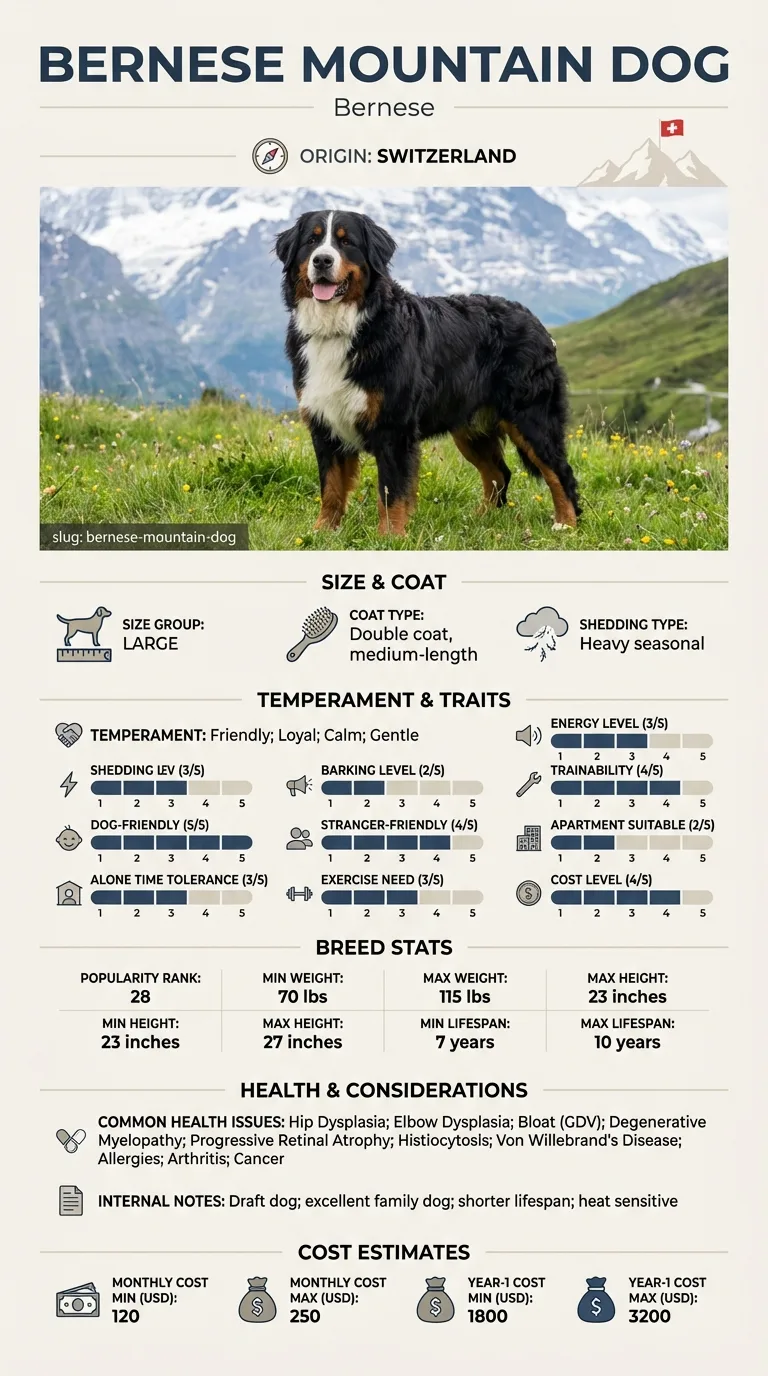
The coat is the primary driver: a medium-length double coat with a heavy seasonal shed cycle, designed to hold warmth against the skin in mountain conditions. Size is the second driver, since a dog of 70 to 115 pounds standing 23 to 27 inches tall produces internal heat in proportion to volume but sheds it through surface area. Coat colour is the third, with dark markings absorbing far more solar radiation than a pale coat. None of these is a fault to be corrected; they are the breed.
Humidity is the most underrated variable, because it removes the effectiveness of panting without changing the number on the thermometer. Surface temperature is the second: asphalt in the sun can sit thirty or forty degrees above air temperature and radiates directly into a dog's underside. Housing matters too, since a home without cooling gives the dog nowhere to recover overnight, and a dog who starts each day already heat-loaded has less margin than one who slept cool.
Heat trouble becomes an emergency quickly and does not wait for an appointment. Go immediately if your Bernese is panting frantically and cannot settle after ten minutes in shade, is drooling thick saliva, has brick-red or very pale gums, vomits, staggers, seems confused, or collapses. Start cooling him with tepid water on the way rather than waiting until you arrive. Book a non-urgent visit if your dog seems to tolerate heat far worse than he did last summer, since that change can signal an underlying cardiac, respiratory or thyroid problem rather than the weather.
Start here: Bernese Mountain Dog Most Common Genetic Disorders
See all Bernese Mountain DOG health problems, which breeds are prone to heat sensitivity, or the full Bernese Mountain DOG breed guide for temperament, exercise needs and ownership costs.
This is not a problem that resolves; it is a seasonal routine that gets easier to run. Most owners need one full summer to work out their local windows, surfaces and shaded routes, and by the second year the schedule runs on autopilot. Coat management shows results within two or three weeks of serious deshedding. What never changes is the underlying limit, so expect to be planning around it every year for the dog's life.
Success is an uneventful summer. Your dog gets outside every day, comes home settled rather than frantic, holds his weight through the season, and has never needed an emergency cooling. It is not a dog who learns to tolerate heat, because that does not happen. It is a household that has stopped asking him to.
Dogs shed heat mainly by panting, which evaporates water from the tongue and airway. That system has a fixed ceiling, and the Bernese hits it sooner than most breeds for three stacking reasons.
The first is insulation. A medium-length double coat with a dense undercoat is engineered to hold a layer of still, warm air against the skin. It does that in winter and it keeps doing it in August. The undercoat sheds heavily on a seasonal cycle, so a Berner carrying last winter's undercoat into June is working against himself.
The second is mass. Heat production scales roughly with body volume while heat loss scales with surface area, and a 70 to 115 pound dog has proportionally less surface for each unit of internal heat than a small dog does. Big dogs simply cool more slowly.
The third is colour. The classic tricolour is predominantly black across the back and sides, and dark coats absorb far more radiant heat in direct sun than light ones. On a pavement walk at midday, a Berner is being heated from above by the sun, from below by the ground, and from inside by his own muscles.
Humidity removes the last margin. Panting only works if the air can accept more water vapour. At high humidity the evaporation slows and the dog's primary cooling mechanism loses most of its effect regardless of what the thermometer says.
Managing heat in this breed is a scheduling problem more than an equipment problem. Almost everything that works is about when and where you walk, not what you buy.

If you think your Bernese has heat sensitivity, the plan is three steps: write down what you have seen and when it started, book a veterinary appointment rather than waiting for the next flare, and take video of the behaviour or symptom before you go — the thing you are worried about rarely happens in the consulting room. Screening in the parents covers hip dysplasia, elbow dysplasia, bloat (gdv).
What the vet visit should produce is a diagnosis and a written plan, not just reassurance: what is being ruled out, what the monitoring interval is, and which signs mean you come back sooner. Ask what the treatment costs across a year rather than per visit, because that is the number that decides whether you are managing this condition or reacting to it.
Between appointments, keep a short log — dates, what you saw, what changed. It is the single most useful thing an owner brings to a follow-up, and for heat sensitivity it is often what separates a clear pattern from a guess.
Bruno had spent five years in Vermont walking two hours a day year round. When his family relocated to Austin in April, they kept the same routine for three weeks and could not understand why he had become sluggish, reluctant at the door, and had gained weight despite the same amount of walking. Their new vet pointed out the obvious: he was not walking the same amount, because he was cutting the walks short himself, and the walks he did complete were leaving him heat-loaded for hours afterwards. The family rebuilt the day around a six in the morning walk and a nine at night walk, both on grass, and added indoor scent games at midday. They stripped his undercoat properly for the first time in his life. By July Bruno was active again, on a completely different schedule from the one he had had for five years.
Key takeaway: A Bernese who suddenly seems lazy after a move to a warmer place is usually not lazy and not ill. He is telling you the schedule no longer fits the climate, and the schedule is the thing that has to change.
No. The double coat insulates against heat as well as cold and it shields skin from direct sun. Shaving removes that protection, exposes pale skin to burning, and in many dogs the coat regrows unevenly. Thorough de-shedding of the dead undercoat achieves the airflow benefit that owners are actually after.
There is no single number, because humidity, sun and surface matter as much as air temperature. As a working rule, many owners of this breed treat the low seventies Fahrenheit in full sun as the point where walks get short and shaded, and stop midday walks entirely above the low eighties. Judge the pavement and the humidity, not just the forecast.
They help modestly and only when used correctly. An evaporative vest works by wetting and airflow, so it does little in high humidity or on a still day, and a vest laid over a dry dense coat can trap heat rather than release it. Wetting the coat down to the skin on the belly, groin and armpits is generally more effective.
Yes, but the household has to be built around it. That means reliable air conditioning, exercise confined to dawn and dusk for several months of the year, and acceptance that summer is a season of shorter, cooler, more frequent outings. Owners who cannot commit to that should think hard before choosing this breed in a hot region.
It compounds several. A dog with hip or elbow dysplasia already tires early, and heat shortens that further. Any cardiac limitation shows up in warm weather first. And because heat pushes owners to shorten walks all summer, weight tends to climb, which then worsens joint load for the rest of the year.
Panting is normal cooling and is not itself alarming. What matters is whether it settles. Panting that continues at full intensity after ten to fifteen minutes of rest in shade, panting with a wide flat tongue and drooling, or panting in a dog who has become unsteady, is a different situation and needs immediate cooling and veterinary attention.
Early morning before the ground has taken on sun, and after dark once pavement has released its heat. Late afternoon is often the worst time despite feeling cooler in the air.
Only combined with moisture. Air moving over a dry double coat does very little. Wet the belly and groin first, then use the fan, and the evaporation does real work.
Yes, meaningfully. This breed sheds heavily on a seasonal cycle, and clearing dead undercoat in spring restores airflow to the skin without damaging the protective outer coat.
Replace summer distance with mental work: scent games, food puzzles and short training sessions indoors. Then cut food slightly rather than assuming the exercise will return.
A one-page prep sheet for this condition: the signs, the questions to ask, what to get priced. Unlocks here.
You get: Vet visit prep sheet
No spam. One-click unsubscribe. See our privacy policy.
Preview page 1 before you decide.