Health
What does a heart disease cough sound like in a Berner?
Softer and wetter than a kennel cough hack, and it shows up at night or within minutes of the dog lying down rather than during excitement.

Quick answer
What does a heart disease cough sound like in a Berner?
Softer and wetter than a kennel cough hack, and it shows up at night or within minutes of the dog lying down rather than during excitement.
Nobody notices a heart losing ten percent of its output. They notice that the dog now waits at the bottom of the driveway.
Owners of middle-aged and senior Bernese Mountain Dogs who are trying to work out where normal aging stops and disease begins, and owners who have just been told their dog has an enlarged heart and want to know what the next few years look like.
This guide is not medical advice. If your dog shows pain, sudden behavior change, or worsening symptoms, consult a licensed veterinarian.
Some links may be affiliate links. We may earn a commission at no extra cost to you. We only suggest products we believe are helpful for dog owners.
We research and check what we publish, but we do not warrant that any figure, date, price, or statement is accurate, complete, or current, and we accept no liability for any loss, cost, injury, or other harm arising from the use of this site. Use it as one reference among several. You remain responsible for your own decisions and for your dog's care - confirm anything that matters with a licensed veterinarian or another qualified professional before you act on it. Full disclaimer.
Heart disease in a Bernese Mountain Dog usually means the heart muscle has stretched and weakened, or a valve has begun to leak, so that output no longer keeps up with what a very large body demands. The functional consequence is loss of exercise reserve, and later, fluid backing up into the lungs or abdomen. Most of the disease happens before any owner sees a symptom.
Heart disease is not the top killer in this breed, but it appears often enough in large deep-chested dogs to be worth watching from middle age. Bernese Mountain Dogs are more likely to face cancer, hip and elbow dysplasia, bloat or degenerative myelopathy. Where cardiac disease does occur, it tends to be adult-onset and progressive rather than sudden.
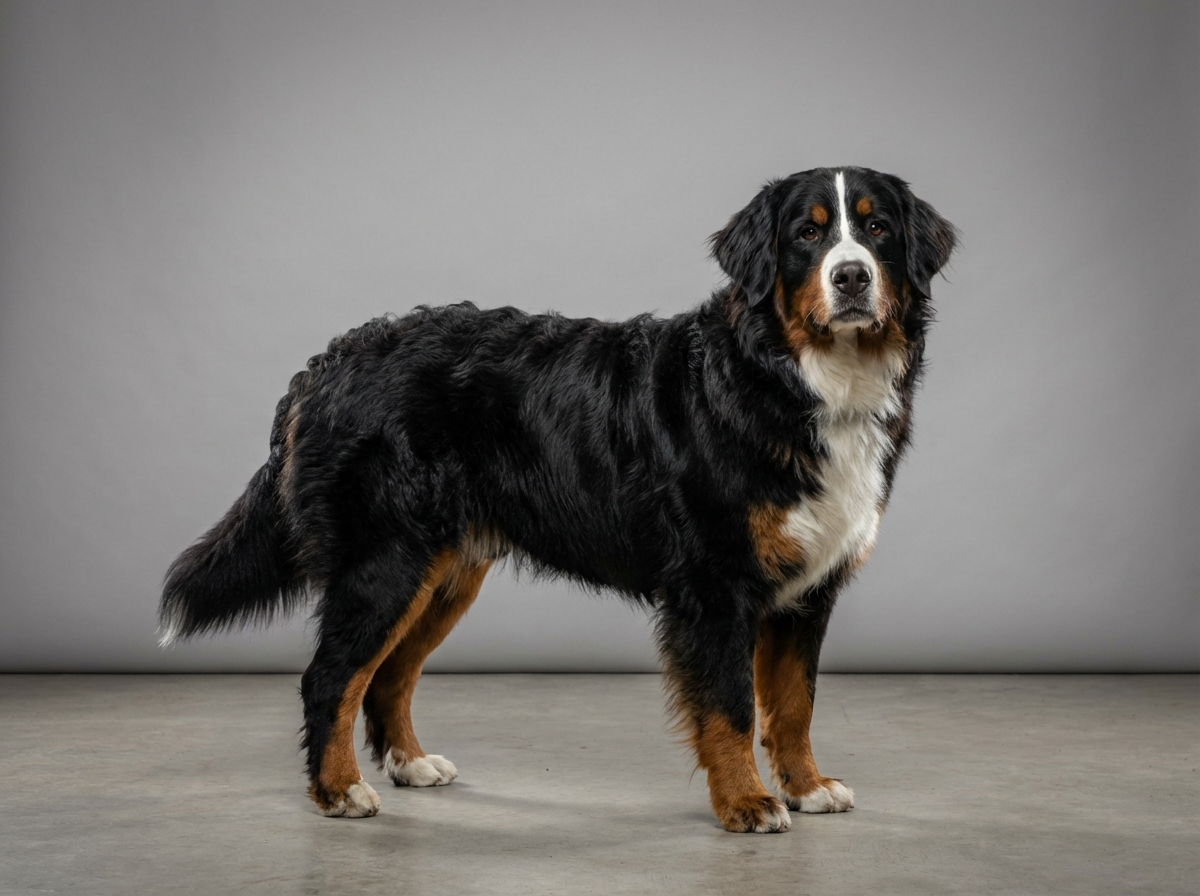
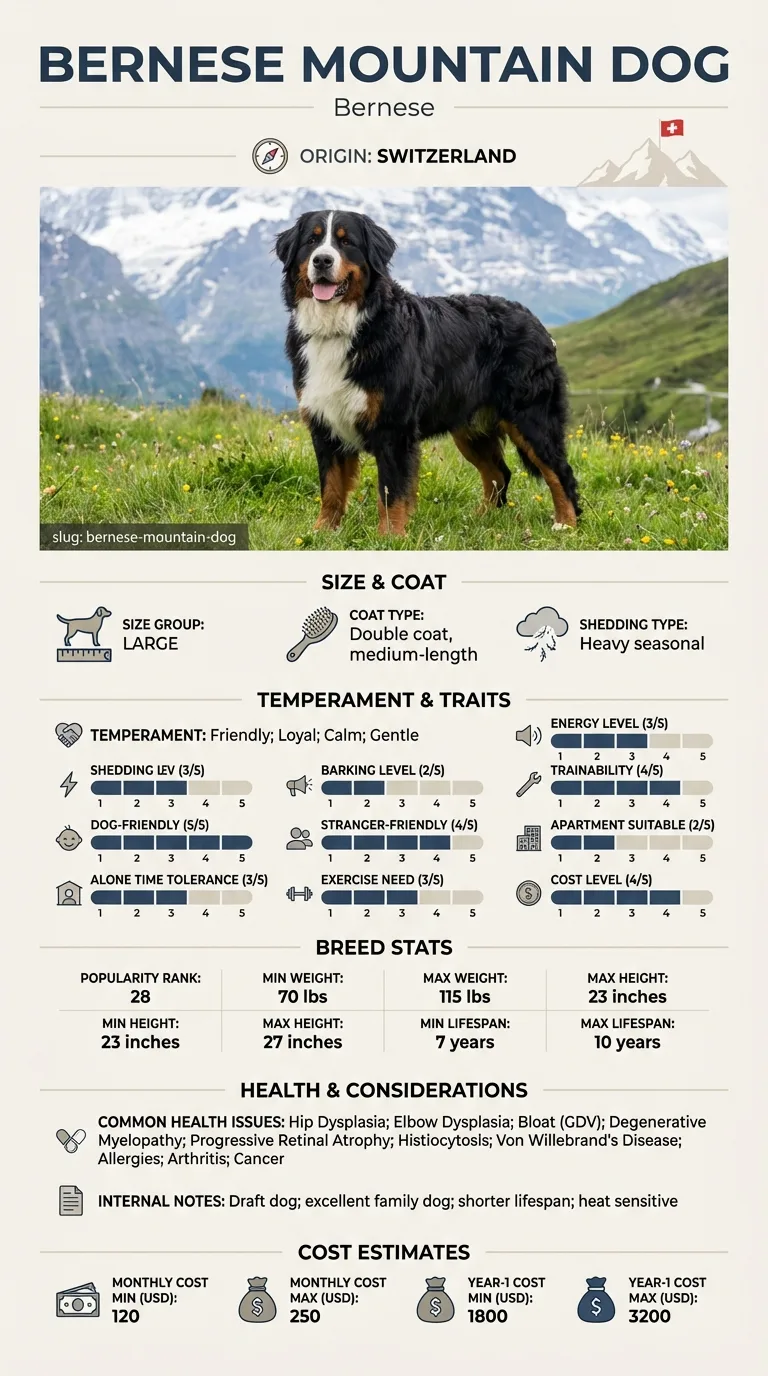
This is a body-size problem before it is a genetic one. Big hearts in big dogs are structurally more vulnerable to chamber dilation, and the Bernese is a genuinely large breed at 23 to 27 inches tall. The breed's calm, gentle temperament works against early detection, because a dog whose personality is already unhurried can lose a great deal of exercise capacity before anyone reads it as abnormal. A moderate energy rating means there is less daily activity in which a deficit would show.
The double coat is the central environmental complication. Berners are heat sensitive, and a warm day already pushes circulation hard before any disease exists, so cardiac limitation surfaces first as a summer problem and gets misread as heat intolerance. Households that exercise their dog in one long daily outing rather than several short ones also mask the change, because a dog who quits at minute forty of a sixty minute walk looks like a dog who simply had enough.
Treat fast, shallow, effortful breathing at rest as an emergency and go immediately, especially with pale, grey or bluish gums, or if your dog will not lie down and instead sits with the head extended. A first-time collapse also warrants an emergency visit rather than a morning appointment. Schedule a prompt but non-emergency visit for a new nighttime cough, a resting breath rate that has climbed over two weeks, a swollen abdomen, or a dog who has quietly stopped using the stairs.
Start here: Bernese Mountain Dog Most Common Genetic Disorders
See all Bernese Mountain DOG health problems, which breeds are prone to heart disease, or the full Bernese Mountain DOG breed guide for temperament, exercise needs and ownership costs.
Expect the first two weeks after diagnosis to be about dose adjustment and getting resting breath counts to settle. From there, most owners describe a plateau lasting months to years, punctuated by recheck imaging. Progression is usually stepwise rather than smooth, with long stable stretches and then a noticeable drop. Planning in six month blocks is more realistic than trying to predict the whole course.
A successful year looks boring. Your dog keeps his appetite, holds his weight, sleeps with a steady breath count, and still enjoys short daily walks. Success is not a dog who returns to hiking; it is a dog who never has an emergency breathing crisis and whose decline, when it comes, is slow enough that you can see it approaching.
Heart disease in dogs runs through a long silent phase, a phase of quiet compensation, and finally congestive failure. Most of a Berner's disease is spent in the first two, which is why diagnosis so often feels sudden even though the process was not.
In the silent phase, the chamber has begun to change shape but the body has room to spare. Nothing is visible. A murmur may or may not be audible. This phase can last a year or more, and it is the phase in which imaging is the only thing that finds anything.
In the compensating phase, the body borrows. Heart rate rises slightly, fluid is retained, and the dog quietly trades away his reserve. Owners describe this as their dog becoming lazy, mellow, or middle-aged. In a breed whose energy level is naturally moderate and whose temperament is calm by design, that description is very easy to believe.
Congestive failure is when the borrowing stops working and fluid backs up into the lungs or the abdomen. That is the phase with the cough, the fast shallow breathing, the distended belly, and the emergency visit. Treatment is far more effective when it starts in the second phase than the third, and the only reliable way to be in the second phase is to notice the mellowing and question it.
Owners often want a supplement to fix this. The honest answer is that weight, diet consistency and medication adherence do far more than anything you can buy off a shelf.

If you think your Bernese has heart disease, the plan is three steps: write down what you have seen and when it started, book a veterinary appointment rather than waiting for the next flare, and take video of the behaviour or symptom before you go — the thing you are worried about rarely happens in the consulting room. Screening in the parents covers hip dysplasia, elbow dysplasia, bloat (gdv).
What the vet visit should produce is a diagnosis and a written plan, not just reassurance: what is being ruled out, what the monitoring interval is, and which signs mean you come back sooner. Ask what the treatment costs across a year rather than per visit, because that is the number that decides whether you are managing this condition or reacting to it.
Between appointments, keep a short log — dates, what you saw, what changed. It is the single most useful thing an owner brings to a follow-up, and for heart disease it is often what separates a clear pattern from a guess.
Otto was eight, and for six years he had walked to the corner every afternoon to meet the school bus. In October his family noticed he was waiting halfway down the block instead, then at the gate, then on the porch. Otto seemed cheerful, ate normally, and had no cough. Because nothing was obviously wrong, they nearly did not mention it. At his annual exam his veterinarian found a resting breath rate in the high thirties and a heart that looked large on a chest radiograph. Imaging confirmed dilation with early fluid changes. He was started on cardiac medication that week. Otto is nine and a half now. He does not walk to the corner, but he does three loops of the back garden a day, and his family logs his sleeping breaths every Sunday night.
Key takeaway: A shrinking route is a measurement. When a dog's habitual distance quietly shortens over weeks, write it down and bring the dates to your veterinarian rather than waiting for a symptom you recognize.
Aging is gradual and even across the day. Cardiac limitation is exertional: the dog starts a walk happily and runs out partway through, and it looks worse in warm weather or after excitement. If a seven year old Berner still greets you at the door with energy but cannot finish his usual loop, that pattern leans cardiac.
No. Coughs come from airway irritation, kennel cough, and in a large breed sometimes from tracheal or chest wall problems. The cardiac pattern is specific: soft, moist, worse at night or shortly after lying down, and paired with faster resting breathing. That combination deserves an appointment.
Structural heart disease is managed, not cured. Medication reduces the workload on the heart and delays congestive failure, sometimes for years, but it does not reverse a stretched chamber or a leaking valve. Treat the goal as a longer, comfortable life rather than a return to a normal heart.
It varies enormously with the type and the stage. Some dogs diagnosed before symptoms live years on medication with little visible change. Dogs first diagnosed during congestive failure generally have a shorter runway. Since this breed averages seven to ten years anyway, a diagnosis at eight is often not the thing that determines the outcome.
Veterinary cardiologists have investigated an association between some non-traditional diets and heart muscle disease, and the picture is still not fully settled. It is not a proven cause in every case. What is reasonable is to review your dog's food with your veterinarian, especially if there is any cardiac finding, rather than switching diets on internet advice.
Almost never entirely. Complete rest costs a large breed its muscle tone and its weight control, both of which matter for the heart. What changes is intensity and duration: several short flat walks in cool air, no bicycle work, no long hikes, and no summer midday outings.
Softer and wetter than a kennel cough hack, and it shows up at night or within minutes of the dog lying down rather than during excitement.
Most healthy dogs sit under about thirty breaths a minute in deep sleep. What matters more than the exact number is your own dog's baseline and whether it is climbing.
Not by itself. This breed is naturally calm with a moderate energy level. The concern is a change in calmness, especially one that arrives over weeks rather than years.
Daily cardiac drugs plus twice-yearly rechecks typically push a Berner's monthly care well above the usual 120 to 250 dollar range. Budget for it as an ongoing line item, not a one-off.
A one-page prep sheet for this condition: the signs, the questions to ask, what to get priced. Unlocks here.
You get: Vet visit prep sheet
No spam. One-click unsubscribe. See our privacy policy.
Preview page 1 before you decide.