Health
When does straining become an emergency?
Thirty minutes of strong straining without producing a puppy, or two hours of weak straining, means calling the vet rather than waiting.

Quick answer
When does straining become an emergency?
Thirty minutes of strong straining without producing a puppy, or two hours of weak straining, means calling the vet rather than waiting.
Most Bernese whelpings go well. The ones that do not go wrong slowly, and the difference is usually whether someone was watching the clock.
Breeders preparing for a first Bernese litter who need to know what normal looks like, and owners of an unexpectedly pregnant bitch who need a plan quickly.
This guide is not medical advice. If your dog shows pain, sudden behavior change, or worsening symptoms, consult a licensed veterinarian.
Some links may be affiliate links. We may earn a commission at no extra cost to you. We only suggest products we believe are helpful for dog owners.
We research and check what we publish, but we do not warrant that any figure, date, price, or statement is accurate, complete, or current, and we accept no liability for any loss, cost, injury, or other harm arising from the use of this site. Use it as one reference among several. You remain responsible for your own decisions and for your dog's care - confirm anything that matters with a licensed veterinarian or another qualified professional before you act on it. Full disclaimer.
Pregnancy and whelping complications in a Bernese Mountain Dog range from a labour that stalls, through malpositioned or oversized puppies requiring caesarean delivery, to post-whelping problems including retained placentas, uterine infection and dangerously low blood calcium during nursing. The breed's structure is reasonably favourable for natural birth; the risks come mainly from large litters, long labours and an inherited clotting disorder documented in the breed.
Most Bernese whelpings proceed without surgical intervention, and this breed is not among those in which caesarean delivery is routine. Serious complications are the exception rather than the rule. What makes preparation worthwhile is that the complications which do occur move fast, and that the breed's documented von Willebrand's disease means bleeding risk cannot be assumed to be normal without testing.
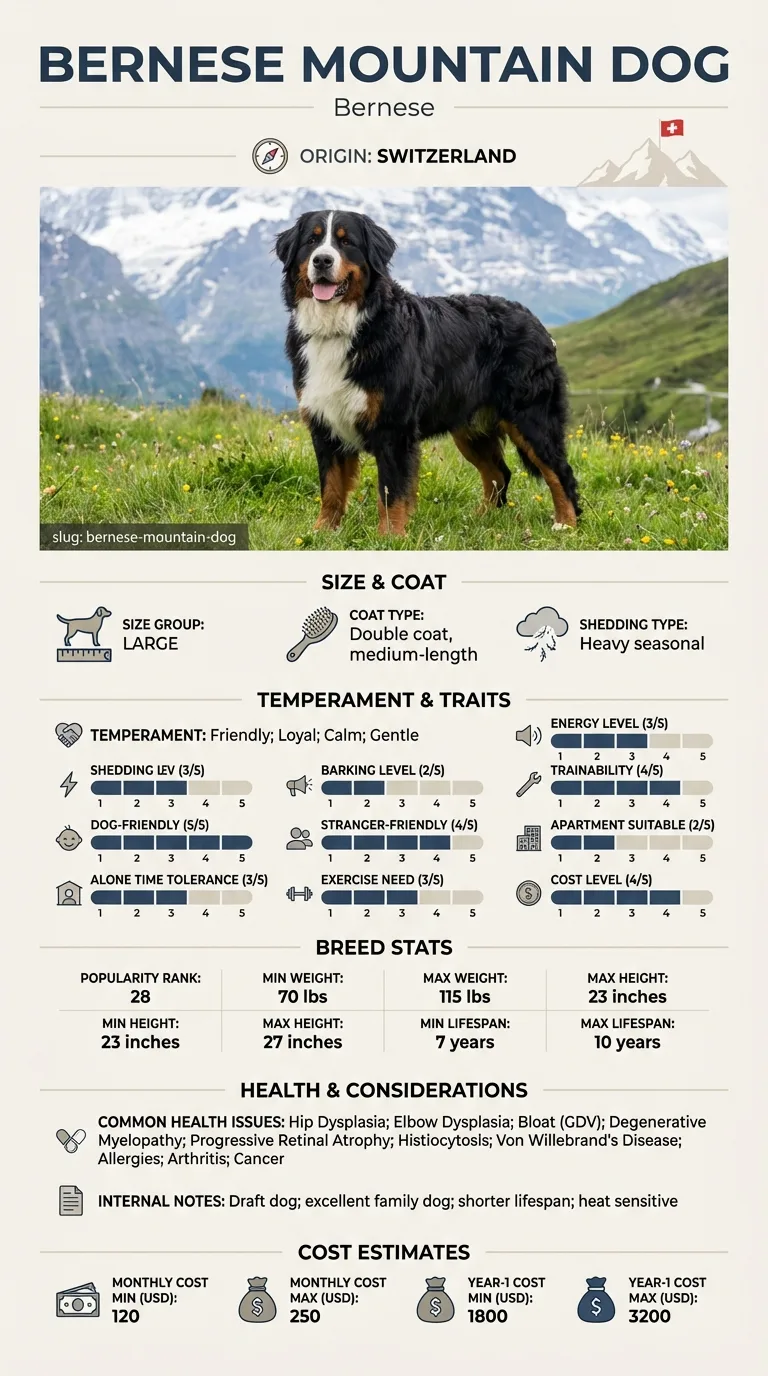
Two breed characteristics dominate. The first is favourable: a Bernese has a proportionate head and a large frame, so the mechanical mismatch that forces caesareans in some breeds is largely absent. The second is not: von Willebrand's disease is documented among this breed's health issues, and a bleeding disorder in an animal undergoing abdominal surgery or a haemorrhagic delivery is a serious complicating factor. Body size adds a practical dimension, since a bitch weighing 70 to 115 pounds in difficulty cannot simply be picked up and carried.
Preparation is the environmental factor that determines outcomes. A whelping area that is warm, quiet, non-slip and away from household traffic reduces stress-related labour delay. Distance from a twenty-four hour surgical facility is a genuine risk variable, because a stalled labour has a window measured in hours. Household staffing matters too, since whelping a large litter is a multi-day task requiring someone present continuously, and fatigue is what causes intervals to be missed.
Contact a veterinarian immediately for strong straining lasting more than thirty minutes without a puppy, weak straining for more than two hours, more than two hours between puppies when more remain, green or dark discharge before the first puppy, a puppy visibly stuck, or a bitch who becomes exhausted, collapses or has a high temperature. After whelping, treat restlessness, panting, stiffness, tremors or seizures in a nursing bitch as an emergency, since low blood calcium progresses rapidly. Foul-smelling discharge or a bitch who stops eating and becomes feverish also needs same-day attention.
Start here: Bernese Mountain Dog Most Common Genetic Disorders
See all Bernese Mountain DOG health problems, which breeds are prone to pregnancy complications, or the full Bernese Mountain DOG breed guide for temperament, exercise needs and ownership costs.
Gestation runs approximately sixty-three days from ovulation. Active labour, once straining begins, typically delivers a whole litter over three to twelve hours depending on numbers, and a very large litter can take longer. Nursing occupies six to eight weeks of intense metabolic demand, during which the bitch will often lose condition despite eating far more than usual. Full recovery of weight and coat commonly takes several months beyond weaning.
Success is a bitch who whelps without surgical intervention, recovers her weight within a few months, and shows no post-whelping infection or calcium crisis, alongside a litter where every puppy gains weight daily from the first day. It also includes something that happens long before: a mating chosen from two health-tested parents, so that the litter does not carry forward the conditions this breed is already struggling with.
Whelping problems are almost always identified by intervals rather than by dramatic events. Write these numbers on a card and put it on the whelping box, because nobody remembers them at three in the morning.
Any honest page about Bernese reproduction has to start earlier than the pregnancy, because this breed carries an unusually heavy documented health load: hip dysplasia, elbow dysplasia, bloat, degenerative myelopathy, progressive retinal atrophy, histiocytosis, von Willebrand's disease, allergies, arthritis and cancer, alongside a seven to ten year average lifespan that is short for any breed and strikingly short for one of this size.
That means the decision to breed is a decision about what gets passed on, and it deserves more scrutiny in this breed than in most. Responsible Bernese breeding involves hip and elbow scoring, eye certification, cardiac evaluation and testing for the inherited bleeding disorder documented in the breed, in both parents, before any mating is considered.
One condition on that list has direct consequences for the whelping itself. Von Willebrand's disease is a bleeding disorder recognised in Bernese Mountain Dogs, and a bitch who carries it is at increased risk of haemorrhage during whelping and particularly during a caesarean section. Knowing her status beforehand changes how a surgical team prepares.
The practical implication is straightforward. If you are planning a litter, the testing happens months in advance and the results inform whether the mating goes ahead at all. If you have an unplanned pregnancy, tell your veterinarian immediately that the breed carries a documented clotting disorder, because that single piece of information affects how any emergency surgery is approached.
This is not a reason never to breed Bernese Mountain Dogs. It is a reason to do it deliberately.

Frieda was five and whelping her second litter. Her breeder had taped an index card to the side of the box with four intervals written on it, because during the first litter she had spent an hour talking herself into believing everything was fine. The first six puppies arrived over four hours without difficulty. Then Frieda settled, cleaned her puppies and appeared entirely content. The imaging count had shown nine. At an hour and fifty minutes with no further puppy, the card said what to do. The breeder rang the emergency service, described the interval, and was told to come in. Uterine inertia was diagnosed. Frieda was treated and delivered the remaining three with assistance. Because her von Willebrand status had been tested and was clear, the team could proceed without additional precautions. All nine puppies survived.
Key takeaway: A contented bitch settling with her puppies is not evidence that whelping has finished. Knowing the expected count and watching the clock are what turn an ambiguous night into a decision.
Large breeds commonly produce sizeable litters, and Bernese litters in the high single figures are unremarkable. Larger litters increase the duration of labour, the metabolic drain on the bitch, and the likelihood that at least one puppy will need assistance, so litter size is worth establishing by imaging before whelping rather than counting on the night.
Less common than in breeds with disproportionate head or pelvic conformation. Bernese Mountain Dogs are structurally reasonably suited to natural birth. Caesareans in this breed are usually driven by labour that has stalled, by an oversized or malpositioned puppy, or by a very large litter exhausting the bitch, rather than by anatomy that makes vaginal delivery impossible.
It is a dangerous fall in blood calcium caused by the demands of milk production, usually appearing in the first few weeks after whelping rather than during it. Signs include restlessness, panting, stiffness, tremors and progression to collapse and seizures. It is a genuine emergency and is more likely in bitches nursing large litters, which makes it relevant here.
No, not without veterinary direction, and this catches people out because it seems protective. Calcium supplementation during pregnancy can interfere with the hormonal regulation that mobilises calcium during nursing and may increase rather than reduce eclampsia risk. Feed an appropriate diet and take advice rather than adding minerals independently.
The phone number of a twenty-four hour facility and the drive time, a thermometer, clean towels, unwaxed dental floss and scissors for cords, a scale for weighing puppies daily, and a written card of the labour intervals. Also have a plan for how you would move a hundred pound bitch in labour to a car, which needs two people.
The bitch is under significant metabolic strain for the whole nursing period, typically six to eight weeks, and she will often lose condition despite eating a great deal. Full recovery of weight and coat frequently takes several months after weaning. In a breed with a shortish lifespan, that recovery period is a meaningful fraction of her adult life.
The early signs are set out in the sections above, and they are the reason to book a veterinary appointment rather than wait. Pregnancy Complications in Berneses is diagnosed by a vet, not from a symptom list, and the sooner it is on record the more options remain open.
Thirty minutes of strong straining without producing a puppy, or two hours of weak straining, means calling the vet rather than waiting.
Von Willebrand's disease, a bleeding disorder documented in Bernese Mountain Dogs, raises the risk of haemorrhage during whelping and caesarean surgery.
Not without veterinary direction. Supplementing during pregnancy can disrupt calcium regulation and may increase the risk of eclampsia after whelping.
Hip and elbow scoring, eye certification, cardiac evaluation and von Willebrand testing in both parents, arranged months before any planned mating.
A one-page prep sheet for this condition: the signs, the questions to ask, what to get priced. Unlocks here.
You get: Vet visit prep sheet
No spam. One-click unsubscribe. See our privacy policy.
Preview page 1 before you decide.