Hip Dysplasia Prevalence in Bernese Mountain Dogs: Reading the Numbers
Quick answer
Why do hip dysplasia statistics vary so much?
Because screening is voluntary, schemes differ, screening ages differ, and sources disagree on whether mild grades count as affected. The spread is methodological, not a sign that someone is lying.
Two breeders can quote you completely different hip dysplasia rates for the same breed and both can be telling the truth.
Buyers comparing Bernese Mountain Dog breeders and trying to work out whether the health claims on a website mean anything, plus owners who have been handed a hip score and cannot tell whether it is good news.
Important reminder
This guide is not medical advice. If your dog shows pain, sudden behavior change, or worsening symptoms, consult a licensed veterinarian.
Some links may be affiliate links. We may earn a commission at no extra cost to you. We only suggest products we believe are helpful for dog owners.
We research and check what we publish, but we do not warrant that any figure, date, price, or statement is accurate, complete, or current, and we accept no liability for any loss, cost, injury, or other harm arising from the use of this site. Use it as one reference among several. You remain responsible for your own decisions and for your dog's care - confirm anything that matters with a licensed veterinarian or another qualified professional before you act on it. Full disclaimer.
What this problem looks like
Prevalence describes how many dogs in a population have a condition. For hip dysplasia in Bernese Mountain Dogs, the available figures come almost entirely from voluntary screening registries, which sample a self-selected slice of the breed. The result is a wide published range and a widespread false confidence in individual numbers quoted on breeder websites and forums.
Common triggers
Marketing copy quoting a single percentage without naming the registry
Comparing a grading scheme result to a laxity measurement as if they were equivalent
Old figures repeated long after breeding practices changed
Counting only severe grades in one source and all grades in another
Assuming unscreened populations are healthier rather than simply unmeasured
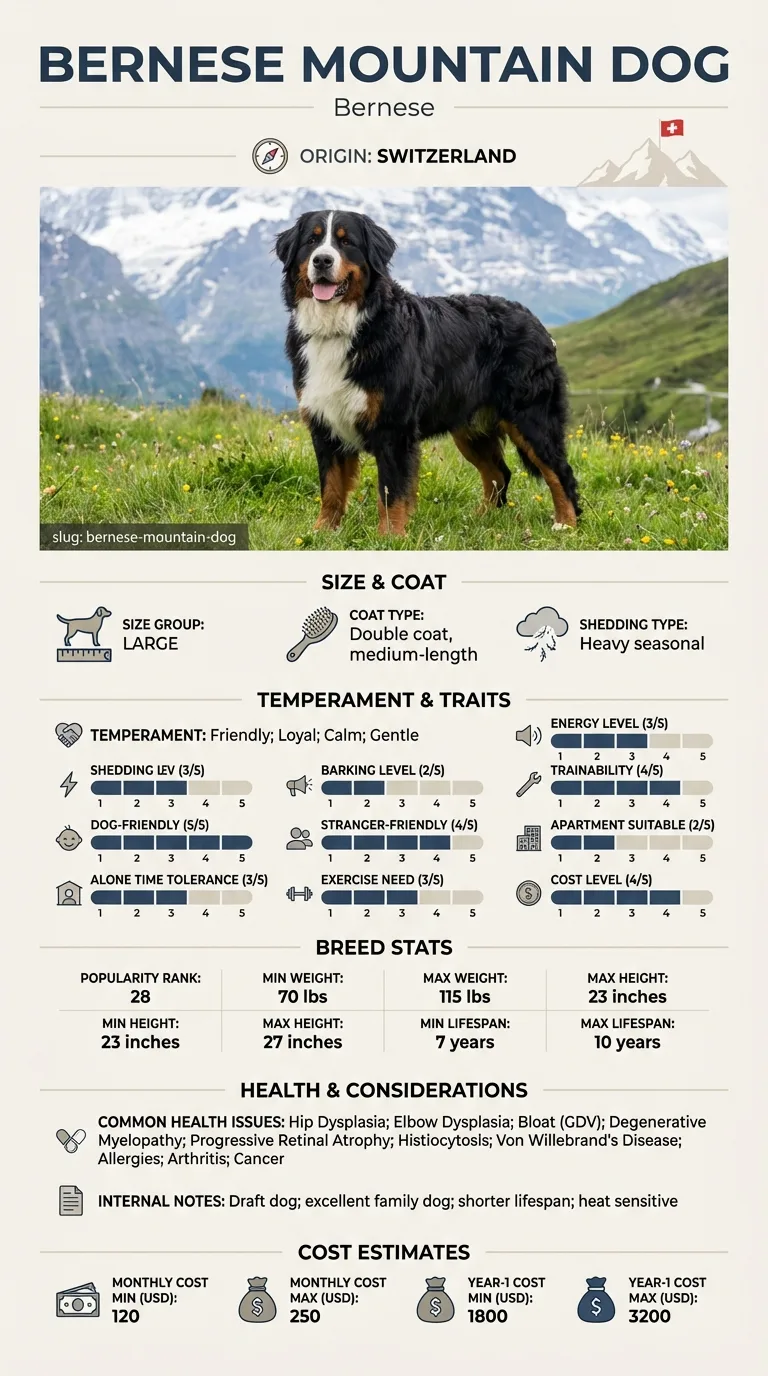
Hip dysplasia is genuinely common in this breed and is listed among its core documented health issues alongside elbow dysplasia, arthritis, bloat and cancer. That much is not in dispute. What is unreliable is any specific percentage, and owners are better served by treating the risk as real and material than by attaching to a number.
Why this happens
Breed factors
The underlying vulnerability is the same one described in any Bernese joint discussion: a polygenic predisposition to joint laxity, amplified by a body that reaches 70 to 115 pounds over an unusually long growth period. What makes prevalence specifically difficult in this breed is the small effective population. Bernese Mountain Dogs are moderately popular rather than numerous, and a limited gene pool means that regional registry data can be dominated by a handful of influential lines rather than reflecting the breed globally.
Environment factors
The reporting environment shapes the numbers as much as biology does. Countries where hip scoring is a condition of registration produce far more complete data than countries where it is optional. Practices that radiograph under sedation with careful positioning produce more consistent grades than those that do not. And veterinary access matters: in regions where sedated radiographs are expensive, only dogs with a suspected problem or a breeding purpose get imaged, which skews everything that follows.
What you can do at home (once it is not an emergency)
When to talk to your vet
This page is about data rather than symptoms, but the clinical triggers still apply. Book an appointment if your Bernese bunny-hops, struggles to rise, is reluctant on stairs, or has lost willingness on walks, regardless of what any parental score said. Seek urgent care for sudden non-weight-bearing lameness, crying on movement, or an abrupt loss of hind limb coordination, since those point to injury or spinal disease rather than to gradual joint change. A good parental hip score is never a reason to dismiss a symptomatic dog.
At home, alongside your vet's plan
Write down the registered names of both parents before you commit to a puppy, then look the results up yourself in the public registry.
Ask which scheme was used and in which country, and note it, so you are comparing like with like across breeders.
Ask how many previous puppies from the same pairing have been scored, and treat an honest do not know as more useful than a vague reassurance.
Keep your own dog's radiographs and grade in a file. If you ever change vets or move country, the original images are worth more than a remembered grade.
If you have your Bernese scored, submit the result to the registry even if it is poor. Under-reporting of affected dogs is exactly what makes these figures unreliable.
More Bernese Mountain DOG health & behavior issues
Verifying a breeder's claims takes an evening, not a month, and it is the highest-value hour a prospective owner will spend. If you have your own dog scored, expect preliminary imaging from around a year and a formal grade from two. Registry results are typically returned within a few weeks of submission. None of this produces a prediction; it produces a position on a spectrum.
Success is making a decision with the right kind of information. That means walking away from a percentage quoted without a source, holding registered names you have checked yourself, understanding which scheme produced them, and accepting that even a well-screened pairing carries residual risk that your own raising choices will partly determine.
Why published rates vary so widely
It is common to see hip dysplasia in Bernese Mountain Dogs quoted anywhere from a modest minority to well over half the breed. Both ends of that range appear in real sources, and the discrepancy is methodological rather than dishonest.
Voluntary submission bias. Owners and breeders are more likely to submit radiographs they expect to look good, which pushes registry rates below the true population rate.
Different scoring systems. A hip evaluated under one scheme and graded on a subjective scale is not directly comparable to a distraction index measured under another.
Different populations. A national registry in one country draws from a different gene pool and different breeding practices than another.
Age at screening. Joints assessed at one year can look better than the same joints at three, so a population screened younger reports lower rates.
Definition of affected. Some figures count only moderate and severe grades, others include borderline and mild, which alone can double or halve a headline percentage.
Reporting era. Decades of screening in this breed have shifted the numbers, so an old figure repeated on a modern website may describe a population that no longer exists.
What actually predicts risk for your individual puppy
Breed-level prevalence is a poor guide to an individual dog, in the same way that a national average tells you very little about one household. What shifts the odds for the puppy in front of you is the family, not the breed.
The most useful information is the scored hips of the sire and dam, and ideally of the grandparents and any earlier siblings. A pairing where both parents scored well, from lines that have been screened for several generations, sits at meaningfully lower risk than a pairing where the paperwork stops at the parents or does not exist.
The second most useful thing is whether the breeder screens the whole litter or only the dogs they keep. Breeders who ask their puppy buyers to submit radiographs at two years, and who track the results, have real data about what their programme produces. Very few do, and the ones who do are worth waiting for.
The third factor is not genetic at all. Prevalence data describes the presence of joint changes on an image; it does not describe whether a dog will be lame. Two dogs with the same radiographic grade can have very different lives depending on body weight, muscling and how they were raised through their first eighteen months.
So the honest framing is this: prevalence tells you the breed carries real risk and that screening matters. Your breeder's records tell you where your puppy sits within that risk. Your own management determines a large part of what the risk turns into.
Hip Dysplasia Prevalence in Bernese Mountain Dogs: Reading the Numbers - What actually predicts risk for your individual puppy
What to do next about hip dysplasia prevalence in Berneses
If you think your Bernese has hip dysplasia prevalence, the plan is three steps: write down what you have seen and when it started, book a veterinary appointment rather than waiting for the next flare, and take video of the behaviour or symptom before you go — the thing you are worried about rarely happens in the consulting room. Screening in the parents covers hip dysplasia, elbow dysplasia, bloat (gdv).
What the vet visit should produce is a diagnosis and a written plan, not just reassurance: what is being ruled out, what the monitoring interval is, and which signs mean you come back sooner. Ask what the treatment costs across a year rather than per visit, because that is the number that decides whether you are managing this condition or reacting to it.
Between appointments, keep a short log — dates, what you saw, what changed. It is the single most useful thing an owner brings to a follow-up, and for hip dysplasia prevalence it is often what separates a clear pattern from a guess.
The same breed, two websites, two very different claims
A family shortlisted two Bernese breeders. The first site stated that hip dysplasia affects around a fifth of the breed. The second stated it affects well over half. Both cited hip dysplasia as a reason their own screening mattered.
Rather than choosing the more reassuring number, the family asked both breeders where the figure came from. The first could not say. The second named a national registry, an era, and explained that the figure counted mild grades as affected.
The family then asked both for the registered names of their sires and dams. One provided them the same day. The other said the certificates were in a folder somewhere.
They bought from the breeder with the alarming statistic and the verifiable paperwork.
Key takeaway: A breeder who quotes a frightening number and can source it is more trustworthy than one who quotes a comfortable number and cannot. Judge the traceability of the claim, not the size of the percentage.
Frequently asked questions
What percentage of Bernese Mountain Dogs have hip dysplasia?
No single trustworthy figure exists. Published rates for this breed span a wide range depending on registry, country, scoring scheme and how mild grades are counted. What can be said reliably is that the Bernese sits among the more affected large breeds and that hip dysplasia appears on the breed's list of core health issues.
Do hip scores from the parents guarantee a healthy puppy?
No. Hip dysplasia is polygenic, so well-scored parents can still produce affected puppies and poorly-scored ones can produce sound offspring. What parental screening does is shift probability, and across generations it shifts it substantially. Treat it as loading the dice rather than removing them.
Is one scoring scheme better than another?
They measure different things. Grading schemes assess joint appearance and remodelling on a positioned radiograph. Distraction measurement quantifies laxity, which is the underlying mechanical problem, and can be performed earlier. Many breeders use one because it is the norm in their country. Neither is worthless and the two are not interchangeable.
Why do rescue and mixed-breed Bernese seem less affected?
Often they are not; they are simply less screened. A dog who never has hips radiographed contributes nothing to prevalence data regardless of what his joints look like. Apparent differences between screened and unscreened populations frequently reflect who got imaged rather than who has the disease.
Should a high breed prevalence put me off the breed?
That is a personal calculation, but be consistent about it. This breed also carries a seven to ten year lifespan and elevated cancer risk, and for most Bernese families those are larger factors than hips. If joint disease is your primary concern, the more useful response is to buy from screened lines and manage growth carefully rather than to fixate on a percentage.
How do I check a breeder's claims independently?
Ask for the registered names of the sire and dam, then look them up in the relevant public health registry yourself rather than relying on a screenshot. Certificates can be misquoted and websites go stale. A breeder confident in their programme will hand over the registered names without hesitation.
Because screening is voluntary, schemes differ, screening ages differ, and sources disagree on whether mild grades count as affected. The spread is methodological, not a sign that someone is lying.
Costs
What single question should I ask a Bernese breeder?
Ask for the registered names of both parents so you can look up their hip results yourself. The willingness to give them tells you more than the scores do.
Health
Does a good hip score mean no arthritis later?
No. Scores describe the joint at the time of imaging. Body weight, conditioning and injury over the following years all affect whether that joint stays comfortable.
Health
Are hips scored before or after two years old?
Preliminary radiographs are often taken from around a year, but formal certification under most schemes waits until two, because joint changes continue to develop.