Health
What is the earliest sign of arthritis in a Bernese?
A slower, more deliberate rise from lying down, especially on cold mornings or after a nap following exercise. Limping usually comes later.

Quick answer
What is the earliest sign of arthritis in a Bernese?
A slower, more deliberate rise from lying down, especially on cold mornings or after a nap following exercise. Limping usually comes later.
In most breeds arthritis is an old-dog problem. In a Bernese with a seven to ten year lifespan, five is middle-aged.
Owners noticing their Berner has started taking the stairs one at a time, sitting down halfway through a grooming session, or getting slower to rise on cold mornings while still behaving like a healthy dog in every other way.
This guide is not medical advice. If your dog shows pain, sudden behavior change, or worsening symptoms, consult a licensed veterinarian.
Some links may be affiliate links. We may earn a commission at no extra cost to you. We only suggest products we believe are helpful for dog owners.
We research and check what we publish, but we do not warrant that any figure, date, price, or statement is accurate, complete, or current, and we accept no liability for any loss, cost, injury, or other harm arising from the use of this site. Use it as one reference among several. You remain responsible for your own decisions and for your dog's care - confirm anything that matters with a licensed veterinarian or another qualified professional before you act on it. Full disclaimer.
Osteoarthritis is progressive damage to the cartilage surface of a joint, followed by bony change at the margins and thickening of the capsule around it. In a Bernese it is usually secondary to a joint that formed abnormally, which is why the breed sees it early rather than only in old age.
Arthritis is listed among the Bernese Mountain Dog's documented health issues, and given that hip and elbow dysplasia are on the same list, joint disease is one of the more predictable things a Berner owner will manage. Severity varies enormously, from a dog who slows on cold mornings to one needing daily medication from middle age.
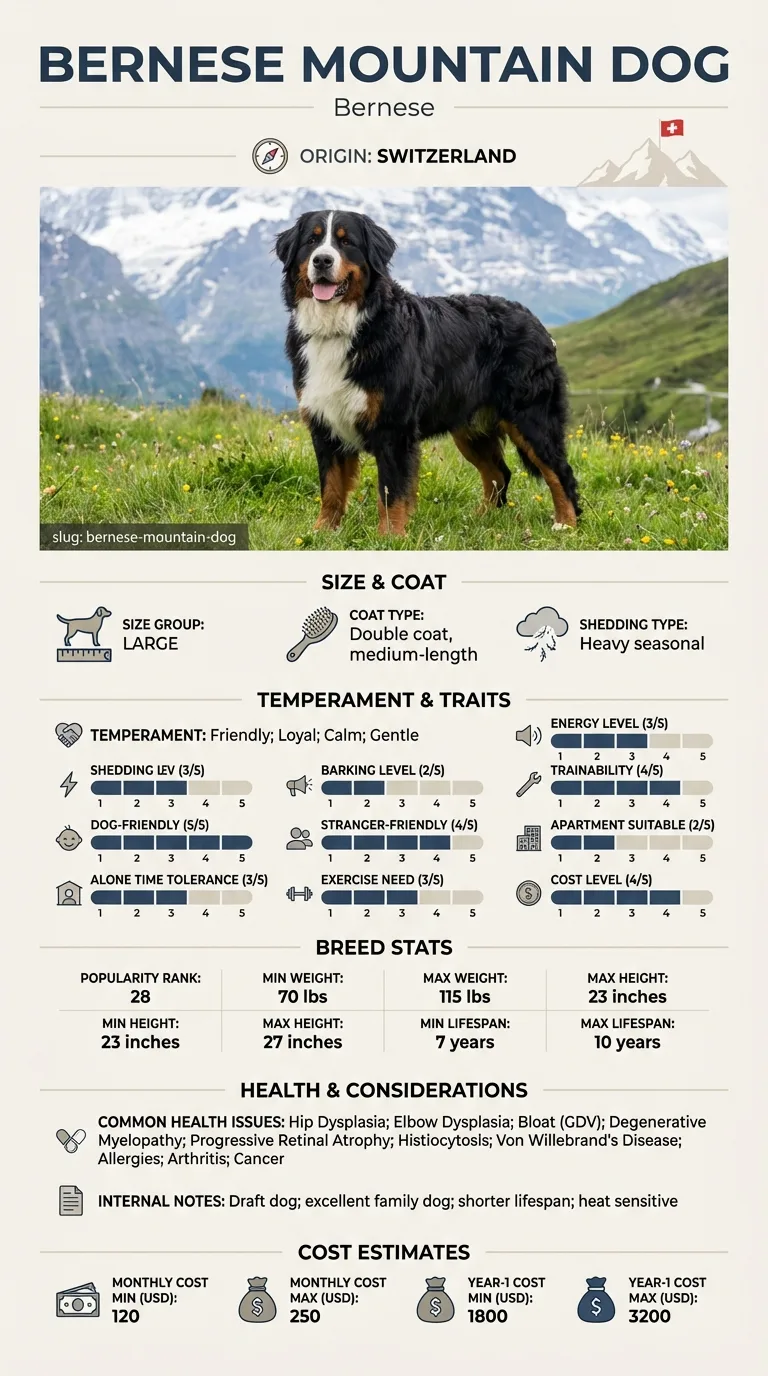
Three breed facts stack up. Documented hip and elbow dysplasia give abnormal joint surfaces. A 70 to 115 pound body loads those surfaces hard every step. And a seven to ten year lifespan compresses the whole timeline, so the wear that a smaller dog spreads over fifteen years happens in half that.
Hard, smooth flooring is the main household driver, because it forces a big dog to brace on every rise. Cold, damp conditions make an affected joint stiffer, and the Bernese happily lies on cold ground given the chance. Inconsistent exercise patterns and steep or repetitive stair use complete the picture.
Book promptly for a limp lasting more than a couple of days, a dog reluctant to put weight on one leg, or new difficulty rising. Go urgently for sudden non-weight-bearing lameness, which in a large breed can mean a ruptured cruciate ligament, a fracture, or in an older dog a bone tumour rather than arthritis. Also seek advice if your dog has become irritable when touched or handled, because pain in a normally gentle breed often shows as a change in temperament before it shows as a limp. Never give human anti-inflammatory or pain medication.
Arthritis progresses at a rate you partly control. These are the everyday decisions that push it faster.
Start here: Bernese Mountain Dog Most Common Genetic Disorders
See all Bernese Mountain DOG health problems, which breeds are prone to arthritis, or the full Bernese Mountain DOG breed guide for temperament, exercise needs and ownership costs.
Traction changes and weight loss show a difference in four to eight weeks. Prescribed pain relief works within days. The disease itself continues, so the plan is reviewed every six months rather than finished.
A dog that still asks for its walk, rises without a struggle most mornings, and holds muscle over the hindquarters. Slower progression, not a cure.
A Bernese carries between 70 and 115 pounds on a frame 23 to 27 inches at the shoulder. Cartilage handles pressure well when the load spreads evenly across a well-shaped joint surface. When a hip socket is shallow or an elbow's components do not meet cleanly, that same load concentrates on a small area, and cartilage wears where it is pressed hardest. Bone remodels at the edges, the joint capsule thickens, and the range of motion narrows. That is osteoarthritis.
The front end matters more than people expect in this breed. The Bernese was bred as a draft dog to pull carts in the Swiss cantons, which is forequarter work, and elbow dysplasia sits on its documented health list right beside hip dysplasia. Front-limb lameness that shows as a shortened stride or a head bob is worth taking as seriously as hind-end weakness.
Traction is the intervention owners consistently underrate. A dog whose feet slip on the way up from a lie-down braces harder with every rise, dozens of times a day. Runners along the routes your dog walks indoors change more about daily comfort than most purchases.
Cold and damp make an arthritic Berner stiffer, which is a strange thing to say about a breed built for alpine winters. A healthy Berner loves the cold. An arthritic one still loves it and pays for it the next morning, so give it a warm, well-padded place to sleep after a winter walk.

Anneli, a six-year-old Berner with elbow changes diagnosed at eighteen months, had started refusing the stairs to the bedroom and would stall halfway through rising from her spot by the kitchen door. Her owners assumed she had simply become an old dog early. Their vet confirmed arthritis in both elbows and set three things in motion: a weight reduction plan taking her from 104 to 92 pounds over five months, prescribed pain relief, and rubber-backed runners along every route she used indoors. The runners made a visible difference within a fortnight. She still sleeps downstairs, but she gets up without stalling.
Key takeaway: The medication mattered, but so did the floor. On a heavy breed, removing the need to brace on every rise is a treatment in its own right.
Where it follows hip or elbow dysplasia, changes can be visible on radiographs before two years old, with clinical signs from three to six. Wear-related arthritis without an underlying joint fault tends to show from six onwards, which is already senior territory for a breed living seven to ten years.
A change in how your dog gets up rather than how it walks. Rocking forward, pausing halfway, or bunny-hopping the back legs on stairs comes well before a visible limp. Berners are stoic and will keep going long past the point of comfort.
Little, often and consistent. Two or three shorter lead walks daily on soft ground beat one long outing, and swimming or underwater treadmill work builds muscle without loading the joint. Your vet or a rehab therapist can set the distance.
It is the single most effective thing an owner controls. Reducing body weight to a lean condition score reduces joint load with every step the dog takes for the rest of its life, and it costs nothing. Ask your vet to score your dog honestly.
No. Cartilage that has worn does not regrow, and the bony changes around the joint are permanent. What is achievable is slowing progression and controlling pain well enough that the dog stays active, which is a meaningfully different goal from cure.
Discuss it with your vet rather than choosing off a shelf. Supplements are an adjunct at best; weight control, traction, controlled exercise and properly prescribed pain relief do the heavy lifting. Never give human pain medication to a dog under any circumstances.
The early signs are set out in the sections above, and they are the reason to book a veterinary appointment rather than wait. Arthritis in Berneses is diagnosed by a vet, not from a symptom list, and the sooner it is on record the more options remain open.
The early signs are set out in the sections above, and they are the reason to book a veterinary appointment rather than wait. Arthritis in Bernese Mountain Dogs is diagnosed by a vet, not from a symptom list, and the sooner it is on record the more options remain open.
A slower, more deliberate rise from lying down, especially on cold mornings or after a nap following exercise. Limping usually comes later.
Rugs or runners over slippery floors along the routes your dog walks indoors, plus keeping the dog lean. Neither costs much and both work every day.
Descending stairs loads the front limbs hard, which matters in a breed prone to elbow disease. Use a ramp where you can and keep the dog's sleeping area on one level.
Expect a recurring rather than one-off cost: rechecks, imaging, prescribed pain relief and possibly rehabilitation sessions. Budget for it as a running expense from middle age.
Yes. Teaching a controlled, four-on-the-floor greeting and a calm settle reduces the jumping and spinning that jar sore joints many times a day.
A one-page prep sheet for this condition: the signs, the questions to ask, what to get priced. Unlocks here.
You get: Vet visit prep sheet
No spam. One-click unsubscribe. See our privacy policy.
Preview page 1 before you decide.