Behavior
Which is more apartment-friendly?
Neither — both score Low (2/5) for apartment suitability.

Quick answer
Which is more apartment-friendly?
Neither — both score Low (2/5) for apartment suitability.
Bernese Mountain Dog or Rottweiler Mix? On paper they differ most on good with other dogs, and on the scales Rottweiler Mix is the heavier at 80–135 lbs. Here is how the two compare on everything that shapes an ordinary week.
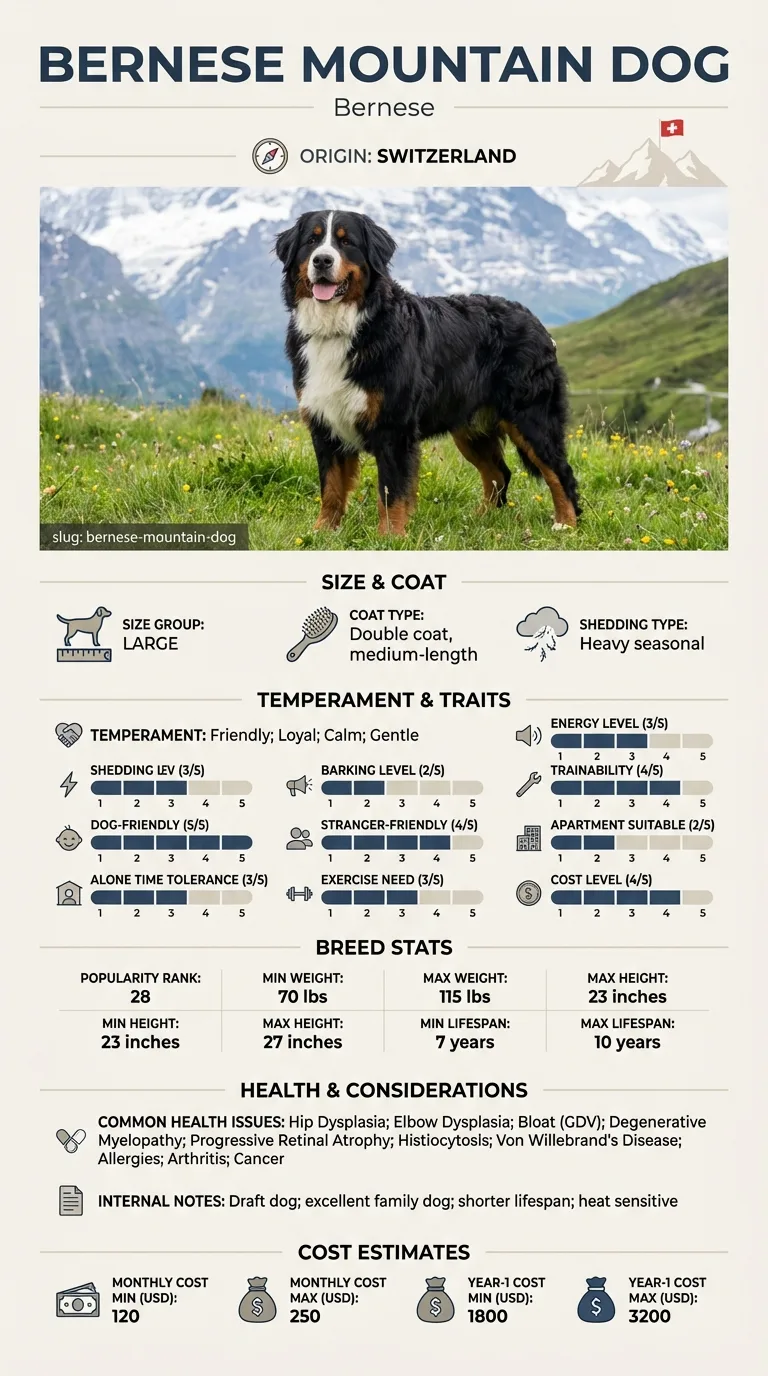
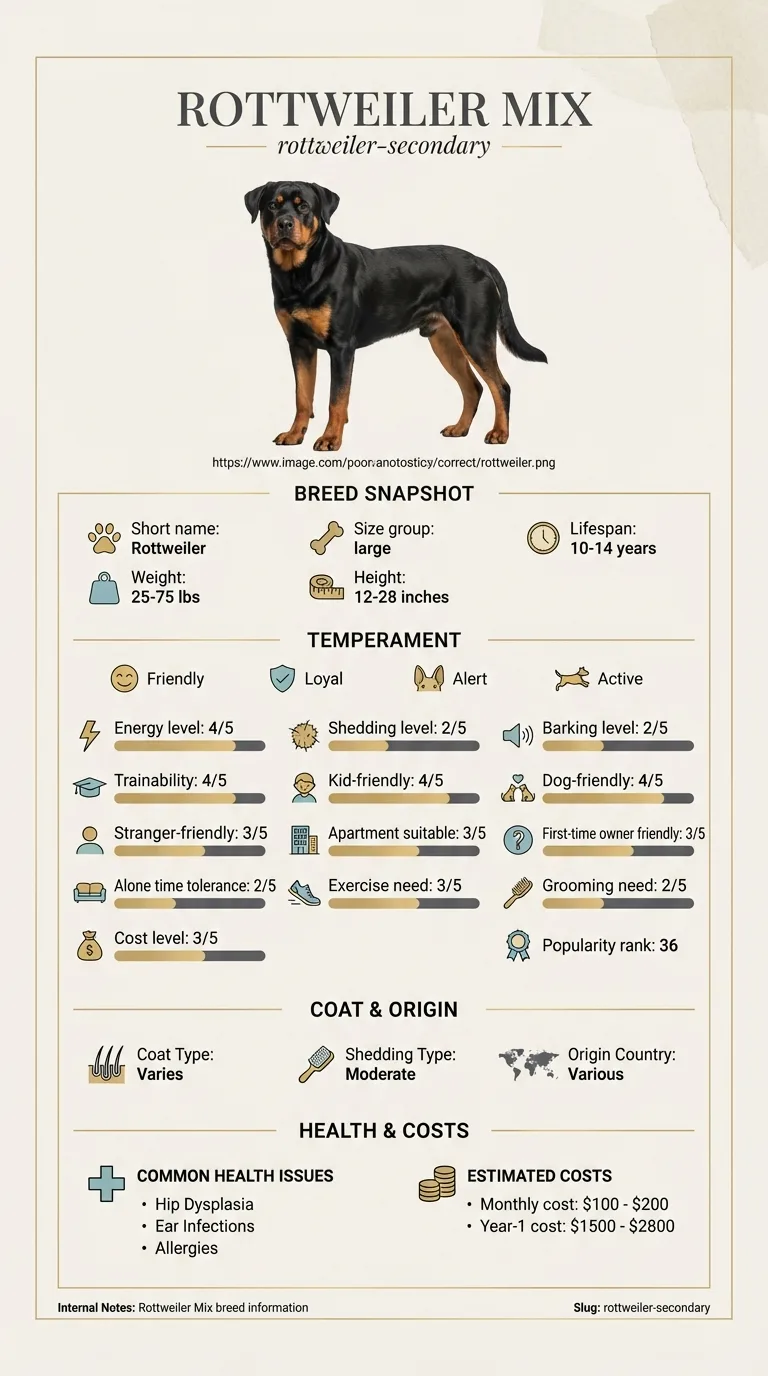
This is for someone already down to Bernese Mountain Dog and Rottweiler Mix and deciding between them. For this pair the decision usually turns on good with other dogs and good for first-time owners, so those are covered first and in most detail. Both rate 2/5 for flats, so housing does not settle this one. It is written for the decision rather than the breed history.
Between Bernese Mountain Dog and Rottweiler Mix, good with other dogs is what separates them, and Bernese Mountain Dog is the lower-effort dog of the two to keep.
Choose Bernese Mountain Dog if this is your first dog, your walking routine is modest and there are young children at home.
Choose Rottweiler Mix if you do not want a standing grooming appointment, shedding is a problem in your house and you want a dog that can keep up with an active routine.
| Feature | bernese mountain dog | rottweiler secondary | Winner |
|---|---|---|---|
| Size class | large | large | Equal |
| Weight | 70–115 lbs | 80–135 lbs | Equal |
| Height | 23–27 in | 22–27 in | Equal |
| Lifespan | 7–10 years | 9–10 years | rottweiler secondary |
| Exercise need | Moderate (3/5) | High (4/5) | bernese mountain dog |
| Grooming need | Moderate (3/5) | Low (2/5) | rottweiler secondary |
| Shedding | High (4/5) | Moderate (3/5) | rottweiler secondary |
| Energy level | Moderate (3/5) | Moderate (3/5) | Equal |
| Barking | Low (2/5) | Low (2/5) | Equal |
| Apartment suitability | Low (2/5) | Low (2/5) | Equal |
| Good for first-time owners | High (4/5) | Low (2/5) | bernese mountain dog |
| Tolerates being alone | Moderate (3/5) | Moderate (3/5) | Equal |
| Trainability | High (4/5) | High (4/5) | Equal |
| Good with kids | Very high (5/5) | Moderate (3/5) | bernese mountain dog |
| Good with other dogs | Very high (5/5) | Low (2/5) | bernese mountain dog |
| Friendly to strangers | High (4/5) | Low (2/5) | bernese mountain dog |
| Cost level | High (4/5) | High (4/5) | Equal |
| Coat | Double coat, medium-length | Short, dense double coat | Equal |
| Origin | Switzerland | Various | Equal |
| Typical monthly cost | $120–$250 | $110–$240 | Equal |
| Typical first-year cost | $1,800–$3,200 | $1,700–$3,200 | Equal |
Both breeds sit in the large class, but the Rottweiler Mix typically outweighs the Bernese by a wide margin — 80 to 135 lbs against 70 to 115 lbs — while their heights nearly converge, 22 to 27 in versus 23 to 27 in. That means a Rottweiler Mix at the top of its range can be considerably denser and more powerfully built than even a big Bernese, with less daylight underneath the frame. Buyers picking between the two for a household with tight doorways or a compact car should expect the Rottweiler Mix to feel noticeably stockier and harder to lift or maneuver as an adult.
Exercise need splits the pair: the Bernese sits at Moderate (3/5) while the Rottweiler Mix climbs to High (4/5), even though both land at Moderate (3/5) for general energy level. In practice that gap shows up in daily routine rather than temperament — the Rottweiler Mix, described as confident and steady, needs a longer structured outlet like a jogging session or working drills to stay settled, whereas the calm, gentle Bernese is satisfied with a solid daily walk plus some open-yard time. Owners who cannot commit to sustained daily activity will find the Bernese the easier fit here.
Grooming tips slightly toward the Rottweiler Mix, rated Low (2/5) against the Bernese's Moderate (3/5), and shedding follows the same pattern — Moderate (3/5) for the mix versus High (4/5) for the Bernese's double coat. The Bernese's medium-length double coat sheds more consistently year-round and needs regular brushing to manage the fluff around furniture and clothing, while the Rottweiler Mix's short, dense double coat is comparatively low-maintenance day to day, needing only routine brushing rather than the seasonal blowouts a Bernese produces. Anyone sensitive to loose hair around the house should lean toward the mix.
Neither breed scores well for apartment life — both land at Low (2/5) for apartment suitability — but barking is a non-issue either way, with both rated Low (2/5). The real difference shows up in solitude and space: both tolerate being alone at a Moderate (3/5) level, so neither is an all-day-alone dog, but the Rottweiler Mix's larger frame and higher exercise drive make cramped quarters harder to manage than they would be for the calmer Bernese. A house with a yard suits both far better than a walk-up unit, especially given the Rottweiler Mix's watchful, alert nature around the home.
First-time owners have a clearer read here: the Bernese scores High (4/5) for beginner suitability while the Rottweiler Mix drops to Low (2/5), despite both sharing High (4/5) trainability on paper. The gap is about temperament management rather than intelligence — a watchful, confident dog descended from a guarding lineage needs a handler who can set boundaries early and socialize consistently, while the friendly, loyal Bernese is naturally more forgiving of a less experienced hand. Anyone new to dog ownership, or without time for structured obedience work in year one, will likely find the Bernese the gentler on-ramp of the two.
With kids and other dogs, the Bernese pulls clearly ahead, rated Very high (5/5) on both counts against the Rottweiler Mix's Moderate (3/5) with kids and Low (2/5) with other dogs. Friendliness to strangers tells the same story — High (4/5) for the Bernese, Low (2/5) for the Rottweiler Mix, which fits its watchful, steady description. A busy household with visiting friends, playdates, or a resident dog already in the home will generally see smoother introductions with the Bernese, while the Rottweiler Mix suits a quieter household that values a more discerning, protective presence over open friendliness.
Lifespan favors the Rottweiler Mix at 9 to 10 years against the Bernese's 7 to 10, a modest but real edge given how much shorter Bernese lifespans run relative to most breeds. The health pictures differ in scope more than severity: the Bernese carries a longer list of ten known concerns, including Bloat (GDV), Degenerative Myelopathy, Histiocytosis, and Von Willebrand's Disease, while the Rottweiler Mix's five flagged issues include Osteosarcoma, Subaortic Stenosis, and Cruciate Ligament Tears alongside shared Hip and Elbow Dysplasia risk. Prospective owners of either dog should budget for orthopedic screening, and Bernese owners in particular should ask breeders about cancer history.
Monthly and first-year costs land close together — $120 to $250 monthly and $1,800 to $3,200 in year one for the Bernese, versus $110 to $240 and $1,700 to $3,200 for the Rottweiler Mix — and both carry a High (4/5) overall cost rating. Neither breed is a budget option; large-breed food volume, joint supplements, and pet insurance premiums for a dog prone to conditions like Bloat or Osteosarcoma add up regardless of which one you choose. The main financial variable ends up being veterinary care tied to each breed's specific health list rather than routine upkeep.
Bernese Mountain Dog weighs 70–115 lbs and lives 7–10 years; Rottweiler Mix weighs 80–135 lbs and lives 9–10 years. The two diverge most on good with other dogs, good for first-time owners and good with kids and 1 other rated axes. They are level on tolerates being alone, apartment suitability and barking, so those cannot decide it. In the table, a "winner" means easier for an ordinary household — not better. Size, coat and origin are recorded without a verdict. Because both breeds are scored the same way, the gaps are reliable even where the absolute numbers are rough.

Usually, yes — the Rottweiler Mix's weight range of 80-135 lbs typically runs heavier than the Bernese's 70-115 lbs, even though their heights overlap closely at 22-27 in versus 23-27 in.
The Bernese Mountain Dog, rated High (4/5) for first-time owners against the Rottweiler Mix's Low (2/5). Its friendly, gentle temperament is generally more forgiving of a less experienced handler than the Rottweiler Mix's watchful, confident nature.
The Bernese sheds more, rated High (4/5) versus Moderate (3/5) for the Rottweiler Mix, owing to its medium-length double coat.
The Bernese Mountain Dog, rated Very high (5/5) with both kids and other dogs, compared to Moderate (3/5) with kids and Low (2/5) with other dogs for the Rottweiler Mix.
The Bernese has a longer flagged list including Bloat (GDV), Degenerative Myelopathy, Histiocytosis, and Von Willebrand's Disease. The Rottweiler Mix's concerns center on Osteosarcoma, Subaortic Stenosis, and Cruciate Ligament Tears, plus Hip and Elbow Dysplasia shared by both.
The Rottweiler Mix has a slight edge, typically living 9-10 years, compared to 7-10 years for the Bernese Mountain Dog.
The Rottweiler Mix, rated High (4/5) for exercise need versus Moderate (3/5) for the Bernese, generally needs a longer or more structured daily outlet.
Neither — both score Low (2/5) for apartment suitability.
Neither; both are rated Low (2/5) for barking.
They're close, but the Bernese runs slightly higher at $120-$250 versus $110-$240 for the Rottweiler Mix.
The Bernese Mountain Dog, rated High (4/5) versus Low (2/5) for the Rottweiler Mix.
Secure checkout on Stripe. We never see your card.
7-day money-back guarantee. Instant access.
Health information here is general and is not veterinary advice. If your dog shows pain, sudden behaviour change, or worsening symptoms, consult a licensed veterinarian.
Some links on this site are affiliate links. We may earn a commission at no extra cost to you, and we only suggest products we believe are helpful for dog owners.
We research and check what we publish, but we do not warrant that any figure, date, price, or statement is accurate, complete, or current, and we accept no liability for any loss, cost, injury, or other harm arising from the use of this site. Use it as one reference among several. You remain responsible for your own decisions and for your dog's care - confirm anything that matters with a licensed veterinarian or another qualified professional before you act on it. Full disclaimer.
Match your lifestyle to the right dog.
Take quizNot sure which breed is right for you? Take our 2-minute quiz to find out.
Take the quiz